
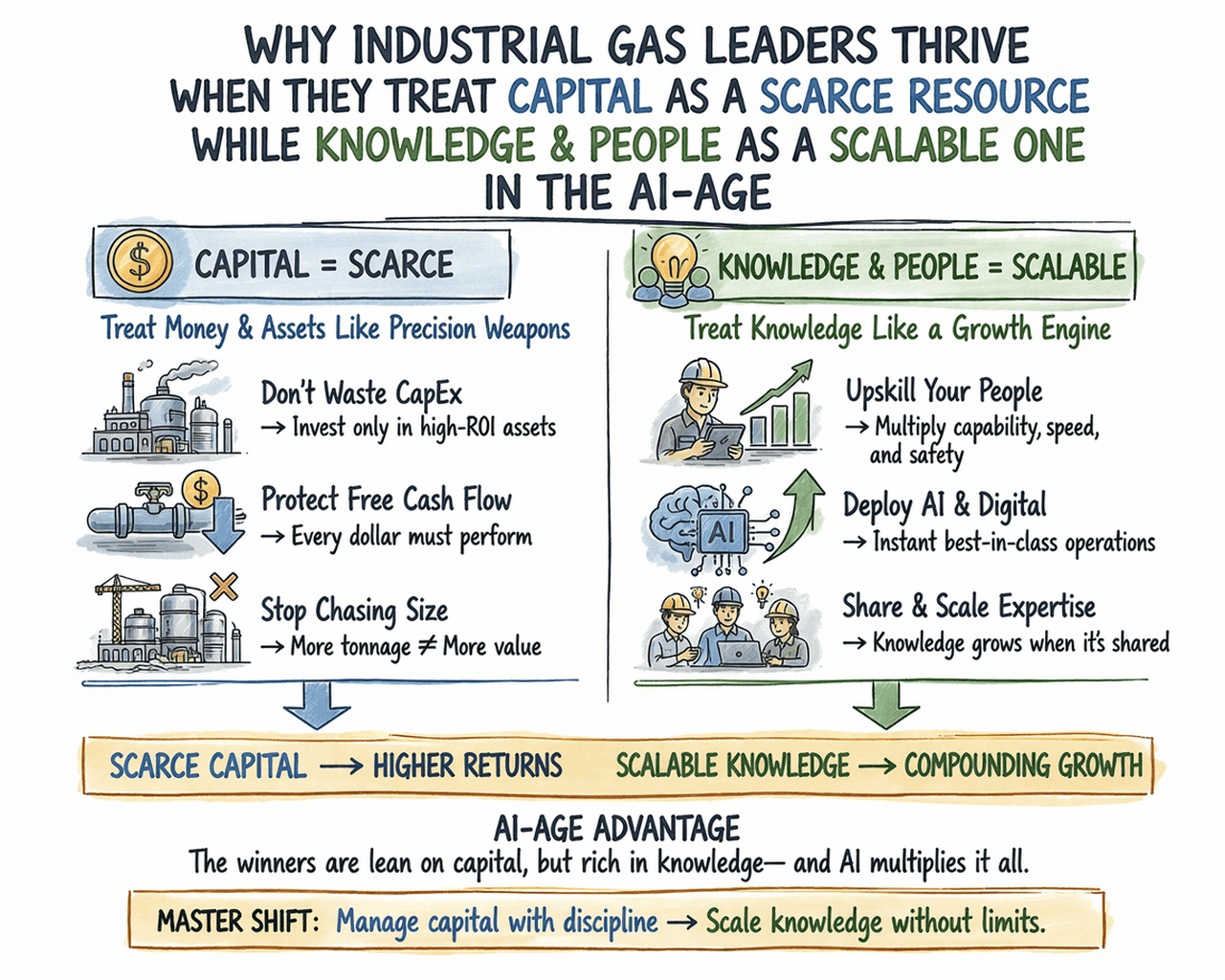
Leadership to Thrive Volatility Governance 2026–2030
A Governance Leadership Blueprint for Industrial Capital Resilience
RapidKnowHow | Josef David | 2026
Executive Summary
Between 2026 and 2030, industrial capital will not be tested by recession cycles alone.
It will be tested by persistent volatility regimes:
• Energy dispersion
• Merchant exposure sensitivity
• Capital intensity mismatches
• Financing normalization
• Geopolitical fragmentation
Industrial Gases serve as the structural test case.
Traditional leadership models focused on growth, cost control, and operational excellence are insufficient under structural volatility.
What is required is:
AI-Orchestrator Leadership — a governance-centered leadership model designed to stabilize and strengthen capital resilience under persistent shock conditions.
This report defines:
• The volatility regime
• The leadership gap
• The AI-Orchestrator governance framework
• Measurable impact architecture
• Strategic implications for Boards, Investors, CxOs and Owners
I. The Leadership Gap in Volatile Industrial Systems
Most industrial leadership frameworks focus on:
• Revenue growth
• EBITDA expansion
• Market share
• Operational efficiency
Under structural volatility, the real risk is:
Silent capital drift.
Leaders who do not install governance discipline mechanisms risk:
• ROCE erosion
• Capital strain
• Valuation compression
• Strategic vulnerability
The leadership gap is not operational.
It is capital-governance oriented.
II. What Is AI-Orchestrator Leadership?
AI-Orchestrator Leadership is:
A structured governance approach that integrates:
• Stress scenario modeling
• Capital allocation discipline
• Merchant exposure governance
• Energy sensitivity mapping
• AI-supported volatility simulation
The objective is not prediction.
The objective is disciplined capital response.
AI is used to:
Enhance scenario awareness
Detect capital drift early
Model sensitivity patterns
Improve governance decision speed
Leadership becomes:
Orchestration of capital resilience.
III. Core Pillars of IGAS AI-Orchestrator Leadership
1️⃣ Stress ROCE Governance
Leaders must institutionalize:
Quarterly stress ROCE simulation under:
• Energy +20–30%
• Merchant utilization decline
• Working capital expansion
• Combined shock conditions
Stress ROCE becomes:
Primary capital durability metric.
2️⃣ Merchant Exposure Discipline
Merchant business amplifies volatility.
Leadership must define:
Structural merchant thresholds
Utilization sensitivity modeling
Contract redesign governance
Merchant must be governed — not celebrated.
3️⃣ Pass-Through Effectiveness (PTE) Monitoring
Lag in pass-through under energy shock creates margin erosion.
AI-Orchestrator leadership installs:
Real-time PTE tracking
Scenario modeling
Contract redesign triggers
PTE below 0.80 signals governance intervention.
4️⃣ Capex Gating Architecture
Hydrogen and sustainability investments must meet:
Stress ROCE hurdle ≥ 18%
Scenario resilience validation
Capital cycle alignment
AI enables:
Capex scenario modeling before approval.
5️⃣ Energy Exposure Mapping
Energy volatility is structural.
Leadership must oversee:
Regional dispersion
Hedging flexibility
Regulatory pass-through
Energy governance becomes capital protection.
IV. The AI Layer: From Reaction to Anticipation
AI-Orchestrator leadership integrates:
• Scenario simulation
• Sensitivity mapping
• Cash-flow stress modeling
• Merchant volatility projection
• Capital employed drift detection
AI does not replace leadership.
It strengthens disciplined decision architecture.
Leadership remains accountable.
AI improves foresight bandwidth.
V. Owner and Board Implications
For Medium-Sized Owners:
AI-Orchestrator leadership preserves sovereignty.
It ensures:
• Independence under volatility
• Capital durability
• Succession stability
• Negotiation leverage
For Boards:
It shifts focus from growth narrative to capital resilience.
For Investors:
It becomes a differentiator in valuation stability.
VI. Case Illustration (Hypothetical)
Platform A — Traditional Leadership
Reported ROCE: 16.8%
Stress ROCE: 13.9%
Merchant: 30%
Capex trend-driven
Result:
ROCE drift + valuation compression.
Platform B — AI-Orchestrator Leadership Installed
Reported ROCE: 17.5%
Stress ROCE: 17.1%
Merchant: 18%
Capex stress-gated
Result:
Capital stability + resilience premium.
Leadership discipline creates divergence.
VII. 2026–2030 Strategic Outlook
Expected trajectory:
2026 → ROCE divergence begins
2027 → Valuation dispersion widens
2028 → Governance-driven consolidation
2029 → Capital reallocates toward disciplined platforms
2030 → Volatility governance becomes competitive advantage
Industrial gases lead the signal.
Other industrial sectors will follow.
VIII. Leadership Recommendations
Boards should:
Install stress ROCE dashboards immediately.
CxOs should:
Align executive incentives to capital durability, not EBITDA alone.
Owners should:
Adopt volatility governance to preserve independence.
Investors should:
Assess governance quality before growth projections.
Closing Thesis
The industrial volatility era 2026–2030 will not reward speed.
It will reward disciplined orchestration of capital resilience.
IGAS AI-Orchestrator Leadership defines the governance architecture required to thrive under structural volatility.
Capital survival is not accidental.
It is governed. – Josef David