
Industrial Gas 2026–2030
A) Executive Summary
Industrial Gas is not a commodity business.
It is a Free Cash Flow Architecture System disguised as an operations business.
The companies that win 2026–2030 will not win by:
- Volume growth alone
- Capex expansion alone
- Energy price hedging alone
They will win by building:
A System that converts Operational Precision into Sustainable Free Cash Flow
and Free Cash Flow into Durable Market Value. – Josef David
RapidKnowHow calls this:
FCF Architecture™
B) The Core Strategic Shift
Traditional Industrial Gas Logic:
Revenue → EBITDA → EBIT → Net Income
RapidKnowHow Logic:
Operational Precision
→ Working Capital Velocity
→ Capex Discipline
→ Free Cash Flow Stability
→ ROCE Above Cost of Capital
→ Market Multiple Expansion
→ Market Value Compounding
The shift is structural.
C) The 5-Pillar FCF Architecture™
1️⃣ Reliability Infrastructure Layer
(Revenue Quality > Revenue Volume)
Customers buy:
- Uptime
- Safety
- Compliance
- Predictability
Action Architecture:
- Zero-interruption KPI
- Energy pass-through automation
- Indexed long-term contracts
Impact:
Revenue stability ↑
Margin volatility ↓
2️⃣ Working Capital Velocity Engine
Industrial Gas trap:
Inventory heavy
Cylinder inefficiencies
Slow receivables
RapidKnowHow Move:
- AI-driven demand forecasting
- Cylinder IoT tracking
- Cash collection acceleration systems
Impact:
Cash release without growth
FCF immediate lift
3️⃣ Capex Discipline Architecture
The illusion:
Growth = new plants
The truth:
Return discipline > expansion speed
Architecture:
- ROICE hurdle rates
- Modular plant design
- Energy-linked ROI modeling
- Kill projects early
Impact:
Capex ↓
ROCE ↑
Multiple ↑
4️⃣ Energy Pass-Through Formula™
Energy is volatility core.
Most companies:
React.
Orchestrator Companies:
Automate.
RapidKnowHow Pass-Through Logic:
Energy Index Δ
→ Contract formula
→ Margin protection
→ Automatic adjustment cycle
Impact:
EBIT stability under energy shocks
Investor confidence ↑
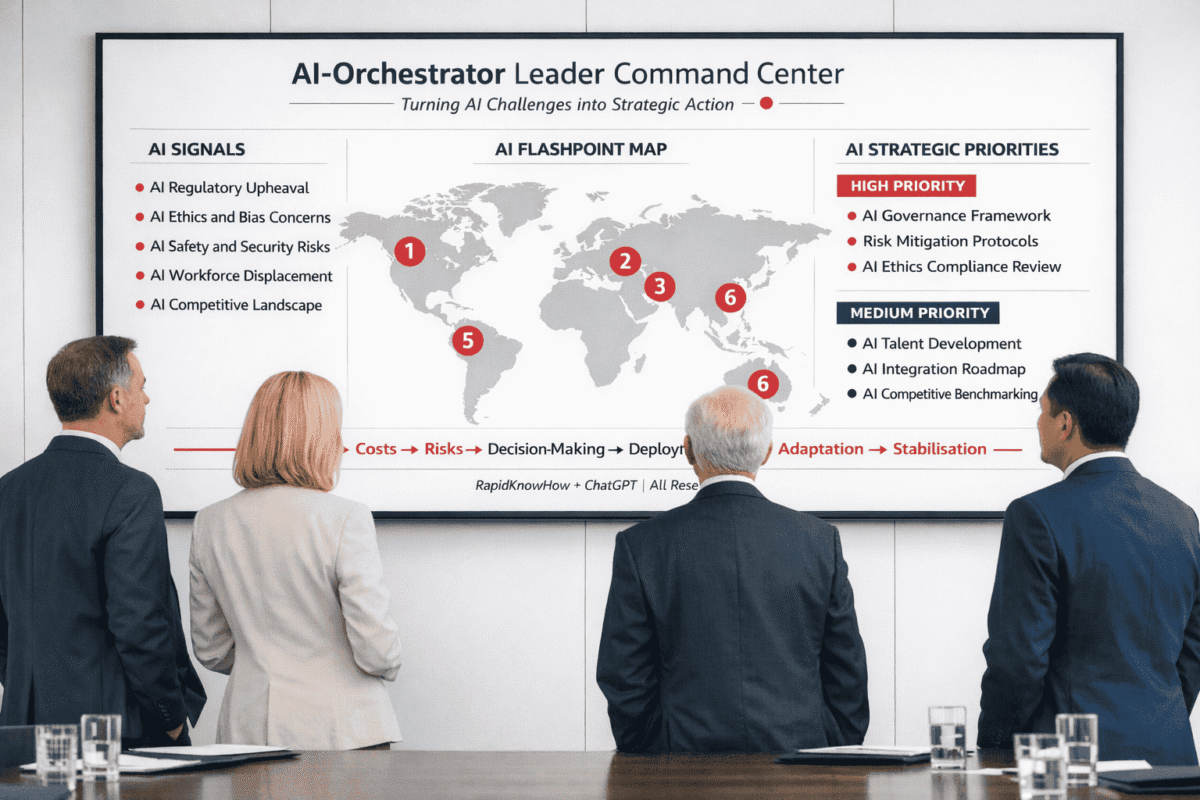
5️⃣ AI-Orchestrator Control Layer
This is the differentiator.
Traditional:
People manage dashboards.
Orchestrator:
System drives decisions.
Architecture:
Signal → Prioritize → Act → Capture → Reinforce
Applied to:
- Pricing
- Capex
- Working capital
- Customer risk
Impact:
Decision latency ↓
FCF acceleration ↑
D) The FCF Compounding Flywheel
Operational Precision
→ Margin Stability
→ FCF Predictability
→ Lower Capital Cost
→ Higher Multiple
→ Stronger Equity
→ Strategic Freedom
This is not linear.
This is multiplicative.
E) Valuation Impact Model
If FCF becomes:
Stable + Predictable + Automated
Then:
Market assigns:
Higher FCF Multiple.
If FCF Multiple increases from:
12× → 15×
And FCF grows structurally 5–7%
Market Value expansion becomes exponential.
This is the invisible lever.
F) Where Traditional IG Leadership Fails
❌ Volume obsession
❌ Reactive pricing
❌ Capex prestige projects
❌ Manual reporting
❌ Weak pass-through discipline
These destroy multiple expansion.
G) The Orchestrator Position 2026–2030
Industrial Gas Leader must become:
System Architect
Capital Allocator
Volatility Dampener
Free Cash Flow Designer
Not:
Plant Manager 2.0
H) Strategic Conclusion
The Industrial Gas industry will bifurcate:
1️⃣ Operational managers
2️⃣ FCF Architects
Only one group commands:
Premium valuation.
RapidKnowHow’s FCF Architecture™ provides:
A structural blueprint
to convert operational precision
into durable market value.