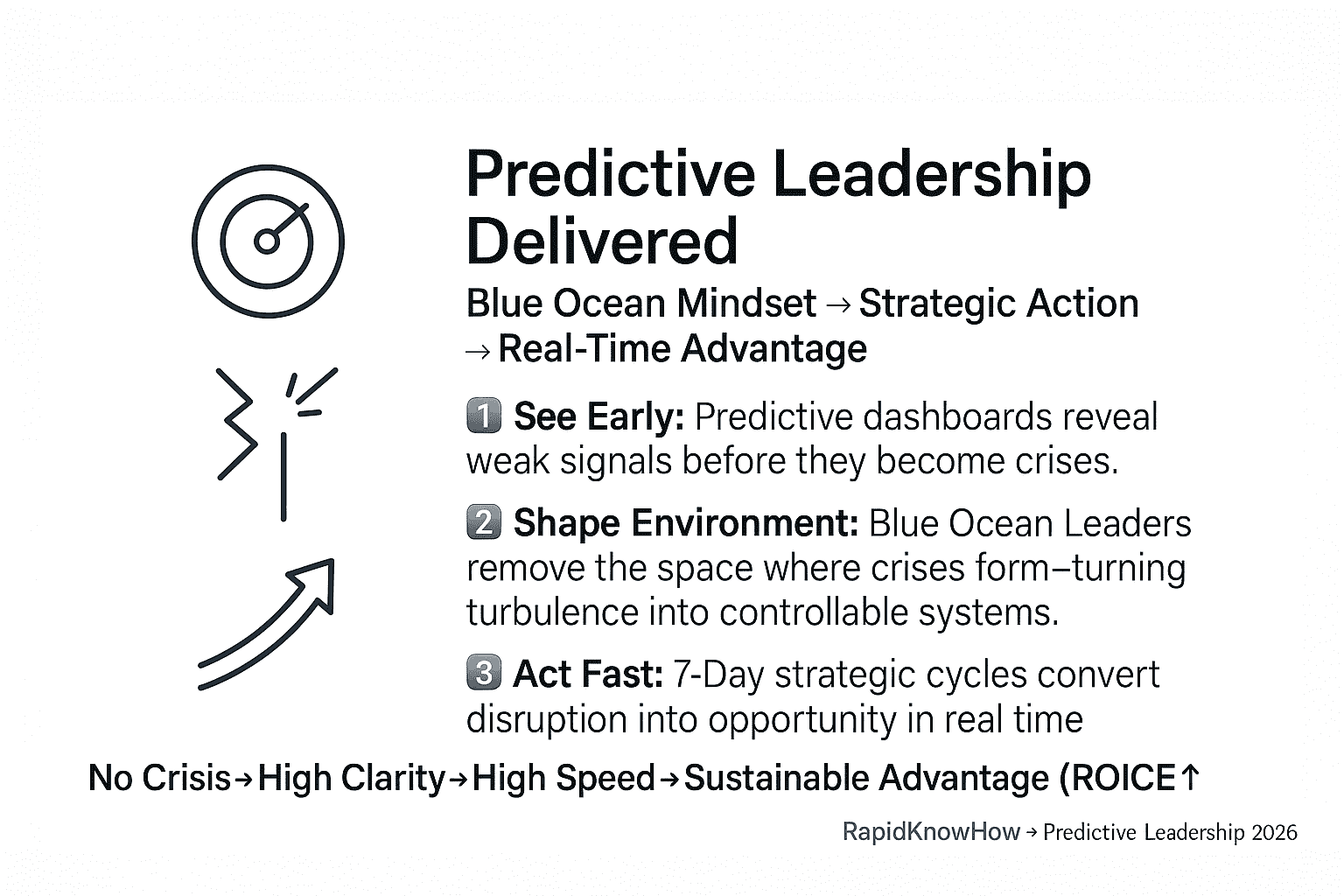

By Applying the Blue Ocean Mindset and Executing Strategic Actions that Shape the Environment
RapidKnowHow + ChatGPT · Power Report 2026
🚀 EXECUTIVE SUMMARY
Predictive Leadership is no longer optional.
In 2026 and beyond, leaders who operate with a Blue Ocean Mindset and shape the environment proactively outperform reactive actors by orders of magnitude.
This Power Report shows:
- How Predictive Leadership works
- Why removing the “crisis space” creates opportunity space
- Which strategic actions generate real-time advantage
- How to execute Predictive Leadership in your organisation, sector, or country
Predictive Leaders do three things differently:
- They look ahead, not around.
- They design the environment, not defend it.
- They turn crisis energy into opportunity cycles in real-time.
This is the RapidKnowHow Blueprint for Predictive Strategic Advantage.
🔥 SECTION 1
The Crisis Space vs The Opportunity Space
Every organization operates inside a predictable structural trap:
THE CRISIS SPACE
Where Red Ocean leaders get stuck:
- reacting to shocks
- firefighting
- blaming environment
- waiting for “stability”
- losing trust and momentum
The Crisis Space grows when:
- leaders depend on old assumptions
- information arrives late
- complexity overwhelms decision cycles
- bureaucracy slows execution
- no predictive metrics exist
👉 The system becomes reactive. Leaders become prisoners.
THE OPPORTUNITY SPACE
Blue Ocean Predictive Leaders create:
- information clarity
- foresight dashboards
- strategic optionality
- fast feedback loops
- controlled innovation zones
Here, leaders remove the conditions in which crises form.
This transforms shocks into signal → action → opportunity.
👉 Leaders become architects, not responders.
🔵 SECTION 2
Blue Ocean Mindset: The 5 Strategic Shifts
Predictive Leadership requires a new mental operating system:
1. From reacting to SHAPING
Red Ocean: “How do we respond?”
Blue Ocean: “How do we pre-configure the environment so the crisis cannot emerge?”
2. From competing to CREATING
Red Ocean: fighting for the same overcrowded space.
Blue Ocean: generating new value factors competitors cannot reach.
3. From bureaucratic cycles to REAL-TIME FEEDBACK
Red Ocean: quarterly reviews, annual strategy.
Blue Ocean: daily dashboards, 7-day strategic cycles.
4. From complexity to SIGNAL CLARITY
Red Ocean: drowning in data.
Blue Ocean: using 3–5 predictive indicators to drive action.
5. From resource control to FLOW-BASED MANAGEMENT
Red Ocean: “we need more resources”.
Blue Ocean: “we need smoother flow” (time, cost, convenience, information).
📡 SECTION 3
Predictive Leadership System: Remove the Crisis Space
Crisis emerges when three conditions exist:
- Uncertainty
- Delay
- Lack of action capacity
Predictive Leaders algorithmically remove these conditions.
THE THREE INTERVENTION LEVERS
1. Remove UNCERTAINTY → via Predictive Dashboards
- Signals on customers, competitors, environment, finance
- Early warning indicators
- Weekly prediction cycles
- ROICE scoreboards
Outcome:
No crisis emerges “unexpectedly”.
2. Remove DELAY → via Decentralized Execution
- Push authority outward
- Standardize 30–60 day innovation templates
- Remove approval bottlenecks
Outcome:
Crisis energy becomes opportunity energy.
3. Remove ACTION BLOCKERS → via Frictionless Systems
- Simplification
- Automation
- Pre-approved playbooks
- Strategic alliances
Outcome:
Crises become solvable within hours or days, not months.
🔵 SECTION 4
The Predictive Leadership Operating Model (PLOM)
RapidKnowHow + ChatGPT Core Model
The PLOM consists of four self-reinforcing loops:
Loop 1: Insight Loop
Detect signals that matter before they matter.
Inputs:
- Real-time dashboards
- Predictive analytics
- Citizen/market sensors
Output:
Clarity.
Loop 2: Design Loop
Design the environment in which success is inevitable.
Inputs:
- Strategy maps
- Blue Ocean design principles
- Structural simplification
Output:
Strategic leverage.
Loop 3: Execution Loop
Implement fast, learn fast, iterate fast.
Inputs:
- 7-day sprints
- 30–60 day innovation cycles
- Clear accountability
Output:
Momentum.
Loop 4: Opportunity Loop
Convert disruptions into advantage.
Inputs:
- Crisis → Signal → Opportunity mapping
- Optionality creation , Evaluation and Selection
- Rapid redeployment
Output:
Sustained advantage.
🚀 SECTION 5
Strategic Actions That Deliver Predictive Leadership in Real-Time
The following actions produce measurable predictive advantage:
1. Establish a Strategic Command Dashboard
- 5–7 predictive indicators
- Weekly strategic insights
- Automated anomaly detection
Outcome:
Early shifts become visible instantly.
2. Build a “No Crisis Zone” via Pre-Configured Responses
- Create scenario playbooks
- Pre-align stakeholders
- Design automatic triggers
Outcome:
Crisis energy collapses.
3. Use “Opportunity Windows” Playbook
Every disruption provides a window:
- customer need
- resource shift
- competitor weakness
- regulatory opening
RapidKnowHow Principle:
Predictive Leaders enter windows of opportunity before others see them.
4. Institutionalize 7-Day Strategic Cycles
- weekly learning
- weekly simplification
- weekly recalibration
Outcome:
Predictive adaptability becomes a habit.
5. Build a Blue Ocean Culture of System Thinking
- Focus on flow, not tasks
- Focus on leverage, not outputs
- Focus on value creation, not industry norms
Outcome:
Your organization sees patterns competitors miss.
🧮 SECTION 6
Predictive Leadership Scoreboard (PLS-20)
A simple 20-point system:
Each “YES” = 1 point.
Do you…
- Have predictive dashboards?
- Use weekly strategic cycles?
- Shape the environment, not react to it?
- Pre-configure crisis responses?
- Focus on prevention over correction?
- Manage based on ROICE principles?
- Use Blue Ocean value creation logic?
- Remove friction systematically?
- Convert disruption into opportunity?
- Use simplification as a strategic weapon?
- Align incentives with outcomes?
- Leverage AI for signal detection?
- Cut decision cycles constantly?
- Map opportunity windows?
- Manage energy flows in teams?
- Use no-crisis zones?
- Work with strategic alliances?
- Reallocate resources dynamically?
- Learn faster than competitors?
- Create strategic optionality monthly?
Score:
- 0–8 → Red Ocean Reactive Leader
- 9–15 → Transitional Predictive Leader
- 16–20 → Blue Ocean Predictive Leader
🔥 FINAL POWER STATEMENT
Predictive Leadership is not about forecasting the future —
it is about shaping the environment so the desired future becomes inevitable.Blue Ocean Mindset + Strategic Action =
No Crisis · High Opportunity · Sustainable Advantage.This is Predictive Leadership Delivered. – Josef David