🎯 Purpose
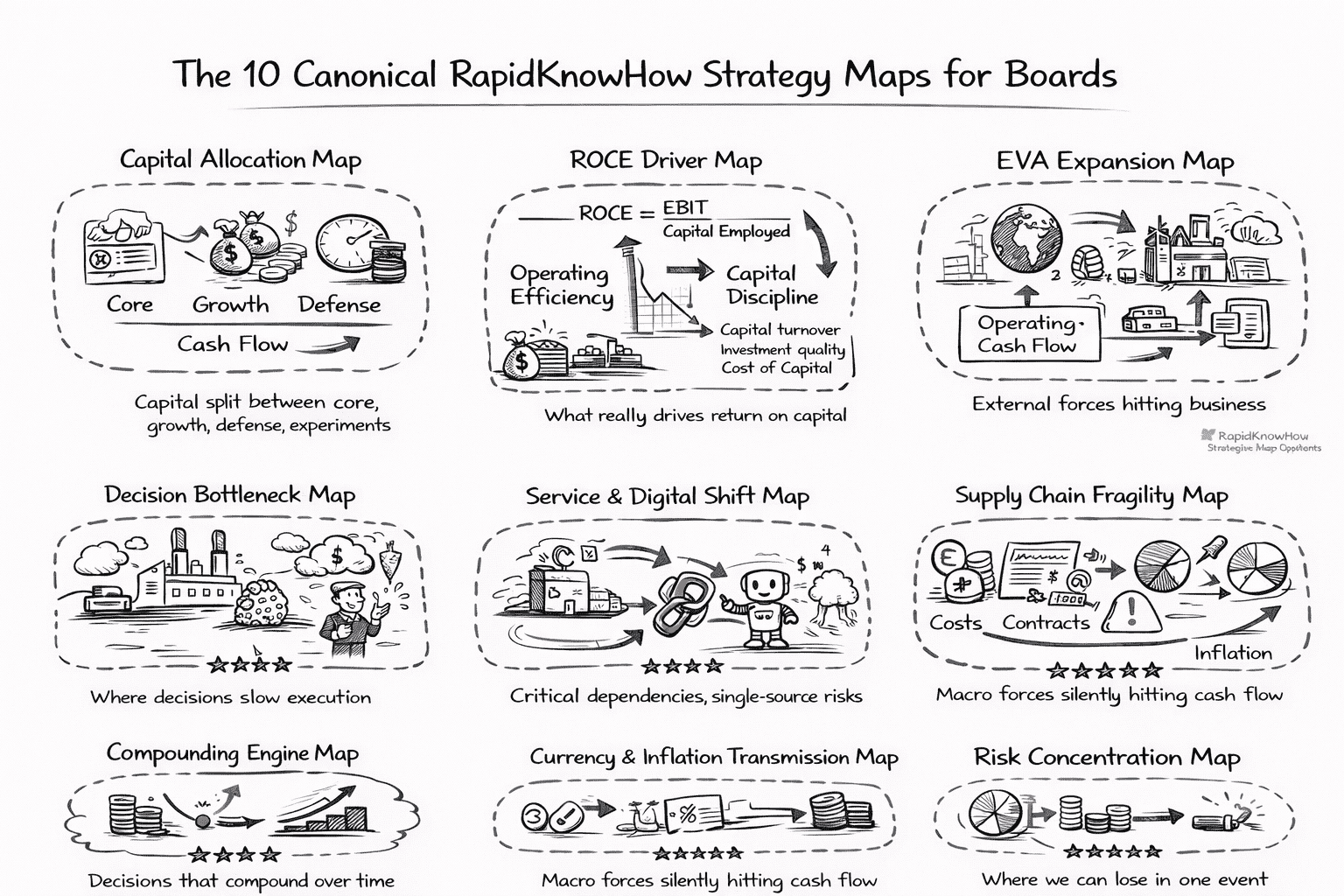
To turn complex business logic (models, systems, value chains, EVA trees, platforms) into simple, human, memorable doodles that:
- create instant understanding (≤15 seconds),
- lower cognitive resistance,
- invite discussion and insight,
- work perfectly for boards, teams, citizens, and learners.
A) THE PRINCIPLE – WHY DOODLES WORK FOR BUSINESS
1️⃣ The Core Insight
People don’t think in PowerPoint.
They think in pictures, metaphors, and stories.
Doodle-style sketches:
- bypass analytical overload,
- activate intuitive understanding,
- make systems feel understandable.
That’s why bad ideas hide in complex charts
and good ideas survive as simple sketches.
2️⃣ What a Business Doodle IS (and IS NOT)
IS
- rough
- imperfect
- symbolic
- human
- slightly ironic or playful
IS NOT
- polished infographic
- data-heavy dashboard
- “consultant beauty”
A doodle says: “This is safe to understand.”
B) THE METHOD – 5 STEPS TO DOODLE ANY BUSINESS MODEL
🧠 STEP 1: Reduce the Business to a SYSTEM LOGIC
Before drawing, ask ChatGPT:
Prompt
Reduce this business model to:
- 3–5 core components
- 1 value flow
- 1 bottleneck
- 1 leverage point
Explain it like to a smart 12-year-old.
👉 Output = System Skeleton
✏️ STEP 2: Translate Logic into SIMPLE SHAPES
Use only:
- ⭕ circles = actors / entities
- ▭ boxes = systems / platforms
- → arrows = value, money, data, power
- ⚠️ clouds = risks, noise, friction
Rule:
If you need more than 5 shapes, you’re not ready to draw.
🎭 STEP 3: Add a HUMAN METAPHOR
Ask ChatGPT:
Prompt
Give me a human or everyday-life metaphor
for this business system.
Funny, slightly ironic, but respectful.
Examples:
- Business model = plumbing system
- Digital platform = waiter with a tablet
- EVA destroyer = leaking bucket
- Asset-heavy model = backpack full of stones
- Service & Digital = light exoskeleton
👉 This is where doodles become memorable.
🖊️ STEP 4: Enforce DOODLE RULES
Tell ChatGPT explicitly:
Prompt
Now describe the sketch in doodle style:
- naive, hand-drawn
- uneven black lines
- imperfect proportions
- simple icons
- no colors, only line drawing
- white background
- looks like it was drawn on a napkin
This prevents “design polish” and keeps thinking visible.
🗯️ STEP 5: Add ONE SPEECH BUBBLE OR LABEL
Each doodle needs one sentence only.
Examples:
- “This is where value leaks.”
- “Here money works harder than assets.”
- “This guy looks busy but creates nothing.”
- “Silence + data = margin.”
If you need more text → the doodle failed.
C) PRACTICAL CHATGPT PROMPT STACK (COPY–PASTE)
🎯 MASTER PROMPT: BUSINESS DOODLE CREATOR
You are a strategic doodle artist.

Task:
Turn the following business model/system into a doodle sketch.

Rules:
- Reduce to max. 5 elements
- Use simple shapes (circles, boxes, arrows)
- Naive, imperfect, hand-drawn look
- Black line only, no color
- Slightly humorous, but insightful
- Add one short speech bubble or caption
- The doodle must explain the system in 15 seconds

Business system:
[PASTE YOUR BUSINESS MODEL HERE]

Also:
Explain briefly why this doodle reveals the core insight better than a slide.
🔁 EXAMPLES YOU CAN APPLY IMMEDIATELY
✔ EVA Business Model
- Bucket labeled “Capital”
- Hole at bottom = WACC
- Water in = NOPAT
- Plug = Service & Digital
Caption:
“Stop filling faster. Start leaking less.”
✔ Traditional vs Service Model
- Left: heavy guy carrying factory
- Right: light guy with tablet + cloud
Caption:
“Same value. Less weight.”
✔ Digital Platform
- Stick figure waiter
- Many tables (customers)
- Tablet routes orders automatically
Caption:
“He doesn’t cook. He orchestrates.”
🧭 RAPIDKNOWHOW INSIGHT
A doodle is not the final answer.
It’s the fastest path to the right question.
Boards argue less.
Teams align faster.
Citizens understand sooner.
Bad ideas are exposed immediately.
That’s why strategy should be sketched before it’s scaled. – Josef David