🧩 The AI-Driven Orchestrator Ecosystem System

Sector Focus: Industrial Gases

This is written as a strategic blueprint, not marketing fluff — designed to become:

  • a leadership doctrine
  • a capability system
  • an operating model
  • a value capture engine
  • a multi-stakeholder ecosystem

for global Industrial Gas companies (Linde, Air Liquide, Air Products, NSHD, Messer).


1️⃣ Purpose & Reason for Existence

Industrial Gas is a systemic backbone industry:

  • Steel + Metallurgy
  • Chemicals + Refining
  • Electronics + Semiconductors
  • Healthcare + Homecare
  • Food + Beverage
  • Welding + SMEs
  • Energy + Hydrogen

Yet leadership today is still built on linear hierarchies, slow committees, plant-centric operations, and fragmented knowledge.

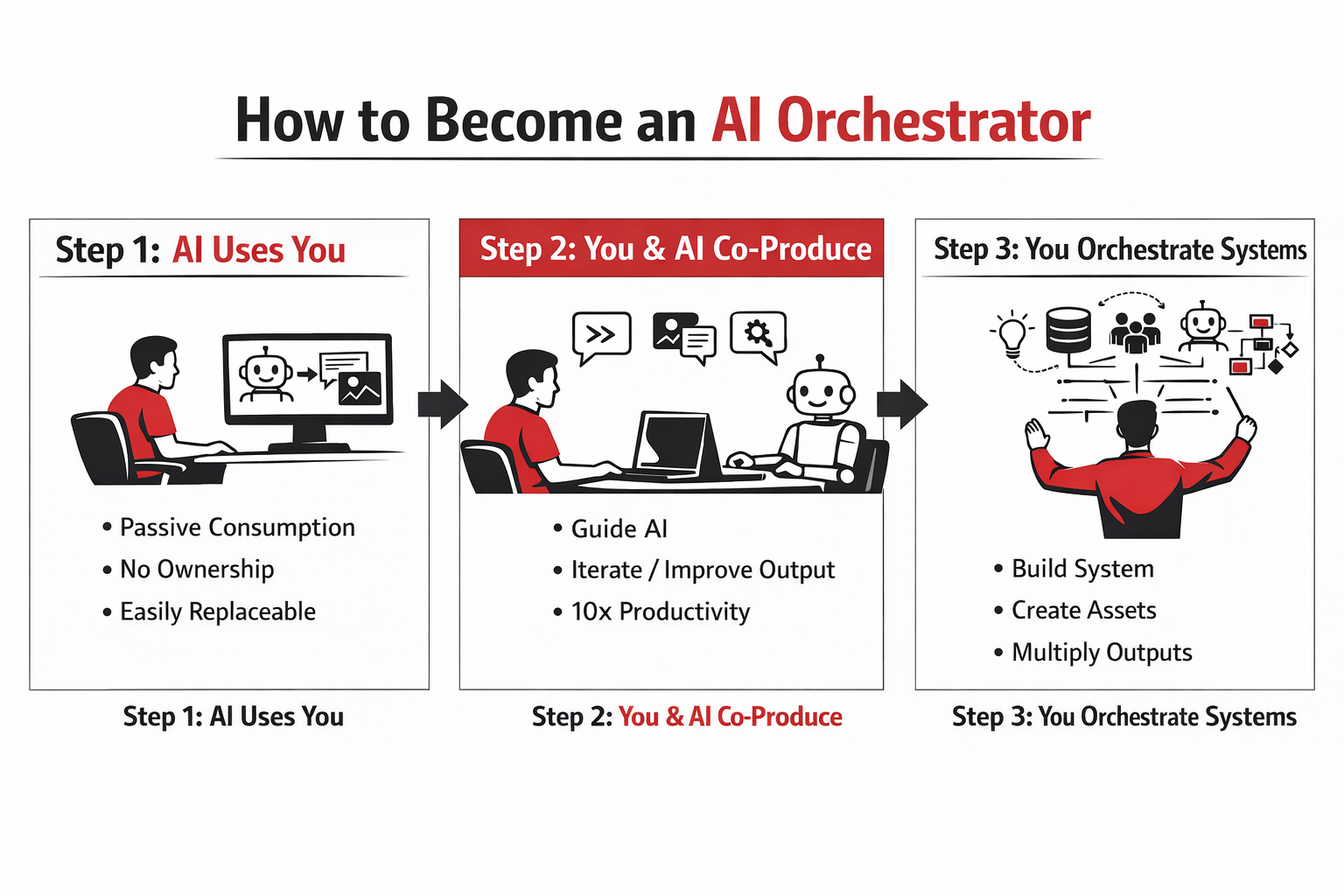
The AI-Driven Orchestrator replaces this with:

Real-time leadership that orchestrates people, plants, contracts, capital, customers, safety, and supply chains as one adaptive ecosystem.

Because Industrial Gas is no longer a company vs company game, but an ecosystem vs ecosystem game:

  • fabs + gas + helium + semicon OEMs
  • steel + hydrogen + pipelines
  • hospitals + logistics + reimbursement
  • chemicals + nitrogen + oxygen enrichment

AI makes such orchestration possible for the first time.


2️⃣ Definition

AI-Driven Orchestrator Leadership = Human Leadership + Machine Intelligence + Ecosystem Coordination + Capital Discipline + Safety Governance

It is not an AI tool.
It is a leadership operating system.

It delivers three compounding advantages:

  1. Time Advantage — faster cognition & execution
  2. Capital Advantage — higher ROI & velocity
  3. Safety Advantage — predictive & preventive

Those three advantages define sector winners 2026–2035.


3️⃣ The Orchestrator Leadership Stack

The System consists of 7 integrated layers:


LAYER 1 — Governance & Safety Core

Purpose: Embed safety, compliance, ethics, and risk control as non-negotiable.

Includes:

  • Safety AI (anomaly detection, near-miss patterns)
  • PPE compliance sensors & audits
  • Root-cause incident analytics
  • Safety culture simulators
  • AI decision gates for risk escalation

Outcome:

Safety becomes predictive, not reactive.


LAYER 2 — Operational Intelligence

Purpose: Convert plants, supply chain, and logistics into data-driven, self-adapting systems.

Includes:

  • SCADA data ingestion
  • Predictive maintenance
  • Uptime analytics
  • Energy optimization
  • Cylinder/ISO digital twin
  • Transport route optimizers
  • Inventory demand forecasting

Outcome:

Reliability and uptime become compounding assets.


LAYER 3 — Ecosystem Intelligence

Purpose: Build connectivity with adjacent industries.

Sub-ecosystems include:

  • Electronics (fabs, OEMs, gas cabinets)
  • Steel & Hydrogen (on-site ASUs, DRI, H₂)
  • Chemicals & Refining (pipeline O₂/N₂/H₂)
  • Healthcare (hospitals + homecare)
  • SME Welding (distributors + rental fleets)

AI unifies:

  • Demand signals
  • Capacity visibility
  • Constraints
  • Contract anchors
  • Capital timing

Outcome:

The Industrial Gas company becomes an ecosystem orchestrator, not a commodity seller.


LAYER 4 — Decision Intelligence (The “Brain”)

Purpose: Transform leadership decision-making.

AI provides:

  • Scenario planning
  • Multi-option decision trees
  • Contract risk analysis
  • Capex optimization
  • Portfolio simulation
  • Hydrogen unit economics
  • Customer churn prediction

Outcome:

Leaders move from quarterly hindsightreal-time foresight.


LAYER 5 — Capital Allocation Engine

Purpose: Convert capital into durable economic moats.

Functions:

  • ROIC forecasting
  • Capex → contract matching
  • Idle asset risk detection
  • Subsidy/Policy signal interpretation
  • JV modeling
  • Anti-trust pathway modeling

Outcome:

No stranded capex, no vanity hydrogen, no idle ASUs.


LAYER 6 — Value Orchestration & Monetization

Purpose: Monetize intelligence via new ecosystem plays.

Revenue & value capture models:

  1. Industrial Gas-as-a-Service
  2. Electronics Process Gas Partnerships
  3. Green Steel Hydrogen Ecosystems
  4. Refinery Optimization Services
  5. Healthcare Respiratory Ecosystems
  6. Cylinder Fleet Management-as-a-Service
  7. ROIC+ Portfolio Optimization Services

Outcome:

Moves the company from product-sellingecosystem value capture.


LAYER 7 — Talent & Knowledge Engine

Purpose: Convert tacit know-how into scalable institutional intelligence.

Includes:

  • AI copilots for sales + plants + engineers
  • Rapid-knowledge extraction from experts
  • Scenario simulation training
  • Leadership augmentation
  • Apprenticeship automation
  • Safety and compliance training engines

Outcome:

Human expertise scales geographically + generationally.


4️⃣ Operating Model of the AI-Orchestrator

The company moves from vertical functional siloshorizontal orchestration loops.

Old Leadership Cycle (Linear)

Data → Report → Meeting → Debate → Decision → Execution → Feedback (months)

New Orchestrator Cycle (Loop)

Signal → Scenario → Decision → Execution → Feedback → Learning (hours)

Powered by AI copilots and digital twins.


5️⃣ Core Pillars for Industrial Gas Adoption

Pillar 1 — Safety & Reliability First

If AI does not improve safety or runtime, it is rejected.

Pillar 2 — Contract & Capital Discipline

All ecosystem plays must sit on solid contract math + ROIC gates.

Pillar 3 — Ecosystem Interoperability

Gas company acts as integrator among:

  • OEMs
  • Policy makers
  • Steelmakers
  • Semiconductor fabs
  • Hospitals
  • Distributors
  • Chemical complexes

Pillar 4 — Regulatory Foresight

AI monitors:

  • subsidies
  • hydrogen roadmaps
  • FTC/EU anti-trust signals
  • reimbursement shifts

Leadership gains policy advantage.


6️⃣ Ecosystem Roles & Power Map

In the AI-Orchestrator model, the Industrial Gas company plays six roles:

  1. Market Integrator
    Aligns steel, hydrogen, pipelines, power, subsidies.
  2. Technology Bridge
    Connects fabs, helium, UHP, OEMs, cabinet suppliers.
  3. Operational Backbone
    Ensures uptime, safety, logistics.
  4. Capital Governor
    Ensures ROIC + avoids stranded assets.
  5. Knowledge Reservoir
    Captures global applications + tacit expertise.
  6. Customer Stickiness Engine
    Via contracts, reliability, advanced gases, co-investment models.

This converts Industrial Gas companies from supplierscritical infrastructure partners.


7️⃣ Strategic Outcomes 2026–2035

The AI-Driven Orchestrator System produces measurable advantages:

OutcomeSector Leverage
Higher reliabilityRenews contracts, wins fabs
Higher ROICSelective capex, JV allocation
Lower OpexPredictive maintenance/logistics
Faster decisionsCapital velocity increases
Lower downtimeSafety & uptime advantage
Ecosystem stickinessMoves beyond commodity pricing
New revenue layersServices + ecosystem models
Talent compoundingAI captures application know-how

This is what future winning players look like.


8️⃣ Competitive Playbook: How to Win Against Peers

Against legacy competitors, the orchestrator wins via:

  1. Safety Advantage (non-negotiable industry differentiator)
  2. Uptime Advantage (fabs & steel value reliability over price)
  3. Capital Velocity Advantage (higher ROIC & contract matching)
  4. Electronics Ecosystem Advantage (helium, UHP, cabinet integration)
  5. Hydrogen Reality Advantage (contract-first, policy-aware)
  6. Knowledge Advantage (AI codifies applications expertise)

This breaks the traditional commodity-margin trap.


9️⃣ Implementation Roadmap (Industrial Gas Specific)

Phase 1: Cognitive Infrastructure (12–18 months)

  • SCADA + contract + safety data unification
  • Executive copilots for strategy + contracts
  • Cylinder & ISO digital twin
  • Hydrogen unit econ simulator
  • Uptime & predictive maintenance

Phase 2: Ecosystem Integration (18–36 months)

  • Fab supply orchestration + helium forecasting
  • Steel/H₂ partnership models with DRI
  • Hospital + homecare logistics model
  • Distributor ecosystems (SME welding)

Phase 3: Ecosystem Value Capture (36–60 months)

  • Contract-based hydrogen platforms
  • Fab uptime-as-a-service
  • Respiratory care ecosystems
  • Capex optimization services
  • JV capital platforms

Outcome:
Global Orchestrator with multi-ecosystem value capture.


🔟 Strategic Closing Statement

In Industrial Gases, leadership strength is not defined by the ASU or the molecule — it is defined by the ability to orchestrate capital, safety, uptime, contracts, knowledge, and ecosystems.
AI is the first force in history that makes this orchestration achievable.
The companies that adopt the AI-Driven Orchestrator Leadership System will dominate 2026–2035.
Josef David

Sharing is Caring! Thanks!