
Core message:
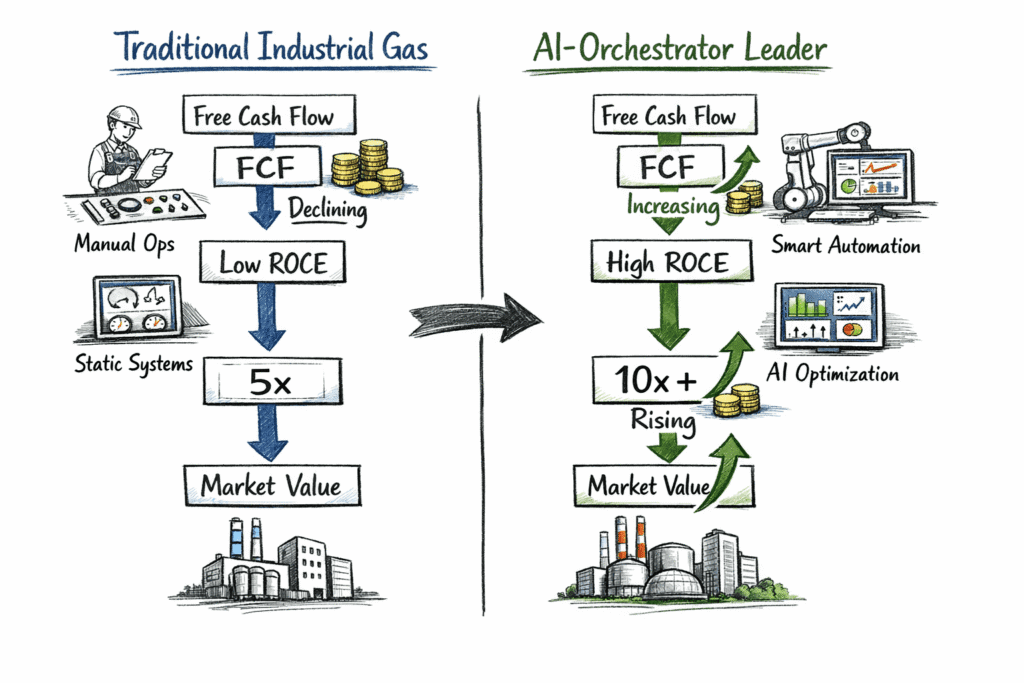
Most industrial gas companies still optimize functions. Leaders optimize cash generation. The winning model is not “sell more gas and hope margins hold.” The winning model is to operate an AI-Orchestrator that continuously detects, prioritizes, and executes the levers that generate free cash flow fastest and most reliably.
The shift:
Traditional model: volume -> revenue -> delayed profit -> weak cash conversion
AI-Orchestrator model: signal -> priority -> action -> FCF -> reinvestment -> compounding advantage
What the AI-Orchestrator does
- Detects signals that matter most: price leakage, pass-through delay, energy cost spikes, plant downtime, contract weakness, customer mix deterioration, slow collections.
- Prioritizes the highest FCF levers.
- Executes actions across pricing, operations, commercial discipline, working capital, and service models.
- Captures the cash effect quickly.
- Converts that effect into ever-growing ROICE.
- Expands the ecosystem so value compounds beyond the company.
Highest-value FCF levers in Industrial Gas
- Pricing discipline
- Faster surcharge/pass-through mechanisms
- Better customer and product mix
- Cylinder and trailer asset productivity
- Receivables acceleration
- Service contract redesign
- Energy and maintenance optimization
- Healthcare / specialty / on-site cross-sell
Leadership rule:
Never scale activity. Scale only proven FCF engines.
CEO takeaway:
The AI-Orchestrator is not a dashboard. It is the operating system that turns industrial gas leadership into continuous cash generation.
From FCF to ROICE: How Industrial Gas Leaders Turn Cash into Strategic Power
Core message:
Free cash flow alone is not enough. The real leadership advantage begins when FCF is converted into ROICE: Return on Innovation, Convenience, and Efficiency.
Why this matters:
Many firms generate cash, then disperse it. Winners convert cash into systems that improve customer value, reduce friction, and increase operating efficiency. That is how one FCF gain becomes a repeatable advantage.
The ROICE conversion logic
- Innovation: redesign offers, bundles, contracts, asset usage, and digital workflows
- Convenience: simplify ordering, delivery visibility, refill reliability, uptime guarantees
- Efficiency: reduce cycle time, waste, manual work, energy loss, idle assets
Industrial Gas examples
- FCF from better pricing -> reinvest into AI-assisted deal guidance
- FCF from lower DSO -> reinvest into digital customer self-service
- FCF from better route utilization -> reinvest into predictive delivery scheduling
- FCF from maintenance savings -> reinvest into plant reliability analytics
- FCF from premium mix shift -> reinvest into specialized application expertise
The compounding effect:
FCF gives room to invest. ROICE makes those investments smarter. Each smart reinvestment creates more FCF. That is the beginning of the compounding loop.
Leadership rule:
Every euro of additional FCF should be assigned a next-best ROICE use.
CEO takeaway:
The strongest industrial gas companies will not merely protect margin. They will build an FCF-to-ROICE flywheel.
The Expanding Ecosystem: How Industrial Gas FCF Compounds Beyond the Company
Core message:
True compounding starts when the company no longer creates value alone. The AI-Orchestrator expands value through an ecosystem of customers, partners, service providers, distributors, application experts, healthcare channels, and digital interfaces.
The new game:
Old model: one company, one transaction, one margin
New model: one platform, many interactions, recurring value, growing cash conversion
What an expanding ecosystem looks like
- Smart contracts with indexation and service upgrades
- Partner-integrated delivery and refill systems
- Customer portals that lock in convenience
- Application partners that raise gas usage value
- Healthcare and homecare channels that increase service revenue
- Data-sharing loops that improve forecasting and uptime
- License or alliance models that copy the system into adjacent regions
Why ecosystems compound FCF
- They improve customer retention
- They increase switching costs
- They raise service intensity
- They reduce selling friction
- They improve forecast quality
- They create repeatable playbooks
- They turn isolated wins into network effects
Strategic rule:
Do not ask, “How do we sell more?”
Ask, “How do we make our value system easier to join, harder to leave, and more profitable to scale?”
CEO takeaway:
The future winner in Industrial Gas is not only a producer or distributor. It is the orchestrator of a value ecosystem that compounds FCF over time.-Josef David