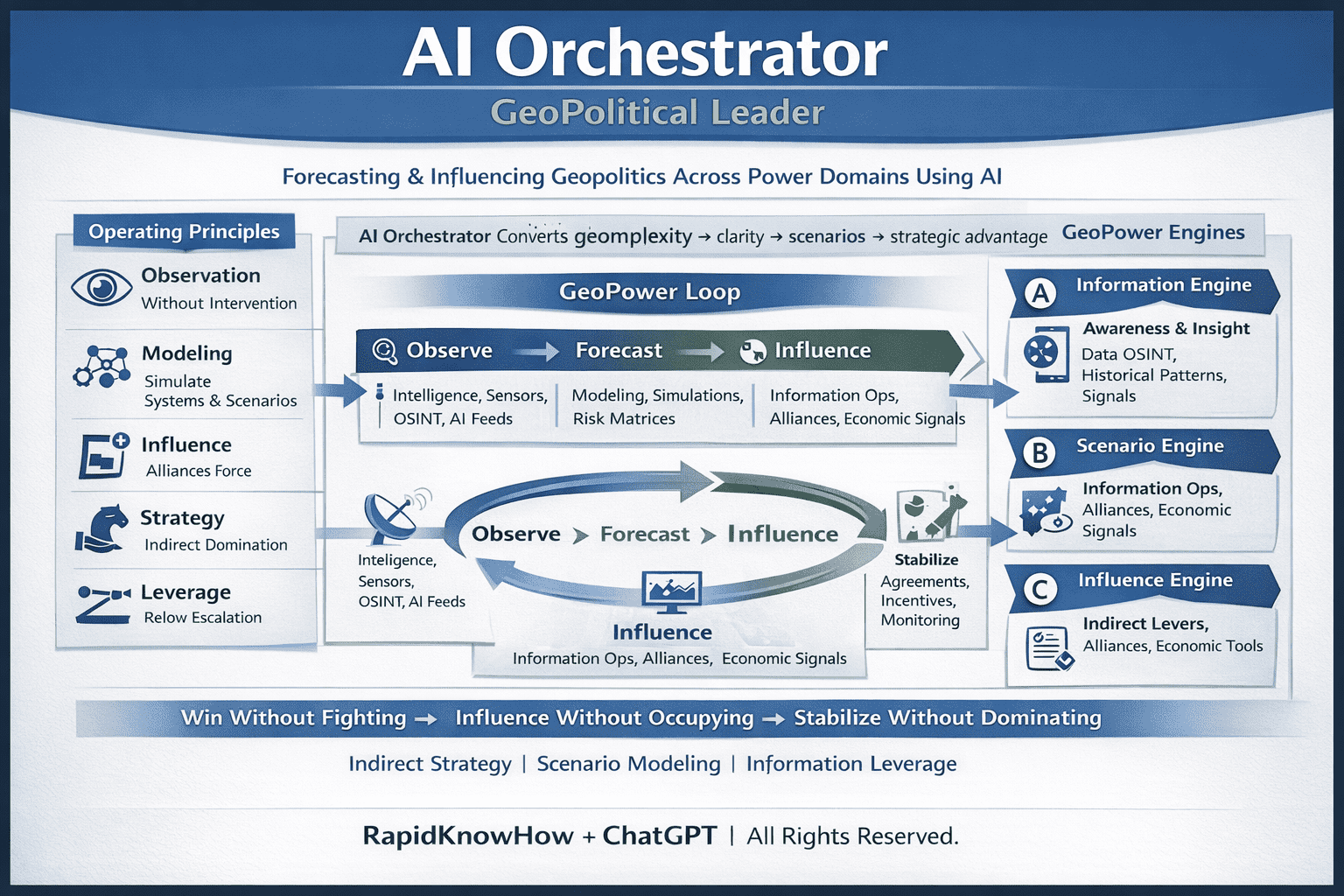
The geopolitical environment 2025–2030 is chaotic, multi-polar, and technology-driven. This environment does not reward rigid hierarchies or slow planners — it rewards flexible orchestrators who integrate AI, alliances, and indirect strategy.
Below are the 7 geopolitical forces that actively thrive the rise of the AI-Orchestrator Leader, followed by what the Orchestrator actually does and captures.
1) Multi-Polar Fragmentation → Demand for Dynamic Intelligence
Situation
- US–China rivalry shapes global supply chains
- EU struggles with fragmented sovereignty & bureaucracy
- BRICS expands into a commodity + finance bloc
- Middle powers (Turkey, UAE, India, Saudi) pursue transactional diplomacy
Resulting Need
Governments, corporates, and investors require:
- Rapid intelligence
- Scenario forecasting
- Adaptive decision models
→ Opportunity for AI-Orchestrator
The Orchestrator becomes a real-time translator of geopolitical chaos into commercial strategy, not a passive analyst.
2) Supply Chain Weaponization → Need for Autonomous Ecosystems
Situation
- Semiconductors (Taiwan)
- Energy (Russia, Middle East)
- Rare Earths (China)
- Food (Black Sea, Brazil)
- Logistics (Panama, Red Sea)
States weaponize chokepoints → industries require strategic autonomy.
→ Opportunity for AI-Orchestrator
Orchestrator builds AI-driven autonomy systems, e.g.:
- Supplier resilience dashboards
- GeoRisk → GeoOpportunity maps
- Strategic substitution models
Winning sectors:
→ Industrial Gas, Pharma, Semiconductors, Automotive, Food, Defense
3) Cyber + Info Warfare → Need for Resilient Perception Management
Situation
States fight through:
- Disinformation
- Narrative control
- Proxy conflicts
- Cyber disruption
- Election interference
Public trust collapses → decision-makers are blind.
→ Opportunity for AI-Orchestrator
The Orchestrator deploys:
- AI-media verification pipelines
- Narrative risk scanners
- Strategic comms playbooks
- Reputation defense systems
→ Not just “security,” but strategic legitimacy management
4) AI Sovereignty Race → Demand for Local AI-Control Systems
Situation
Every region is building AI Sovereignty:
- US = Private AI hegemony (OpenAI, Anthropic)
- China = State AI vertical control
- EU = Regulatory sovereignty (AI Act)
- India = Affordable mass-scale public AI
- Middle East = Sovereign tech funds
→ Opportunity for AI-Orchestrator
Orchestrator becomes the leader who can:
Design AI systems that comply with sovereignty, ethics, and law
for:
- Business
- Government
- Civil society
The Orchestrator turns AI from “black-box tech” to sovereign infrastructure.
5) Economic Stagnation + Demographics → Efficiency Imperative
Situation
OECD + EU face:
- Aging demographics
- Talent shortages
- Slow productivity
- Deindustrialization pressure
Resulting Need
Governments and industries require:
- Efficiency
- Automation
- Productivity multipliers
→ Opportunity for AI-Orchestrator
The Orchestrator positions AI as:
→ Productivity Sovereignty System
Delivering:
- Cost efficiency
- Talent augmentation
- Knowledge capture
- Process speed-up
6) New Capital Geography → Capital Follows Competent Orchestration
Situation
Investors shift from markets → capabilities:
Capital today chases:
- Critical infrastructure
- Security & autonomy
- AI & automation
- Energy transition
- Logistics control
- Data & intelligence
→ Opportunity for AI-Orchestrator
The Orchestrator becomes the capital attractor because they:
- Define models
- Build ecosystems
- Connect markets
- Reduce geopolitical risk
Orchestrator = competence premium.
7) From Hierarchies to Networks → Leadership Model Disruption
Situation
Hierarchical leadership is too slow for 2025–2030.
The world is shifting to:
- Networks
- Ecosystems
- Ad-hoc alliances
- Multi-node decision-making
→ Opportunity for AI-Orchestrator
The Orchestrator is the network leader, not the commander:
They lead through:
- Integration
- Coordination
- Facilitation
- Enablement
In geopolitics, control is shifting from territory → networks.
In business, control is shifting from P&L → ecosystems.
This is the Orchestrator’s terrain.
So What is the AI-Orchestrator Leader?
Definition (RapidKnowHow Style):
The AI-Orchestrator Leader is the integrator of multi-domain intelligence, technology, alliances, and capital to create resilient ecosystems that thrive in geopolitical volatility.
Core Capabilities
The Orchestrator must:
✓ Sense (Intelligence)
✓ Interpret (Clarity)
✓ Model (Simulation)
✓ Decide (Indirect Strategy)
✓ Enable (Ecosystem Build)
✓ Capitalize (Value Capture)
Value Capture Model
Geopolitics → Orchestrator → Value Capture in:
1. Sovereign Value
- Security
- Autonomy
- Compliance
2. Economic Value
- Efficiency
- Productivity
- Resilience
3. Strategic Value
- Positioning
- Alliance leverage
- Competitive insulation
Why Geopolitics Thrives the Orchestrator Instead of the Technocrat
Technocrats optimize within systems.
Orchestrators re-design across systems.
Geopolitics = multi-domain by nature
→ military + economy + tech + logistics + culture + finance
Therefore:
- Technocrats drown in complexity
- Orchestrators thrive in complexity
Conclusion:
The geopolitical situation 2025–2030 is not an obstacle.
It is the fuel that accelerates the rise of AI-Orchestrator Leadership.
Because in volatile systems:
- Intelligence matters
- Networks matter
- Resilience matters
- Speed matters
- Indirect strategy wins
The AI-Orchestrator Leader becomes the:
→ Most valuable operator in business and geopolitics
Because they convert:
Volatility → Insight → Strategy → Systems → Cashflow