
A) Executive Insight
The most powerful leadership capability in 2026–2030 is not strategy design, operational excellence, or digital transformation alone.
👉 It is Compounding Leadership.
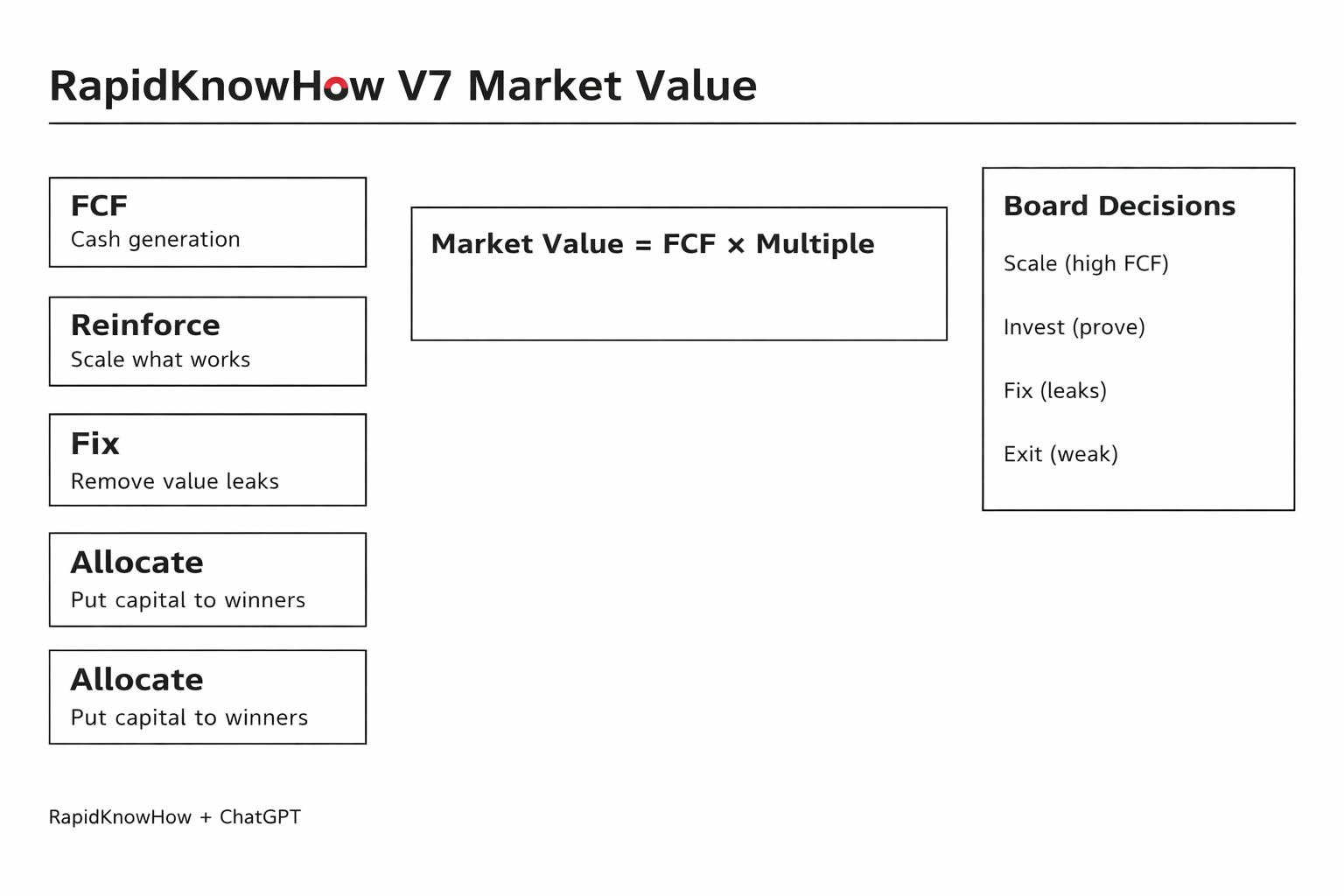
Compounding Leadership is the ability to continuously convert Free Cash Flow (FCF) into higher Market Value through intelligent capital allocation.
At its core, the system is simple:
Market Value = Free Cash Flow × Market Multiple
However, what differentiates leading companies from laggards is not the formula — it is the systematic execution of reinforcing and balancing loops that drive FCF and influence the multiple.
Leaders who master this system do not just grow — they compound value over time.
B) The Core System Architecture
The RapidKnowHow V7 Model is built on four interconnected elements:
1. Free Cash Flow (FCF) – The Foundation
FCF represents real economic performance. It reflects:
- pricing power
- operational efficiency
- capital discipline
Without strong FCF, no sustainable value creation is possible.
2. Reinforcing Loop – Scaling What Works
The reinforcing loop accelerates growth:
- better performance → higher FCF
- higher FCF → more investment
- more investment → even better performance
Examples:
- AI-driven optimization
- pricing improvements
- service differentiation
👉 This is the Virtuous Cycle.
3. Balancing Loop – Fixing What Destroys Value
The balancing loop prevents collapse:
- cost overruns
- inefficiencies
- risk exposure
- working capital leaks
Leaders who ignore this loop enter a Vicious Cycle:
declining FCF → reduced investment → further decline.
👉 The balancing loop protects the system from self-destruction.
4. Capital Allocation – The Strategic Lever
Capital allocation determines where the next euro goes.
The rule is clear:
👉 Allocate capital to the strongest FCF compounding engines.
This requires evaluating each business unit based on:
- FCF level
- growth potential
- execution quality
- risk exposure
The V6 Portfolio Allocator formalizes this into a decision engine:
Score = FCF × (1 + Growth × Quality) × (1 − Risk)
This enables leaders to:
- scale winners
- invest selectively
- fix weak units
- exit non-performing assets
C) The Market Value Engine
Once FCF is optimized and capital is allocated effectively, the final lever is the Market Multiple.
The multiple reflects:
- growth expectations
- risk perception
- strategic positioning
- leadership credibility
👉 The market rewards predictable, scalable, high-quality FCF.
Thus, leadership has two responsibilities:
- Increase FCF
- Earn a higher multiple
When both move in the same direction, value creation becomes exponential.
D) The AI Allocator – From Insight to Action
Traditional management relies on reporting and periodic decision-making.
The RapidKnowHow system introduces a new layer:
👉 AI Allocator Logic
The AI continuously evaluates:
- FCF gaps
- growth strength
- execution quality
- risk exposure
- external shocks
Based on these signals, it recommends:
- increasing growth drivers
- strengthening problem-fixing mechanisms
- reallocating capital
- adjusting risk exposure
This transforms leadership from:
- reactive → proactive
- static → dynamic
- fragmented → systemic
E) Board-Level Decision Framework
The system translates complexity into four clear decisions:
1. Scale
High FCF, strong growth, low risk
→ allocate aggressively
2. Invest Selectively
Solid economics, but execution must prove
→ controlled scaling
3. Fix
Cash leaks or weak loops
→ immediate corrective action
4. Exit
Low compounding potential
→ redeploy capital
👉 This creates clarity at the board level in 15 seconds.
F) The Compounding Effect
The real power of the system emerges over time.
When applied consistently:
- FCF improves
- capital is reallocated to winners
- weak units are corrected or removed
- market confidence increases
- multiples expand
👉 This leads to compounding Market Value growth.
In contrast, traditional systems:
- dilute capital
- tolerate inefficiencies
- react too late
Result: stagnation or decline.
G) Strategic Advantage
Organizations applying this model gain:
1. Speed
Faster identification of value drivers and risks
2. Clarity
Simple, actionable decision framework
3. Focus
Capital flows to highest-return opportunities
4. Resilience
Balancing loop prevents systemic failure
5. Compounding
Sustained value creation over multiple cycles
H) Application in Industrial Gas (Example)
In the Industrial Gas sector, this translates into:
- optimizing pricing and contracts
- improving asset utilization
- managing energy cost exposure
- strengthening service reliability
- reallocating capital to high-ROCE segments
Leaders who master these levers will:
- increase FCF
- improve ROCE
- expand valuation multiples
👉 and dominate the market.
I) Final Insight
Compounding Leadership is not about doing more.
👉 It is about doing the right things repeatedly:
- grow what works
- fix what destroys value
- allocate capital intelligently
J) One-Line Summary
👉 “Grow cash. Allocate better. Multiply value.”
K) CEO Takeaway
If you remember only one thing:
👉 Market Value is not managed directly — it is the outcome of disciplined FCF growth and superior capital allocation.
RapidKnowHow ● Board Growth System V4 – AI Allocator
AI recommendation engine for Reinforcing Loop, Balancing Loop, and Shock Response
A) System Controls
Current Value
Target Value
Growth Rate
Feedback Strength
Balancing Strength
External Shock
Steps
RunVirtuousViciousFixApply AI Allocator
B) Board Diagnosis
System
–
Final Value
–
Gap to Target
–
Loop Dominance
–
Board Action
Run simulation
AI Allocator Recommendation
–
AI Parameter Shift
–
C) Actual vs Target
D) Current Scenario vs AI Allocated Scenario
E) AI Allocator Logic
| Condition | AI Interpretation | Allocator Action |
|---|---|---|
| Large negative gap | System too far below target | Increase balancing + improve growth |
| Negative shock | System under pressure | Neutralize shock + strengthen correction |
| Negative growth or weak feedback | Reinforcing loop too weak | Raise growth / feedback carefully |
| Overshoot risk | Growth may outrun control | Limit feedback + tighten balancing |
RapidKnowHow ● Board Growth System V4 – AI Allocator
A) System Controls
B) Board Diagnosis
C) Actual vs Target
D) Current Scenario vs AI Allocated Scenario
E) AI Allocator Logic
| Condition | AI Interpretation | Allocator Action |
|---|---|---|
| Large negative gap | System too far below target | Increase balancing + improve growth |
| Negative shock | System under pressure | Neutralize shock + strengthen correction |
| Negative growth or weak feedback | Reinforcing loop too weak | Raise growth / feedback carefully |
| Overshoot risk | Growth may outrun control | Limit feedback + tighten balancing |
Grow cash. Allocate better. Multiply value.