Here’s a deep, structured, research-oriented overview of the Habsburg Empire—one of the central political entities in European history, whose complexity has inspired centuries of scholarship.
📌 A) Foundations: Dynasty, Territories, and Structure
1. Origins of the Habsburgs
- The House of Habsburg began as a relatively minor noble family in what is now Switzerland in the late 13th century.
- Its rise was extraordinary: through strategic marriage alliances more than conquest—a policy famously captured in the Latin maxim “Bella gerunt alii, tu felix Austria nube” (“Let others wage war; you, happy Austria, marry”).
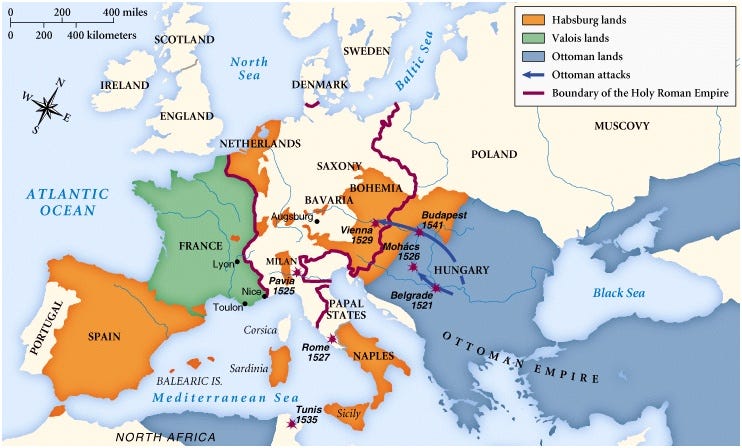
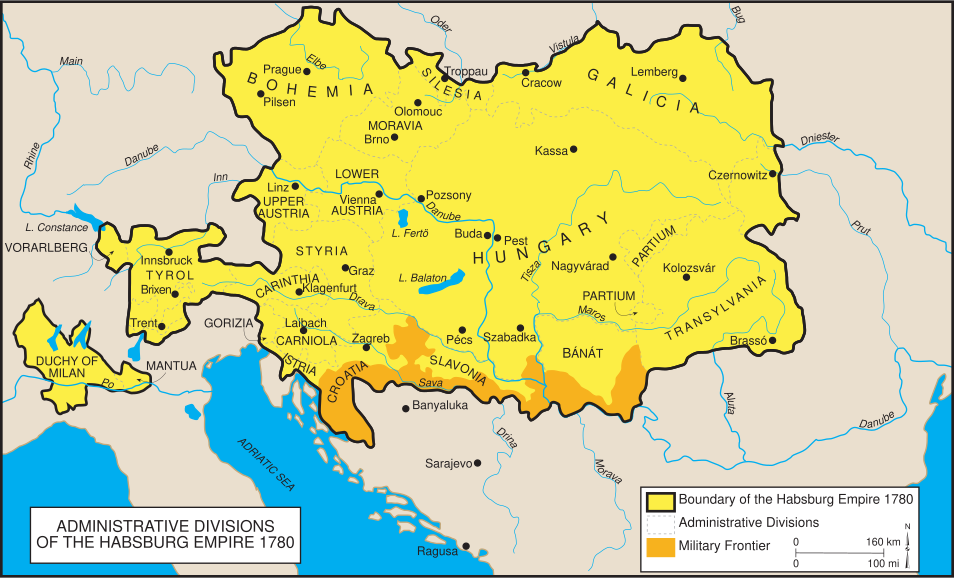
- Expansion peaked as Habsburgs inherited or acquired lands across Central Europe, uniting Austria, Bohemia, Hungary, and more under their rule.
2. Composite Monarchy – Not a Centralized Nation
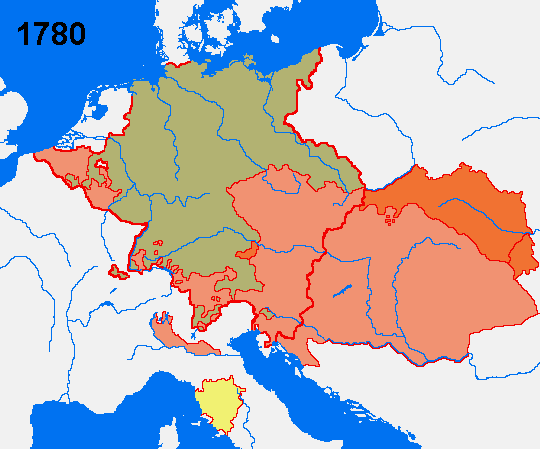
- For much of its existence, what we call the Habsburg Empire was not a single unified state. It was a composite monarchy: a collection of distinct realms, each with its own laws, elites, privileges, and histories, all bound to the dynasty rather than to a single constitutional framework.
- This polycentric structure made governance complex but also flexible in dealing with regional diversity.
3. Holy Roman Empire Connection
- Habsburgs were heavily embedded in the Holy Roman Empire. For centuries, they provided many of its emperors, giving them extensive political clout in Central Europe prior to 1806.
📌 B) Major Eras in Habsburg History
1. Early Expansion: 14th–16th Centuries
- Rudolf I became King of Germany (1273), anchoring Habsburg power in the fragmented Holy Roman Empire.
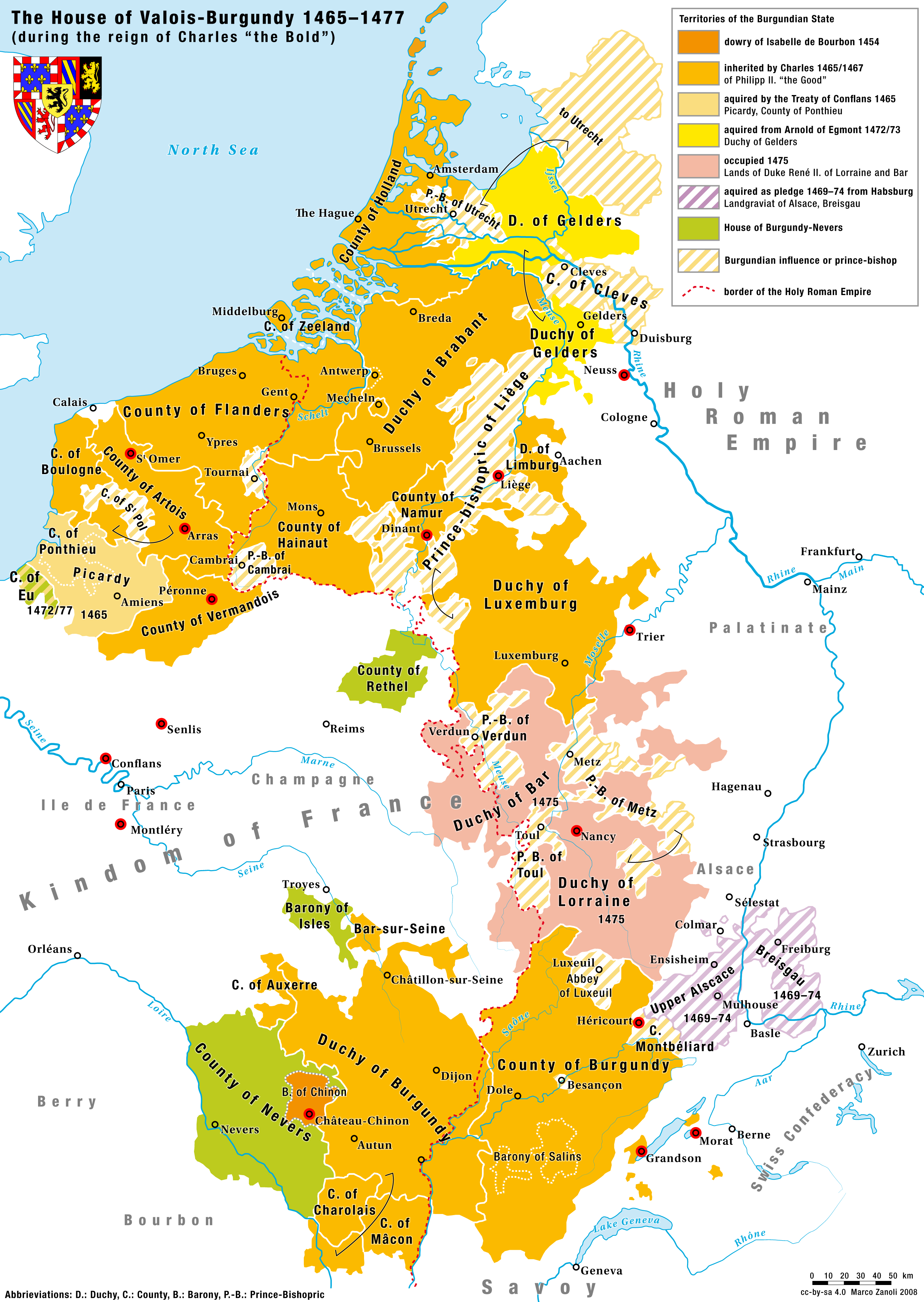
- By inheritance and diplomacy in the 14th–15th centuries, they secured territories like Kärnten, Tirol, and Burgundy, expanding influence across Europe.
- The 1526 Habsburg accession to the crowns of Bohemia and Hungary after the Battle of Mohács marks the consolidation of Eastern and Western Habsburg lands—a key moment frequently used as a starting point for empire histories.
2. Religious Wars and the Reformation
- The Habsburgs became staunch defenders of Catholicism during the Reformation and Counter-Reformation, enmeshing religious conflict with political rule.
3. Baroque & Enlightened Absolutism
- The 17th–18th centuries saw both cultural flourishing and state reform. Think expansive palaces (like Schönbrunn) and sustained military engagement against the Ottomans.
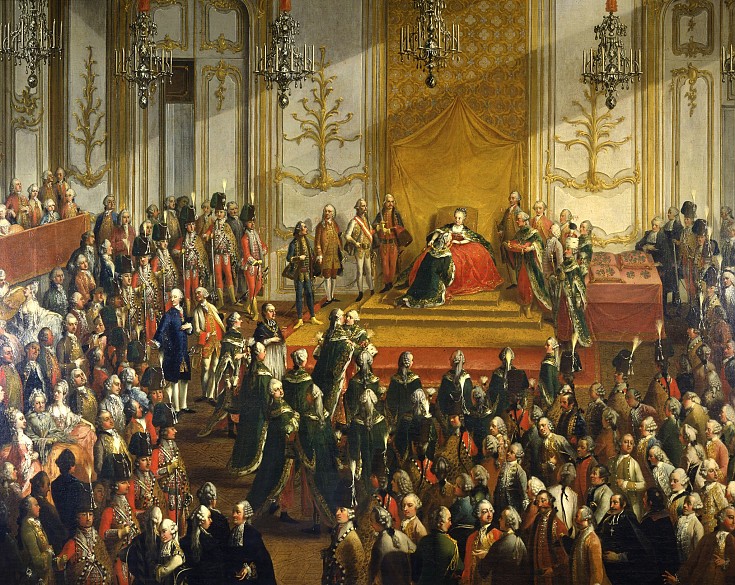
- Reformist rulers like Maria Theresa and Joseph II pursued administrative modernization, centralized taxation, and legal overhaul—but often met resistance from local elites.
4. Austrian Empire and the 19th Century
- In 1804, with Napoleon reshaping Europe, Francis II declared the Austrian Empire (Kaisertum Österreich) to anchor Habsburg sovereignty even as the Holy Roman Empire collapsed (1806).
- The 1867 Ausgleich created the Austro-Hungarian Dual Monarchy, recognizing Hungary as an equal partner but keeping other lands under joint rule.
5. World War I and Dissolution
- Nationalist movements, ethnic tensions, and the pressures of warfare ultimately unraveled the imperial structure. After defeat in 1918, Emperor Karl I dissolved the monarchy and various national states emerged from the former empire’s territories.
📌 C) Themes and Debates in Modern Research
1. Empire or Monarchy?
- Historians debate whether the term “empire” applies: Habsburg leadership rarely used traditional imperial rhetoric outside short periods (1804–1867), and its territorial cohesion was limited by design—partly why some scholars call it a composite monarchy rather than a classical empire.
2. Nationalism, Modernization, and the State
- Traditional views saw Habsburg decline as inevitable under rising nationalism. Recent scholarship (e.g., Pieter Judson’s work) challenges this, suggesting the monarchy had significant potential for political modernization and was less doomed than often claimed.
- Contemporary debates engage how the regime managed ethnic diversity, governance across territories, and cultural integration.
3. Legacy and Historiography
- The Habsburg Empire’s legacy remains central to understanding Central European identity, border formations, and multilingual societies in the modern era. Its complexity continues to provoke deep academic inquiry.
📌 D) Key Facts
- Duration: ~1282–1918 as a ruling dynasty; empire configurations from 1526 (broad rule) to 1918 (formal empire dissolved).
- Capital: Vienna
- State Type: Dynastic monarchy evolving into empire and dual monarchy (post-1867).
- Diversity: Multi-ethnic (Germans, Hungarians, Czechs, Slovaks, Croats, Italians, Poles, Romanians, Slovenes, Serbs, Ukrainians, and more).
- Fall: End of World War I; successor states include Austria, Hungary, Czechoslovakia (later Czech Republic and Slovakia), Yugoslavia (later Balkan states), and parts of Poland and Romania.
📌 E) Recommended Deep Academic Sources
To go even deeper academically:
- Pieter M. Judson, The Habsburg Empire: A New History (Harvard UP, 2016) — major contemporary reinterpretation.
- Robert A. Kann, History of the Habsburg Empire (University of California Press) — classic political and cultural analysis.
- Steven Beller, The Habsburg Monarchy 1815–1918 — detailed 19th-century focus.
Comparing Personalities, Goals and Assess Achievements of Habsburg Rulers from the Beginning to 1918
Here is your deep, structured RapidKnowHow comparative analysis of Habsburg rulers — focusing on Personality → Goals → Achievements → Strategic Assessment across the full arc (from rise to collapse).
🏰 HABSBURG RULERS: PERSONALITY • GOALS • ACHIEVEMENTS (1273–1918)
RapidKnowHow Deep Comparative Research
A) THE FOUNDERS & EXPANSIONISTS (1273–1526)
→ Build Power through Survival + Marriage Strategy
1. Rudolf I of Habsburg


Personality
- Pragmatic, opportunistic, disciplined power-builder
Goals
- Secure dynastic survival
- Gain territorial base (Austria core)
Achievements
- Became King of Germany (1273)
- Acquired Austria → foundation of Habsburg power
Strategic Assessment
✅ SUCCESS: Established the power base model
➡️ From minor noble → ruling dynasty
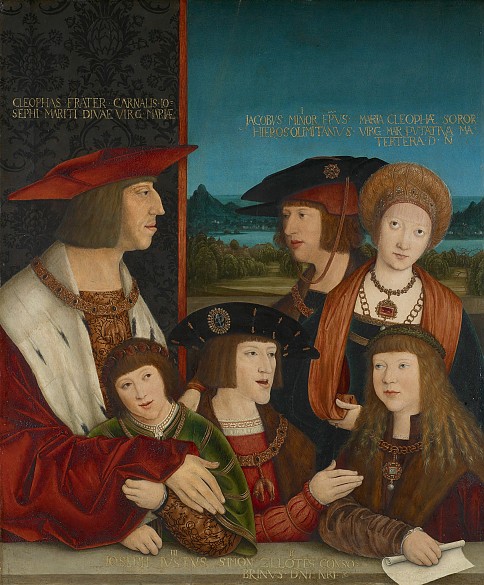
2. Maximilian I, Holy Roman Emperor

Personality
- Visionary, charismatic, risk-taking strategist
Goals
- Expand influence across Europe
- Use marriage instead of war
Achievements
- Marriage alliances → Burgundy, Spain
- Positioned Habsburgs as European superpower
Strategic Assessment
✅ MASTERSTROKE: Invented the “Marriage Empire Model”
➡️ Highest ROICE in dynastic history
3. Charles V, Holy Roman Emperor


Personality
- Burdened, dutiful, deeply religious
Goals
- Maintain universal Christian empire
- Contain Reformation
Achievements
- Ruled largest empire of his time (Europe + Americas)
- Failed to unify religiously
Strategic Assessment
⚠️ OVERSTRETCH FAILURE
➡️ Empire too complex → fragmentation inevitable
B) CONSOLIDATORS & DEFENDERS (1526–1740)
→ Defend Empire vs Ottomans + Internal Stability
4. Ferdinand II, Holy Roman Emperor


Personality
- Dogmatic, authoritarian, religious zealot
Goals
- Enforce Catholic unity
- Strengthen imperial authority
Achievements
- Won key phases of Thirty Years’ War
- Devastated Central Europe
Strategic Assessment
⚠️ PYRRHIC SUCCESS
➡️ Won war phases, lost long-term stability
5. Leopold I, Holy Roman Emperor


Personality
- Patient, resilient, conservative
Goals
- Defend Europe from Ottomans
- Maintain dynastic continuity
Achievements
- Victory after Siege of Vienna (1683)
- Expansion into Hungary
Strategic Assessment
✅ DEFENSIVE SUCCESS
➡️ Secured Central Europe
C) REFORMERS & MODERNISERS (1740–1815)
→ Transform Empire into State
6. Maria Theresa

Personality
- Strong, pragmatic, maternal authority
Goals
- Preserve empire after crisis
- Modernize administration
Achievements
- Centralized bureaucracy
- Strengthened army + taxation
Strategic Assessment
✅ TURNAROUND LEADER
➡️ Saved empire from collapse
7. Joseph II, Holy Roman Emperor


Personality
- Idealistic, impatient, radical reformer
Goals
- Enlightenment reforms
- Rational, centralized state
Achievements
- Abolished serfdom
- Religious tolerance
Strategic Assessment
⚠️ OVER-REFORM FAILURE
➡️ Too fast → backlash → partial rollback
D) SURVIVAL IN THE AGE OF NATIONALISM (1815–1867)
→ Hold Empire Together
8. Francis I of Austria


Personality
- Conservative, cautious, risk-averse
Goals
- Maintain order
- Prevent revolution
Achievements
- Stability after Napoleon
- Supported Metternich system
Strategic Assessment
⚠️ STABILITY WITHOUT INNOVATION
➡️ Delayed decline
9. Franz Joseph I of Austria
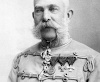
Personality
- Duty-driven, rigid, disciplined
Goals
- Preserve empire unity
- Manage nationalism
Achievements
- Austro-Hungarian Compromise (1867)
- Long-term stability
Strategic Assessment
⚠️ PARTIAL SUCCESS / STRATEGIC FAILURE
➡️ Stabilized short-term, failed long-term integration
E) THE FINAL RULER (1916–1918)
→ Too Late Reform Attempt
10. Charles I of Austria


Personality
- Ethical, peace-oriented, inexperienced
Goals
- End World War I
- Reform empire into federation
Achievements
- Attempted peace negotiations
- Failed to stop collapse
Strategic Assessment
❌ TOO LITTLE, TOO LATE
➡️ Structural collapse unstoppable
🧠 B) STRATEGIC META-ANALYSIS (RapidKnowHow Insight)
1. Evolution Pattern
| Phase | Strategy | Outcome |
|---|---|---|
| Rise | Marriage & alliances | Explosive expansion |
| Peak | Universal empire | Overstretch |
| Defense | Religion & war | Stabilization |
| Reform | Centralization | Mixed success |
| Decline | Delay & compromise | Collapse |
2. Winning vs Losing Leadership Patterns
✅ Winning Leaders
- Rudolf I → Foundation
- Maximilian I → Expansion model
- Maria Theresa → Turnaround
👉 Pattern:
Pragmatic + adaptive + timing right
⚠️ Mixed Leaders
- Charles V → Overstretch
- Joseph II → Over-reform
- Franz Joseph → Delay strategy
👉 Pattern:
Right vision, wrong execution speed
❌ Failing Endgame
- Charles I
👉 Pattern:
Correct strategy but no time + weak system
⚡ C) FINAL INSIGHT (Feynman Style)
👉 “Empires don’t collapse because they lack power — they collapse when leadership fails to adapt the system to rising complexity.”
🚀 D) RAPIDKNOWHOW STRATEGIC LESSONS
1. Growth Strategy
- Use low-cost expansion (marriage model) instead of war
✔️ Applicable: M&A, partnerships, ecosystems
2. Complexity Management
- Avoid overstretch (Charles V problem)
✔️ Build modular, federated systems
3. Reform Speed
- Balance speed vs resistance
✔️ Joseph II mistake = too fast
4. Survival Strategy
- Short-term stability ≠ long-term success
✔️ Franz Joseph lesson
5. Endgame Rule
- Reform before crisis, not during
✔️ Charles I = too late
Habsburg rulers from rise to 1918
The Habsburgs ruled Austria from 1282 to 1918, added Bohemia and Hungary in 1526, and from 1867 to 1918 governed Austria-Hungary as a Dual Monarchy. Modern scholarship also stresses that this was not a simple nation-state but a layered, composite monarchy that had to manage diversity, local privileges, and rising nationalism.
Personality = style of rule
- Goal = strategic objective
- Achievement = what was actually delivered
- Assessment = net legacy
Top rulers, compressed into one board view
Rudolf I
Personality: pragmatic founder.
Goal: secure a territorial base.
Achievement: became German king in 1273 and established the Habsburg position that led to Austrian rule from 1282 onward.
Assessment: foundational success.
Maximilian I
Personality: ambitious, theatrical, strategic.
Goal: expand through dynastic leverage rather than constant war.
Achievement: marriage alliances helped bring Burgundy and later Spain into the wider Habsburg orbit.
Assessment: highest expansion efficiency.
Charles V
Personality: dutiful, universalist, heavily burdened.
Goal: hold together a Christian world monarchy.
Achievement: presided over an immense transcontinental empire, but could not resolve the Reformation or sustain durable cohesion.
Assessment: peak power, peak overstretch.
Maria Theresa (1740–1780)
Personality: resilient, practical, state-building.
Goal: preserve the monarchy after succession crisis and strengthen it internally.
Achievement: major military, fiscal, and administrative reforms; she is widely treated as one of the most consequential Habsburg rulers.
Assessment: turnaround leader.
Joseph II (sole ruler 1780–1790)
Personality: restless, rationalist, impatient reformer.
Goal: create a more centralized and enlightened state.
Achievement: pushed reforms on religion, administration, and serfdom, but generated strong resistance and partial rollback.
Assessment: strong intent, weak political pacing.
Franz Joseph I
Personality: disciplined, dutiful, conservative.
Goal: preserve imperial unity in the age of nationalism.
Achievement: reigned from 1848 to 1916 and accepted the 1867 Ausgleich, which gave Hungary equal status within Austria-Hungary.
Assessment: short-term stabilizer, long-term non-solver.
Charles I
Personality: ethical, conciliatory, peace-oriented.
Goal: end the war and federalize the empire before total collapse.
Achievement: made secret peace efforts and in October 1918 proposed transforming Austria into a federal union, but the monarchy collapsed weeks later.
Assessment: too late.
Executive verdict
- The dynasty won when it was adaptive, indirect, and opportunistic.
- It weakened when scale and diversity outran governance capacity.
- It failed at the end because reform came during systemic breakdown, not before it.
One-line insight
The Habsburg system created extraordinary dynastic reach, but its rulers increasingly struggled to convert inherited diversity into a durable political model.
Habsburg Empire V2: Personality, Goals, Achievements
Objective: Compare major Habsburg rulers and test which leadership style builds, stabilises, reforms, or weakens a multi-ethnic empire.
Foundation = 20 points
Expansion = 20 points
Reform = 20 points
Cohesion = 20 points
Endurance = 20 points
High score = adaptive ruler
Mid score = mixed ruler
Low score = overstretch or late reform
Rudolf I
Personality:
Goal:
Achievement:
Assessment:
Total Score: /100
Self-Test
Which leadership style is strongest for a complex empire?
🏰 HABSBURG EMPIRE: PERSONALITY • GOALS • ACHIEVEMENTS (1273–1918)
RapidKnowHow POWERPOST – MASTER EDITION
🅰️ WHY IT MATTERS (Feynman Clarity)
👉 “The Habsburg Empire proves that power can build an empire — but only adaptive leadership can sustain it.”
🎯 CORE QUESTION
Why did one of Europe’s most powerful dynasties rise for 600 years — and then collapse in 4 years (1914–1918)?
⚡ THE SIMPLE ANSWER
- Rise = Smart, low-cost expansion + adaptability
- Fall = High complexity + slow/late adaptation
🅱️ WHAT HAPPENED (THE 5 PHASE SYSTEM)
1. FOUNDATION (1273–1500)
Key Leader: Rudolf I of Habsburg
- Built power base (Austria)
- Strategy: Survival + opportunism
✅ Result: Strong foundation
2. EXPANSION (1500–1556)
Key Leader: Maximilian I, Holy Roman Emperor
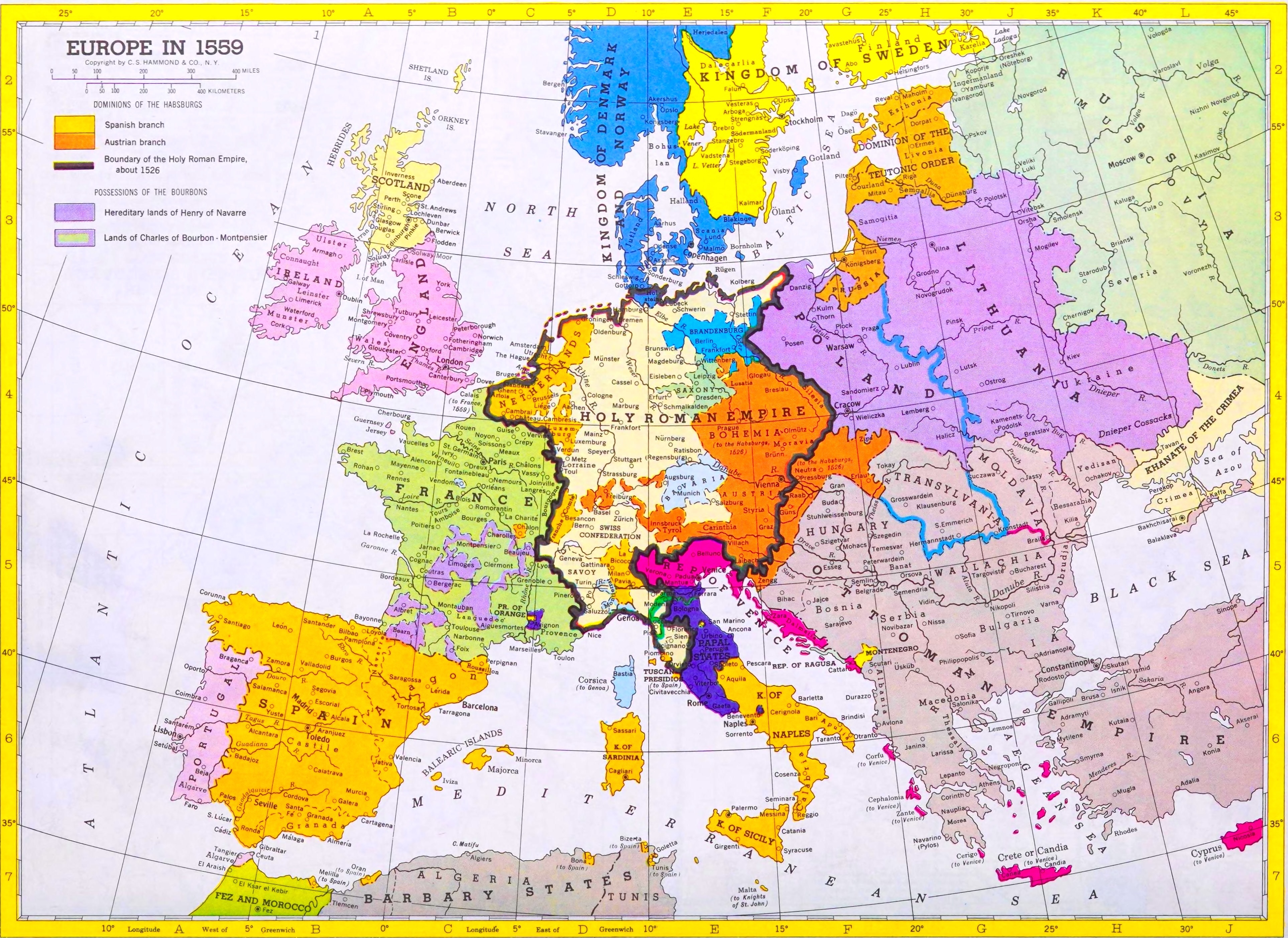
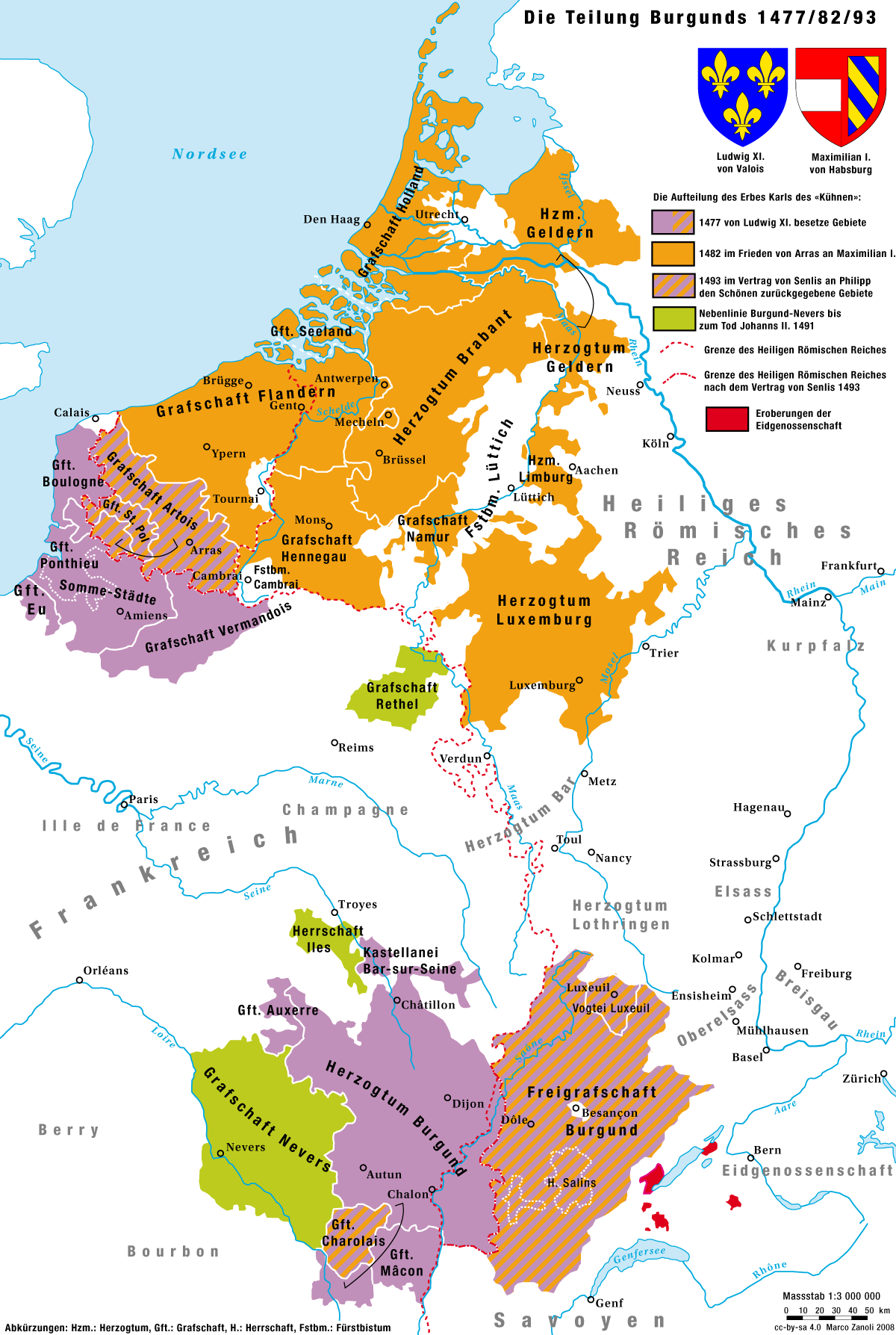
- Used marriage strategy instead of war
- Expanded into Spain, Burgundy
🚀 Result: Maximum expansion at minimum cost
3. OVERSTRETCH (1556–1700)
Key Leader: Charles V, Holy Roman Emperor
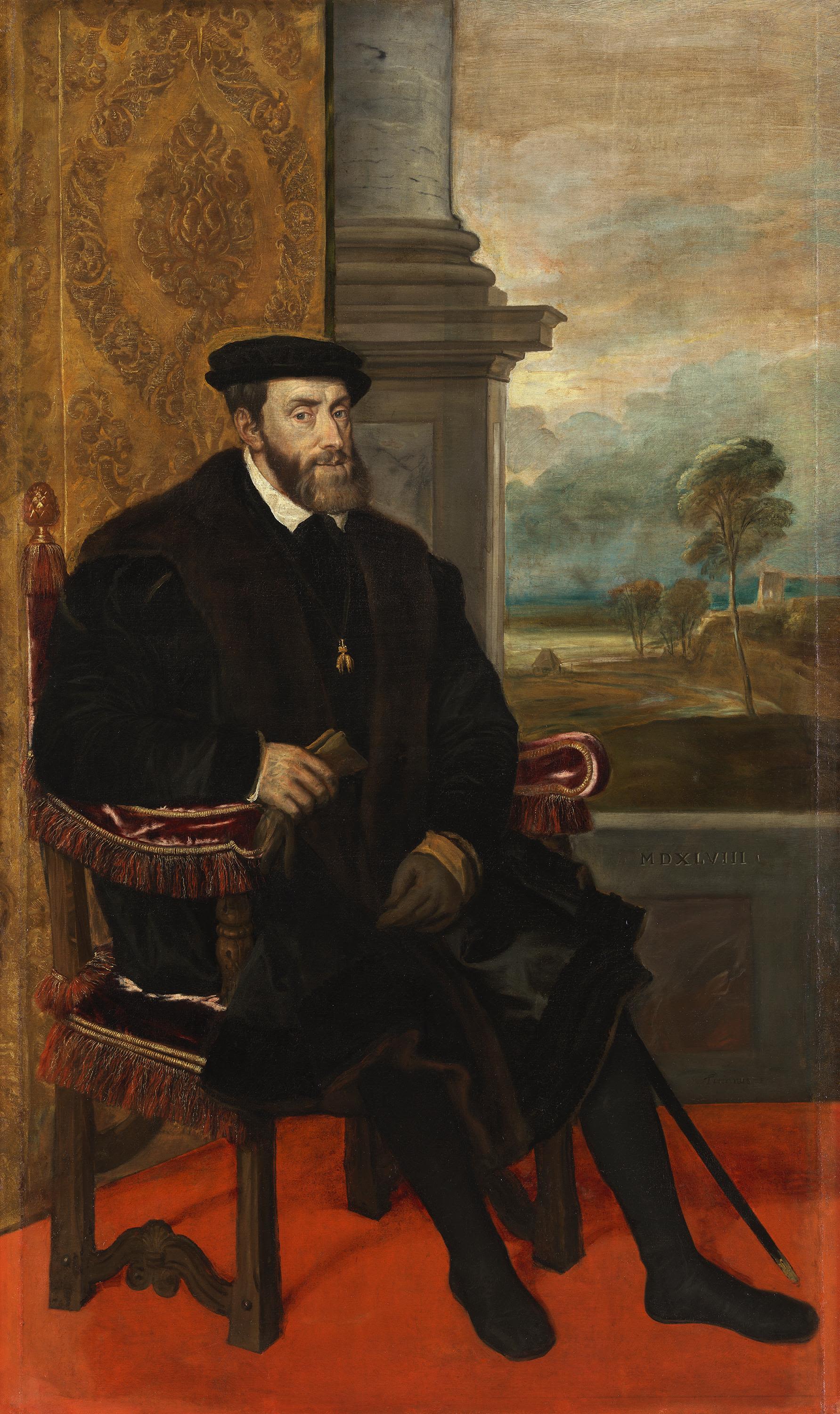

- Built largest empire in Europe
- Tried to control religion + politics
⚠️ Result: Too complex → fragmentation
4. REFORM & STABILISATION (1700–1867)
Key Leaders:
- Maria Theresa
- Joseph II, Holy Roman Emperor
- Modernised administration, army, taxation
- Tried Enlightenment reforms
⚖️ Result: Mixed success
- Maria Theresa → ✅ Balanced reform
- Joseph II → ⚠️ Too fast
5. DECLINE & COLLAPSE (1867–1918)
Key Leaders:
- Franz Joseph I of Austria
- Charles I of Austria
- Dual monarchy = partial solution
- Rising nationalism ignored
❌ Result: Collapse after WWI
🅲 INSIGHTS & STRATEGIC LESSONS
⚡ THE 5 WIN / FAIL RULES
✅ 1. INDIRECT STRATEGY WINS
- Maximilian: marriage > war
👉 Today: partnerships > costly expansion
⚠️ 2. OVERSTRETCH KILLS
- Charles V: too big, too complex
👉 Today: scaling without systems fails
⚖️ 3. REFORM SPEED = CRITICAL
- Maria Theresa: right pace → success
- Joseph II: too fast → resistance
⚠️ 4. STABILITY ≠ SOLUTION
- Franz Joseph: delayed problems
👉 Today: short-term fixes hide long-term risk
❌ 5. TOO LATE = GAME OVER
- Charles I: correct strategy, wrong timing
🧠 FINAL CEO TRUTH
👉 “Every system collapses when complexity grows faster than its ability to adapt.” – Josef David
🚀 RAPIDKNOWHOW APPLICATION (BUSINESS / POLITICS / LIFE)
USE THIS MODEL
| Situation | Apply Habsburg Lesson |
|---|---|
| Scaling business | Avoid Charles V overstretch |
| Entering markets | Use Maximilian partnerships |
| Transforming org | Use Maria Theresa pacing |
| Managing crisis | Act BEFORE collapse |
| Leading long-term | Build adaptive systems |
🔥 FINAL STRATEGIC SNAPSHOT
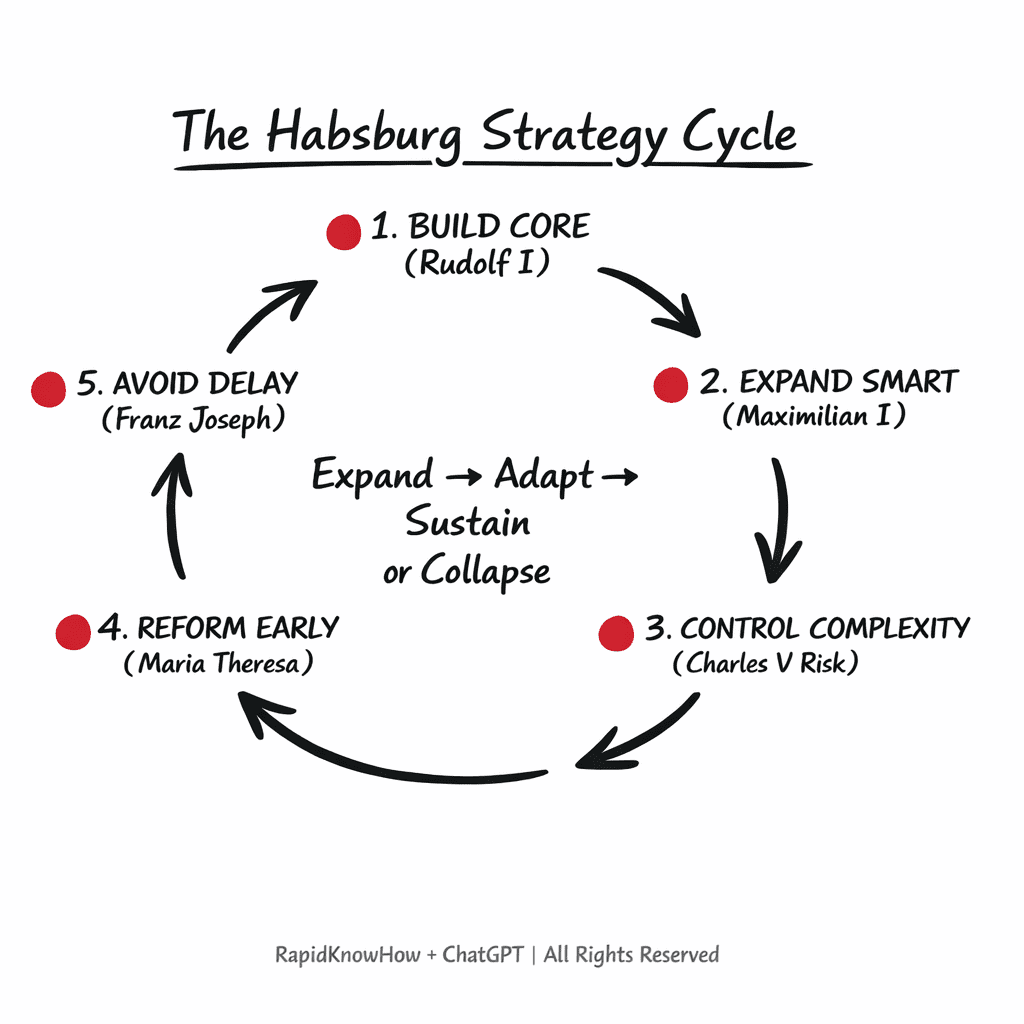
- Build smart (Rudolf)
- Expand smart (Maximilian)
- Avoid overload (Charles V)
- Reform smart (Maria Theresa)
- Act early (before 1918 moment)