A) ACTION GUIDE — PURPOSE
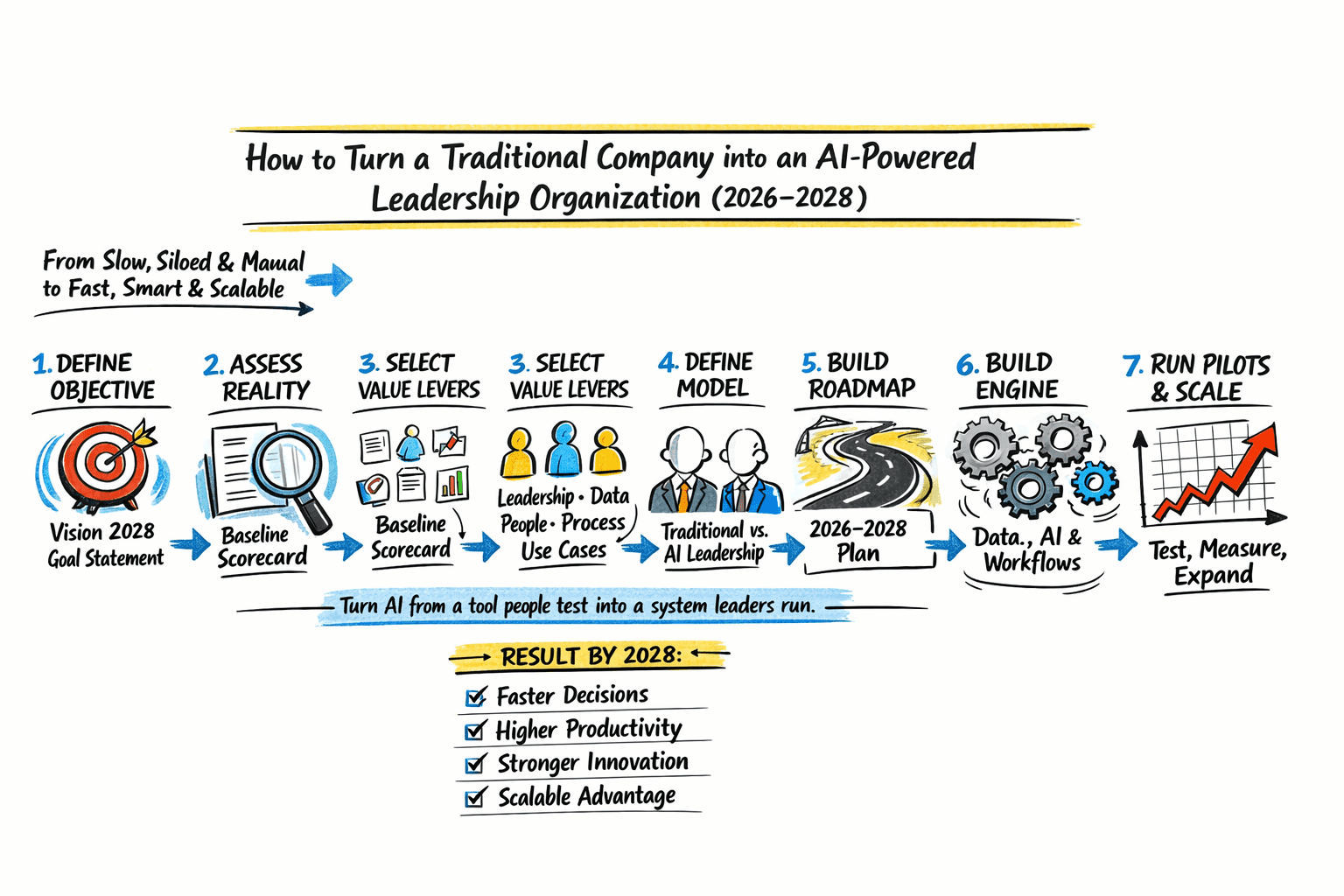
How to Turn a Traditional Company into an AI-Powered Leadership Organization (2026–2028)
This guide is about moving from:
- slow decisions
- silo thinking
- manual work
- reactive management
to:
- faster decisions
- AI-supported leadership
- smarter workflows
- stronger innovation
- scalable execution
Feynman sentence:
Turn AI from a tool people test into a system leaders run.
B) THE STEP-BY-STEP ACTION GUIDE
STEP 1 — DEFINE THE TRANSFORMATION OBJECTIVE
First, make the objective concrete.
Ask:
- What must be different by the end of 2028?
- What leadership capability must improve?
- What business result must become visible?
- Why does this matter now?
Write one transformation statement:
“By 2028, we will become an AI-powered leadership organization that makes faster decisions, runs smarter processes, and creates higher value through people + data + AI.”
Action:
- align CEO and leadership team on one sentence
- define 3 outcomes only
- communicate the reason for change
Output:
Transformation Objective 2028
STEP 2 — ASSESS THE CURRENT COMPANY REALITY
Do not start with AI tools. Start with reality.
Assess:
- leadership mindset
- decision speed
- data quality
- process efficiency
- digital maturity
- employee skills
- current use of AI
- governance and risk readiness
Use a simple scoring model:
- 1 = weak
- 2 = developing
- 3 = usable
- 4 = strong
- 5 = leading
Action:
- score each function
- identify the 5 biggest bottlenecks
- identify the 3 strongest starting points
Output:
Baseline Scorecard 2026
STEP 3 — CHOOSE THE 5 PRIORITY VALUE LEVERS
Do not try to transform everything at once.
Focus on 5 levers:
1. Leadership
Can leaders think and act with AI?
2. Data
Is core data usable for decisions?
3. People
Do employees know how to work with AI?
4. Processes
Which workflows can be automated or improved?
5. Use Cases
Where can AI create fast value?
Action:
- rank the 5 levers from highest to lowest impact
- choose 2 levers for immediate focus
- assign one owner for each lever
Output:
AI Transformation Value Map
STEP 4 — DEFINE THE AI LEADERSHIP MODEL
This is the most important shift.
A traditional company is managed by hierarchy.
An AI-powered leadership organization is led by:
- insight
- data
- systems
- faster learning
- better execution
Define what leaders must do differently:
Traditional leader
- asks for reports
- waits for meetings
- decides late
- manages functions
AI-powered leader
- uses live signals
- works with AI copilots
- decides faster
- leads across functions
- scales what works
Action:
- define the new leadership behaviors
- train top 20 leaders first
- build one AI leadership standard for all managers
Output:
AI Leadership Model
STEP 5 — BUILD THE 2026–2028 ROADMAP
Use 3 phases only.
PHASE 1 — 2026: ASSESS + PILOT
Objective:
- create clarity
- test value quickly
- reduce fear
- prove usefulness
Actions:
- define 10 top use cases
- launch 3 pilots
- train leadership team
- create AI governance basics
- identify quick wins
Expected result:
- first productivity gains
- first decision-support gains
- visible management confidence
PHASE 2 — 2027: BUILD + INTEGRATE
Objective:
- connect pilots to workflows
- build data + AI capability
- move from isolated use to structured use
Actions:
- strengthen data foundation
- integrate AI into daily workflows
- train managers and key teams
- define standards, roles, controls
- expand successful pilots
Expected result:
- broader adoption
- smarter process flow
- better coordination across functions
PHASE 3 — 2028: SCALE + LEAD
Objective:
- turn capability into leadership advantage
- make AI part of the operating model
- create visible business superiority
Actions:
- scale winning use cases across the company
- build AI-supported decision dashboards
- measure value by function
- align culture, incentives, and leadership rhythm
- communicate success internally and externally
Expected result:
- AI-powered leadership becomes normal
- company acts faster and smarter than before
- market sees a stronger, more adaptive organization
Output:
3-Year Transformation Roadmap
STEP 6 — BUILD THE AI ENGINE
The engine is not one tool.
It is the combination of:
- data
- workflows
- people
- AI tools
- governance
- leadership routines
Build 6 engine blocks:
1. Data block
Reliable, accessible, decision-relevant data
2. Use case block
Clear business problems AI can solve
3. Workflow block
Processes where AI saves time or improves quality
4. People block
Employees who know how to use AI correctly
5. Governance block
Rules for security, ethics, compliance, accuracy
6. Leadership block
Managers who drive adoption and accountability
Action:
- define owner for each block
- measure monthly progress
- remove friction fast
Output:
AI Operating Engine
STEP 7 — RUN PILOTS THAT MATTER
Choose pilots with visible business value.
Good pilot areas:
- customer service
- sales support
- pricing analysis
- procurement
- finance reporting
- knowledge management
- quality control
- leadership dashboards
Use this rule:
High pain + high frequency + measurable gain = strong pilot
Action:
For each pilot define:
- problem
- current cost or delay
- AI-supported solution
- owner
- timeline
- KPI
- scaling decision
Output:
Pilot Portfolio
STEP 8 — TRAIN LEADERS FIRST, THEN TEAMS
Transformation fails when leaders delegate AI to IT.
Start at the top.
Train leaders in:
- AI thinking
- good prompting
- decision support
- risk awareness
- workflow redesign
- performance interpretation
Then train teams in:
- practical AI use
- role-specific workflows
- quality control
- escalation rules
Action:
- create one executive learning sprint
- create one manager playbook
- create one frontline AI-use guide
Output:
AI Capability Program
STEP 9 — CHANGE THE OPERATING RHYTHM
The company must not only have AI.
It must run differently.
Create a new rhythm:
Weekly
- review signals
- review pilot progress
- remove barriers
Monthly
- assess KPI improvement
- decide scale / stop / improve
- share best practices
Quarterly
- review leadership maturity
- review value creation
- refresh roadmap priorities
Action:
- install AI review in leadership meetings
- make adoption measurable
- make scaling decisions faster
Output:
AI Leadership Rhythm
STEP 10 — MEASURE VALUE THE CEO CAN SEE
If value is vague, support dies.
Track CEO-level metrics:
- decision speed
- process time saved
- labor productivity
- cost reduction
- quality improvement
- innovation output
- customer value
- revenue support
- employee adoption
- leadership usage
Action:
Create one dashboard with:
- 5 KPI only for CEO
- 5 KPI for operational leaders
- pilot-by-pilot value tracking
Output:
AI Value Dashboard
STEP 11 — SCALE WHAT WORKS
Do not scale experiments.
Scale proven value.
Scale only when:
- KPI improved
- users trust it
- workflow is stable
- governance is clear
- ownership is assigned
Action:
- stop weak pilots
- standardize strong pilots
- roll out by function or geography
- communicate results visibly
Output:
Scaling Plan
STEP 12 — BECOME AN AI-POWERED LEADERSHIP ORGANIZATION
You have arrived when:
- leaders use AI in decision-making
- teams use AI in daily workflows
- the company learns faster
- data supports action
- strong use cases scale
- leadership becomes more adaptive
- business value is visible
At this point AI is no longer a project.
It is part of how the company leads.
Output:
AI-Powered Leadership Organization 2028
C) SIMPLE 2026–2028 MASTER FLOW
2026
Define → Assess → Pilot
2027
Build → Train → Integrate
2028
Scale → Lead → Differentiate
C) EXECUTIVE 1-PAGE VERSION
Goal:
Turn a traditional company into an AI-powered leadership organization by 2028.
The path:
- Define the objective
- Assess reality
- Select value levers
- Define leadership model
- Build roadmap
- Build engine
- Run pilots
- Train leaders and teams
- Change operating rhythm
- Measure value
- Scale what works
- Lead with AI
Expected result by 2028:
- faster decisions
- higher productivity
- better innovation
- stronger leadership
- scalable business advantage
C) FINAL SENTENCE
An AI-powered leadership organization is a company where leaders, teams, data, and workflows work as one intelligent system.
HOW TO TURN A TRADITIONAL COMPANY INTO AN AI-POWERED LEADERSHIP ORGANIZATION
The Step-by-Step Guide
Create one clear transformation statement for 2028.
Action: Align CEO and leadership team on one sentence and 3 outcomes only.
Score leadership, data, skills, process efficiency, AI use, and governance.
Action: Identify the 5 biggest bottlenecks and the 3 strongest starting points.
Focus on leadership, data, people, processes, and use cases.
Action: Rank the 5 levers and choose 2 for immediate focus.
Move from slow functional management to AI-supported cross-functional leadership.
Action: Define the new leadership behaviors and train the top 20 leaders first.
Use 3 phases: 2026 assess + pilot, 2027 build + integrate, 2028 scale + lead.
Action: Define major milestones, owners, and expected results per year.
Create the engine using data, workflows, people, AI tools, governance, and leadership routines.
Action: Assign one owner for each engine block and track progress monthly.
Select pilots with high pain, high frequency, and measurable gain.
Action: Define problem, owner, KPI, timeline, and scaling decision for each pilot.
Start with leadership, then expand to managers and operational teams.
Action: Build one executive sprint, one manager playbook, and one frontline guide.
Install weekly, monthly, and quarterly AI leadership reviews.
Action: Review signals, KPI progress, barriers, and scaling decisions regularly.
Track decision speed, productivity, quality, innovation, customer value, and adoption.
Action: Create one simple CEO dashboard and one operational KPI dashboard.
Scale only proven value, not experiments.
Action: Stop weak pilots, standardize strong ones, and roll out by function or geography.
Make AI part of how the company leads, decides, learns, and scales.
Action: Embed AI into leadership routines, workflows, and performance management.
2027: Build → Train → Integrate
2028: Scale → Lead → Differentiate