From AI-User → AI-Co-Creator → AI-Orchestrator – Step-by-Step
1. Executive Summary
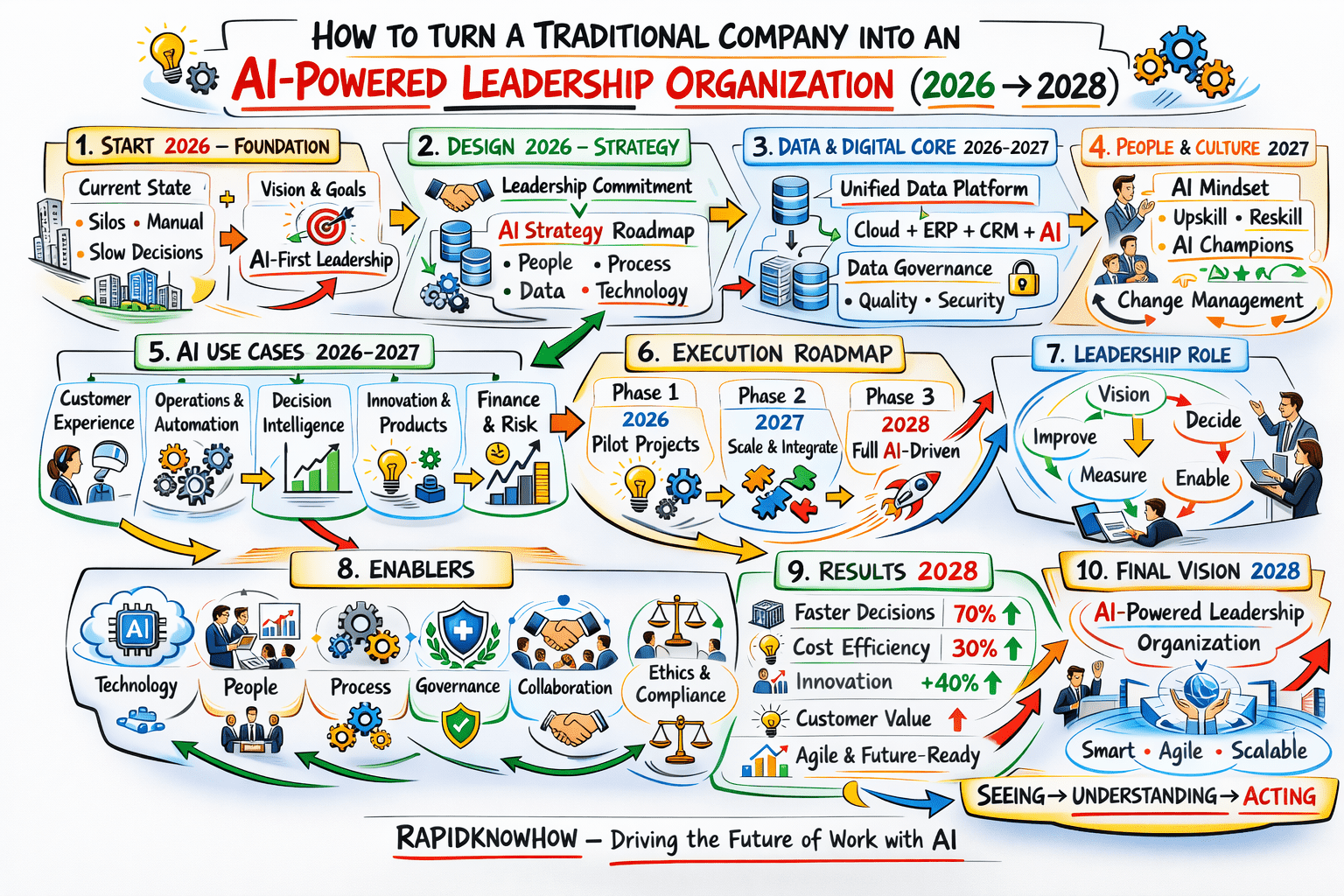
2026 is the turning point where AI is no longer a tool – it is an infrastructure.
Leaders who stay at “AI as a gadget” level will get outpaced by those who design AI-powered systems.
This Power Report gives you a clear, practical path:
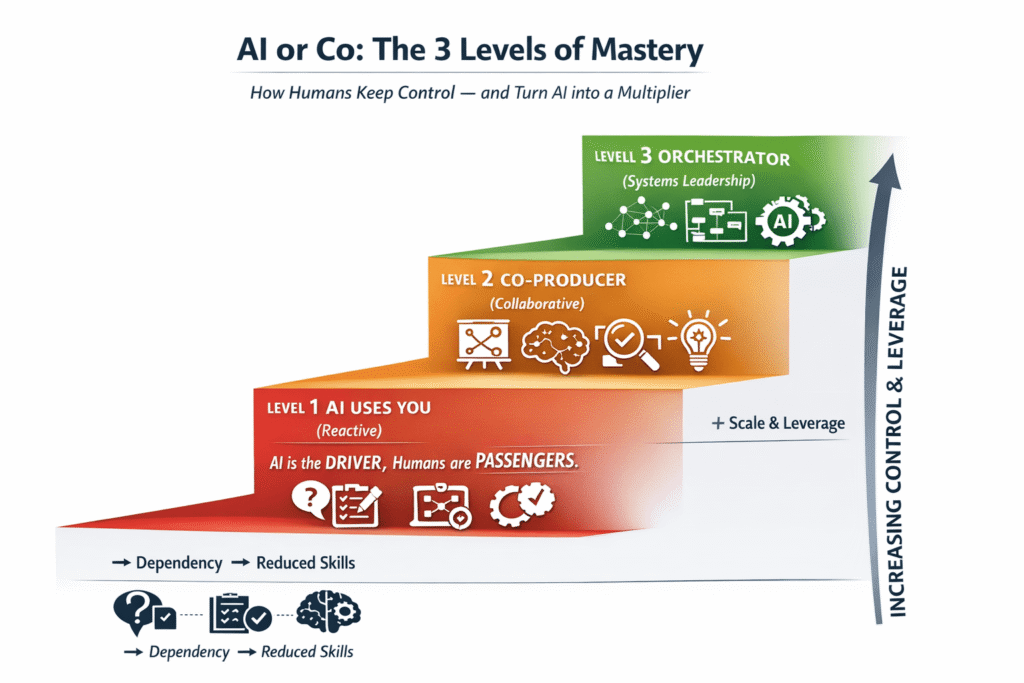
- AI-User (Consumer Mode) – AI uses you. You consume answers. Zero leverage.
- AI-Co-Creator (Co-Producer Mode) – you and AI work together. You guide, critique, improve.
- AI-Orchestrator (System Mode) – you design workflows, assets, and governance that scale.
Core Principle
Consumers react to AI. Co-Creators guide AI. Orchestrators design and own AI-powered systems.
Your mission as an AI-Leader in 2026:
Move yourself and your organization along this ladder – deliberately, fast, and with governance.
2. Why AI-Leadership Matters in 2026
- Speed: Strategy cycles compress from years → months → weeks.
- Complexity: Data, stakeholders, and risks grow exponentially.
- Scarcity: Talent and attention are limited – systems win, solo heroes don’t.
- Power: Those who own AI-enhanced processes and IP capture disproportionate value.
AI-Leadership is no longer about knowing which tools exist. It is about:
- Where you insert AI in the value chain
- How you govern outputs and risks
- Which assets and systems you build that others do not have
3. The RapidKnowHow AI-Leadership Ladder
Overview
| Level | Role Name | Who Leads? | Value Creation | Replaceability |
|---|---|---|---|---|
| 1 | AI-User | AI | Near zero | High |
| 2 | AI-Co-Creator | You + AI | Moderate / rising | Medium |
| 3 | AI-Orchestrator | You (with system) | High / compounding | Low |
Your objective is to climb this ladder and bring your key people with you.
4. Level 1 – The AI-User (Consumer Mode)
4.1 Definition
You consume whatever AI gives you.
AI is essentially a smarter search engine for you – nothing more.
Typical behaviours
- Ask generic questions
- Copy/paste output into slides or emails
- Little validation, no iteration
- No templates, no documentation, no IP
4.2 Risks
- No ownership – the know-how lives in the AI history, not in your system.
- No IP creation – everything remains “one-off.”
- Easily replaceable – anyone else with access to the same model can do what you do.
- False confidence – AI sounds confident even when it’s wrong, and you may not detect it.
4.3 Diagnostic – Are You Here?
You are still mainly an AI-User if:
- You cannot show a single AI-created asset (template, playbook, model) that your team uses repeatedly.
- You don’t track where AI is used in your workflows.
- Your prompts are unstructured (e.g. “write me a strategy for …”).
4.4 Key Moves to Leave Level 1
- Introduce structure into prompts
- Use patterns: Context → Task → Format → Tone → Constraints.
- Start comparing AI outputs with your knowledge and data.
- Capture the first assets:
- A reusable prompt library
- A standard outline for reports or proposals
- Set a basic rule:
- “Nothing from AI goes out to clients or management without human validation.”
Your goal at this stage:
Stop being passive. Start steering.
5. Level 2 – The AI-Co-Creator (Co-Producer Mode)
5.1 Definition
You and AI co-produce outputs.
You bring context, judgement, and direction; AI brings speed and variation.
5.2 Characteristics
- You break work into iterations: draft → critique → refine → finalize.
- You request multiple options and choose or combine the best.
- You use AI for structure, language, visuals, scenarios, and coding – depending on your role.
- You start to build libraries: prompts, templates, checklists.
5.3 Benefits
- 10× productivity on analysis, writing, visuals, coding.
- Higher quality: fewer blank pages, more polished drafts.
- Faster learning: you see more options and perspectives.
5.4 Diagnostic – Are You Here?
You are firmly at Level 2 if:
- You can show standardised AI workflows (e.g. “How we generate a market brief in 30 minutes”).
- You frequently say: “Let’s let AI draft this and we’ll refine it.”
- Your team uses AI during work, not only “when there’s time to play.”
5.5 Key Moves to Reach Level 3
- Shift from output to workflow thinking
- Ask: “How can we make this repeatable?” not only “How do we solve it now?”
- Document the steps you follow when using AI for a task.
- Package the workflow:
- Put steps into a checklist, SOP, or micro-playbook.
- Use small pilots:
- Choose 1–3 high-impact workflows (e.g. proposals, briefings, dashboards).
- Run them with AI every time, refine the process.
Your new question becomes:
“How do we build a system so others can do this as well as I do?”
6. Level 3 – The AI-Orchestrator (System Mode)
6.1 Definition
You design and own AI-enhanced systems that combine:
- AI models
- Tools (office suite, CRM, BI, low-code platforms, automations)
- Data (internal + external)
- People (roles, skills, responsibilities)
- Governance (access, risk, quality)
You no longer just “use AI” – you orchestrate an ecosystem.
6.2 Characteristics of an AI-Orchestrator
- System Designer
- You map end-to-end processes and identify where AI creates real leverage.
- Asset Builder
- You build reusable artefacts: templates, calculators, dashboards, libraries, simulation games.
- Governance Owner
- You define rules for usage, validation, data security, and ethics.
- Value Multiplier
- You scale systems across teams, clients, regions.
6.3 Benefits
- Compounding assets – each new project strengthens your toolkit.
- Scalable value creation – new people can be onboarded into your system.
- Defensibility – your way of working becomes a competitive moat.
- Monetisation potential – systems, dashboards, and playbooks can be licensed.
6.4 Diagnostic – Are You Here?
You are operating at Level 3 if:
- You can draw at least one AI-enhanced workflow map for your business.
- You have named assets (e.g. “RapidKnowHow Strategy Engine”, “GeoRisk Dashboard”) that are reused across projects.
- Others in your organisation follow your AI playbooks instead of improvising.
7. The Practical Roadmap – 90 Days to AI-Orchestration
Phase 1 (Days 1–30): Upgrade from User → Co-Creator
Objectives
- Replace passive use with structured co-creation.
- Build the first visible productivity wins.
Actions
- Identify 3–5 recurring tasks (reports, emails, concepts, workshops).
- Design structured prompts for each task.
- Run a before/after experiment – time & quality without AI vs with AI.
- Capture best prompts and first templates in a shared library.
Phase 2 (Days 31–60): Build Co-Creation Workflows
Objectives
- Turn ad-hoc co-creation into repeatable workflows.
- Begin documenting your emerging “AI way of working.”
Actions
- Pick 2 priority workflows (e.g. client proposals, risk briefings).
- Document them as step-by-step processes, including where AI is used.
- Pilot the workflow with a small team.
- Measure: cycle time, quality, stakeholder feedback.
- Improve the workflow and lock in the standard operating procedure (SOP).
Phase 3 (Days 61–90): Design Your First AI-Orchestrated System
Objectives
- Move from improved workflows to a small but real system.
- Create a named asset you can showcase.
Actions
- Choose one system to design, for example:
- “AI-Powered Strategic Briefing System”
- “AI-Driven Deal Review Engine”
- “AI-Assisted Innovation Sprint Framework”
- Map the system:
- Inputs (data, questions, constraints)
- Process (AI steps, human steps, tools)
- Outputs (reports, dashboards, decisions)
- Define governance:
- Who is allowed to use AI here?
- How is quality verified?
- What data is off-limits?
- Build version 1:
- Templates, prompt packs, checklists, and a simple dashboard or tracker.
- Run 3–5 real cases through the system, then refine.
You now have:
- A named, documented AI-system
- Clear evidence of time and quality gains
- A platform you can scale, license, and continuously improve
8. Leadership Mindset for the AI-Orchestrator
To sustain this transformation, you adopt four guiding principles:
- From Tasks to Systems
- Never stop at “this works once.” Ask: “How do we turn this into a reusable asset?”
- From Solo Hero to Playbook
- Your goal is not to be the smartest AI user, but the one who creates the clearest playbook.
- From Output to Outcomes
- Measure success by business impact (faster, cheaper, safer, better decisions), not by number of prompts used.
- From Hype to Governance
- Treat AI as critical infrastructure: with rules, monitoring, and continuous learning.
9. Closing: Your AI-Leadership Commitment for 2026
RapidKnowHow Positioning
“AI will not replace leaders. But leaders who orchestrate AI-systems will replace leaders who don’t.”
Your commitment for 2026:
- I will not remain an AI-User.
- I will master AI-Co-Creation in my daily work.
- I will design at least one AI-Orchestrated System that creates measurable value.