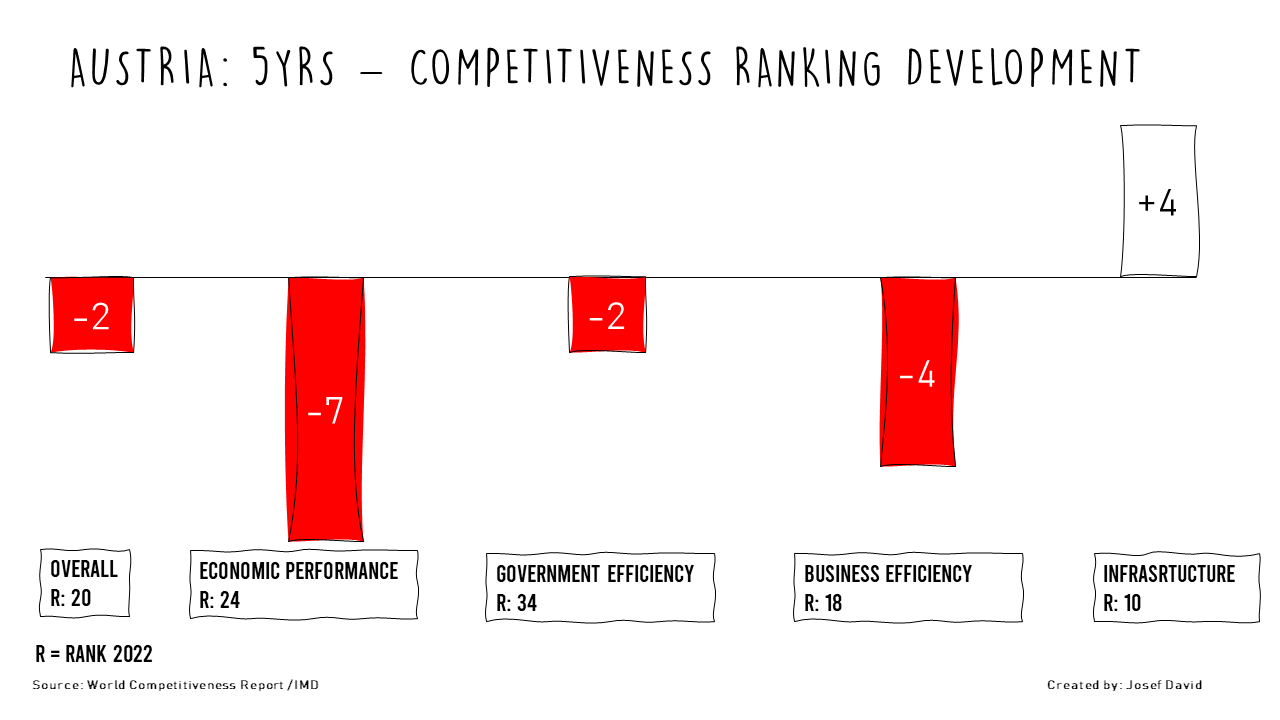
Result Delivered: A concrete, measurable roadmap to move Austria from a stagnating mid-field position to a Top-10 Competitive Nation by 2030.
HABIT 1 — Protecting Bureaucracy Instead of Increasing Productivity
Why this reduces competitiveness:
Austria’s public sector operates with:
- Too many administrative layers
- Slow decision pathways
- High regulatory burden
- Paper-driven processes
- Low automation adoption
This destroys speed, investment attraction, innovation, and trust.
Where countries fail:
- They preserve structures instead of redesigning them
- They hire more administrators instead of digitizing processes
- They reward compliance instead of performance
THE STRATEGY THAT THRIVES:
1. The Lean Governance Model (LGM-2030)
1. Collapse Bureaucracy Layers
Reduce ministry overlaps, consolidate agencies, automate forms.
→ 30–40% faster approvals.
2. AI-Driven Administration
Automate:
- Permits
- Subsidy allocation
- Case classification
- Scheduling
→ Lower cost, faster service, fewer errors.
3. Public-Sector KPIs
Service time, cost per case, satisfaction score — published monthly.
→ Trust rises when performance becomes visible.
Result Delivered:
A lean, predictable, transparent government that accelerates business and citizen productivity.
HABIT 2 — Taxing Work Heavily While Underrewarding Innovation
Why this reduces competitiveness:
Austria suffers from:
- High labor taxes
- Weak startup incentives
- Slow capital formation
- Low R&D commercialization
- Brain drain of top performers
High tax pressure = low motivation to innovate, invest, or scale.
Where countries fail:
- They tax progress
- They subsidize stagnation
- They complicate entrepreneurship
THE STRATEGY THAT THRIVES:
2. The Innovation & Talent Magnet Model (ITM-2027)
1. High-Value Tax Reform
Lower taxes on work, increase incentives on innovation, IP creation, and reinvestment.
2. Startup & Scaleup Fast Lanes
One-stop licenses, founder visas, zero-tax innovation zones.
3. Talent Retention Engine
Scholarships, dual-education innovation academies, research-industry alliances.
Result Delivered:
Austria becomes a magnet for talent, startups, investors, and applied innovation.
HABIT 3 — Building Sectors for Yesterday Instead of Ecosystems for Tomorrow
Why this reduces competitiveness:
Austria invests heavily in traditional sectors but underinvests in:
- AI
- Green tech
- Digital health
- Robotics
- Predictive mobility
- Circular economy
This locks the country into low-growth trajectories.
Where countries fail:
- They protect industries instead of transforming them
- They promote subsidies instead of ecosystems
- They work in silos instead of networks
THE STRATEGY THAT THRIVES:
3. The Ecosystem Leadership Strategy (ELS-2030)
1. Build 5 National Growth Ecosystems
- AI & Automation
- Eco-Energy & Hydrogen
- Life-Science & Biotech
- Circular Manufacturing
- Predictive Mobility
2. Public–Private Value Chains
Connect universities + SMEs + corporates + government into one growth engine.
3. KPI-Driven Competitiveness Dashboard
Monitor:
- Productivity
- Export strength
- Innovation output
- Skills
- Investment inflow
Result Delivered:
Austria enters the next decade with globally competitive sectors — not protected relics.
THE EXECUTIVE 15-SECOND VERSION
- Bureaucracy slows → Lean Governance accelerates
- High taxes block progress → Innovation incentives unlock growth
- Old industries decline → Ecosystems build new competitiveness
Result Delivered:
Austria moves from stagnation → momentum → a Top-10 competitive nation by 2030.