
Improving Competitiveness with the RapidKnowHow Model
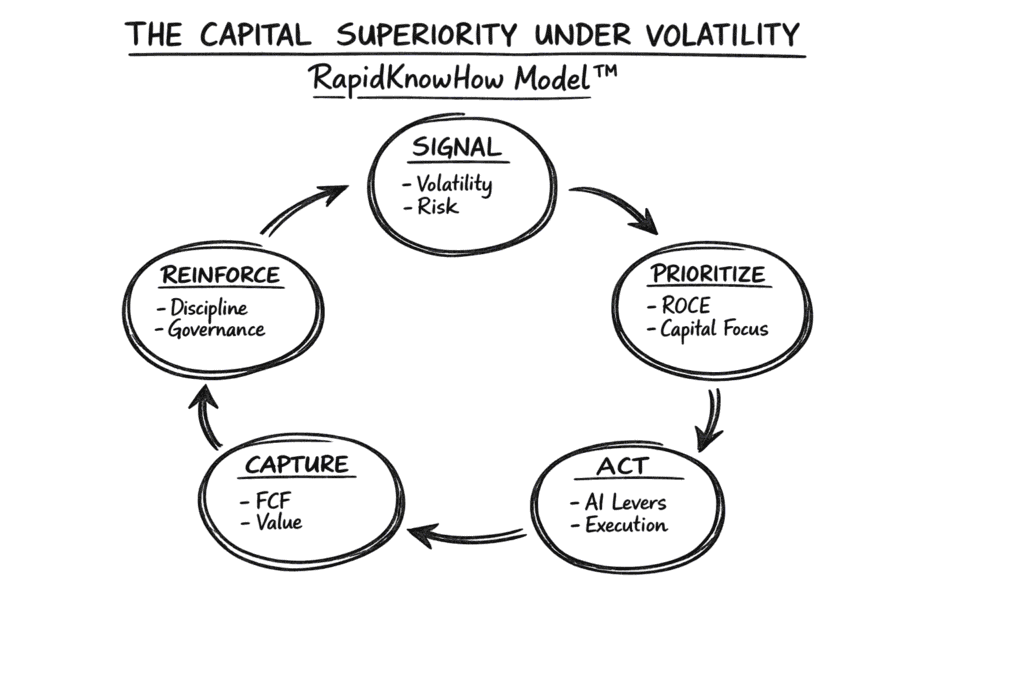
Signal → Prioritize → Act → Capture → Reinforce

Applying our AI-Orchestrator mindset to Austria as a national system is powerful.
Let’s structure it clearly in your preferred A), B), C) format.
A) SIGNAL (2026): What Is Really Happening?
1️⃣ Structural Signals
- Slower GDP growth vs. innovation leaders (e.g., Switzerland, Denmark)
- High labor costs + rigid regulation
- Energy cost volatility post-Ukraine shock
- Over-regulated SME environment
- Demographic pressure
2️⃣ Competitive Benchmark Pressure
- Switzerland: innovation + capital efficiency
- Denmark: digital governance + labor flexibility
- Austria: industrial ecosystem depth (despite slowdown)
3️⃣ Opportunity Signals
- Strong Mittelstand (KMU backbone)
- High technical education level
- Strategic location CEE gateway
- Stable legal system
- Strong industrial clusters (machinery, energy, health)
Strategic Diagnosis:
Austria does not suffer from lack of competence.
It suffers from friction and slow execution speed.
B) PRIORITIZE (2026-2027): Focus on 5 National Levers
Using your Orchestrator logic:
Don’t reform everything. Remove friction where ROICE is highest.
🎯 Priority 1: Reduce Regulatory Friction
- One-stop digital licensing platform
- Time-to-permit cap (max 90 days)
- Regulatory sunset clauses
🎯 Priority 2: Industrial AI Acceleration
- AI tax credit for SMEs
- AI adoption sprint (90-day model like your RapidKnowHow Sprint)
- Public-private AI labs
🎯 Priority 3: Energy Competitiveness
- Industrial power price stabilization
- Faster renewable permitting
- Hydrogen corridor CEE
🎯 Priority 4: Capital Market Strength
- SME IPO simplification
- Pension fund domestic equity allocation
- Venture capital incentives
🎯 Priority 5: Talent & Skills
- AI + digital mandatory curriculum
- Dual education 2.0
- Fast-track skilled immigration
Key Principle:
Austria must compete on speed + efficiency, not subsidies.
C) ACT (2027–2028): Execution Framework
Now the Orchestrator stage.
Step 1: Create a National Competitiveness Board
- Industry
- SME leaders
- AI experts
- Independent fiscal auditors
Step 2: KPI Dashboard
- Time-to-permit
- SME AI adoption rate
- Energy price vs EU average
- FDI inflow
- Industrial ROCE
Step 3: 90-Day Reform Sprints
Each reform executed in:
Signal → Define → Implement → Measure → Adjust
No multi-year bureaucracy cycles.
D) CAPTURE (2028–2029): Monetize Competitiveness
If reforms work, Austria should capture:
- Higher FDI inflow
- Higher productivity per employee
- Stronger SME export performance
- Increased tax revenue without tax increases
- Stronger stock market capitalization
Goal:
Move from “high-cost stable country”
to
“high-efficiency premium innovation hub.”
E) REINFORCE (2029–2030): Lock-In the Gains
This is where most countries fail.
Reinforcement must include:
- Performance-based budgeting
- Continuous AI integration in public services
- Export-driven cluster ecosystems
- Political transparency dashboards
- Citizen feedback loops
🔥 Strategic Snapshot for Leaders
Austria’s problem is not structural collapse.
It is execution velocity.
If Austria increases:
- Regulatory speed +30%
- AI productivity +20%
- Energy predictability +25%
It could regain competitiveness ranking momentum by 2030.
🎯 Strategic Reflection
From RapidKnowHow’s AI-Orchestrator Leadership lens:
Austria needs:
- Fewer debates
- More sprint cycles
- Measurable ROICE per reform
The country must shift from:
“Consensus administration”
to
“Outcome-driven orchestration.” – Josef David