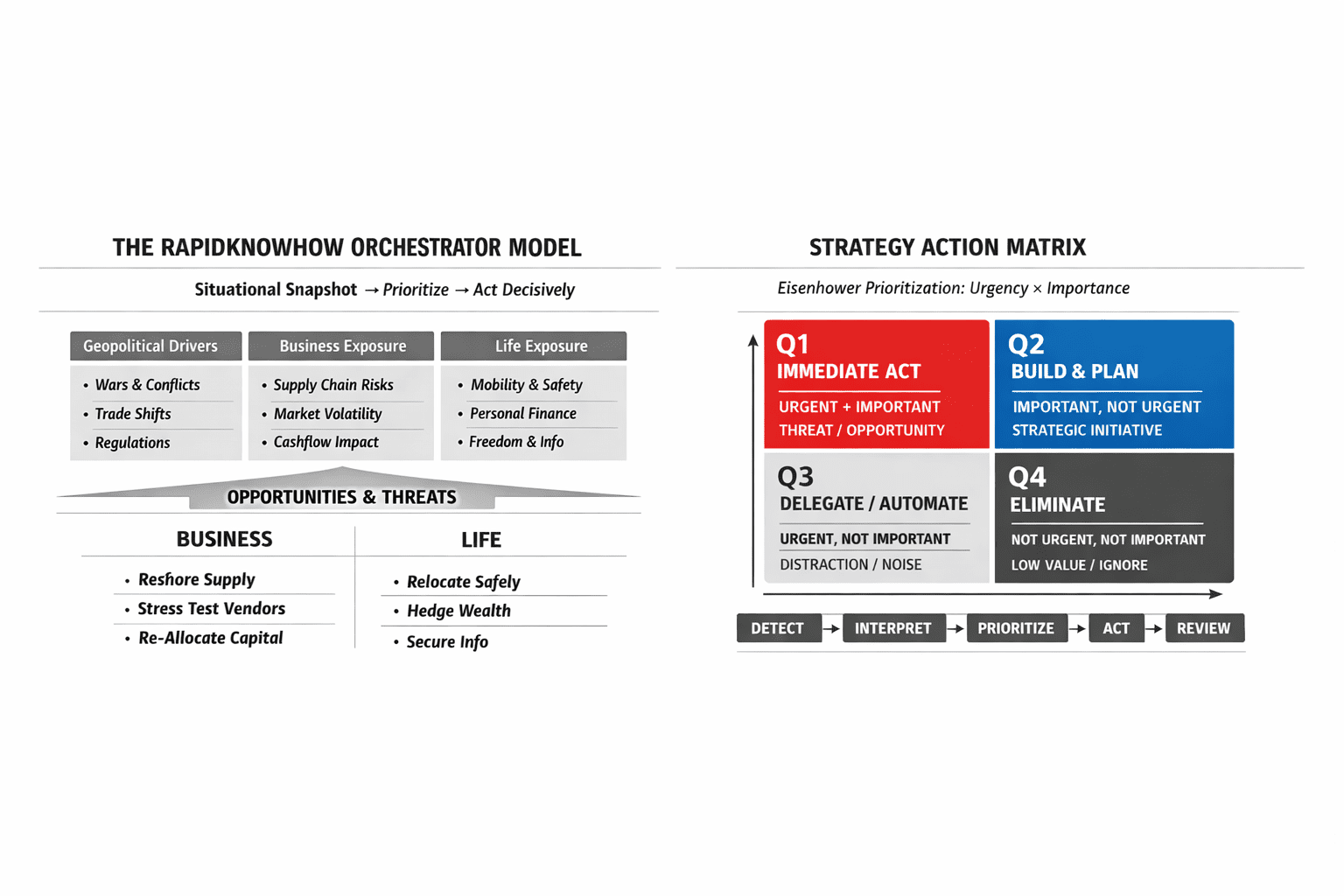
Detect GeoPolitical / Structural Drivers → Assess & Prioritize (Urgent + Important) → Convert into Actions (Business & Life)
Below you get 30 top cases – 10 Business, 10 GeoPolitics, 10 Life – each mapped through this loop.
0. One Template for All 30 Cases
For every case we use the same micro-logic:
- DETECT – Drivers
What’s really moving the situation? - ASSESS – Urgent + Important?
Q1 Act / Q2 Design / Q3 Delegate / Q4 Eliminate - ACT – RapidKnowHow Actions
Concrete moves (Business &/or Life).
I. 10 Business Cases
1. Industrial Gas: EU Tariffs & Supply Risk
- Detect: Trade tensions, energy prices, sanctions, customer dependence on a few majors.
- Assess: Q1 ACT – supply continuity + margin risk.
- Act:
- Reshore or dual-source bulk supply.
- Launch asset-light service models (On-Site as-a-Service).
- Lock in strategic customers with long-term ROICE contracts.
2. Semiconductor Shortage & Reshoring
- Detect: Chip scarcity, US/EU industrial policy, Asia concentration.
- Assess: Q1 ACT for auto, electronics, industrial OEMs.
- Act:
- Map chip exposure by product line.
- Redesign products to use alternative nodes.
- Co-invest / pre-pay with foundries for guaranteed capacity.
3. Automotive: EV Transition vs Cash-Flow
- Detect: Policy push for EVs, consumer uncertainty, capex explosion.
- Assess: Q2 DESIGN – existential but not overnight.
- Act:
- Scenario plan ICE → EV revenue mix.
- Shift from “sell cars” to “mobility services”.
- Build BaaS: battery leasing, charging networks, software subscriptions.
4. Logistics & Shipping Disruptions (Canals, Piracy, Wars)
- Detect: Chokepoints (Suez, Panama), conflict routes, freight price spikes.
- Assess: Q1 ACT for global manufacturers and retailers.
- Act:
- Diversify routes and ports.
- Increase safety stock for critical SKUs.
- Negotiate flexible contracts with carriers (volume bands, surcharges caps).
5. Energy Transition for Heavy Industry
- Detect: CO₂ pricing, green hydrogen, nuclear debates, ESG pressure.
- Assess: Q2 DESIGN – strategic but slower burn.
- Act:
- Build decarbonisation roadmap (scopes 1–3).
- Pilot green hydrogen / electrification at one flagship plant.
- Monetise decarbonisation as a service for customers.
6. Big Tech AI Race (Cloud + Models)
- Detect: Foundation models, GPU scarcity, regulatory scrutiny.
- Assess: Q1 ACT for tech; Q2 DESIGN for all others.
- Act:
- Identify 3–5 core processes to augment with AI (sales, service, planning).
- Build “AI control tower” to govern risk, IP and data.
- Partner instead of build-everything-yourself.
7. Retail & Consumer: High Inflation / Low Confidence
- Detect: Rising prices, rate hikes, wage pressure.
- Assess: Q1 ACT – demand & margin compression.
- Act:
- Re-tier product portfolio (basic / value / premium).
- Use dynamic pricing & targeted promotions.
- Cut non-value-add complexity in assortment and operations.
8. Healthcare Capacity Shocks
- Detect: Ageing population, pandemics, staff shortages.
- Assess: Q1 ACT for hospitals; Q2 DESIGN for payers & governments.
- Act:
- Use AI triage & remote monitoring to free capacity.
- Move from fee-for-service to preventive BaaS (Health-as-a-Service).
- Build regional care hubs with telemedicine.
9. Cyber-Attacks on Critical Infrastructure
- Detect: Ransomware and state-sponsored attacks on energy, logistics, hospitals.
- Assess: Q1 ACT for any connected operator.
- Act:
- Map crown-jewel systems and backup paths.
- Run red-team exercises quarterly.
- Insure, but focus on prevention and rapid recovery playbooks.
10. Family-Owned Mid-Caps Facing Succession & Private Equity
- Detect: Ageing owner, capital needs, PE funds hunting for deals.
- Assess: Q2 DESIGN – high impact, moderate urgency.
- Act:
- Build 5-year succession + ownership map.
- Use BaaS and AI to increase valuation before sale/IPO.
- Decide: hold, partner, or sell with control clauses.
II. 10 GeoPolitical Cases
11. Russia–Ukraine Conflict & Energy Security
- Detect: War, sanctions, gas supply, grain exports, NATO posture.
- Assess: Q1 ACT for Europe; Q2 DESIGN globally.
- Act:
- Reduce dependence on single-source gas/oil.
- Rebuild storage, interconnectors, and renewables.
- Hedge input costs and adjust product pricing.
12. China–Taiwan Tensions & Tech Supply Risk
- Detect: Military drills, chip concentration, US–China tech war.
- Assess: Q1 ACT for chip-reliant sectors; Q2 DESIGN for others.
- Act:
- Classify products by Taiwan-chip dependency.
- Build “Taiwan-off” contingency plans.
- Diversify foundry relations and inventory buffers.
13. Middle East & Energy Chokepoints
- Detect: Conflicts affecting Strait of Hormuz / Red Sea, oil supply risk.
- Assess: Q1 ACT – fuel price, insurance risk, route closures.
- Act:
- Create alt-routes and fuel suppliers.
- Install surcharges clauses in contracts.
- Enhance physical and cyber-security for logistics.
14. Arctic / Greenland Strategic Competition
- Detect: Melting ice, new sea routes, rare earths, US–EU–Russia–China rivalry.
- Assess: Q2 DESIGN – strategic long-term.
- Act:
- Monitor shipping opportunities & resource concessions.
- Position Nordic/Arctic alliances and ports.
- Invest in cold-climate infrastructure technologies.
15. BRICS Expansion & De-Dollarisation Talk
- Detect: BRICS+ enlargement, alternative payment systems, local-currency trade.
- Assess: Q2 DESIGN – deep impact over time.
- Act:
- Scenario-plan currency, settlement and sanctions risk.
- Diversify funding and banking partners geographically.
- Price some trade flows in multiple currencies.
16. EU Strategic Autonomy (Defense, Tech, Energy)
- Detect: EU defence initiatives, digital regulations, industrial policy.
- Assess: Q2 DESIGN – regulatory and subsidy landscape.
- Act:
- Map EU funding & regulation opportunities.
- Align R&D and compliance early.
- Use EU projects as leverage for scale and legitimacy.
17. US Political Polarisation & Policy Swings
- Detect: Elections, abrupt trade/tax/climate policy changes.
- Assess: Q1 ACT for US-exposed businesses.
- Act:
- Stress-test P&L for key policy scenarios (tariffs, taxes, climate rules).
- Avoid over-reliance on single US policies or subsidies.
- Build bipartisan relationship maps, not one-party bets.
18. Migration Pressures & Border Politics
- Detect: Conflicts, climate events, economic gaps driving migration.
- Assess: Q2 DESIGN for governments, large employers, cities.
- Act:
- Plan labour-force integration strategies.
- Invest in housing, education, and local legitimacy.
- Use migration as talent and entrepreneurship engine.
19. Digital Sovereignty & Data Localization
- Detect: Laws on data residency, AI, and platform control.
- Assess: Q1 ACT for data-heavy industries.
- Act:
- Map data flows vs. jurisdiction rules.
- Create regional data zones and compliant cloud setups.
- Adjust AI models and analytics to local law.
20. Climate Agreements & Carbon Border Adjustments
- Detect: Carbon pricing, CBAM-type mechanisms, climate litigation.
- Assess: Q2 DESIGN – structural cost and competitiveness issue.
- Act:
- Quantify embedded carbon in key products.
- Invest in low-carbon processes; monetise green premium.
- Collaborate in sector alliances to shape standards.
III. 10 Life / Career / Wealth Cases
21. Individual Wealth in High-Inflation Environments
- Detect: Real inflation vs official, wage vs asset dynamics.
- Assess: Q1 ACT for households.
- Act:
- Build emergency fund (6–12 months).
- Shift from pure cash to mixed assets (productive + defensive).
- Cut non-essential recurring costs.
22. AI Disrupting White-Collar Jobs
- Detect: Automation of analysis, writing, coding, legal, consulting.
- Assess: Q1 ACT for vulnerable roles; Q2 DESIGN for others.
- Act:
- Identify tasks most exposed; retrain on AI-orchestration.
- Build a personal “AI stack” to multiply output.
- Develop unique domain expertise + human strengths.
23. Digital Surveillance & Privacy Erosion
- Detect: Data tracking by states, platforms, employers.
- Assess: Q1 ACT if you are a dissident / journalist / activist; Q2 DESIGN otherwise.
- Act:
- Harden devices (encryption, 2FA, minimal apps).
- Separate identities (work, personal, sensitive).
- Use privacy-respecting services where possible.
24. Relocation & Geo-Arbitrage (Country Choice)
- Detect: Tax policy, stability, healthcare, education, freedoms.
- Assess: Q2 DESIGN – high impact life decision.
- Act:
- Compare 3–5 countries/cities on your key criteria.
- Test via 3–6 month stays before full move.
- Align residency, tax, schooling, and business structure.
25. Family Health Shocks
- Detect: Chronic illness, accident, long-term care needs.
- Assess: Q1 ACT for affected family.
- Act:
- Stabilise finances (insurance claims, debt restructuring).
- Simplify life admin; delegate non-essential tasks.
- Set up routines and support systems for caregivers.
26. Inter-Generational Wealth & Legacy
- Detect: Ageing parents, inheritance, business ownership.
- Assess: Q2 DESIGN – crucial, not always urgent.
- Act:
- Clarify wills, trusts, and beneficiary structures.
- Map “who gets what responsibility” not just “who gets money”.
- Document values and principles in a Legacy Charter.
27. Personal Burnout & Over-Commitment
- Detect: Exhaustion, cynicism, declining performance, health warning signs.
- Assess: Q1 ACT – immediate life risk.
- Act:
- Eliminate Q3/Q4 commitments (urgent but unimportant & pure noise).
- Introduce recovery blocks into calendar.
- Seek medical/psychological support where needed.
28. Career Strategy in a Fragmented World
- Detect: Non-linear careers, project markets, remote work.
- Assess: Q2 DESIGN – reshape work-life model.
- Act:
- Define your 1–2 “flagship skills” and 1–2 “flagship problems”.
- Build a portfolio: employment + side projects + learning.
- Use AI and platforms to reach global clients.
29. Information Overload & Mis-/Disinformation
- Detect: Endless feeds, polarisation, propaganda.
- Assess: Q1 ACT for mental health and decisions.
- Act:
- Cut non-trusted channels; keep a short list of sources.
- Allocate fixed “intelligence windows” per day.
- Use note-taking to convert info → insight → action.
30. Personal Security in Unstable Cities / Regions
- Detect: Crime, protests, political violence, law-enforcement weakness.
- Assess: Q1 ACT if directly exposed; Q2 DESIGN if risk rising.
- Act:
- Map safe vs unsafe areas and routes.
- Adjust routines: times, transport, locations.
- Prepare relocation and emergency plans.