RapidKnowHow Strategic PowerReport
Core Thesis:
AGA did not lose Gustaf Dalén’s legacy because it stopped producing gases. It lost the full legacy when it stopped behaving like a system-invention company and became primarily a focused industrial gas supplier. The decisive strategic break began in the late 1960s and 1970s, when AGA concentrated back on gases, and became final in 2000, when AGA became part of Linde. Dalén’s original model was broader: gas + invention + automation + safety + energy efficiency + global infrastructure.
B) The Founder Legacy: What Gustaf Dalén Really Built
Gustaf Dalén’s legacy was not simply an industrial gas company. It was a practical innovation system.
Dalén received the 1912 Nobel Prize in Physics for automatic regulators used with gas accumulators for illuminating lighthouses and buoys. The Nobel Prize summary highlights his work on automatic regulation and gas-saving lighthouse technology.
His lighthouse system shows the true Dalén formula:
Problem → Scientific Insight → Practical Invention → Automated System → Global Use → Long-Term Value
The important point is this: Dalén did not merely invent a product. He created self-regulating infrastructure.
His system solved real problems:
- Remote lighthouses needed reliable light.
- Acetylene created powerful illumination.
- Flashing technology reduced gas consumption.
- The sun valve switched lights off during daylight.
- Automation reduced human labor and operating cost.
- Safety engineering made large-scale use possible.
The Swedish National Museum of Science and Technology notes that Dalén registered 99 patents and created revolutionary beacon-lighting systems.
That is why the true Dalén legacy can be summarized in one sentence:
Dalén turned gas into intelligent infrastructure.
C) When AGA Left the Legacy
1. Cultural Break: 1937 — The Founder Leaves
Dalén died in 1937. After that, AGA still carried the name, history, and engineering culture, but the founder’s personal invention force disappeared. This was not yet a strategic collapse. Many founder-led companies continue successfully after the founder dies. But from that moment, AGA needed to institutionalize Dalén’s method.
The key question became:
Would AGA remain an invention-led system company — or become a conventional industrial company?
2. Strategic Break: Late 1960s–1970s — Focus Replaces Founder Breadth
This is the critical turning point.
AGA had moved into many product fields over time, including radios, televisions, cars, cookers, welding, and other industrial technologies. Later, the company returned to its core gas business. Linde’s regional history states that AGA produced radios, TVs, and cars over the years, but returned to its core gas business in the 1970s.
Another industry history summary says that during the late 1960s, AGA began concentrating on the gas sector.
This was understandable. Conglomerates often lose focus. Investors and managers prefer clarity. Industrial gases were attractive because they created recurring demand, strong customer dependence, and stable cash flow.
But strategically, something was lost.
AGA narrowed from:
Gas + engineering + automation + applications + invention systems
to:
Industrial gas production and distribution
That was the point where AGA began leaving the full Dalén legacy.
3. Corporate End Point: 2000 — AGA Becomes Part of Linde
The final break came when Linde acquired AGA. The European Commission’s 2000 merger decision states that Linde was to acquire control of the whole of AGA. Linde’s own history also states that AGA has been part of Linde since 2000.
This ended AGA as an independent strategic platform.
AGA’s assets, people, customers, and regional strength continued.
But AGA’s sovereign founder identity ended.
Strategic verdict:
AGA began leaving Dalén’s legacy in the late 1960s and 1970s when it narrowed its innovation scope. It finally left the independent Dalén legacy in 2000 when it became part of Linde.
D) What Did AGA Lose?
AGA did not lose “gas.”
AGA lost the chance to become the world leader in gas-enabled intelligent industrial systems.
Dalén’s founder logic had four powerful elements:
1. Automation Before Automation Was Fashionable
The sun valve was an early self-regulating system. It made infrastructure operate without constant human control. This is the same logic behind modern AI-orchestrated industrial systems.
2. Energy Efficiency Before Sustainability Was Fashionable
Dalén’s flashing technology reduced gas consumption. The core mindset was not “sell more gas.” It was use gas intelligently to create more value with less waste.
3. Safety as a Business Model
Acetylene was powerful but dangerous. AGA’s early success depended on making it usable and safe. Safety was not compliance. Safety was market creation.
4. Infrastructure Thinking
Dalén’s solutions worked in remote, harsh, mission-critical environments. That is exactly the profile of industrial gas customers today: steel plants, hospitals, chemical plants, refineries, food chains, semiconductor fabs, and energy systems.
AGA could have translated this into a modern strategic identity:
“We build intelligent gas systems that make industry safer, cleaner, more automated, and more profitable.”
E) What If AGA Had Kept Dalén’s Legacy?
Scenario 1: AGA Becomes the Nordic Siemens of Industrial Gas Systems
If AGA had kept the full Dalén logic, it might have combined:
industrial gases + control systems + sensors + application engineering + safety automation + energy optimization
This would have moved AGA beyond molecule supply into system leadership.
It could have competed in areas such as:
- automated welding systems
- hospital oxygen platforms
- smart gas logistics
- remote monitoring of gas installations
- combustion optimization
- industrial safety systems
- marine safety infrastructure
- hydrogen control systems
- gas-efficiency software
- AI-based gas demand forecasting
In this scenario, AGA would not only sell gases. It would sell intelligent process performance.
Scenario 2: AGA Becomes the Global Leader in Energy-Saving Gas Applications
Dalén’s original innovation was deeply connected to energy savings. The lighthouse system used gas more intelligently.
If AGA had fully kept that principle, it could have become the leading company for:
less energy, less waste, higher uptime, better safety, lower emissions
That would be extremely relevant today.
Modern industrial customers do not only ask, “Can you deliver oxygen, nitrogen, hydrogen, argon, helium, or CO₂?”
They increasingly ask:
Can you reduce my cost?
Can you reduce my emissions?
Can you improve my process?
Can you protect my uptime?
Can you improve my cash flow?
A Dalén-driven AGA would have answered this decades earlier.
Scenario 3: AGA Remains Independent and Becomes a Swedish Global Champion
Sweden built global champions: ABB, Atlas Copco, SKF, Sandvik, Alfa Laval, Ericsson, Saab, Volvo. AGA could have remained in that family as a Swedish industrial technology champion.
Its natural strategic position could have been:
AGA = Intelligent Gas Infrastructure
Instead, AGA became part of Linde’s global industrial gas consolidation.
Linde gained regional scale and assets.
AGA lost independent strategic destiny.
F) The Leadership Lesson for Industrial Gas Today
The AGA story is not nostalgia. It is a warning.
Many industrial gas companies today risk making the same mistake:
They protect the molecule business but underdevelop the system business.
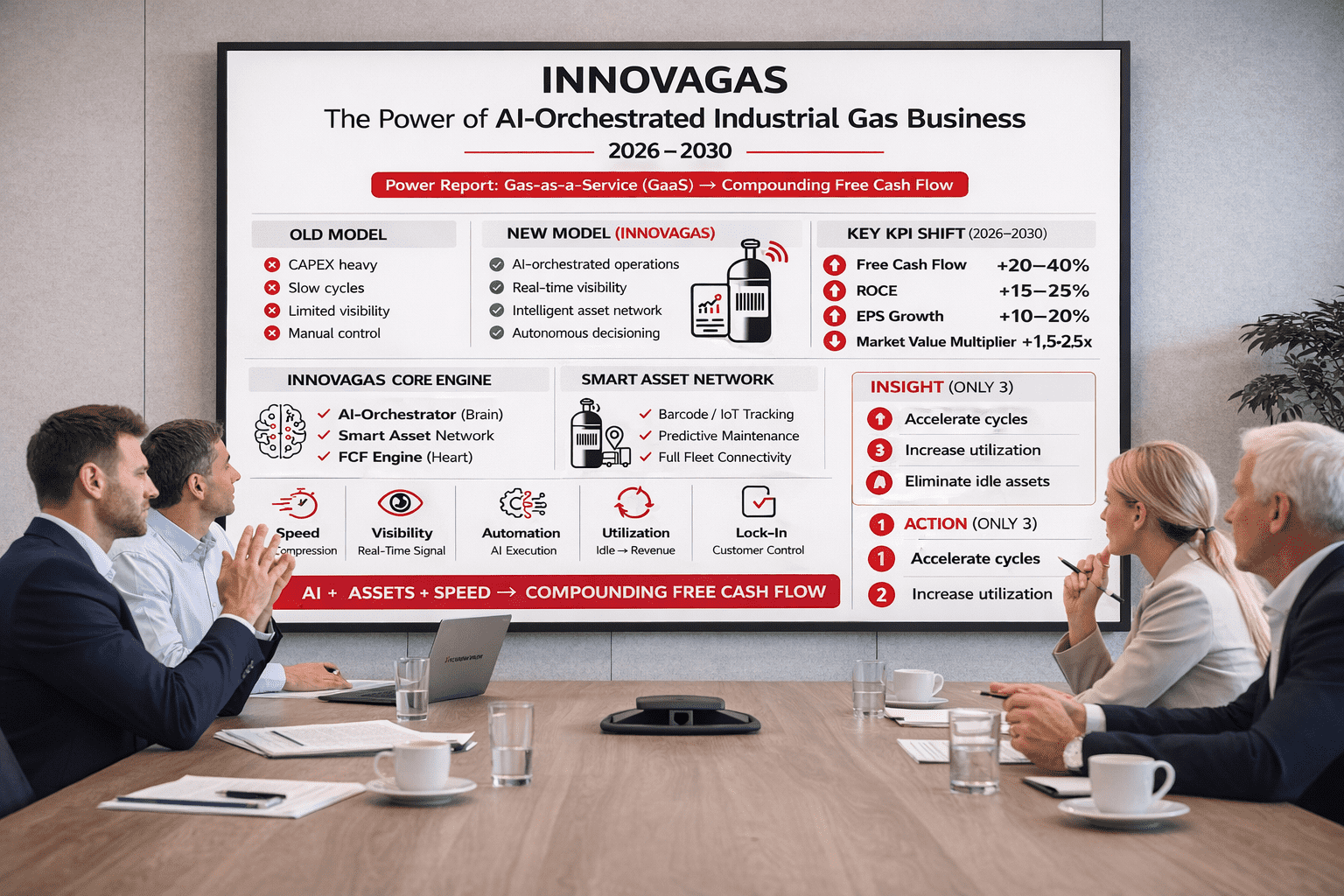
The future will not be won only by producing more gas. It will be won by orchestrating value around gases.
The future industrial gas leader must become:
Gas Supplier → Application Partner → Efficiency Partner → AI-Orchestrated Value Partner
The Dalén legacy is therefore highly modern.
It points directly to the future:
1. From Gas Volume to Customer Value
Do not ask only: “How many tons can we sell?”
Ask: “How much value can our gas system create?”
2. From Product Margin to FCF Impact
The winning supplier will prove how gas applications improve customer free cash flow through uptime, productivity, energy savings, quality, and safety.
3. From Delivery Network to Intelligence Network
Industrial gas logistics, production, storage, consumption, and maintenance should be AI-orchestrated.
4. From Sustainability Claims to Measured Results
The next industrial gas legacy will be built by verified reductions in energy use, emissions, waste, risk, and downtime.
5. From Corporate Memory to Founder Method
Dalén should not be remembered only as a portrait on the wall. His method should be operationalized.
G) RapidKnowHow Strategic Legacy Map
Dalén Legacy Original Model
Real Problem
↓
Scientific Insight
↓
Gas-Based Invention
↓
Automated Control
↓
Energy Saving
↓
Safety System
↓
Global Infrastructure
↓
Compounding Value
AGA Departure Model
Founder Invention System
↓
Broader Industrial Diversification
↓
Refocus on Core Gases
↓
Loss of System-Invention Identity
↓
Acquisition by Linde
↓
End of Independent Legacy Platform
Future Revival Model
Gas + AI + Automation + Safety + Efficiency + FCF Impact
↓
Industrial Gas AI-Orchestrator™
H) Final Verdict
AGA left Gustaf Dalén’s full legacy when it narrowed its strategic identity from invention-driven system leadership to focused industrial gas supply.
That shift began in the late 1960s and 1970s.
It became final in 2000 with the Linde acquisition.
But the deeper conclusion is more important:
AGA did not lose because it focused on gases. It lost because it did not scale Dalén’s full invention logic into the next industrial age.
Dalén’s legacy was never just acetylene, oxygen, or lighthouses.
It was the ability to turn gases into intelligent, automated, reliable, energy-saving infrastructure.
That is exactly what the industrial gas sector needs today.
RapidKnowHow Legacy Sentence
Gustaf Dalén’s real legacy was not AGA as a gas company. It was AGA as an intelligent industrial system creator. If AGA had kept that legacy, it could have become the global pioneer of AI-orchestrated industrial gas infrastructure long before the world had a name for it.
RapidKnowHow® — THE DECISION COMPANY™
Industrial Gas Leadership 2030
PROVE VALUE. THEN SCALE.
Watch the 60-second roadmap: 10 strategic actions for DACH and CEE, 2026–2030.
Start with ONE customer challenge. Use the Industrial Gas Action Guide to turn your first action into a measurable result.
RapidKnowHow® — Leading Industrial Gas Opportunity Signal Identifier in DACH & CEE
Leave a Reply