
Building a System That Continuously Generates FCF, Converts It into ROICE, and Compounds Through an Expanding Ecosystem
Industrial gas has always been a capital-intensive, execution-heavy industry. Plants, filling stations, cylinders, trailers, route networks, energy inputs, maintenance, safety, contracts, and customer uptime all shape the economics.
For decades, many players managed these elements through functional silos: sales optimized volume, operations optimized reliability, finance optimized budgets, and leadership reviewed monthly reports.
That model can still operate, but it no longer leads.
In the AI age, leadership advantage comes from orchestrating the whole system around one governing outcome: continuously improving free cash flow.
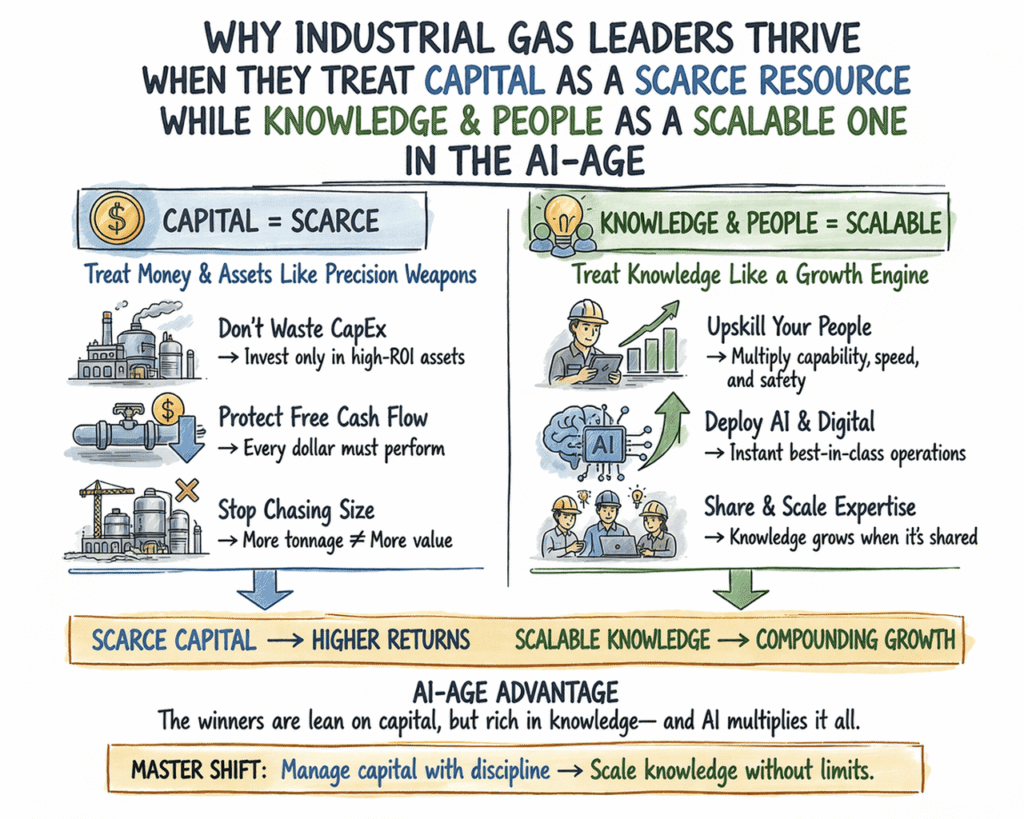
Free cash flow matters because it is the most honest proof of business quality.
Revenue can rise while economics weaken.
EBIT can improve while working capital expands.
Growth can look impressive while value leaks through poor pricing, delayed pass-through, idle assets, slow collections, weak contract design, and operational inefficiencies.
Free cash flow exposes whether the company is truly converting effort into economic strength. That is why the Industrial Gas FCF Command Center should become the core system of leadership.
The AI-Orchestrator model starts with signals. Not all data matters equally. Leaders must focus on the signals that shape cash generation most directly: pricing leakage, delay in energy or surcharge pass-through, customer mix deterioration, asset utilization gaps, route inefficiencies, plant downtime, maintenance overruns, overdue receivables, weak service attachment, and contract structures that fail to protect value. The role of the orchestrator is to detect these signals early, rank them by impact, and direct management attention toward the levers that move free cash flow fastest and most sustainably.
This is a major shift from reporting to operating. A report tells management what happened. An orchestrator determines what must happen next. That is why the FCF Command Center should run on a disciplined loop: Signal -> Prioritize -> Execute -> Capture Value -> Convert into ROICE -> Compound Through Ecosystem. This loop replaces fragmented management with focused value creation.
The first task is to generate FCF continuously.
In industrial gas, the strongest levers are usually not mysterious.
Pricing discipline is one of the most powerful. A few basis points of improved price quality across a broad installed base can produce major cash effects.
Pass-through speed matters equally. When energy or supply costs rise, delay destroys cash.
Contract redesign is another lever: stronger indexation, clearer service terms, and better bundle logic improve both margin and predictability.
Working capital is equally crucial. Receivables acceleration, deposit discipline, better invoicing quality, and inventory visibility can unlock cash without new capital expenditure.
Asset productivity is a further driver. Better cylinder turn, route optimization, trailer usage, plant uptime, and maintenance prioritization all improve the cash engine.
Yet generating more FCF is only the first half of the challenge.
The second is conversion into ROICE: Return on Innovation, Convenience, and Efficiency.
This is where many companies fail.
They generate cash, but do not systematically transform it into a stronger business model.
The AI-Orchestrator should therefore direct incremental cash into a disciplined ROICE portfolio.
Innovation means redesigning how value is delivered. In industrial gas, this may include smarter service contracts, predictive supply models, digital replenishment systems, uptime guarantees, application-based selling, and new bundles that shift the discussion from gas price to total customer outcome.
Convenience means reducing friction for the customer: easier ordering, more transparent delivery, faster issue resolution, better planning, and improved service reliability.
Efficiency means reducing the cost and complexity of serving customers while increasing throughput, quality, and asset yield.
When FCF is reinvested this way, each gain becomes a multiplier.
Better pricing funds smarter digital tools.
Better collections fund customer self-service.
Better route performance funds predictive logistics.
Better plant efficiency funds reliability analytics.
Over time, this creates a flywheel: stronger FCF funds stronger ROICE, and stronger ROICE creates stronger FCF.
The third stage is compounding through an expanding ecosystem.
A company acting alone can improve.
A company that orchestrates an ecosystem can compound.
In industrial gas, the ecosystem includes distributors, application specialists, healthcare channels, engineering partners, maintenance providers, logistics partners, digital interface providers, and customers themselves.
The goal is not simply to add partners, but to build repeatable interaction models that increase customer value and deepen economic returns.
For example, a smart customer portal can improve order convenience and retention.
- A logistics partner connected to forecasting systems can reduce route waste.
- A healthcare channel can increase recurring service revenue.
- Application partners can raise the value customers derive from gas use, strengthening both price realization and stickiness.
- Regional alliance models can extend proven playbooks without duplicating every fixed cost. The ecosystem therefore turns isolated operational gains into scalable strategic advantage.
To manage this well, leaders need a practical FCF grouping system.
Very High FCF levers should receive weekly CEO attention. These include pricing discipline, pass-through speed, mix improvement, contract redesign, receivables acceleration, and asset productivity.
High FCF levers should be driven hard by business unit leaders and operational heads. These include route optimization, energy efficiency, maintenance prioritization, cross-selling, procurement improvement, and working-capital visibility.
Medium FCF levers should be standardized and scaled once the higher-impact engines are stable. These include back-office automation, reporting simplification, training systems, lead qualification workflows, and ecosystem onboarding.
The strategic leadership question is simple:
Are we running projects, or are we operating a compounding FCF system?
Projects end. Systems learn. Projects consume attention. Systems generate momentum.
The Industrial Gas winners of the next years will not be those with the most presentations, but those with the strongest operating rhythm around free cash flow.
The AI-Orchestrator Industrial Gas FCF Command Center is therefore more than a management concept.
It is the governing system for sustained value creation.
It aligns commercial, operational, financial, and ecosystem decisions around one compounding logic.
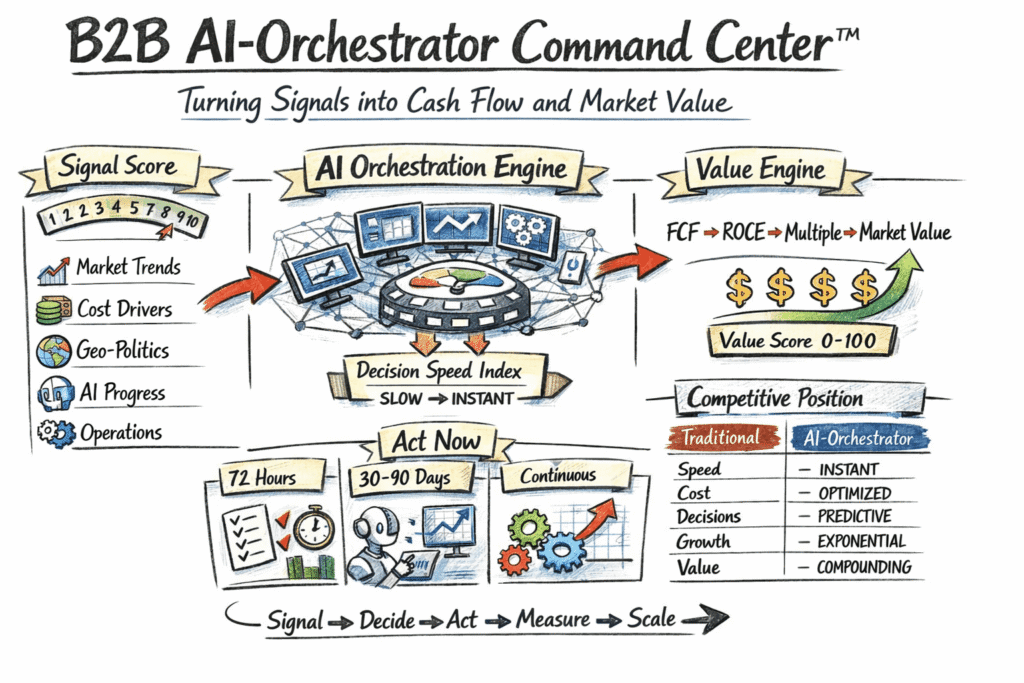
First generate FCF. Then convert it into ROICE. Then expand the ecosystem so the gains repeat, spread, and strengthen over time. That is how industrial gas leadership moves from periodic improvement to continuous compounding. – Josef David