
Why Organisational Design Is Now a Valuation Decision
Executive Power Report 2026–2030
Industrial Gas Focus | Cross-Industry Transferable
1️⃣ Executive Summary
Architecture Determines Enterprise Value
From 2026–2030, enterprise valuation in capital-intensive industries will be determined less by asset scale and more by organisational architecture.
In Industrial Gas, two companies with identical assets can produce radically different valuation outcomes based solely on governance structure.
Architecture → Volatility → FCF Stability → Market Multiple → Enterprise Value
The financial gap is structural — not cyclical.
2️⃣ Why Traditional Functional Architecture Underperforms
Industrial Gas operates under:
• High capital intensity
• Energy exposure
• Long asset lifecycles
• Hydrogen investment waves
• Regulatory pressure
Traditional functional organisations optimise departments:
Production
Sales
Finance
Procurement
But markets value systems, not silos.
Lag between functions creates volatility.
Volatility reduces predictability.
Predictability drives valuation multiples.
3️⃣ The AI-Orchestrator Architecture
The solution is not digital transformation.
It is governance redesign.
Three structural layers:
Layer 1 – Signal Intelligence
Energy exposure, hydrogen IRR stress, working capital velocity.
Layer 2 – Orchestration Hub
Cross-functional compression of decision cycles.
Layer 3 – Dynamic Capital Allocation
Rolling 90-day re-ranking of capital priorities.
This architecture reduces lag at the system level.
4️⃣ Financial Transmission Mechanics
The financial logic is linear and defensible.
Reduced lag
→ Reduced volatility
→ Stable FCF trajectory
→ Lower perceived risk
→ Higher valuation multiple
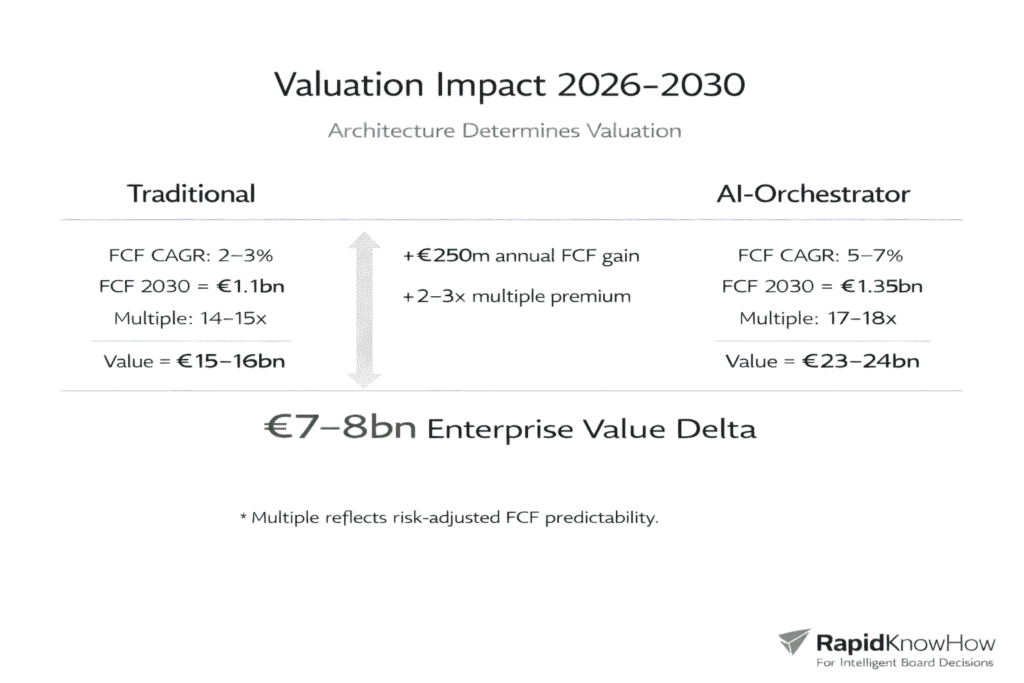
For a €10bn enterprise:
Traditional
FCF CAGR: 2–3%
Multiple: 14–15×
AI-Orchestrator
FCF CAGR: 5–7%
Multiple: 17–18×
The combined effect produces a €7–8bn valuation delta.
5️⃣ Governance Evolution
Boards must move from reporting oversight to orchestration oversight.
Traditional governance reviews past performance.
AI-Orchestrator governance monitors forward stability.
Five governance indicators define the model:
- Exposure Index Trend
- FCF Volatility Range
- CapEx Re-Ranking Ratio
- Pricing Response Time
- Working Capital Velocity
If three indicators deteriorate simultaneously, structural intervention is required.
6️⃣ Industrial Gas as the Blueprint Industry
Industrial Gas makes the architecture visible because:
• CapEx mistakes compound over decades
• Energy shocks are immediate
• Hydrogen waves test capital discipline
• Pricing discipline determines margin durability
But this model applies equally to:
Energy
Infrastructure
Manufacturing
Healthcare
Logistics
Any capital-intensive system exposed to volatility benefits from orchestration.
7️⃣ Strategic Conclusion
This is not an AI discussion.
It is a capital markets discussion.
The board question becomes:
Are we structured to optimise functions
or structured to protect enterprise value?
From 2026–2030:
Organisational design is a valuation decision. – Josef David