
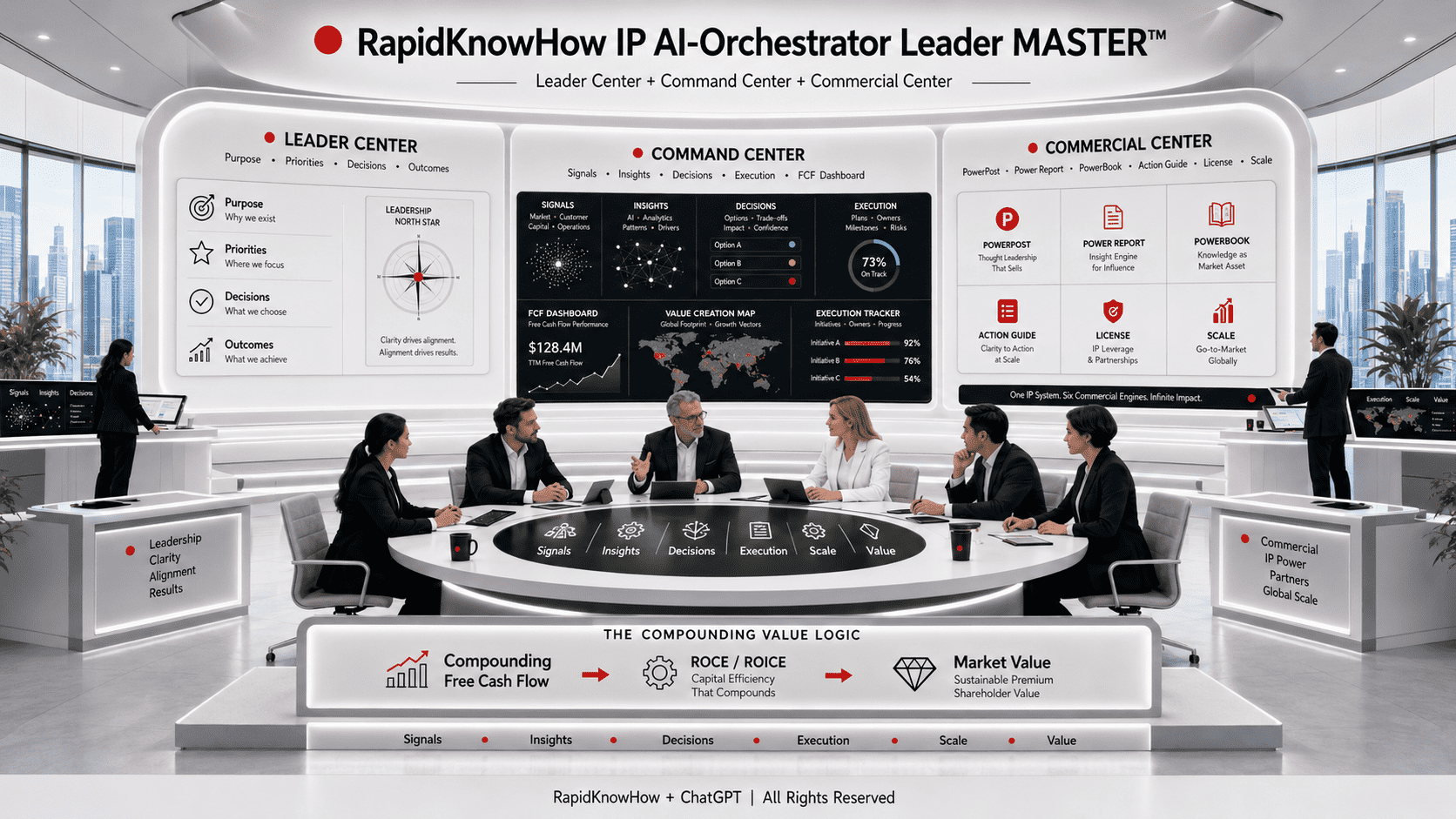
Assessment through the RapidKnowHow IP AI-Orchestrator B2B Leader Lens
Mobility + Industrial Technology + Energy & Building Technology + AI + Software + FCF Recovery
Author: Josef David
RapidKnowHow + ChatGPT
Executive Summary
Bosch is one of the most important B2B transformation cases in the AI age because it sits at the intersection of mobility, industrial technology, energy and building technology, consumer technology, sensors, automation, software and artificial intelligence.
Bosch is not simply a traditional automotive supplier. It is transforming into a software-enabled, AI-powered, hardware-anchored technology group.
The decisive question is:
Can Bosch turn its hardware excellence, software competence, sensor know-how, manufacturing depth and AI investments into stronger Free Cash Flow, better capital productivity and higher strategic market value?
Bosch’s strategic challenge is demanding. It faces pressure in automotive markets, high restructuring needs, the expensive shift to electric and software-defined mobility, weak German car production and intense global competition. Reuters reported in June 2026 that Bosch plans 22,000 job cuts in its core automotive business and is targeting a 2026 profit margin of 4% to 6%, compared with a much weaker prior year affected by restructuring costs.
At the same time, Bosch has a powerful AI-age opportunity. At CES 2026, Bosch positioned itself around the combination of hardware and software, stating that it can bridge the physical and digital worlds. Bosch expects software and services sales to exceed €6 billion by the beginning of the next decade, with about two-thirds coming from Mobility, and plans to invest more than €2.5 billion in AI by the end of 2027.
Through the RapidKnowHow lens, the strategic value chain is:
Hardware + Sensors + Software + AI → Customer Outcomes → Free Cash Flow → ROCE / ROICE → Strategic Market Value
The RapidKnowHow assessment is clear:
Bosch wins if it turns software-hardware integration into customer value, productivity, operational efficiency and cash-generative B2B transformation. Bosch loses if restructuring, complexity and automotive margin pressure absorb the value created by AI and software.
1. Why Bosch Matters
Bosch matters because it is one of the few global technology groups with real depth in both physical systems and digital systems.
Many AI companies understand software but not industrial reality. Many traditional manufacturers understand hardware but struggle with scalable software. Bosch stands between both worlds. That creates a powerful position in the AI age.
Bosch’s strategic fields include:
Mobility systems
Automotive components
Sensors
Driver assistance and automated driving
Industrial technology
Manufacturing systems
Energy and building technology
Consumer products
Software and services
AI-enabled products and operations
The key transformation opportunity is not to become a pure software company. That would weaken Bosch’s identity.
The opportunity is to become a full-stack AI-Orchestrator: a company that combines sensors, hardware, software, AI, manufacturing, industrial domain knowledge and customer systems into measurable B2B outcomes.
The old Bosch logic was:
Engineering excellence → Product quality → Customer trust
The new Bosch logic must become:
Engineering excellence → AI-enabled systems → Customer outcomes → Free Cash Flow → Strategic value
2. RapidKnowHow AI-Orchestrator Lens
The RapidKnowHow lens assesses Bosch through six dimensions:
- Leader Center – strategic focus, portfolio direction, restructuring discipline and AI/software ambition.
- Command Center – operational intelligence, manufacturing productivity, mobility transformation, software progress, cost and cash.
- Commerce Center – scalable customer offers in mobility, manufacturing, energy, building technology and services.
- Free Cash Flow – cash generation after restructuring, R&D, capex and transformation investment.
- ROCE / ROICE – capital productivity across plants, platforms, technologies, software and AI programs.
- Strategic Market Value – long-term value as a software-enabled industrial technology group.
The central question:
Can Bosch orchestrate its huge technology base into fewer, clearer, higher-return growth systems?
3. Leader Center Assessment
Bosch’s Leader Center is strong in vision but under pressure in execution.
The strategic direction is clear: combine the physical and digital worlds. At CES 2026, Bosch emphasized the “software-hardware symbiosis,” including software-defined mobility, AI-based cockpit systems, by-wire technologies, agentic AI in factories and cooperation with partners such as Microsoft and Kodiak AI.
This is strategically correct because Bosch’s competitive advantage lies in integration. Bosch knows vehicles, factories, sensors, components, automation, safety systems and industrial operations. AI becomes powerful when it is embedded into these real systems.
However, leadership must manage a major tension:
Invest in the future while restructuring the past.
Bosch is facing a difficult automotive environment. Reuters reported that the company is dealing with weak German car production, the investment-heavy EV transition and major job reductions in its automotive division.
Therefore, the Leader Center priorities should be:
Simplify the portfolio.
Protect cash.
Reduce structural cost.
Scale software and services.
Focus AI investments on measurable customer outcomes.
Strengthen manufacturing productivity.
Prioritize high-return mobility, industrial and energy technologies.
Avoid scattered innovation without FCF proof.
Leader Center Score: 8/10
Bosch has a credible AI-age vision. The leadership challenge is converting that vision into focused value creation under heavy restructuring pressure.
4. Command Center Assessment
Bosch needs a powerful AI-Orchestrator Command Center because its transformation is complex.
The Command Center should monitor:
Mobility profitability
EV and software-defined vehicle programs
By-wire technology progress
Sensor and chip supply risk
Manufacturing productivity
Factory AI deployment
Supply-chain resilience
R&D allocation
Customer order quality
Energy and building technology growth
Industrial technology performance
Restructuring progress
Working capital
Free Cash Flow
ROCE by business field
Bosch’s Command Center advantage is that the company can apply AI internally and externally. Internally, AI can improve production, quality, predictive maintenance, supply-chain efficiency and engineering speed. Externally, AI can strengthen customer systems in vehicles, factories, buildings and industrial operations.
At CES 2026, Bosch described cooperation with Microsoft to make factories fit for the future with agentic AI, and the company’s broader message was that software and hardware must work together to create smarter products and solutions.
The RapidKnowHow Command Center logic for Bosch is:
Sense market pressure → optimize operations → accelerate software → reduce cost → improve customer outcomes → measure FCF
The risk is dashboard overload. Bosch does not need more isolated data systems. It needs an integrated operating cockpit that connects signals to decisions, decisions to execution and execution to cash.
Command Center Score: 8/10
Bosch has strong operational and AI potential. The challenge is disciplined deployment at scale.
5. Commerce Center Assessment
The Commerce Center is where Bosch must convert technology into scalable customer value.
Bosch should not sell AI as a feature. It should sell AI-enabled outcomes.
The strongest Commerce Center opportunities include:
1. Software-Defined Mobility
Bosch can provide sensors, by-wire systems, software, high-performance computers and network components for intelligent vehicles. Bosch expects software, sensor technology, high-performance computers and network components sales to double by the mid-2030s to well over €10 billion.
2. By-Wire Systems
Brake-by-wire and steer-by-wire are strategically important because they enable software-defined driving, new vehicle architectures and automated mobility. Bosch expects cumulative sales revenue of more than €7 billion from brake-by-wire and steer-by-wire by 2032.
3. Autonomous Trucking Platforms
Bosch announced cooperation with Kodiak AI for redundant platforms used in driverless trucks. Reuters reported that Bosch will provide key automotive-grade components such as sensors and steering systems for a production-ready autonomous platform.
4. Industrial AI and Smart Manufacturing
Bosch can turn its own manufacturing know-how into external B2B credibility: AI for quality, maintenance, supply chain, factory automation and productivity.
5. Energy and Building Technology
Bosch can package heating, building automation, energy efficiency and connected systems into customer value offers, especially as energy costs and decarbonization pressure rise.
6. Services and Software Revenue
Bosch expects software and services sales to exceed €6 billion by the beginning of the next decade. This is critical because recurring and software-enabled revenue can improve cash quality and strategic value.
The Commerce Center must express customer outcomes simply:
Improve safety.
Reduce downtime.
Increase factory productivity.
Improve vehicle intelligence.
Lower energy cost.
Improve lifecycle value.
Reduce system complexity.
Enable software-defined performance.
Commerce Center Score: 8/10
The opportunity is strong. The risk is that too many technology offers become too complex for customers to understand and monetize.
6. Free Cash Flow Lens
Free Cash Flow is the truth number for Bosch’s transformation.
AI, software, electrification and restructuring all consume money before they create measurable value. Bosch must therefore prove that its transformation increases cash generation, not only future potential.
FCF improves when Bosch:
Reduces automotive structural cost.
Improves factory productivity.
Uses AI to lower defects and waste.
Focuses R&D on high-return platforms.
Builds scalable software and services.
Improves pricing power through differentiated systems.
Reduces working capital.
Avoids low-return technology bets.
Turns manufacturing AI into productivity gains.
Scales by-wire and software-defined mobility solutions.
Uses partnerships to reduce capital burden.
Reuters reported that Bosch expects revenue growth of 2% to 5% in 2026 and a profit margin of 4% to 6%, with restructuring actions expected to support results after costs weighed in 2025.
The RapidKnowHow FCF question is:
Does each Bosch AI and software initiative improve cash, margin, productivity, customer value or capital efficiency?
If yes, scale.
If no, stop or redesign.
FCF Potential Score: 7.5/10
Bosch has major upside, but restructuring costs and automotive transition pressure remain heavy.
7. ROCE / ROICE Lens
Bosch’s ROCE / ROICE challenge is capital productivity.
As a large engineering and manufacturing group, Bosch must decide where capital, R&D and management attention create the best long-term returns.
The RapidKnowHow ROCE / ROICE question is:
Which technologies turn Bosch’s engineering strength into repeatable, scalable and capital-efficient value?
Bosch improves ROCE / ROICE by:
Scaling software and services.
Using AI to improve internal productivity.
Reducing low-return automotive capacity.
Prioritizing by-wire, sensors, software-defined mobility and industrial AI.
Using partnerships to share risk.
Converting hardware into software-enabled systems.
Reducing complexity in product portfolios.
Focusing on high-value B2B customer outcomes.
Measuring each AI project by return impact.
The by-wire revenue target and software/services ambition are important because they can improve Bosch’s margin mix if execution works.
ROCE / ROICE Potential Score: 7.5/10
The upside is real, but Bosch must prove that high investment in AI and software produces returns faster than legacy automotive pressure erodes value.
8. Multiple and Strategic Market Value Lens
Bosch is privately held, so market value is not expressed through a daily listed-company multiple. But strategic enterprise value still matters for financing strength, partner attractiveness, customer trust, talent, innovation power and long-term independence.
Bosch’s strategic market value rises if it is seen as:
A software-enabled industrial technology leader.
A trusted AI-hardware integrator.
A leader in software-defined mobility systems.
A high-quality supplier of safety-critical components.
A productivity partner for manufacturing customers.
A credible energy and building technology player.
A cash-disciplined transformation company.
The strategic narrative should shift from:
Large automotive supplier under restructuring pressure
to:
AI-enabled software-hardware orchestrator for mobility, industry, buildings and everyday technology.
That shift is possible because Bosch’s positioning directly links the physical and digital worlds. But it must be supported by FCF proof, not only innovation messaging.
Strategic Market Value Potential Score: 8/10
9. Strategic Risks
Risk 1: Automotive Transition Pressure
The shift to EVs and software-defined vehicles creates high investment needs while legacy profitability is under pressure.
Risk 2: Restructuring Friction
Large job cuts and cost programs can damage morale, slow implementation or create political resistance.
Risk 3: AI Investment Without Payback
Bosch plans to invest more than €2.5 billion in AI by the end of 2027. This must be linked to measurable productivity, revenue and cash outcomes.
Risk 4: Software Complexity
Software-defined mobility requires speed, release discipline and user experience that traditional suppliers must master.
Risk 5: Supply-Chain Shocks
Reuters reported that Bosch sees Middle East conflict risks as potentially affecting supply of key raw materials used in semiconductors, including helium.
Risk 6: Portfolio Complexity
Bosch operates across many business fields. Without orchestration, complexity can dilute capital productivity.
Risk 7: Competition from AI-Native and China-Based Players
Bosch competes not only with traditional suppliers but also with fast digital, EV and automation challengers.
The RapidKnowHow warning:
Bosch wins if software-hardware orchestration beats restructuring pressure. Bosch loses if complexity turns AI into cost rather than cash.
10. Strategic Recommendation
Bosch should be assessed and managed through this RapidKnowHow value chain:
Leader Center → Command Center → Commerce Center → Free Cash Flow → ROCE / ROICE → Strategic Market Value
Leader Center
Sharpen the transformation agenda around software-hardware integration, AI deployment, mobility systems, industrial productivity, energy/building technology and cost discipline.
Command Center
Build a real-time Bosch Transformation Cockpit for mobility profitability, AI projects, software progress, manufacturing productivity, restructuring, supply risk, working capital and FCF.
Commerce Center
Package Bosch capabilities into customer outcomes: safer mobility, smarter factories, lower energy cost, better uptime, software-defined performance and lifecycle value.
Free Cash Flow
Make each AI, software and restructuring initiative pass the cash-impact test.
ROCE / ROICE
Prioritize capital toward scalable systems with visible return paths: software/services, by-wire, sensors, industrial AI, energy/building solutions and productivity platforms.
Strategic Market Value
Build the narrative: Bosch as the AI-age software-hardware orchestrator for mobility, industry, buildings and intelligent everyday technology.
Final Strategic Fazit
Bosch is one of the most important B2B transformation cases in the AI age because it has something many companies lack: deep physical-world expertise and growing digital-world capability.
The company’s future will not be decided by AI announcements alone. It will be decided by whether Bosch can convert AI, software, sensors, hardware and manufacturing know-how into measurable customer outcomes, Free Cash Flow, capital productivity and strategic enterprise value.
Through the RapidKnowHow IP AI-Orchestrator B2B Leader Lens, the decisive point is:
Bosch must become less of a complex industrial supplier and more of an AI-orchestrated software-hardware value system.
The strategic line is:
Hardware + Sensors + Software + AI + Manufacturing Know-How → Customer Outcomes → Free Cash Flow → ROCE / ROICE → Strategic Market Value.
B) RapidKnowHow Rating
| Dimension | Rating |
|---|---|
| Strategic Position | 8/10 |
| AI-Orchestrator Potential | 8.5/10 |
| FCF Potential | 7.5/10 |
| ROCE / ROICE Potential | 7.5/10 |
| Strategic Market Value Potential | 8/10 |
| Complexity Risk | High |
| Overall Assessment | Strong AI-age transformation case; upside depends on converting software-hardware strength into cash-generating customer outcomes |
C) Strategic Call-to-Action
Create the matching PNG Denkposter:
“BOSCH – Software-Hardware AI-Orchestrator B2B Transformation Case”
Visual flow:
Mobility + Industrial Technology + Energy & Building → Hardware + Sensors + Software + AI → Transformation Command Center → Customer Outcomes → Free Cash Flow → ROCE / ROICE → Strategic Market Value
SEO Headline:
Bosch B2B Transformation in the AI Age: From Automotive Supplier to Software-Hardware AI-Orchestrator
Subheadline:
A RapidKnowHow assessment of how Bosch can turn AI, software, sensors and manufacturing excellence into Free Cash Flow, capital productivity and strategic market value.
Strategic CTA:
Build the Bosch AI-Orchestrator Transformation Cockpit: map every AI/software initiative to customer outcome, FCF impact, ROCE/ROICE contribution and strategic value. – Josef David
D) Sources
- Bosch CES 2026 Media Service – used for Bosch’s software-hardware positioning, software/services revenue targets, AI investment of more than €2.5 billion by end-2027, by-wire sales target, agentic AI factory collaboration with Microsoft and Kodiak AI cooperation.
- Reuters, June 10, 2026 – used for 2026 outlook, 4%–6% margin target, 2%–5% revenue growth target, automotive restructuring, 22,000 job cuts and supply-chain risk context.
- Reuters, January 5, 2026 – used for Bosch/Kodiak AI cooperation on autonomous trucking hardware, sensors, steering systems and redundant autonomous platforms.