Assessment through the RapidKnowHow IP AI-Orchestrator B2B Leader Lens
Chemical Transformation + Verbund Logic + China Growth + Cost Discipline + FCF Recovery
Author: Josef David
RapidKnowHow + ChatGPT
Executive Summary
BASF is one of the most important B2B transformation cases in Europe because it represents the full challenge of the chemical industry: energy intensity, global demand shifts, China growth, European cost pressure, portfolio complexity, sustainability requirements, capital intensity and Free Cash Flow discipline.
BASF is not simply a chemical company. It is an integrated industrial value system. Its traditional strength is the Verbund model: integrated production, shared infrastructure, by-product use, energy efficiency and long value chains. The new challenge is to turn this industrial strength into an AI-orchestrated operating model that improves speed, resilience, cash flow and capital productivity.
In 2025, BASF reported sales of €59.7 billion, EBITDA before special items of €6.6 billion, ROCE of 5.8%, operating cash flow of €5.6 billion, Free Cash Flow of €1.3 billion and capex of €4.0 billion. In Q1 2026, sales were €16.0 billion, EBITDA before special items was €2.36 billion, and Free Cash Flow was negative €1.38 billion, which BASF notes is usually negative in Q1 due to seasonality, especially in Agricultural Solutions.
Through the RapidKnowHow IP AI-Orchestrator B2B Leader Lens, the key question is:
Can BASF turn chemical complexity into orchestrated portfolio focus, cost discipline, customer value, Free Cash Flow and improved capital productivity?
The strategic value chain is:
Verbund + Portfolio Focus → Operational Command Center → Customer Application Value → Free Cash Flow → ROCE / ROICE → Multiple → Compounding Market Value
The RapidKnowHow assessment:
BASF wins if it transforms from a complex chemical giant into an AI-orchestrated chemistry value system with disciplined capital allocation and stronger cash conversion.
1. Why BASF Matters
BASF matters because it sits at the base of many industrial value chains. Its products and solutions support automotive, construction, agriculture, consumer goods, electronics, home care, personal care, nutrition, coatings, materials, chemicals and industrial applications.
That makes BASF strategically important for:
- European industrial competitiveness
- Global chemical supply chains
- China growth and dependency risk
- Energy-intensive production
- Sustainability transformation
- Agricultural and specialty chemistry
- Industrial decarbonization
- Materials innovation
- Customer application performance
BASF’s transformation is not only a company story. It is a test case for whether a European chemical leader can remain globally competitive while Europe faces high energy costs, regulatory pressure, weak industrial growth and structural competition from China, the United States and the Middle East.
The transformation problem is clear:
BASF has enormous chemical know-how and Verbund strength, but value is created only if complexity becomes cash-generating focus.
2. RapidKnowHow AI-Orchestrator Lens
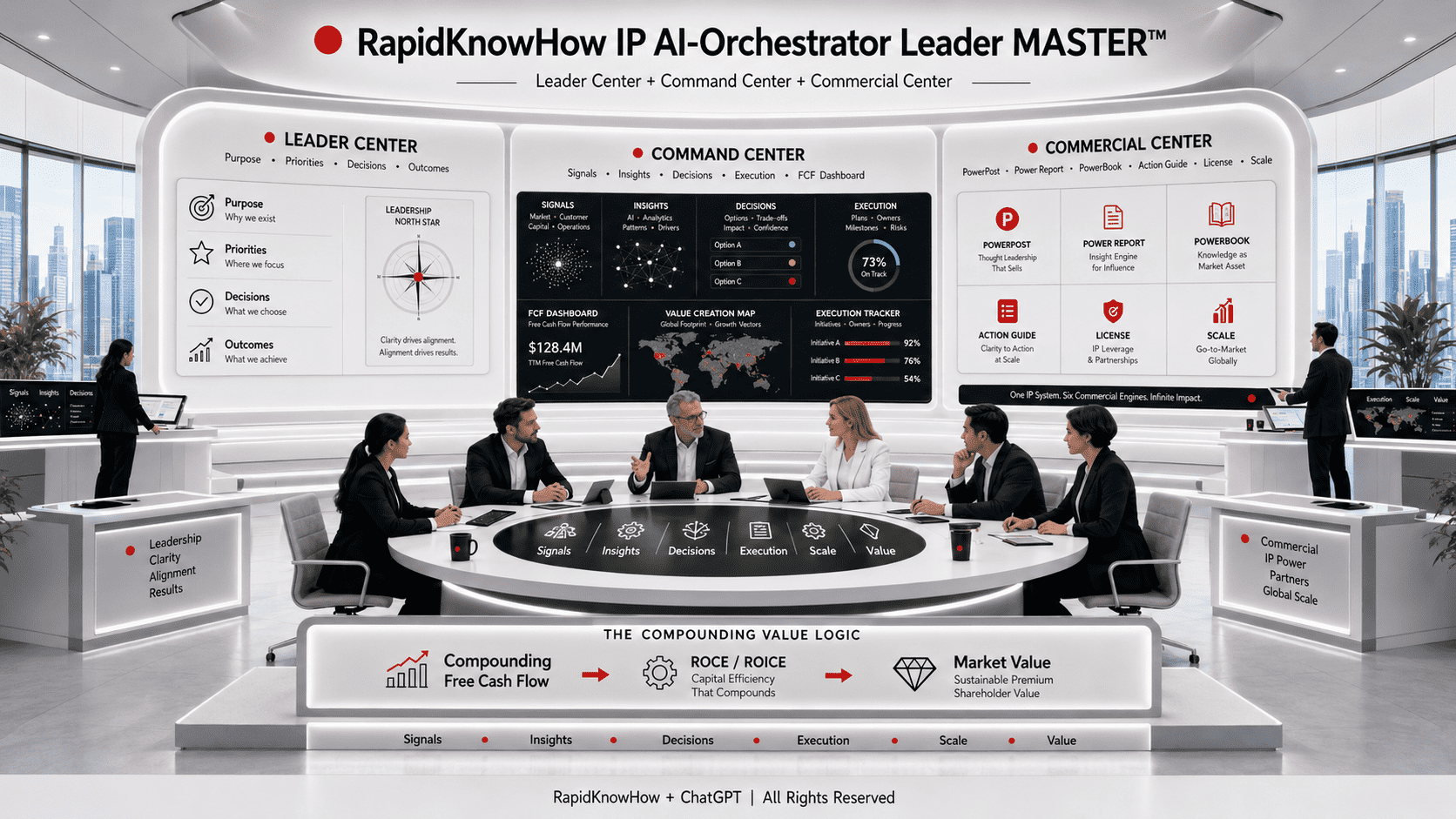
The RapidKnowHow lens assesses BASF through six dimensions:
- Leader Center – strategic focus, portfolio direction, China logic, cost discipline and capital allocation.
- Command Center – operational intelligence, energy exposure, demand signals, plant utilization, margin, working capital and Free Cash Flow.
- Commerce Center – customer application solutions, sustainability offers, specialty chemistry, agricultural value and service models.
- Free Cash Flow – cash generation after capex, restructuring, working capital and transformation investments.
- ROCE / ROICE – capital productivity across sites, segments, assets and innovation platforms.
- Multiple / Market Value – investor confidence in future cash flow quality, portfolio clarity and strategic resilience.
The decisive question is not whether BASF has science and scale. It does.
The decisive question is whether BASF can orchestrate these strengths into profitable, resilient and capital-efficient growth.
3. Leader Center Assessment
BASF’s Leader Center must solve three strategic tensions.
First, BASF must defend and improve its European base, especially Ludwigshafen, while managing high energy and regulatory costs.
Second, BASF must grow where chemical demand is strongest, especially China. BASF inaugurated its world-scale Verbund site in Zhanjiang, Guangdong, in March 2026. BASF describes Zhanjiang as efficient, digital and sustainable by design, fully powered by renewable electricity, and focused on a diversified portfolio including basic chemicals, intermediates and specialty chemicals for transportation, consumer goods, electronics, home care and personal care.
Third, BASF must simplify the portfolio and allocate capital toward activities with stronger margins, better customer relevance and higher cash returns.
The Leader Center must therefore answer:
Which businesses deserve growth capital?
Which assets must be restructured, partnered, sold or separated?
Which customers and applications create the best long-term value?
Which regions offer the best risk-adjusted returns?
Which investments improve Free Cash Flow and ROCE?
Which activities create complexity without value?
BASF’s 2026 guidance shows the challenge: adjusted EBITDA is expected in a range of €6.2 billion to €7.0 billion, compared with €6.6 billion in 2025, while the company continues cost-cutting and restructuring efforts.
Leader Center Score: 7.5/10
BASF has strong assets and strategic options, but its leadership challenge is high because portfolio complexity, European cost pressure and China exposure must be orchestrated carefully.
4. Command Center Assessment
BASF needs a powerful Command Center because chemical transformation is too complex for static planning.
A BASF AI-Orchestrator Command Center should monitor:
- Energy cost exposure
- Feedstock prices
- Demand by customer industry
- Regional growth signals
- Plant utilization
- Verbund efficiency
- Product margin
- Customer profitability
- Supply-chain bottlenecks
- Working capital
- Capex progress
- CO₂ and sustainability metrics
- China risk and opportunity
- Ludwigshafen competitiveness
- Free Cash Flow impact
- ROCE by asset and segment
The Command Center logic is:
Sense demand → monitor energy/feedstock → optimize Verbund → protect margin → allocate capital → improve Free Cash Flow
This is where BASF has major AI-orchestrator potential. Chemical companies operate with thousands of variables: prices, logistics, recipes, customer orders, energy use, plant reliability, safety, emissions, maintenance, working capital and product mix. AI can support better forecasting, optimization and decision-making.
But the Command Center must not become a dashboard cemetery. It must connect data to management decisions:
What should be produced?
At which site?
For which customer?
At what margin?
With what working-capital impact?
With what energy and CO₂ footprint?
With what Free Cash Flow effect?
Command Center Score: 8/10
BASF has excellent data and operational depth. The opportunity is to connect it into a clearer decision and execution system.
5. Commerce Center Assessment
The Commerce Center is where BASF converts chemistry into customer value.
BASF should not only sell molecules, materials and formulations. It should sell measurable customer outcomes.
The strongest Commerce Center opportunities include:
- Sustainable Materials
Helping customers reduce CO₂ footprint, improve recyclability and meet regulatory requirements. - Battery and Mobility Materials
Supporting electrification, lightweighting, coatings, thermal materials and circular battery solutions. - Agricultural Solutions
Improving crop performance, resilience and resource productivity. - Nutrition and Care
Supporting personal care, home care, health, food and nutrition applications. - Industrial Solutions
Improving performance, durability, processing efficiency and lifecycle value. - China Customer Application Platform
Using Zhanjiang to serve fast-growing Chinese customer industries with local supply and tailored solutions. - Verbund Value Services
Packaging BASF’s integrated production know-how, resource efficiency and sustainability logic into customer-facing value propositions.
The Commerce Center should package BASF’s strength into:
- Customer value briefings
- Application Power Reports
- Sustainability value calculators
- CO₂ footprint improvement cases
- Industry-specific solution packages
- Joint innovation programs
- Lifecycle performance dashboards
- Regional customer transformation offers
The Commerce Center question is:
How does BASF prove that its chemistry improves the customer’s productivity, sustainability, risk position and Free Cash Flow?
Commerce Center Score: 8/10
The potential is strong, but BASF must translate technical complexity into clear business outcomes.
6. Free Cash Flow Lens
Free Cash Flow is the truth number for BASF.
In chemicals, revenue and volume can be misleading if margins are weak, working capital rises, energy costs increase or capex absorbs cash. BASF’s 2025 Free Cash Flow of €1.3 billion improved from €0.7 billion in 2024, while capex declined from €6.0 billion to €4.0 billion. This shows the importance of capital discipline.
FCF improves when BASF:
- Reduces structural costs
- Improves product mix
- Protects pricing and margins
- Improves plant utilization
- Reduces working capital
- Prioritizes higher-return capex
- Restructures weak assets
- Increases specialty and customer-specific value
- Uses Verbund efficiency better
- Reduces energy intensity
- Improves supply reliability
- Converts sustainability into priced value
BASF’s Q1 2026 negative Free Cash Flow should not be overinterpreted because BASF states that Q1 FCF is usually negative due to seasonality, especially in Agricultural Solutions. The more important question is full-year cash conversion and trend.
FCF Potential Score: 7.5/10
BASF has cash-generating capacity, but the capital intensity and cyclicality of chemicals remain significant.
7. ROCE / ROICE Lens
BASF’s 2025 ROCE was 5.8%. That is an improvement from 5.1% in 2024, but still shows the central challenge: capital productivity must improve.
The RapidKnowHow ROCE / ROICE question is:
Which assets, segments and regions generate the best return on capital after energy, working capital, capex and risk?
BASF improves ROCE / ROICE by:
- Raising returns at major production sites
- Reducing capital tied in low-return businesses
- Improving asset utilization
- Increasing specialty and differentiated solutions
- Prioritizing high-value customer applications
- Optimizing working capital
- Using AI for production planning and maintenance
- Reducing energy intensity
- Ensuring Zhanjiang reaches targeted returns
- Restructuring underperforming European assets
- Separating or partnering less-integrated businesses where appropriate
The Zhanjiang Verbund site is strategically important but also a capital-productivity test. It creates growth exposure to China and a modern renewable-powered Verbund platform, but the return must justify the scale and geopolitical risk.
ROCE / ROICE Potential Score: 7/10
The upside is real, but improving returns across such a large asset base is difficult.
8. Multiple and Market Value Lens
BASF’s market value depends on whether investors believe the company can produce more resilient, higher-quality future cash flows.
A stronger market multiple requires:
- Clearer portfolio story
- Stronger FCF conversion
- Higher ROCE
- More disciplined capex
- Better cost competitiveness
- Reduced European structural burden
- Credible China growth returns
- Less cyclicality or better cycle management
- More customer-facing specialty value
- Higher trust in management execution
The market-value narrative should shift from:
Complex cyclical chemical giant under pressure
to:
AI-orchestrated chemical value system with disciplined portfolio focus, efficient Verbund assets, China growth exposure and improving cash returns.
That shift is possible, but BASF must prove it through execution.
Market Value Potential Score: 7.5/10
9. Strategic Risks
Risk 1: European Cost Disadvantage
High energy, regulation and weak demand can pressure Ludwigshafen and other European assets.
Risk 2: China Dependency
Zhanjiang strengthens China exposure, but geopolitical and demand risks must be managed.
Risk 3: Capital Intensity
Large chemical investments can reduce flexibility if returns disappoint.
Risk 4: Cyclicality
Chemicals remain exposed to industrial cycles, prices and customer inventory behavior.
Risk 5: Portfolio Complexity
Too many businesses can dilute management attention and capital discipline.
Risk 6: Sustainability Cost Gap
Customers may demand lower CO₂ products but resist paying adequate premiums.
Risk 7: Execution Risk
Cost-cutting, restructuring, China ramp-up and innovation must happen simultaneously.
The RapidKnowHow warning:
BASF wins if Verbund intelligence beats portfolio complexity. BASF loses if capital remains trapped in low-return structures.
10. Strategic Recommendation
BASF should be assessed and managed through this RapidKnowHow value chain:
Leader Center → Command Center → Commerce Center → Free Cash Flow → ROCE / ROICE → Multiple → Compounding Market Value
Leader Center
Simplify the transformation agenda: portfolio focus, China returns, European competitiveness, sustainability monetization and FCF discipline.
Command Center
Build a real-time Chemical Transformation Cockpit for energy, demand, margins, utilization, working capital, CO₂, capex and cash.
Commerce Center
Turn chemistry into customer business outcomes: productivity, sustainability, performance, risk reduction and lifecycle value.
Free Cash Flow
Make every strategic initiative pass the cash-conversion test.
ROCE / ROICE
Prioritize capital toward assets and applications with visible return paths.
Multiple
Earn investor confidence through execution, transparency, portfolio clarity and improving cash quality.
Compounding Market Value
Convert Verbund strength, China growth, customer innovation and AI-enabled operations into higher-quality future cash flows.
Final Strategic Fazit
BASF is one of the defining B2B transformation cases in the chemical industry.
It has scale, science, customer access, Verbund know-how and global reach. But these strengths create value only if they are orchestrated with strategic focus, energy discipline, portfolio clarity, customer relevance and capital productivity.
Through the RapidKnowHow IP AI-Orchestrator B2B Leader Lens, the decisive point is:
BASF must become less of a complex chemical conglomerate and more of an AI-orchestrated chemistry value system.
The strategic line is:
Verbund + Portfolio Focus + China Growth + Cost Discipline + Customer Application Value → Free Cash Flow → ROCE / ROICE → Multiple → Compounding Market Value. – Josef David