
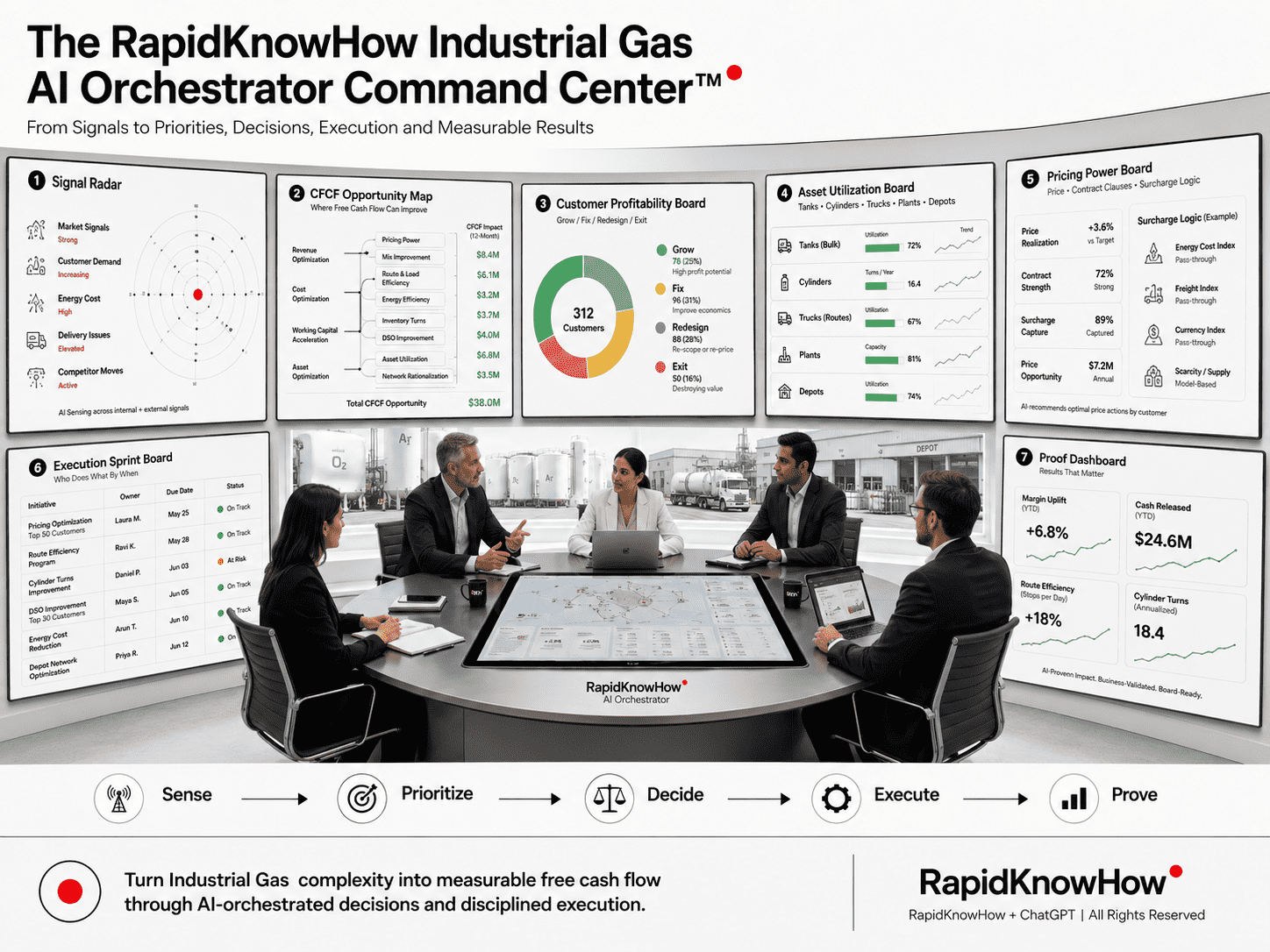
Business Case B2B Transformation: Messer
Assessment through the RapidKnowHow IP AI-Orchestrator INDUSTRIAL GAS Leader Lens
Local-for-Local Industrial Gas Power + Helium + Specialty Gases + FCF Discipline
Author: Josef David
RapidKnowHow + ChatGPT
Executive Summary
Messer is an excellent B2B transformation case for the RapidKnowHow Industrial Gas AI-Orchestrator Leader Lens because it represents a focused, privately held, specialist-driven industrial gas model.
Messer is not the largest global industrial gas company, but it has a distinctive strategic position: it is the world’s largest privately held specialist for industrial, medical, electronic and specialty gases, operating across Europe, Asia and the Americas. In 2025, Messer reported revenue of €4.5 billion, EBITDA of €1.4 billion, a stable EBITDA margin of 31%, investments of €747 million, and more than 12,000 employees.
Through the RapidKnowHow lens, Messer’s strategic value chain is:
Local-for-Local Gas Business → Application Know-How → Operational Resilience → Specialty Gas / Helium / Healthcare / Electronics Growth → Free Cash Flow → ROCE / ROICE → Strategic Market Value
The central assessment is:
Messer can win as an AI-Orchestrator Industrial Gas Leader if it turns its focused gas expertise, local customer closeness, application know-how and cash-generative business model into a scalable command-center and commerce-center system.
1. Why Messer Matters
Messer matters because it is a pure industrial gas specialist with a clear identity. It manufactures and supplies oxygen, nitrogen, argon, carbon dioxide, hydrogen, helium, shielding gases, specialty gases, medical gases, food gases and gas mixtures. Its products serve industry, environmental protection, medicine, food and beverage, welding and cutting, 3D printing, construction, research and science.
This makes Messer a strong case for B2B transformation because the industrial gas sector sits quietly behind many essential industries.
Industrial gases are needed for:
- Steel and metallurgy
- Chemicals
- Food and beverage
- Healthcare
- Electronics
- Aerospace
- Welding and cutting
- Batteries
- Environmental applications
- Hydrogen and decarbonization projects
- Helium applications such as MRI, semiconductors and advanced technologies
The strategic opportunity is not simply to sell more gas. The opportunity is to become a value orchestrator for customer applications.
2. RapidKnowHow AI-Orchestrator Lens
The RapidKnowHow lens assesses Messer through six dimensions:
- Leader Center – strategic focus, capital allocation, portfolio direction.
- Command Center – operational intelligence, pricing, logistics, energy, utilization, risk.
- Commerce Center – customer solutions, application know-how, packaged offers, sector growth.
- Free Cash Flow – ability to convert operations into cash and strategic freedom.
- ROCE / ROICE – capital productivity in a capital-intensive gas business.
- Market Value / Strategic Value – long-term value as a focused industrial gas specialist.
The key question:
Can Messer turn industrial gas expertise into AI-orchestrated customer value, operational performance and compounding cash flow?
3. Leader Center Assessment
Messer’s Leader Center has a clear strategic foundation: focus, resilience and local-for-local execution.
Its 2025 annual report highlights that Messer’s local-for-local operating framework helped limit direct impact from geopolitical tensions and economic uncertainty. This is strategically important because industrial gases depend heavily on local production, local distribution, local customer relationships and regional industrial demand.
The Leader Center strengths are:
- Clear industrial gas specialist identity
- Private ownership and long-term orientation
- Strong EBITDA margin
- Balanced regional footprint
- Local-for-local resilience
- Focus on innovation and sustainability
- Investment in production facilities and infrastructure
- Strong position in medical, electronic and specialty gases
Messer also reduced net debt from €3.6 billion to €3.2 billion in 2025, strengthening the balance sheet while investing €747 million in production facilities and infrastructure.
Leader Center Score: 8.5/10
Main leadership challenge: Messer must convert its strong specialist position into more visible AI-orchestrated value systems without losing the entrepreneurial closeness of its local-for-local model.
4. Command Center Assessment
The Command Center is where Messer can create the next performance leap.
Industrial gas businesses need constant control over:
- Plant utilization
- Electricity and energy cost
- Bulk logistics
- Cylinder productivity
- Pricing and pass-through
- Customer profitability
- Contract quality
- Inventory and working capital
- Safety and reliability
- Maintenance
- Medical gas reliability
- Specialty gas quality
- Helium sourcing security
Messer’s Command Center opportunity is especially strong because its business is diversified by region, product and end market. In 2025, Messer reported regional growth dynamics across Asia, Europe and the Americas: electronics and battery materials in Asia, food and beverage plus healthcare in Europe, and aerospace, electronics and food and beverage in the Americas.
The RapidKnowHow Command Center logic for Messer:
Sense demand → monitor energy → control pricing → optimize logistics → protect supply → improve customer value → increase Free Cash Flow
A Messer AI-Orchestrator Command Center should include:
- Energy exposure radar
- Pricing pass-through dashboard
- Regional demand radar
- Helium supply risk dashboard
- Cylinder productivity tracker
- Bulk logistics optimizer
- Customer profitability map
- Capex and project return board
- FCF impact tracker
- Sustainability and decarbonization opportunity radar
Command Center Score: 8/10
Main risk: if digital systems remain fragmented by region or business line, Messer may miss the full value of cross-regional learning.
5. Commerce Center Assessment
The Commerce Center is Messer’s strongest growth lever.
Messer has deep application know-how across gases, technologies and customer industries. Its opportunity is to package that know-how into repeatable commercial systems.
The Commerce Center should convert gas expertise into:
- Customer value briefings
- Application Power Reports
- Sector-specific gas productivity guides
- Medical gas reliability packages
- Food and beverage gas solution offers
- Welding productivity programs
- Electronics and specialty gas quality programs
- Helium security offers
- Hydrogen and decarbonization workshops
- Industrial Gas Command Center packages
The most attractive commercial growth areas are:
1. Electronics and Battery Materials
Asia growth was supported by electronics and battery materials demand. This points to a strong future market where specialty gases, purity, reliability and supply security matter.
2. Food and Beverage
Growth in Europe and the Americas was supported by food and beverage demand, making this a stable application platform.
3. Healthcare / Medical Gases
Messer’s medical gas role is strategically important because reliability, compliance and trust matter more than pure price.
4. Helium
Messer strengthened helium sourcing capabilities through strategic investments in helium assets and reserves in 2024, which were integrated into the Americas region in 2025. QatarEnergy also signed a long-term agreement to supply Messer with 100 million cubic feet of high-purity helium annually from Ras Laffan facilities, according to Reuters.
5. Decarbonization and Green Hydrogen
Messer states that sustainability and innovation remain central to its long-term strategy, including investments in decarbonization, green hydrogen and next-generation manufacturing.
Commerce Center Score: 8.5/10
Main challenge: product and application knowledge must be packaged into clear, monetizable customer outcomes.
6. Free Cash Flow Lens
Messer’s industrial gas model is cash-generative but capital-intensive.
Its 2025 performance shows a strong margin profile and balance sheet strengthening. Revenue was €4.5 billion, EBITDA €1.4 billion, EBITDA margin 31%, net debt reduced to €3.2 billion, and investments reached €747 million.
The RapidKnowHow FCF lens asks:
Which actions improve cash generation without weakening long-term competitiveness?
For Messer, FCF improves through:
- Strong pricing discipline
- Energy pass-through effectiveness
- Asset utilization
- Logistics optimization
- Reliable supply contracts
- Specialty gas growth
- Medical gas reliability
- Helium sourcing security
- Working capital discipline
- Capex prioritization
- Application-based value selling
- Local-for-local operational resilience
The key FCF principle:
Messer should not only sell gases. It should sell measurable customer performance supported by reliable gas supply.
FCF Potential Score: 8/10
7. ROCE / ROICE Lens
Industrial gases require disciplined capital allocation. Plants, tanks, cylinders, trucks, distribution assets and specialty gas infrastructure must produce attractive returns.
The RapidKnowHow ROCE / ROICE question:
Does each euro of capital employed strengthen long-term cash generation and competitive position?
Messer improves ROCE / ROICE by:
- Prioritizing high-return regional growth
- Increasing utilization of production assets
- Improving cylinder and logistics productivity
- Expanding specialty gases and helium supply security
- Building customer application solutions
- Using digital tools to reduce operating waste
- Strengthening pricing discipline
- Avoiding low-return capacity expansion
- Converting know-how into asset-light commercial products
Its 2025 investment focus on countries such as the United States, China and Vietnam suggests targeted growth in high-relevance markets.
ROCE / ROICE Potential Score: 8/10
8. Multiple and Strategic Market Value Lens
Messer is privately held, so market value is not expressed through daily stock-market multiple like listed peers. But strategic market value still matters.
For a privately held industrial gas specialist, strategic value is driven by:
- Quality of cash flow
- EBITDA resilience
- Regional growth footprint
- Product portfolio strength
- Specialty gas capability
- Helium security
- Healthcare and electronics exposure
- Customer retention
- Balance sheet strength
- Scalable operating systems
- Long-term ownership credibility
The value narrative is:
Focused specialist + resilient local-for-local model + strong EBITDA margin + strategic gases + supply security + digital command systems = higher strategic enterprise value.
Strategic Market Value Potential Score: 8.5/10
9. Strategic Risks
Messer’s opportunity is strong, but several risks must be managed.
Risk 1: Energy Cost Volatility
Industrial gas production is energy-intensive. Weak pass-through can pressure margins.
Risk 2: Capital Intensity
Growth requires investment. Poor capital allocation can weaken ROCE.
Risk 3: Regional Complexity
Local-for-local is resilient but may reduce standardization if not orchestrated well.
Risk 4: Helium Supply Risk
Helium is strategically attractive but supply security is critical.
Risk 5: Hydrogen Hype Risk
Green hydrogen offers opportunity but can destroy capital if projects lack customer economics.
Risk 6: Digital Fragmentation
Without a unified command-center logic, data may not translate into decisions.
The RapidKnowHow warning:
Messer wins if local entrepreneurship is strengthened by AI orchestration, not replaced by bureaucracy.
10. Strategic Recommendation
Messer should be assessed through the RapidKnowHow industrial gas value chain:
Leader Center → Command Center → Commerce Center → Free Cash Flow → ROCE / ROICE → Strategic Market Value
Leader Center
Sharpen the growth agenda around local-for-local strength, specialty gases, helium, healthcare, food, electronics and decarbonization.
Command Center
Build a real-time performance system for energy, pricing, utilization, logistics, customer profitability, supply risk and FCF.
Commerce Center
Package application know-how into customer value offers, sector reports, workshops, command-center packages and licenseable systems.
Free Cash Flow
Prioritize pricing, pass-through, asset utilization, working capital and high-value customer applications.
ROCE / ROICE
Use disciplined capital allocation and asset productivity to protect returns.
Strategic Market Value
Strengthen Messer’s position as the privately held specialist that combines resilience, innovation, local customer closeness and cash-generative growth.
Final Strategic Fazit
Messer is a highly attractive RapidKnowHow B2B transformation case because it combines focus, resilience, specialist know-how and strong industrial gas fundamentals.
The company’s future opportunity is not only to grow as a gas supplier. Its opportunity is to become an AI-orchestrated industrial gas value partner for customers in healthcare, food, electronics, aerospace, welding, hydrogen, specialty gases and helium.
The core strategic line is:
Messer wins if it turns local-for-local industrial gas expertise into customer outcomes, customer outcomes into Free Cash Flow, Free Cash Flow into ROCE / ROICE, and ROCE / ROICE into strategic market value.– Josef David