Assessment through the RapidKnowHow IP AI-Orchestrator B2B Leader Lens
Author: Josef David
RapidKnowHow + ChatGPT
Executive Summary
Siemens is one of the most relevant global B2B transformation cases because it is no longer simply an industrial conglomerate. It is moving toward becoming an integrated technology, automation, infrastructure, software and AI-enabled industrial platform.
Through the RapidKnowHow IP AI-Orchestrator B2B Leader Lens, Siemens can be assessed as a company that is already moving from traditional industrial leadership toward orchestrated value creation.
The strategic logic is clear:
Industrial Assets → Digital Intelligence → Customer Outcomes → Free Cash Flow → ROCE / ROICE → Market Value
Siemens’ transformation challenge is not whether it has technology. It does. The challenge is whether it can orchestrate its business units, software platforms, AI capabilities, infrastructure solutions, mobility systems and customer relationships into compounding value faster than competitors.
The RapidKnowHow assessment:
Siemens is a strong B2B transformation leader, but its next value leap depends on integration, simplification, speed and commercialization discipline.
1. Siemens as a B2B Transformation Case
Siemens operates at the intersection of several major global B2B markets:
- Industrial automation
- Factory digitalization
- Smart infrastructure
- Electrification
- Mobility systems
- Industrial software
- AI-enabled engineering
- Healthcare technology through Siemens Healthineers
- Financing and transformation services
This makes Siemens a central player in the transformation of real-world industries.
Its core strength is the connection between physical industry and digital intelligence. Siemens does not only sell software. It also understands machines, factories, buildings, rail systems, power distribution, industrial processes and customer operations.
This is a strategic advantage.
Many digital companies understand data but not operations. Many industrial companies understand operations but not scalable digital platforms. Siemens sits between both worlds.
Through the RapidKnowHow lens, this is the strongest value position:
Siemens can orchestrate the real world and the digital world into measurable B2B outcomes.
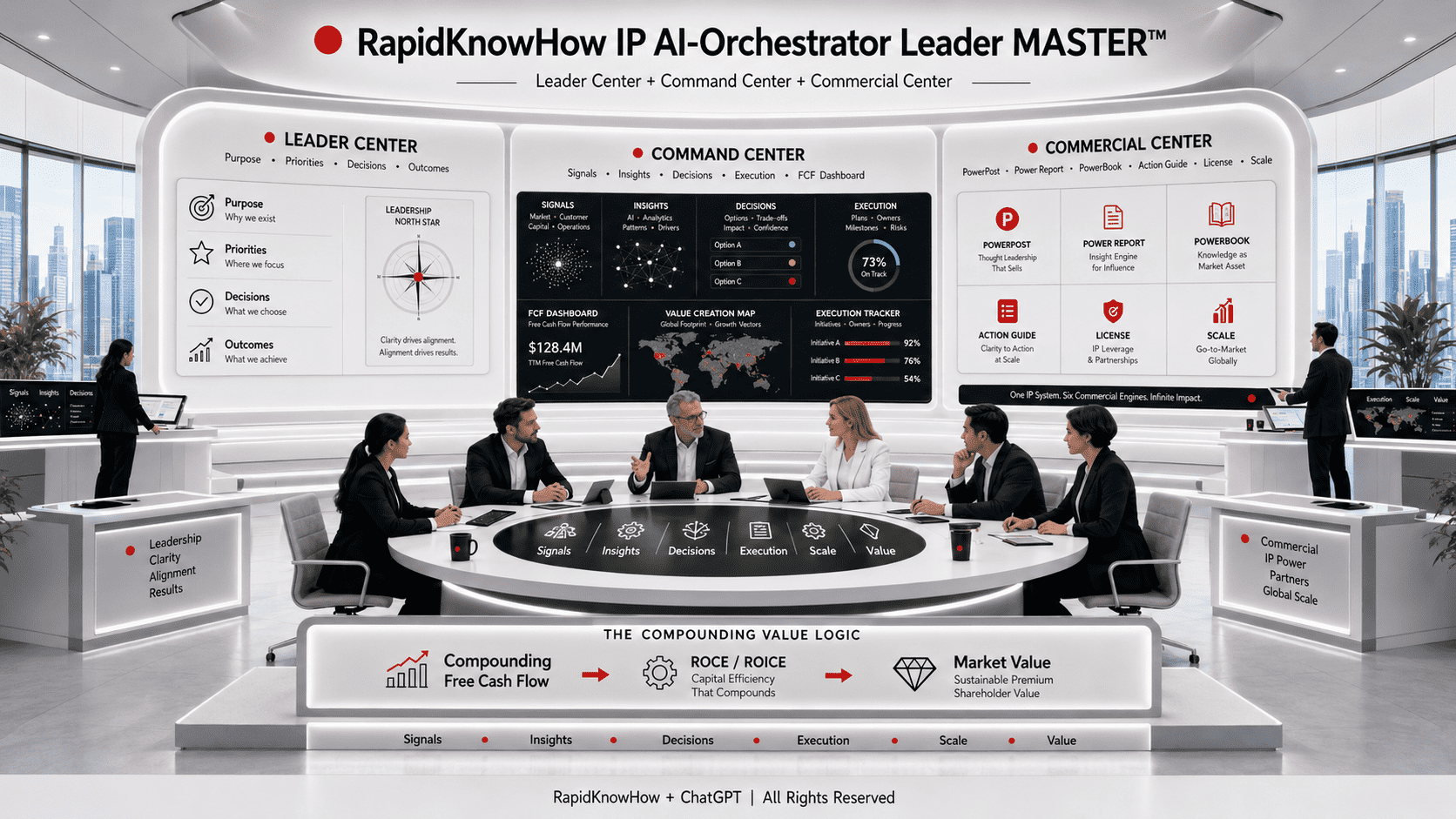
2. The RapidKnowHow AI-Orchestrator B2B Leader Lens
The assessment uses six questions.
1. Signal Radar
Does Siemens detect the right market signals early?
2. Insight Engine
Does Siemens translate signals into strategic direction?
3. Decision Board
Does Siemens allocate capital and leadership focus to the strongest value pools?
4. Execution Tracker
Does Siemens convert strategy into measurable implementation?
5. FCF / ROCE Logic
Does Siemens generate cash and capital productivity from transformation?
6. Commercial Center
Does Siemens package its capabilities into scalable offers, platforms and recurring value streams?
This lens does not only ask whether Siemens is innovative. It asks whether Siemens turns innovation into compounding business value.
3. Leader Center Assessment
The Siemens Leader Center is strong.
The company has a clear strategic direction: combining the real and digital worlds. This is a powerful positioning because the next stage of B2B transformation will happen in factories, buildings, infrastructure, mobility systems and critical industrial operations.
The leadership priority appears to be moving Siemens toward a more focused technology company with stronger software, AI and digital capabilities.
From the RapidKnowHow perspective, the strategic leadership logic is:
Focus the portfolio. Strengthen digital platforms. Improve capital allocation. Scale high-margin software and service models. Convert industrial expertise into recurring value.
The Leader Center score is high because Siemens has:
- Clear strategic positioning
- Strong B2B credibility
- Global customer access
- Deep industrial know-how
- Strong capital base
- Digital growth ambition
- Ability to acquire and integrate software capabilities
Main leadership risk: Siemens may become too complex if the transformation is not simplified into clear customer outcome systems.
4. Command Center Assessment
The Siemens Command Center is the operational intelligence layer.
Siemens has the ingredients for a powerful Command Center:
- Installed base in industry and infrastructure
- Automation data
- Building and energy data
- Mobility system data
- Software platforms
- Customer process knowledge
- AI and digital twin capabilities
- Financial strength
The strategic question is whether Siemens can turn these ingredients into real-time customer value systems.
In RapidKnowHow terms, the Command Center should answer:
What is happening in the customer’s operation?
Where is productivity lost?
Where is energy wasted?
Where is downtime rising?
Where is asset utilization weak?
Where can AI improve engineering, maintenance, safety, cost and speed?
Where can Siemens create measurable Free Cash Flow for the customer?
This is the key opportunity:
Siemens can become the operating intelligence partner for industrial customers.
Not only supplier.
Not only software vendor.
Not only equipment provider.
But B2B transformation orchestrator.
Main Command Center risk: too many dashboards, too little decision logic. The winning model must connect data to decisions, decisions to execution, and execution to measurable business impact.
5. Commerce Center Assessment
The Commerce Center is where Siemens must turn intelligence into scalable revenue.
The most powerful Siemens commercial transformation is the shift from product sales to outcome-based B2B value systems.
Traditional model:
Product → Project → Revenue
New model:
Platform → Insight → Customer Outcome → Recurring Revenue → Free Cash Flow → Market Value
The strongest Siemens Commerce Center opportunities include:
- Industrial AI solutions
- Digital twin applications
- Energy efficiency systems
- Smart building operating models
- Factory automation upgrades
- Predictive maintenance
- Lifecycle service contracts
- Software subscriptions
- Xcelerator-based ecosystem offers
- Customer transformation programs
- Financing-enabled solution packages
The value proposition should not be “buy Siemens technology.”
It should be:
Use Siemens to improve productivity, resilience, energy performance, asset efficiency and industrial Free Cash Flow.
This is the core B2B transformation shift.
6. Free Cash Flow Lens
Free Cash Flow is the truth number of transformation.
A B2B transformation is only valuable if it improves:
- Customer productivity
- Siemens margin quality
- Recurring revenue
- Capital efficiency
- Cash conversion
- Pricing power
- Customer retention
- Platform scalability
Siemens’ reported strong Free Cash Flow in Q2 FY2026 supports the case that the company has the financial strength to continue investing, integrating and scaling.
But the strategic question remains:
Can Siemens make Free Cash Flow compound through software, AI, services and platform-based business models?
If yes, Siemens can increase quality of earnings and market value.
7. ROCE / ROICE Lens
Siemens’ transformation should ultimately improve return on capital.
The ROCE / ROICE logic is:
Better portfolio focus → better capital allocation → higher-margin software and services → stronger cash generation → improved capital productivity.
The biggest value lever is moving more of the company’s growth toward scalable, asset-light, recurring or high-margin digital-industrial revenue.
This does not mean abandoning hardware. Siemens’ advantage is precisely the combination of hardware, software and domain expertise.
The goal is:
Use the physical installed base as the platform for digital and AI-enabled recurring value.
That is where ROCE / ROICE improvement can become powerful.
8. Market Value Lens
Market value rises when investors believe that future cash flows are:
- Growing
- Resilient
- High quality
- Capital efficient
- Scalable
- Defensible
Siemens has strong potential because it operates in markets with long-term structural demand:
- Automation
- Electrification
- Infrastructure modernization
- Energy efficiency
- Industrial AI
- Mobility modernization
- Digital twins
- Software-defined industry
The market value opportunity is to be perceived not as a traditional industrial group, but as a leading industrial AI and software-enabled infrastructure company.
The multiple can improve if investors see:
More recurring revenue. More software growth. Better margin quality. Stronger Free Cash Flow. Higher capital productivity. Clearer portfolio focus.
9. RapidKnowHow Strategic Assessment
Strengths
Siemens has strong industrial credibility, global scale, deep customer access, strong technology assets, digital growth momentum and a relevant AI transformation narrative.
Weaknesses
The company remains complex. Complexity can slow decisions, weaken accountability and reduce the clarity of the external investment story.
Opportunities
Siemens can become the leading AI-Orchestrator for industrial transformation, smart infrastructure, mobility and digital operations.
Threats
Competitive pressure comes from industrial peers, software companies, cloud platforms, automation specialists, energy technology firms and fast-moving AI-native challengers.
10. Strategic Recommendation
Siemens should be assessed and positioned through a simple value chain:
Leader Center → Command Center → Commerce Center → Free Cash Flow → ROCE / ROICE → Multiple → Compounding Market Value
Leader Center
Sharpen strategic priorities and simplify the transformation story.
Command Center
Turn industrial and infrastructure data into customer decision systems.
Commerce Center
Package solutions into repeatable, scalable, outcome-based B2B offers.
Free Cash Flow
Measure transformation by cash impact, not only revenue growth.
ROCE / ROICE
Improve capital productivity through software, services and scalable platforms.
Multiple
Earn a stronger valuation through recurring, resilient and high-quality cash flows.
Compounding Market Value
Convert industrial trust, AI capability and customer outcomes into long-term enterprise value.
Final Strategic Fazit
Siemens is a leading B2B transformation case because it has the rare combination of industrial depth, digital capability, customer trust and global scale.
Through the RapidKnowHow IP AI-Orchestrator B2B Leader Lens, Siemens should be seen as a company moving from industrial technology provider to AI-enabled value orchestrator.
The next game is not only automation.
The next game is orchestration.
Siemens wins if it turns industrial intelligence into customer outcomes, customer outcomes into Free Cash Flow, Free Cash Flow into ROCE / ROICE, and ROCE / ROICE into compounding market value. – Josef David