
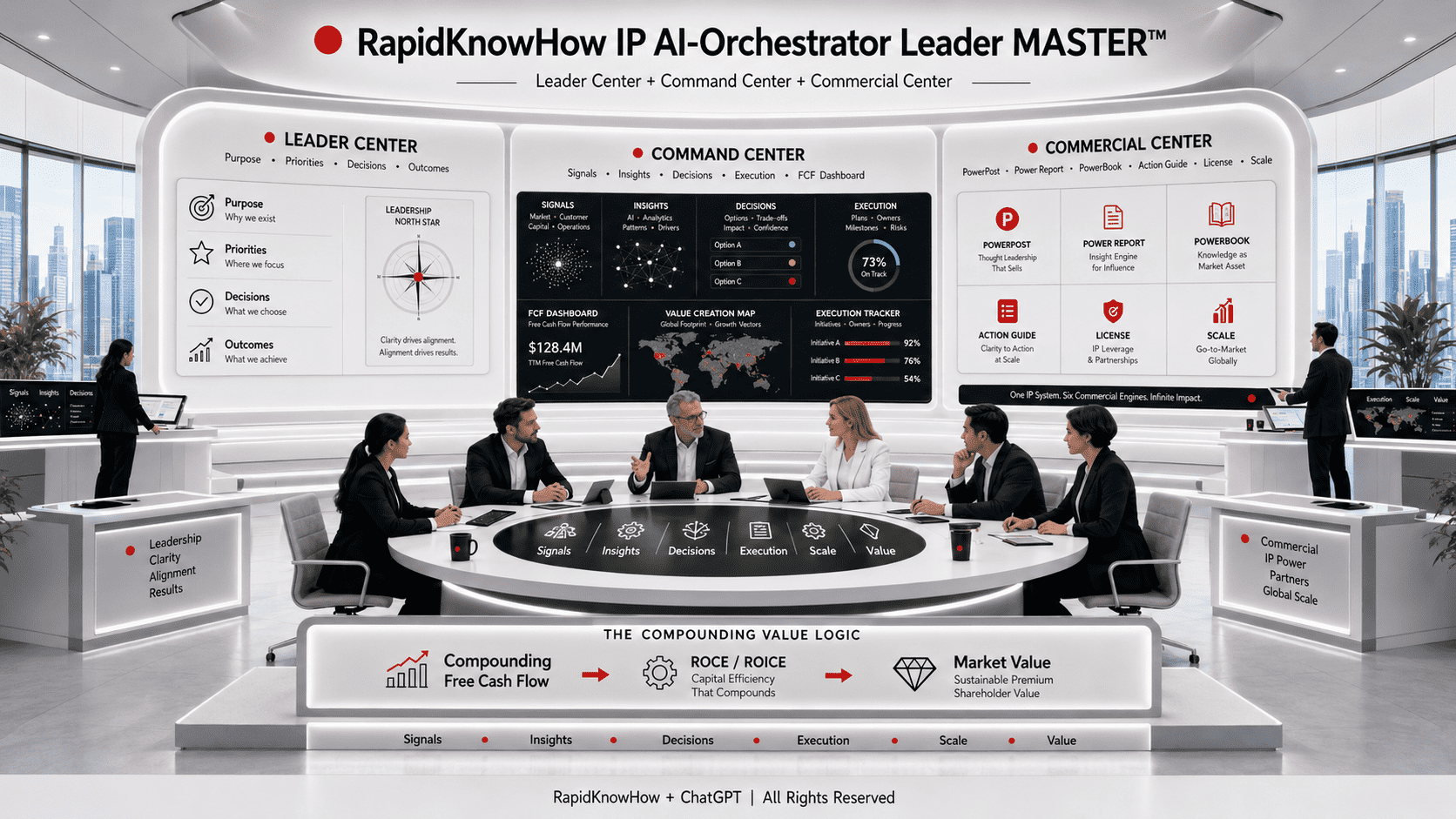
Assessment through the RapidKnowHow IP AI-Orchestrator B2B Leader Lens
Automotive Transformation + Software + China Reset + Cost Discipline + FCF Recovery
Author: Josef David
RapidKnowHow + ChatGPT
Executive Summary
Volkswagen Group is one of the most important B2B transformation cases in Europe because it represents the full complexity of the automotive transition: combustion-to-electric shift, software-defined vehicles, China competition, platform transformation, labor restructuring, brand complexity, capital intensity and Free Cash Flow discipline.
Volkswagen is not simply an EV case. It is a system transformation case.
The Group must orchestrate brands, platforms, software, factories, suppliers, dealers, financial services, China partnerships, European labor structures and customer demand into one coherent value system.
In 2025, Volkswagen Group reported sales revenue of €321.9 billion, operating result of €8.9 billion, operating margin of 2.8%, and Automotive Division net cash flow of €6.4 billion. In Q1 2026, it reported sales revenue of €75.7 billion, operating result of €2.5 billion, operating return on sales of 3.3%, and Automotive Division net cash flow of €2.0 billion.
Through the RapidKnowHow IP AI-Orchestrator B2B Leader Lens, the key question is:
Can Volkswagen turn scale, brands, platforms and industrial capability into software-enabled, cash-generative, capital-disciplined mobility value?
The strategic value chain is:
Brand Portfolio → Platform Architecture → Software + China Speed → Operational Restructuring → Customer Outcomes → Free Cash Flow → ROCE / ROICE → Multiple → Market Value
The RapidKnowHow assessment:
VW wins if orchestration beats complexity. VW loses if complexity absorbs cash faster than transformation creates value.
1. Why Volkswagen Matters
Volkswagen matters because it is one of Europe’s largest industrial systems. It is not only a carmaker. It is a network of brands, suppliers, factories, financing arms, software units, engineering centers, dealer systems and national industrial interests.
That makes VW strategically important for:
- European industrial competitiveness
- German manufacturing employment
- Supplier ecosystems
- EV transition
- Software-defined vehicles
- Battery and platform strategy
- China market competition
- Capital allocation in asset-heavy industries
VW’s transformation is therefore more than a company story. It is a test case for whether a large European industrial group can reinvent itself under pressure from faster, leaner, software-driven and China-based competitors.
The transformation problem is clear:
VW has enormous scale, but scale only creates value if it becomes speed, quality, software capability, pricing power and Free Cash Flow.
2. RapidKnowHow AI-Orchestrator Lens
The RapidKnowHow lens assesses VW through six dimensions:
- Leader Center – strategic focus, portfolio direction, capital allocation and transformation discipline.
- Command Center – operational intelligence, software progress, platform cost, China speed, factory productivity and FCF monitoring.
- Commerce Center – customer value offers, fleet solutions, software services, financing, aftersales and mobility packages.
- Free Cash Flow – cash generation from operations after capex, restructuring and technology investment.
- ROCE / ROICE – capital productivity across platforms, factories, brands and software.
- Multiple / Market Value – investor confidence in future cash flow quality and transformation credibility.
The decisive question is not whether VW can build vehicles. It can.
The decisive question is whether VW can orchestrate its system into a profitable, fast, software-enabled mobility business.
3. Leader Center Assessment
VW’s Leader Center faces one of the toughest tasks in global industry: simplify a complex group while transforming products, software, factories, cost base and regional strategy.
The leadership priorities are:
- Restore margin quality.
- Improve cost competitiveness in Germany and Europe.
- Rebuild competitiveness in China.
- Accelerate software-defined vehicle capability.
- Reduce platform complexity.
- Improve brand accountability.
- Protect premium value at Audi, Porsche and other higher-margin assets.
- Make volume brands profitable again.
- Convert EV transition into profitable growth, not cash drain.
Volkswagen’s 2025 operating result fell sharply to €8.9 billion from €19.1 billion in 2024, with operating return on sales down to 2.8%. The company cited impairments and expenses linked to Porsche’s adjusted product planning among key drivers of the decline.
This means the Leader Center must be brutally disciplined.
The Group needs fewer transformation slogans and more operating clarity:
Which platforms win? Which brands create cash? Which projects destroy returns? Which factories are competitive? Which software systems create customer value? Which regions deserve capital?
Leader Center Score: 7.5/10
VW has scale, brands and engineering power. But leadership complexity remains high.
4. Command Center Assessment
VW needs a powerful Command Center because its transformation is too complex for traditional reporting cycles.
A VW AI-Orchestrator Command Center should monitor:
- Brand profitability
- Platform cost
- EV margin by model
- Software defect rates and release speed
- China model development speed
- Factory productivity
- Battery cost exposure
- Supplier risk
- Dealer and fleet demand
- Working capital
- Capex commitments
- Restructuring progress
- Free Cash Flow impact
- Customer satisfaction
- Warranty and quality signals
The China situation shows why this is essential. Volkswagen aims to make the majority of its vehicles in China on its China Electronic Architecture by 2030. The architecture is intended to allow vehicles to be developed up to 30% faster and 40% cheaper than older MEB-based processes, helping VW respond faster to Chinese competitors.
This is Command Center logic in action:
Local signal → local architecture → faster development → lower cost → better customer fit → competitiveness recovery
VW’s reported workforce-reduction plans in Germany also show the urgency of cost-command discipline. Reuters reported that Volkswagen aims to cut 19,000 jobs in Germany by the end of 2026 as part of broader restructuring, with factory costs at German sites already reduced by 20% by 2025.
Command Center Score: 7.5/10
VW has the data and operating scale. The challenge is speed, accountability and execution discipline.
5. Commerce Center Assessment
VW’s Commerce Center must transform the customer and revenue model.
Traditional automotive logic:
Vehicle sale → dealer margin → financing → service
New automotive logic:
Vehicle platform → software layer → services → fleet/data/energy ecosystem → lifecycle revenue → customer loyalty → Free Cash Flow
VW’s Commerce Center opportunities include:
- Software-defined vehicle services
- Fleet and corporate mobility packages
- Subscription features where customers see real value
- Charging and energy services
- Used-car and lifecycle value management
- Aftersales digitization
- Financing and insurance integration
- Commercial vehicle solutions
- Battery health and residual-value services
- China-specific smart vehicle offers
- Brand-specific customer communities
The Commerce Center challenge is that customers will not pay for “digital features” unless they solve real problems.
The customer value must be clear:
- Lower total cost of ownership
- Better safety
- Better charging experience
- Better fleet uptime
- Better residual value
- Better software experience
- Better energy efficiency
- Better service convenience
VW must shift from selling cars to orchestrating lifetime mobility value.
Commerce Center Score: 7/10
The potential is huge, but the execution burden is high.
6. Free Cash Flow Lens
Free Cash Flow is the truth number for VW.
The Group can report large revenue, deliveries and market presence, but transformation success depends on whether cash remains after investment, restructuring and technology spending.
VW’s Automotive Division net cash flow was €6.4 billion in 2025, up 24% from 2024. In Q1 2026, Automotive Division net cash flow improved to €2.0 billion versus negative €828 million in Q1 2025.
This is positive. But VW’s transformation still consumes enormous capital.
FCF improves when VW:
- Reduces platform complexity
- Cuts fixed costs
- Improves factory productivity
- Raises EV margin quality
- Reduces software delays
- Improves China competitiveness
- Protects premium brand cash contribution
- Improves working capital
- Prioritizes profitable models
- Avoids low-return capex
- Scales software and service revenue
- Improves pricing discipline
The RapidKnowHow FCF question:
Does each transformation action create cash discipline or consume cash without strategic return?
FCF Potential Score: 7.5/10
VW has cash-generating power, but transformation cash demands remain very high.
7. ROCE / ROICE Lens
VW’s ROCE / ROICE challenge is capital productivity.
The Group has factories, brands, platforms, software programs, battery investments, joint ventures, dealer networks and large R&D commitments. The risk is not lack of assets. The risk is too many assets producing too little return.
The RapidKnowHow ROCE / ROICE question is:
Which platforms, brands, software architectures and regions produce the best return on invested capital?
VW improves ROCE / ROICE by:
- Reducing platform duplication
- Increasing scale benefits per architecture
- Improving EV platform profitability
- Reducing engineering cycle time
- Using China architecture to lower development cost
- Cutting underutilized capacity
- Strengthening premium brand margins
- Using financial services intelligently
- Avoiding politically driven low-return investments
- Monetizing software and lifecycle services
- Improving supplier and battery cost economics
The China Electronic Architecture is strategically important because it targets faster and cheaper development. If successful, it can directly improve capital productivity in VW’s most difficult competitive market.
ROCE / ROICE Potential Score: 7/10
The upside is strong, but complexity and capital intensity are heavy.
8. Multiple and Market Value Lens
VW’s market value challenge is confidence.
Investors tend to discount complexity, low margins, slow transformation, governance friction and capital-heavy uncertainty. VW can improve its multiple if the market sees:
- Clearer brand accountability
- Higher margin resilience
- Better software execution
- Stronger China competitiveness
- Improved EV profitability
- Positive FCF trend
- Reduced German cost burden
- Capital discipline
- Simplified portfolio logic
- Credible recurring revenue streams
The market value narrative should shift from:
Large legacy auto group under pressure
to:
Capital-disciplined mobility technology group with strong brands, software-enabled customer value and improving cash conversion.
That shift is possible, but not automatic.
Market Value Potential Score: 7.5/10
9. Strategic Risks
Risk 1: Complexity Beats Speed
VW’s size can slow decisions while Chinese competitors move faster.
Risk 2: Software Execution
Software-defined vehicles require release speed, quality and user experience that traditional OEMs have struggled to master.
Risk 3: China Competition
BYD, Geely, Xpeng and other Chinese players challenge VW on speed, cost and smart features.
Risk 4: German Cost Base
High labor and factory costs pressure competitiveness.
Risk 5: EV Margin Pressure
EV growth without margin quality can destroy value.
Risk 6: Brand Portfolio Complexity
Multiple brands can create strategic reach, but also duplication and internal friction.
Risk 7: Political and Labor Constraints
Restructuring speed may be limited by social and political realities.
The RapidKnowHow warning:
VW wins if it converts scale into speed. VW loses if scale remains bureaucracy.
10. Strategic Recommendation
VW should be assessed and managed through this RapidKnowHow value chain:
Leader Center → Command Center → Commerce Center → Free Cash Flow → ROCE / ROICE → Multiple → Compounding Market Value
Leader Center
Simplify the transformation agenda: profitable EVs, software quality, China speed, platform cost, factory productivity and FCF discipline.
Command Center
Build a real-time Transformation Cockpit for software, platforms, factories, brands, China, cost, capex and cash.
Commerce Center
Turn vehicles into lifetime mobility value systems: fleet, financing, charging, software, service, residual value and energy integration.
Free Cash Flow
Make every strategic program pass the cash test.
ROCE / ROICE
Prioritize capital toward platforms, brands and regions with visible return paths.
Multiple
Earn investor confidence through fewer promises and more measurable execution.
Compounding Market Value
Convert strong brands, global scale, industrial expertise and software-enabled services into higher-quality future cash flows.
Final Strategic Fazit
Volkswagen is one of the defining B2B transformation cases of the decade.
It has global scale, powerful brands, engineering depth, industrial capacity and financial strength. But these advantages create value only if they are orchestrated with speed, software competence, customer relevance, cost discipline and capital productivity.
Through the RapidKnowHow IP AI-Orchestrator B2B Leader Lens, the decisive point is:
VW must become less of a complex industrial empire and more of an AI-orchestrated mobility value system.
The strategic line is:
Brand Portfolio + Platform Architecture + Software + China Speed + Cost Discipline → Customer Outcomes → Free Cash Flow → ROCE / ROICE → Multiple → Compounding Market Value. – Josef David