
RapidKnowHow® PowerReport
Transforming Concentrated Advantage into Mass Outcomes
Created by Josef David
Powered by ChatGPT
July 2026
EXECUTIVE SUMMARY
Throughout human history, a relatively small class of rulers, inventors, owners, priests, military leaders, financiers or technology companies has controlled resources that could subsequently be transferred to the mass population.
These resources included:
- Agricultural knowledge
- Land and water systems
- Writing and education
- Military technology
- Money and financial systems
- Machines and energy
- Media and communication
- Industrial production
- Digital platforms
- Data, algorithms and artificial intelligence
The resulting process has repeatedly produced two radically different outcomes.
The Wealth Path
A leading class develops an advantage, standardizes it, scales it and distributes its benefits.
The result can be:
Higher productivity → lower costs → broader access → increasing income → reinvestment → compounding wealth
The Disaster Path
A ruling class concentrates power, standardizes control, mobilizes the population and transfers the costs of its ambitions to society.
The result can be:
Concentrated power → mass manipulation → extraction → conflict → destruction → collapse
The central conclusion of this PowerReport is:
Class-to-Mass is neither inherently good nor inherently evil. It is a scaling system. Its outcome depends on who controls it, what is scaled, who receives the benefits and who carries the risks.
The decisive governance challenge is therefore not eliminating leadership, excellence, ownership or hierarchy.
It is ensuring that:
Concentrated capability creates distributed value rather than concentrated extraction and mass destruction.
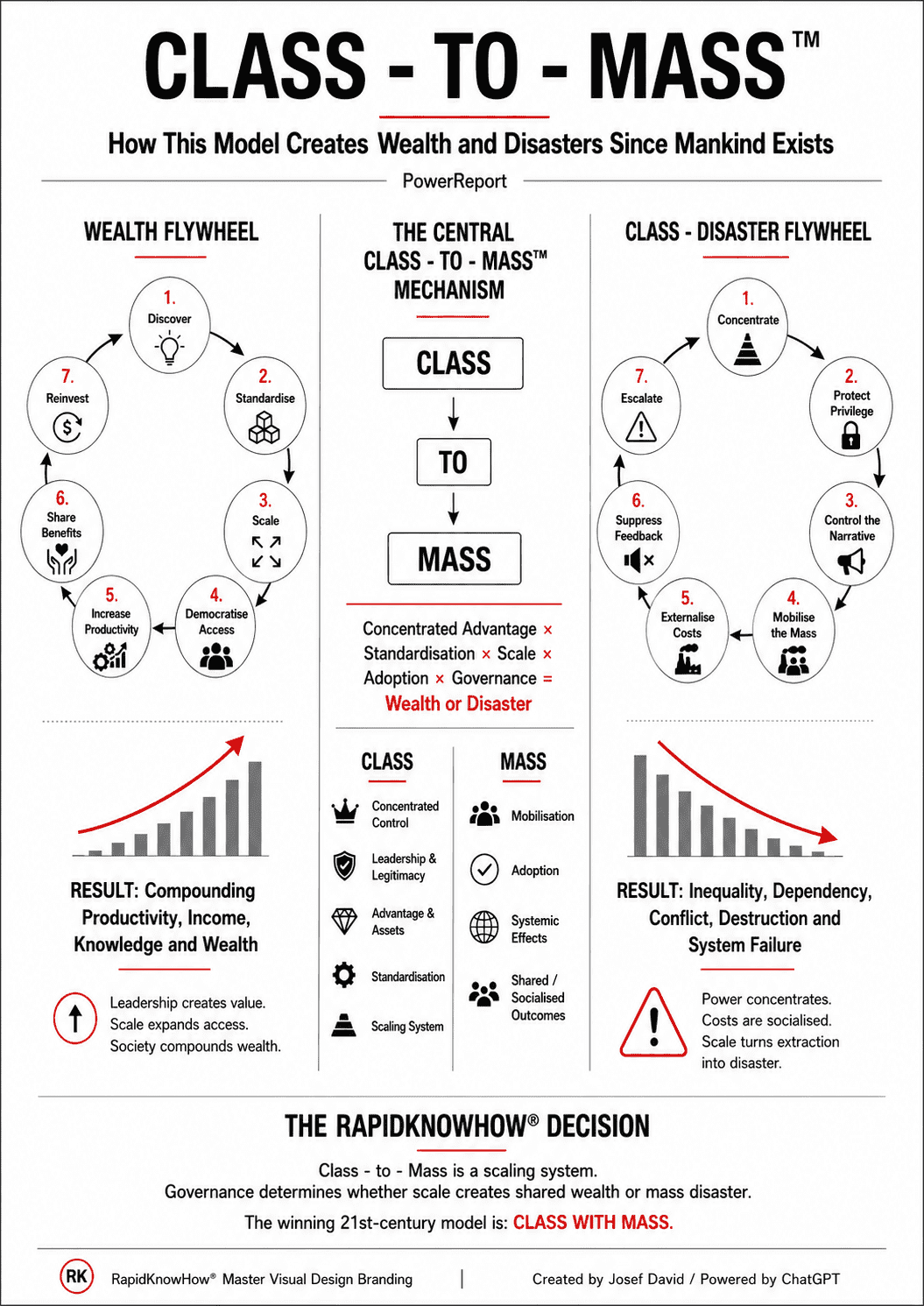
1. WHAT IS THE CLASS-TO-MASS™ MODEL?
The Class-to-Mass™ Model describes how an advantage initially controlled by a small group is transformed into large-scale economic, political or social outcomes.
CLASS
C — Concentrated Control
A limited group controls the critical resource:
- Land
- Knowledge
- Capital
- Technology
- Energy
- Communication
- Military power
- Institutions
L — Leadership and Legitimacy
The controlling group claims the authority to determine:
- What should be produced
- How society should be organised
- Which rules should apply
- Who should receive the benefits
- Who should bear the costs
A — Advantage and Assets
The class possesses a scarce advantage:
- Superior knowledge
- Better organisation
- Capital
- Technology
- Networks
- Legal privileges
- Military capability
- Control of information
S — Standardisation
The advantage is converted into a repeatable system:
- Standard products
- Standard laws
- Standard currencies
- Standard processes
- Standard education
- Standard messages
- Standard behaviour
S — Scaling System
Institutions, infrastructure and incentives allow the system to expand beyond its original creators.
MASS
M — Mobilisation
Large numbers of people are activated as:
- Workers
- Soldiers
- Consumers
- Taxpayers
- Voters
- Followers
- Data providers
- Platform users
A — Adoption
The population accepts, purchases, follows or is forced to use the system.
S — Systemic Effects
The effects become larger than the actions of any single participant.
These effects can include:
- Network effects
- Economic growth
- Urbanisation
- Social mobility
- Inequality
- Environmental damage
- Political polarisation
- War
S — Shared or Socialised Outcomes
The final benefits and costs are distributed across society.
However, they are rarely distributed equally.
Owners may receive the profits while society carries pollution, debt, unemployment or military risk.
2. THE FUNDAMENTAL CLASS-TO-MASS EQUATION
The strategic result of the system can be expressed as:
Mass Outcome
Concentrated Advantage × Standardisation × Scale × Adoption × Governance Quality
Governance quality determines whether scale becomes productive or destructive.
Positive Governance
- Benefits are broadly shared.
- Workers and citizens retain agency.
- External costs are controlled.
- Competition remains possible.
- Leaders remain accountable.
- Feedback can correct failure.
Negative Governance
- Benefits remain concentrated.
- Costs are transferred to outsiders.
- Information becomes controlled.
- Dissent is suppressed.
- Expansion becomes more important than sustainability.
- Leaders are protected from the consequences of their decisions.
The same organisational capabilities that can build hospitals, transport systems and communication networks can also build surveillance systems, propaganda machines and industrialised warfare.
3. THE HISTORICAL EVOLUTION
Phase 1: Agriculture and the First Surplus
Agriculture enabled societies to produce and store surpluses.
Surplus supported:
- Permanent settlements
- Specialised labour
- Administration
- Trade
- Military protection
- Monumental construction
- Early states
But stored surplus also created something that could be controlled, taxed, inherited or seized.
Archaeological research shows that social differentiation and wealth inequality existed in prehistoric societies and generally became more visible from the Neolithic and Bronze Age onward. Research on prehistoric Central Europe found persistent inequality even within upper social groups, while other studies connect centralised political, military and ritual power with early state formation.
Wealth Created
- Food security
- Division of labour
- Cities
- Trade
- Knowledge accumulation
- Organised infrastructure
Disaster Created
- Land concentration
- Forced labour
- Tax exploitation
- Hereditary privilege
- Organised warfare
- Vulnerability to crop and governance failure
The agricultural class converted control of land and surplus into control over the mass population.
Phase 2: Empires and Organised Scale
Empires developed the early infrastructure of mass integration:
- Roads
- Currencies
- Legal systems
- Administrative standards
- Tax systems
- Military networks
- Common languages
These systems could expand trade, improve coordination and transfer knowledge across vast territories.
Yet imperial scale also increased the capacity to extract resources from distant populations. Research comparing ancient Rome and Han China highlights how imperial structures increased the potential for economic inequality through large-scale extraction and redistribution.
Wealth Created
- Larger markets
- Transport networks
- Common commercial rules
- Urban development
- Cultural exchange
- Greater economic specialisation
Disaster Created
- Conquest
- Slavery
- Tribute systems
- Destruction of local autonomy
- Elite wealth concentration
- Repeated succession wars
The central imperial question was:
Was the mass population integrated to create shared prosperity—or subordinated to finance the ruling centre?
Phase 3: Religion, Writing and Institutional Knowledge
Writing allowed knowledge, law, taxation, religious doctrine and political authority to survive individual leaders.
Religious and administrative institutions created:
- Shared moral systems
- Education
- Social cohesion
- Long-term knowledge preservation
- Organised charity
- Legitimate authority
But they could also be used to define outsiders, prohibit competing ideas and justify wars or persecution.
The Class-to-Mass mechanism became informational:
A small literate class defined the worldview of a largely non-literate population.
The critical asset was no longer only land.
It was the authority to determine what was true, sacred, lawful and socially acceptable.
Phase 4: Printing, Finance and the Nation-State
Printing dramatically lowered the cost of reproducing ideas.
Knowledge that had previously been restricted to courts, monasteries and universities could reach much larger populations.
This supported:
- Literacy
- Scientific exchange
- Political debate
- Commercial information
- Administrative coordination
- National identity
However, the same communication infrastructure also enabled:
- Religious propaganda
- Nationalist mobilisation
- Political manipulation
- Mass stereotyping
- Revolutionary agitation
- Centralised state control
Words, symbols and repeated narratives can prepare populations for organised violence. The United Nations identifies hate speech and dehumanisation as recurring precursors to atrocity crimes and genocide.
The printing revolution demonstrated a permanent Class-to-Mass principle:
The ability to distribute knowledge also creates the ability to distribute deception.
Phase 5: Colonial Companies and Global Extraction
European states and chartered companies combined:
- Military power
- Commercial capital
- Navigation
- Legal privilege
- Administrative systems
- International finance
A relatively small ownership class could control resources, labour and trade routes across large parts of the world.
Wealth Created
- Global trade networks
- Shipping infrastructure
- Financial innovation
- International exchange
- New production systems
Disaster Created
- Forced labour
- Slavery
- Resource extraction
- Destruction of local industries
- Artificial borders
- Political dependency
- Long-term institutional inequality
The benefits flowed disproportionately toward owners and imperial centres.
Many of the social, political and economic costs remained in the controlled territories.
This was Class-to-Mass without balanced participation:
The mass supplied labour, resources and risk. The class controlled ownership, pricing and strategic decisions.
Phase 6: The Industrial Revolution
The Industrial Revolution combined machinery, energy, capital and standardised production.
For most of history, average living standards had changed very slowly. Industrialisation eventually broke this pattern and enabled sustained increases in output and consumption per person.
The industrial Class-to-Mass system operated through:
Invention → factory → standardisation → mass production → falling unit costs → mass consumption
Over the longer term, economic growth and industrial development contributed to higher incomes, better health, education and declining extreme poverty. Historical estimates contain uncertainty, but the broad conclusion that average incomes increased and extreme poverty declined over the last two centuries is strongly supported.
Wealth Created
- Productivity growth
- Affordable products
- Transport
- Electricity
- Medical equipment
- Mass employment
- Growing consumer markets
- Expanding middle classes
Disaster Created
- Dangerous factories
- Child labour
- Urban overcrowding
- Labour exploitation
- Resource depletion
- Industrial pollution
- Extreme owner-worker power imbalances
Industrialisation proved that mass production can raise living standards enormously.
It also proved that productivity gains do not automatically produce fair participation.
Phase 7: Fordism and Mass Consumer Capitalism
Fordism combined standardised production with relatively well-paid mass employment.
Workers became consumers of the products they helped manufacture.
The model created a reinforcing cycle:
Higher productivity → higher wages → mass purchasing power → higher demand → larger production volumes
This was one of history’s most successful wealth-producing Class-to-Mass systems.
However, it also encouraged:
- Excessive consumption
- Planned obsolescence
- Corporate concentration
- Car-dependent development
- Household debt
- Environmental externalities
The industrial and consumer economy generated enormous material progress while also scaling fossil-energy use and greenhouse-gas emissions.
The IPCC estimates historical cumulative net carbon dioxide emissions of approximately 2,400 ± 240 gigatonnes between 1850 and 2019. It also finds that industry contributed almost half of the increase in global greenhouse-gas emissions during the early twenty-first century.
The costs of consumption were therefore not fully reflected in the price paid by the consumer.
They were partly transferred to:
- Future generations
- Communities near production sites
- Ecosystems
- Countries with lower historical emissions
- The global climate system
Phase 8: Mass Politics and Industrialised War
The modern nation-state gained the ability to mobilise millions through:
- Compulsory education
- National media
- Conscription
- Taxation
- Railways
- Industrial production
- Central banking
- National identity
This capacity supported public infrastructure and welfare systems.
But it also transformed warfare.
Previously limited military conflicts could become:
- Total wars
- Industrial arms races
- Mass conscription systems
- Propaganda campaigns
- Population displacement
- Mechanised destruction
The ruling and military classes could define the enemy, while the mass population supplied soldiers, taxes, labour and casualties.
The essential disaster mechanism was:
Elite conflict → mass narrative → mass mobilisation → industrial production → mass destruction
Phase 9: Welfare States and the Broad Middle Class
During the twentieth century, many countries developed institutions that distributed more of the benefits of industrial productivity:
- Public education
- Healthcare
- Social insurance
- Pensions
- Labour rights
- Progressive taxation
- Public infrastructure
- Wider home ownership
These systems partially transformed Class-to-Mass into Class-with-Mass.
The population was not merely a production input or consumer market.
Citizens became participants in national prosperity.
Nevertheless, global ownership remains highly concentrated. The World Inequality Report 2026 estimates that the top 10% own roughly three-quarters of global wealth, while the bottom half owns approximately 2%.
The International Labour Organization also reported that the global labour income share declined by 1.6 percentage points between 2004 and 2024.
These findings point toward a renewed separation between:
- Those who own scalable assets
- Those who depend primarily on labour income
Phase 10: Digital Platforms
Digital platforms created a new Class-to-Mass structure.
A small number of companies can provide services to billions of people with very low additional distribution costs.
The strategic assets are:
- Software
- User networks
- Data
- Algorithms
- Digital infrastructure
- Brand trust
- Platform standards
- Ecosystem control
Wealth Created
- Near-zero-cost information distribution
- Global communication
- Digital entrepreneurship
- New markets
- Faster innovation
- Lower transaction costs
- Access to knowledge
Disaster Risks
- Winner-takes-most markets
- Surveillance
- Behavioural manipulation
- Misinformation
- Addiction mechanisms
- Loss of privacy
- Platform dependency
- Concentrated control of public communication
The mass population simultaneously becomes:
- The customer
- The product
- The data source
- The distribution channel
- The content creator
- The target of algorithmic influence
4. THE AI CLASS-TO-MASS REVOLUTION
Artificial intelligence is the most powerful Class-to-Mass accelerator since industrialisation.
A relatively small group currently controls much of the frontier capability:
- Advanced chips
- Data centres
- Cloud infrastructure
- Foundation models
- Specialist talent
- Proprietary data
- Distribution platforms
Stanford’s 2026 AI Index reports that industry produced more than 90% of notable frontier models in 2025. The OECD warns that AI markets contain persistent competition risks arising from concentrated access to compute, data and skills, first-mover advantages and increasing vertical integration.
AI therefore creates two possible futures.
AI Wealth Future
AI capabilities are broadly accessible and used to:
- Improve productivity
- Accelerate scientific discovery
- Personalise education
- Improve healthcare
- Reduce administrative work
- Help smaller businesses compete
- Lower expert-knowledge costs
- Support better decisions
The Class-to-Mass process becomes:
Frontier intelligence → accessible tools → human augmentation → mass productivity → shared prosperity
AI Disaster Future
AI ownership and governance remain concentrated while the social costs are distributed.
Potential effects include:
- Extreme market concentration
- Labour displacement without participation
- Automated surveillance
- Political manipulation
- Autonomous weapons
- Information pollution
- Loss of human agency
- Dependency on a few infrastructure providers
The process becomes:
Concentrated intelligence → automated control → mass dependency → concentrated wealth → systemic vulnerability
The decisive AI question is not simply:
How intelligent will AI become?
It is:
Who will own the intelligence, who will orchestrate it, who will receive its economic benefits and who will carry the risks when it fails?
5. THE TWO CLASS-TO-MASS FLYWHEELS
THE WEALTH FLYWHEEL
1. Discover
A class of entrepreneurs, scientists or leaders develops a valuable advantage.
2. Standardise
The knowledge is converted into a repeatable product, process or system.
3. Scale
Capital, infrastructure and distribution multiply its reach.
4. Democratise Access
The mass population gains access at falling cost.
5. Increase Productivity
People and organisations produce more value with fewer resources.
6. Share Benefits
Workers, consumers, owners and society participate in the value created.
7. Reinvest
Surplus is invested in further innovation, infrastructure and capability.
Result
Compounding productivity, income, knowledge and wealth
THE DISASTER FLYWHEEL
1. Concentrate
A class gains control of critical resources and institutions.
2. Protect Privilege
Rules are designed to preserve the controlling position.
3. Control the Narrative
Information is selected, simplified or manipulated.
4. Mobilise the Mass
Fear, identity, dependency or incentives direct mass behaviour.
5. Externalise Costs
Workers, outsiders, taxpayers, future generations or nature carry the risks.
6. Suppress Feedback
Criticism is treated as disloyalty or obstruction.
7. Escalate
The system must expand to maintain legitimacy, growth or control.
Result
Inequality, dependency, conflict, destruction and eventual system failure
6. WHY CLASS-TO-MASS SYSTEMS FAIL
Failure 1: Ownership Without Responsibility
Decision-makers receive the upside but do not carry the full downside.
Examples include:
- Executives rewarded for short-term performance
- Governments transferring debt to future taxpayers
- Industries transferring pollution costs to society
- Military leaders protected from battlefield consequences
- Platforms profiting from engagement while society carries information damage
Failure 2: Scale Becomes the Objective
The original purpose is replaced by the pursuit of growth itself.
The organisation begins asking:
How can we become larger?
Instead of:
What sustainable value are we creating?
Failure 3: The Mass Loses Agency
People become passive:
- Consumers rather than owners
- Followers rather than participants
- Data sources rather than beneficiaries
- Soldiers rather than decision-makers
- Employees without influence over productivity gains
Failure 4: Standardisation Eliminates Diversity
Standardisation lowers costs, but excessive standardisation can eliminate:
- Local knowledge
- Independent thinking
- Competition
- Cultural diversity
- System redundancy
- Alternative solutions
The system becomes efficient but fragile.
Failure 5: Information Becomes Propaganda
Leaders stop using information to understand reality.
They use information to manufacture consent.
When feedback is suppressed, strategic errors compound until failure becomes unavoidable.
Failure 6: External Costs Accumulate
A business, empire or society can appear successful because it excludes important costs from its calculations.
These may include:
- Environmental damage
- Health effects
- Social instability
- Military risk
- Infrastructure degradation
- Lost human capabilities
- Future liabilities
The reported wealth may therefore be partly an unrecorded transfer from someone else.
7. THE RAPIDKNOWHOW® CLASS-TO-MASS GOVERNANCE TEST
Every scalable business, political movement, technology or social system should be assessed across seven dimensions.
Score each dimension from 0 to 5.
1. Value Creation
Does the system create demonstrable value—or merely transfer existing value toward its controllers?
2. Access
Can the wider population access the benefits at reasonable cost?
3. Participation
Can workers, users and citizens influence decisions that materially affect them?
4. Ownership
Do those who contribute to value creation participate in the resulting wealth?
5. Transparency
Can outsiders understand how decisions, prices, algorithms and risks are determined?
6. Externalities
Are environmental, social and geopolitical costs recognised and governed?
7. Resilience
Can the system absorb shocks, correct errors and survive leadership failure?
Interpretation
29–35: Compounding Wealth System
The class provides leadership and capability while the mass participates in value creation and outcomes.
22–28: Productive but Fragile System
The system creates substantial value, but ownership, externalities or accountability require correction.
15–21: Extractive System
Benefits are becoming concentrated while risks are increasingly socialised.
0–14: Disaster Escalation System
The system depends on control, manipulation, extraction or continuous expansion.
8. THE GOVERNANCE PRINCIPLES
Principle 1: Leadership Must Create More Value Than It Extracts
Superior rewards can be justified by superior contribution.
They cannot be justified merely by control of the system.
Principle 2: Scale Must Expand Participation
The larger the system becomes, the more important it is that employees, users, suppliers and communities participate in its gains.
Principle 3: Decision Rights and Consequences Must Remain Connected
Those making high-impact decisions must remain exposed to meaningful consequences.
Principle 4: External Costs Must Be Visible
A system cannot be considered profitable when important costs are transferred to society, nature or future generations.
Principle 5: The Mass Must Retain Agency
People must remain capable of:
- Leaving
- Choosing alternatives
- Challenging decisions
- Accessing information
- Building competing systems
- Participating in ownership
Principle 6: Concentrated Power Requires Distributed Oversight
The greater the concentration of capital, technology or information, the stronger the need for:
- Independent governance
- Transparent standards
- Competition
- Auditing
- Stress testing
- Democratic legitimacy
Principle 7: Human Purpose Must Govern Technology
Technology should increase human capability.
Humans should not be reorganised merely to serve the requirements of technology.
9. STRATEGIC APPLICATION FOR BUSINESS LEADERS
Every company is a Class-to-Mass system.
The leadership class controls:
- Capital allocation
- Strategic information
- Technology
- Organisation design
- Pricing
- Employment
- Investment priorities
Employees, customers, suppliers and communities form the mass system through which the strategy becomes reality.
The Traditional Extractive Model
Leadership decides → employees execute → customers pay → owners capture → society absorbs external costs
The Sustainable Wealth Model
Leadership orchestrates → employees contribute → customers benefit → participants share → society gains
The highest-value companies of the AI age will not merely own powerful technology.
They will govern ecosystems in which:
- Expertise is converted into scalable solutions.
- AI augments employees rather than merely removing labour.
- Customers receive measurable outcomes.
- Suppliers participate in long-term value creation.
- Risks are identified before they become crises.
- Productivity gains are converted into free cash flow and sustainable enterprise value.
10. THE RAPIDKNOWHOW® DECISION
Class-to-Mass has been one of mankind’s greatest wealth engines.
It has enabled humanity to:
- Accumulate knowledge
- Build cities
- Produce food at scale
- Develop medicine
- Industrialise production
- Educate billions
- Connect the world
- Create unprecedented economic output
But the same model has also enabled:
- Slavery
- Imperial extraction
- Industrial warfare
- Totalitarian control
- Mass propaganda
- Environmental degradation
- Extreme wealth concentration
- Digital surveillance
The difference was never scale alone.
The difference was governance.
FINAL CONCLUSION
Human progress requires exceptional individuals, capable leaders, innovators, investors and institutions.
The objective should not be to abolish the class capable of creating new systems.
The objective must be to prevent that class from converting capability into unaccountable control.
The winning model for the twenty-first century is therefore not:
Class Against Mass
Nor is it:
Mass Against Class
It is:
CLASS WITH MASS
A small group may discover, lead and orchestrate.
But the resulting system must:
- Create real value
- Expand access
- Distribute opportunity
- Preserve human agency
- Share economic gains
- Control external costs
- Remain accountable
The ultimate Class-to-Mass governance rule is:
Concentrate capability to create value.
Distribute opportunity to compound wealth.
Govern scale to prevent disaster.
RAPIDKNOWHOW® POWER SENTENCE
Class → Advantage → Standardisation → Scale → Mass Adoption → Governance → Wealth or Disaster
SOURCES AND CONFIDENCE
Core Sources
- Stanford Institute for Human-Centered Artificial Intelligence, AI Index Report 2026
- OECD, Artificial Intelligence Markets: Recent Developments and Competition Issues, 2026
- World Inequality Lab, World Inequality Report 2026
- International Labour Organization, labour-income and wage reports
- World Bank research on industrialisation, growth and poverty
- Our World in Data, historical economic growth and poverty research
- Intergovernmental Panel on Climate Change, Sixth Assessment Report
- United Nations, genocide prevention, hate-speech and atrocity-risk resources
- Peer-reviewed archaeological and historical inequality research published by Nature journals
Confidence Assessment
Historical direction: High
Economic growth and poverty relationship: High, with measurement uncertainty for early historical periods
Ancient inequality estimates: Medium to High, depending on archaeological proxies
Industrial and climate effects: High
AI ownership and infrastructure concentration: High
Future AI outcomes: Scenario-based; Medium confidence
Class-to-Mass™ causal framework: Proprietary analytical synthesis
RapidKnowHow® Method
Signal → Evidence → Historical Pattern → System Analysis → Scenario → Decision → Action
RapidKnowHow® — THE DECISION COMPANY™
Industrial Gas Leadership 2030
PROVE VALUE. THEN SCALE.
Watch the 60-second roadmap: 10 strategic actions for DACH and CEE, 2026–2030.
Start with ONE customer challenge. Use the Industrial Gas Action Guide to turn your first action into a measurable result.
RapidKnowHow® — Leading Industrial Gas Opportunity Signal Identifier in DACH & CEE