Grow, fix, redesign or exit — the decision leaders must make
Not every customer is a good customer.
In Industrial Gas, this truth is often hidden because revenue can look attractive while free cash flow is weak.
A customer may buy regularly, appear loyal, and generate visible turnover. But after delivery cost, cylinder usage, emergency service, special handling, overdue payments, weak pricing, contract risk, and administrative effort, the real value may be much lower than expected.
Some customers grow the business.
Some customers drain the business.
The leadership task is to know the difference.
The Wrong Question
Many companies ask:
How much revenue does this customer generate?
That is not enough.
The better question is:
How much controllable free cash flow does this customer create after cost-to-serve and capital use?
This changes the decision completely.
The Four Customer Groups
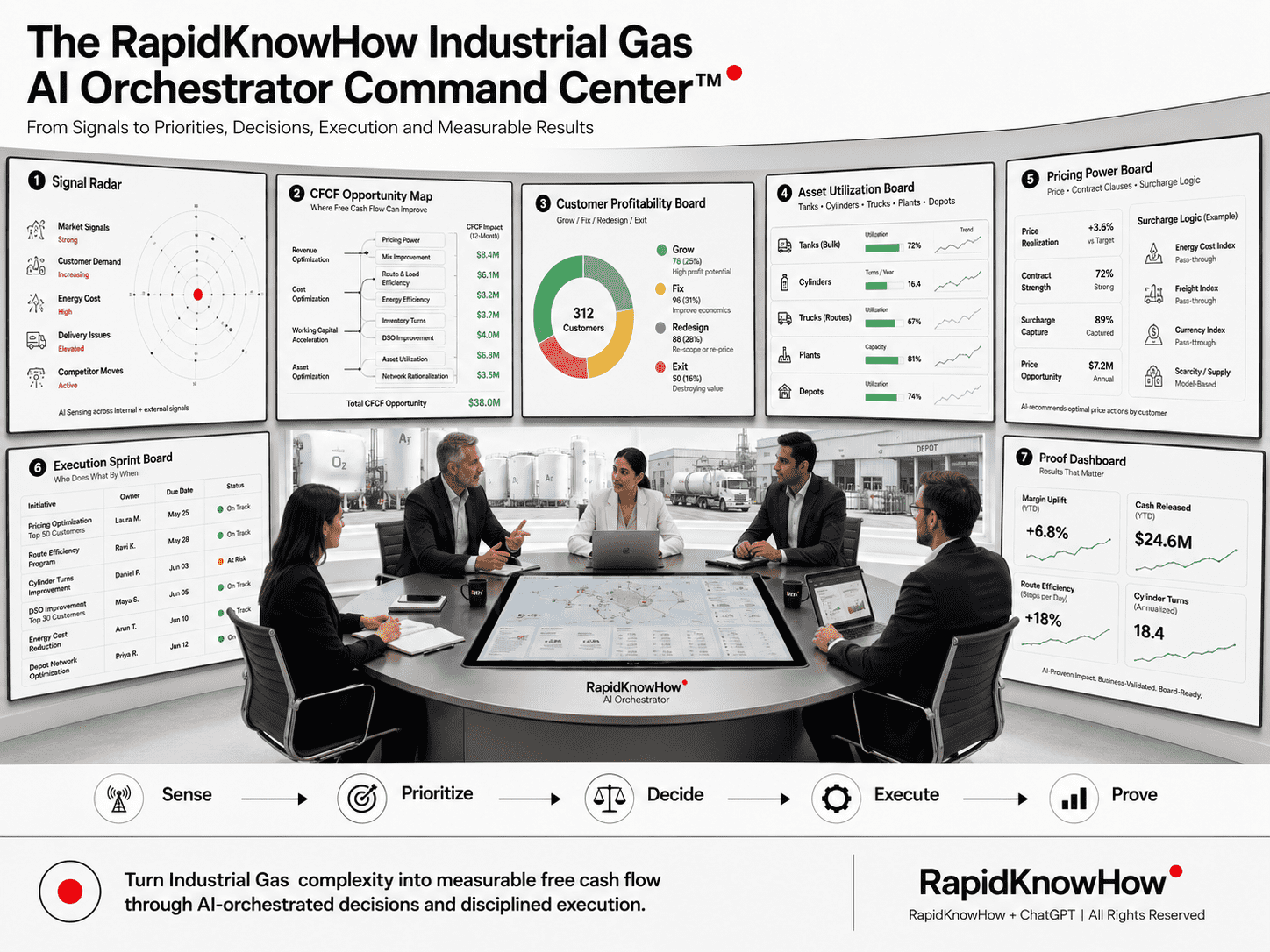
The RapidKnowHow Industrial Gas AI-Orchestrator Command Center™ classifies customers into four practical groups.
1. Grow
These customers create strong margin, good cash flow, strategic value, and efficient asset use.
Leadership action:
Protect them. Serve them well. Expand share of wallet. Offer value-added solutions.
2. Fix
These customers have potential, but current economics are weak.
They may need better pricing, improved contract terms, payment discipline, delivery rules, or product mix changes.
Leadership action:
Reprice, renegotiate, improve service discipline, and monitor improvement.
3. Redesign
These customers are not necessarily bad, but the current service model is wrong.
They may order too often in small quantities, require too many emergency deliveries, hold too many cylinders, or demand a service level that is not paid for.
Leadership action:
Change the service model: minimum order quantities, delivery windows, digital ordering, standard service tiers, surcharges, or bundled offers.
4. Exit
Some customers destroy value and have little strategic reason to continue.
They consume assets, create operational stress, delay payment, resist price correction, and absorb management attention.
Leadership action:
Exit professionally, reduce service, apply surcharges, or move them to a self-service model.
Why This Matters
Customer profitability is not only a sales topic.
It affects:
Margin
Delivery cost
Cylinder productivity
Depot workload
Receivables
Contract risk
Employee workload
Asset utilization
Free cash flow
ROCE
A weak customer portfolio can make an entire region look underperforming even when the market is attractive.
The AI-Orchestrator Decision Rhythm
The Command Center helps leaders run a weekly customer value review:
Sense: Identify customer signals
Prioritize: Rank by CFCF impact
Decide: Grow, fix, redesign, or exit
Execute: Assign owner and action
Prove: Measure margin and cash impact
This creates discipline.
No more vague discussion.
No more “all customers are important.”
No more revenue illusion.
The First 30-Day Customer Profitability Sprint
Week 1: Identify the bottom 20% of customers by CFCF contribution
Week 2: Diagnose the cause: price, service, asset use, receivables, contract, or delivery pattern
Week 3: Define customer action: grow, fix, redesign, or exit
Week 4: Start customer conversations and measure the first impact
Leader Action Sentence
Industrial Gas leaders should not manage customers by revenue alone; they should manage customers by free-cash-flow contribution, strategic relevance, cost-to-serve, and capital intensity.
Strategic Call-to-Action
Start with the Customer Profitability Board™ inside the RapidKnowHow Industrial Gas AI-Orchestrator Command Center™ and classify every key customer into one of four decisions: Grow, Fix, Redesign or Exit.