
Power Strategy to Accelerate Europe’s Strategic Position and Become the Strategy Leader in 2030
A) Executive Strategic Snapshot
Europe enters 2026 with a strong foundation but weak acceleration. The EU still has a massive single market, strong industrial know-how, high savings, advanced research, and trusted institutions. The European Commission states that the EU single market generates 17% of global GDP, European households hold around €10 trillion in savings, and the EU has trade agreements with 76 countries. These are not small assets; they are strategic power reserves.
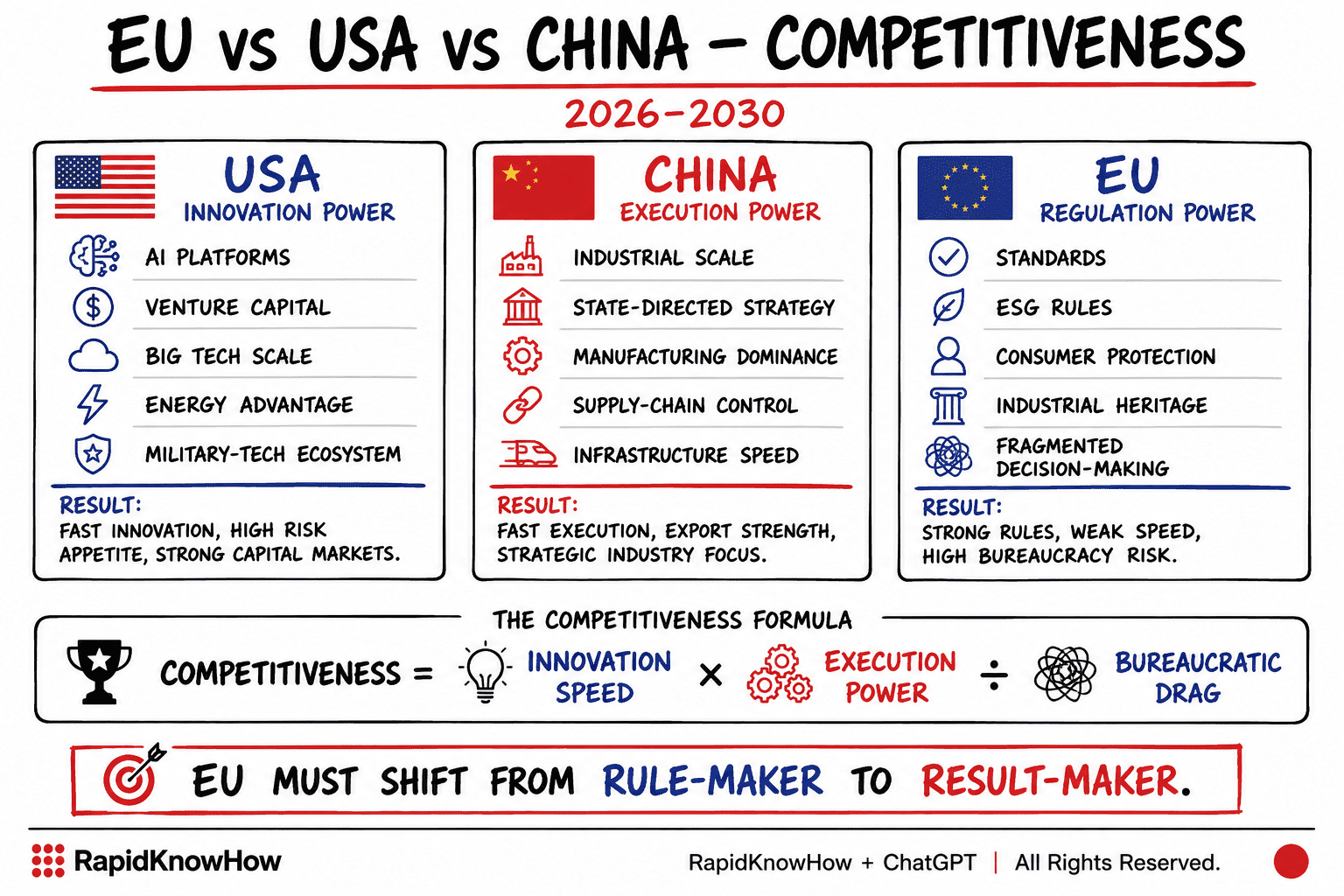
The problem is not that Europe lacks resources. The problem is that Europe converts resources into scale too slowly. The USA wins through innovation speed, capital-market depth, entrepreneurial execution, AI platform leadership, and a large domestic market. China wins through industrial scale, coordinated execution, infrastructure build-out, supply-chain control, and long-term state-directed industrial focus. Europe too often wins in rules, standards, caution, and fragmentation — but loses in speed, scale, and strategic concentration.
The 2026 competitiveness gap is visible in growth momentum. The IMF projects the United States to grow 2.3% in 2026 and 2.1% in 2027, supported by fiscal policy, earlier rate cuts, corporate investment incentives, technology momentum, and productivity gains. The euro area is projected to slow from 1.4% in 2025 to 1.1% in 2026 and 1.2% in 2027, with energy costs and manufacturing weakness weighing on performance. China is projected to grow 4.4% in 2026, supported by stimulus and lower-than-previously-assumed tariff pressure.
RapidKnowHow Strategic Diagnosis:
Europe is not poor. Europe is slow. Europe is not weak. Europe is fragmented. Europe is not without innovation. Europe fails too often to scale innovation into globally dominant platforms, industrial champions, and strategic cash-flow systems.
B) The Competitive Game: USA, China, EU
1. USA: Innovation-Speed Model
The USA leads through capital, software ecosystems, AI platforms, venture markets, management ambition, and speed of commercial deployment. Its system rewards risk, fast scaling, and market capture. The USA can absorb failure because its capital markets are deep and its entrepreneurial culture is execution-driven. The weakness: rising public debt, political polarization, tariff volatility, and dependence on global supply chains. The IMF projects U.S. public debt rising from 124% of GDP in 2025 to 142% in 2031, which shows the strength of U.S. growth is paired with fiscal risk.
2. China: Execution-Scale Model
China leads through coordination, manufacturing depth, infrastructure speed, industrial policy, and export capacity. Its power lies in moving from policy decision to physical deployment quickly: factories, ports, grids, logistics, batteries, solar, EVs, and supply chains. The weakness: demographic pressure, debt overhang, geopolitical distrust, export dependency, and lower consumer confidence.
3. EU: Regulation-Trust Model
Europe leads in standards, social stability, industrial heritage, sustainability credibility, engineering quality, and rule-based legitimacy. But this strength becomes a weakness when regulation grows faster than execution. The European Commission’s own Competitiveness Compass identifies three necessities: closing the innovation gap, decarbonising the economy, and reducing dependencies. It also names five horizontal enablers: cutting red tape, removing single-market barriers, enabling better financing, promoting skills, and improving coordination.
That is the right diagnosis. The 2026–2030 question is whether Europe can turn this into execution.
C) Power Strategy 2026–2030: From Rule-Maker to Strategy Leader
Strategic Objective 2030:
Europe becomes the world’s most trusted, fastest-scaling, sustainability-driven industrial and AI execution region.
Not the USA copy. Not the China copy. A European model: democratic, fast, investable, secure, innovative, and execution-focused.
Strategic Formula:
EU Competitiveness = Innovation Speed × Industrial Scale × Capital Mobilisation × Energy Advantage ÷ Bureaucratic Drag
1. Close the Innovation-to-Scale Gap
Europe produces research, talent, and deep technology. But too many companies remain small, sell early, or scale in the USA. The EU must create a 28th regime for scale-ups: one simple European company form, one digital registration process, one tax-light innovation corridor, one cross-border capital passport, one fast public-procurement path for strategic technologies.
The Commission already points toward a 28th legal regime, EU start-up and scale-up strategy, AI adoption, robotics, quantum, biotech, space, and advanced materials. The strategic task is to convert these into measurable execution KPIs: time to register, time to fund, time to permit, time to first public customer, time to cross-border expansion.
2030 Target: Europe creates at least 100 globally competitive scale-ups in AI, clean tech, health tech, industrial automation, defense tech, and advanced materials.
2. Mobilise European Savings into European Growth
Europe has savings, but not enough growth capital. The €10 trillion household savings base is a strategic weapon only if converted into productive investment. The EU must move from “savings parked safely” to “capital deployed strategically.”
This requires a true Savings and Investments Union, deeper capital markets, tax incentives for long-term equity investment, pension-fund participation, and European growth funds targeted at strategic sectors. The goal is not subsidy dependency. The goal is to create investable pipelines where private capital follows credible execution.
2030 Target: European growth capital becomes the default funding source for European scale-ups, instead of forcing them to move to U.S. capital markets.
3. Build a Clean Industrial Execution System
Europe cannot lead if energy-intensive industry faces permanently higher energy drag. The Commission’s Compass includes the Clean Industrial Deal, affordable energy action plan, and tailored action plans for chemicals, steel, and metals. This must become a practical industrial cost-reduction system.
Europe needs fast permitting for grids, nuclear where politically accepted, renewables, storage, hydrogen where economically justified, LNG flexibility, and long-term clean power contracts for industry. The purpose is not ideology. The purpose is competitive industrial power.
2030 Target: Europe becomes the preferred location for clean manufacturing, not merely the regulator of clean manufacturing.
4. Reduce Strategic Dependencies
Draghi’s competitiveness report stresses that the EU must coordinate trade agreements, direct investment with resource-rich nations, stockpiles in selected critical areas, and industrial partnerships to secure key technology supply chains. This is a hard-power competitiveness issue.
Europe must focus on raw materials, semiconductors, energy equipment, pharmaceuticals, defense inputs, AI infrastructure, industrial gases, and logistics corridors. Strategic autonomy does not mean isolation. It means no single external actor can paralyze European industry.
2030 Target: Europe controls or has trusted access to the critical inputs required for AI, energy transition, defense, healthcare, and advanced manufacturing.
5. Install a European Execution Governance Model
The EU needs an “Execution Cabinet” logic: fewer declarations, more delivery dashboards. Every strategic sector should have a board-style dashboard: investment committed, permits approved, plants built, jobs created, energy cost reduced, imports replaced, patents commercialized, scale-ups funded, and FCF impact generated.
The Commission says competitiveness starts with making business easier and faster and deepening the single market across all sectors. This must become Europe’s management mantra.
Execution Rule:
No major EU competitiveness initiative should be approved without a 90-day action map, 12-month delivery KPI, owner, budget, and public progress dashboard.
Final Strategic Conclusion
Europe can become the strategy leader by 2030 — but only if it stops confusing regulation with competitiveness. The USA teaches innovation speed. China teaches execution scale. Europe must combine both with democratic trust, industrial excellence, and sustainable value creation.
RapidKnowHow Bottom Line:
Europe’s winning position is not “USA-style capitalism” or “China-style state control.” Europe’s winning position is AI-orchestrated democratic execution: fast enough to compete, trusted enough to lead, industrial enough to matter, and strategic enough to keep European growth, capital, and innovation in Europe.
Sources & Reliability Assessment
For: EU versus USA and China: Competitiveness Report 2026
1. European Commission — Competitiveness Compass
The European Commission’s Competitiveness Compass is the core EU policy source for the report. It defines the EU’s three strategic necessities: closing the innovation gap, decarbonising the economy, and reducing dependencies. It also frames the need to translate the Draghi diagnosis into practical EU action.
Reliability: Very high. Official EU policy source.
Used for: EU strategic priorities, competitiveness pillars, innovation gap, decarbonisation, dependency reduction.
2. European Commission — Competitiveness Priorities 2024–2029
This source explains the Commission’s broader competitiveness agenda: making business easier, decarbonising the economy, driving innovation, tackling skills and labour shortages, and accelerating investment.
Reliability: Very high. Official EU Commission source.
Used for: EU execution agenda, business simplification, investment acceleration, skills and labour-force priorities.
3. Council of the European Union — Competitiveness Compass Overview
The Council summary confirms the strategic direction of the Competitiveness Compass and states that its purpose is to make business easier and faster while strengthening Europe’s prosperity. It also confirms the three major pillars: innovation, decarbonisation/competitiveness, and security/dependency reduction.
Reliability: Very high. Official EU Council source.
Used for: Cross-checking the EU competitiveness framework and the “faster/easier business” execution message.
4. Mario Draghi Report — The Future of European Competitiveness
The Draghi report is the foundational strategic diagnosis behind the EU competitiveness debate. It identifies the root causes of Europe’s weakening position in strategic sectors and proposes a new industrial strategy to restore competitiveness.
Reliability: Very high. Commission-hosted strategic report by Mario Draghi.
Used for: Europe’s structural weaknesses, industrial strategy, strategic dependencies, sectoral execution priorities, and the need for coordinated EU-level action.
5. IMF — World Economic Outlook, April 2026
The IMF’s April 2026 World Economic Outlook provides the macroeconomic baseline for the USA, China, the euro area, and the global economy. It is used to compare growth momentum and to frame the competitive pressure on Europe in 2026–2027.
Reliability: Very high. Primary international macroeconomic source.
Used for: Growth projections, macroeconomic risk environment, USA/euro area/China comparison, global uncertainty context.
6. IMF — World Economic Outlook, April 2026, Chapter 1
Chapter 1 provides additional detail on global prospects, China’s export-supported growth momentum, inflation and commodity-price risks, and the wider macroeconomic disruption caused by geopolitical conflict.
Reliability: Very high. Primary IMF analytical source.
Used for: China momentum, global risk environment, geopolitical and commodity-price pressure on competitiveness.
7. European Commission — General EU Competitiveness Page
This source confirms that the Commission is placing competitiveness at the heart of the EU economic agenda in response to AI, climate change, geopolitical tensions, and global economic transformation.
Reliability: Very high. Official EU source.
Used for: Framing competitiveness as a central EU priority and linking it to AI, geopolitics, innovation, and sustainable prosperity.
Clean Source Conclusion
The report is based primarily on official EU sources and IMF macroeconomic data, supported by the Draghi competitiveness diagnosis. The strongest sources are the European Commission Competitiveness Compass, the Draghi Report, and the IMF World Economic Outlook April 2026. Together they support the central conclusion:
Europe does not lack strategic assets. Europe lacks execution speed, capital mobilisation, industrial scale, and coordinated delivery. The 2030 opportunity is to transform the EU from a rule-making power into an execution-driven strategy leader. – Josef David