
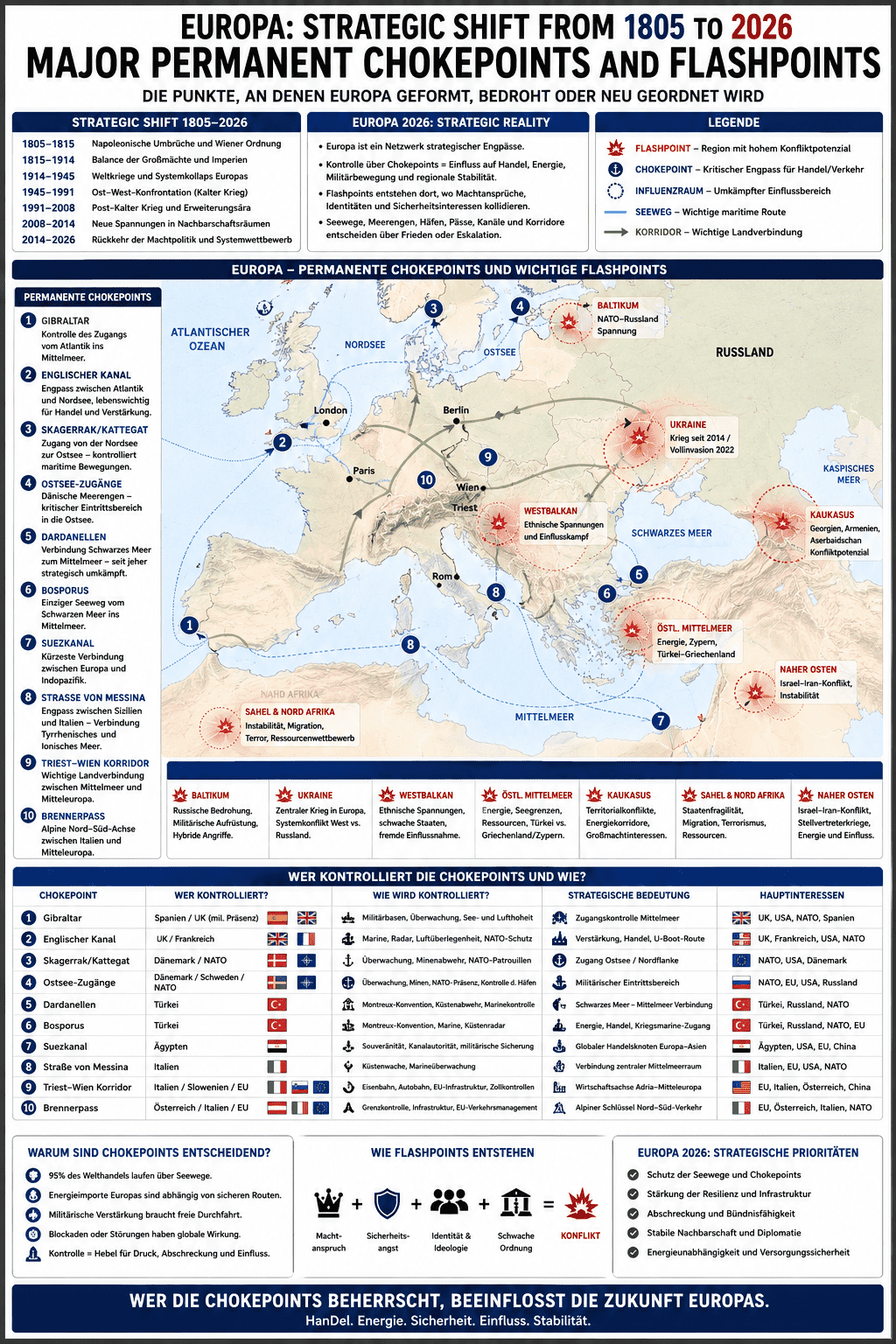
Major Permanent Chokepoints and Flashpoints
Europe’s Strategic Shift 1805–2026: The Permanent Chokepoints and Flashpoints That Shape Power
A RapidKnowHow Power Report on how sea gates, corridors, borderlands and conflict zones have shaped Europe’s trade, war, alliances, security architecture and geopolitical future from Napoleon to the Ukraine War.
Strategic Call-to-Action
See the chokepoint. Understand the flashpoint. Anticipate the power shift.
1. Executive Strategic Snapshot
Europe’s strategic history from 1805 to 2026 can be read through two enduring realities:
- Permanent chokepoints – narrow maritime, land and logistical gateways that shape trade, energy, military movement and strategic access.
- Recurring flashpoints – contested spaces where great-power rivalry, national identity, security fears and weak political order repeatedly collide.
The key lesson is simple:
Whoever influences Europe’s chokepoints can affect Europe’s commerce, military posture and resilience. Whoever mishandles Europe’s flashpoints can trigger wider systemic change.
From Napoleon’s wars to the Vienna settlement, from the collapse of empires in 1914–1918 and 1939–1945 to the Cold War, EU/NATO expansion and the Russia–Ukraine war, Europe has repeatedly been reshaped not by abstract ideas alone, but by control over gateways and instability in contested border zones.
2. The Strategic Shift Across Six Eras
1805–1815: Napoleonic Disruption
Napoleon showed that military mobility, continental control and blockade strategy could reorder Europe. Britain responded through naval dominance and maritime chokepoint protection. Already at this stage, Gibraltar, the Channel approaches, and Mediterranean access mattered.
Strategic shift: Europe learned that continental hegemony and maritime control are two different power systems.
1815–1914: Balance of Power and Imperial Competition
After Vienna, Europe aimed at stability, but the real contest continued through imperial competition, industrialization, nationalism and access to corridors and seas. The Balkans, the Straits, and the Black Sea region became increasingly sensitive. The rise of Germany changed the balance in Central Europe.
Strategic shift: Stability depended on balancing land powers, sea powers and collapsing imperial frontiers.
1914–1945: System Breakdown
The two world wars turned Europe’s transport axes, ports, seas and borderlands into military systems. The English Channel, Baltic access, Trieste/Adriatic access, the Dardanelles, and Central/Eastern European corridors all mattered. Flashpoints turned into fronts.
Strategic shift: Chokepoints became warfighting infrastructure; flashpoints became civilization-scale battlefields.
1945–1991: Cold War Europe
Europe became a divided strategic theatre. Chokepoints were now embedded into alliance systems: NATO and the Warsaw Pact. The Danish Straits, Turkish Straits, Channel, Mediterranean, Alpine corridors, and Central European plains all mattered as escalation routes or defensive barriers.
Strategic shift: Control moved from individual states to alliance architectures.
1991–2014: Expansion and Integration
The post-Cold War era seemed to reduce traditional geopolitics, but only on the surface. EU and NATO expansion moved the strategic frontier eastward. Logistics corridors, energy routes and ports gained importance. Trieste, Brenner, the Baltic gateway, and Black Sea access regained significance.
Strategic shift: Economic integration transformed some borders into supply routes, but did not remove geopolitics.
2014–2026: Return of Hard Geopolitics
Russia’s seizure of Crimea, the Donbas war, the full-scale invasion of Ukraine, Baltic insecurity, Eastern Mediterranean energy disputes and renewed focus on resilience have pushed Europe back into a security-first mindset.
Strategic shift: Europe is moving from a market-centered order to a resilience-and-security-centered order.
3. Europe’s Major Permanent Chokepoints
1. Gibraltar
The gateway between the Atlantic and the Mediterranean.
Why it matters: naval access, commercial shipping, energy routes, military mobility, monitoring sea traffic.
Core logic: whoever secures Gibraltar influences the western entrance to the Mediterranean.
2. English Channel / Dover Strait
The narrow connection between Britain and continental Europe.
Why it matters: trade, reinforcement, migration management, energy and military logistics.
Core logic: it is Europe’s most important short-distance maritime connector.
3. Danish Straits / Skagerrak / Kattegat / Øresund
The access system between the North Sea and the Baltic.
Why it matters: maritime trade, naval access, Baltic security, NATO north flank.
Core logic: control of Baltic access shapes the strategic environment for Scandinavia, Germany, Poland and the Baltic states.
4. Bosporus and Dardanelles
The gateway between the Black Sea and the Mediterranean.
Why it matters: Ukraine, Russia, Türkiye, grain exports, naval movement, Black Sea balance.
Core logic: without access through the Straits, Black Sea strategy is constrained.
5. Trieste / Northern Adriatic
A crucial access point for Central Europe to the Adriatic and wider Mediterranean system.
Why it matters: ports, logistics, energy, supply chain links for Austria, Southern Germany, Northern Italy and parts of Central Europe.
Core logic: it is a commercial and logistical maritime outlet for inland Europe.
6. Brenner Pass
The classic north–south alpine corridor between Italy and Central Europe.
Why it matters: freight, mobility, industrial supply chains, European land connectivity.
Core logic: it connects Mediterranean and Central European production systems.
7. Suwałki Corridor
The narrow land corridor between Poland and Lithuania, between Kaliningrad and Belarus.
Why it matters: NATO-Baltic security, land reinforcement, deterrence credibility.
Core logic: this is one of Europe’s most sensitive land chokepoints in the NATO–Russia confrontation zone.
8. Strait of Messina and Eastern Mediterranean Sea Lanes
Important connectors for Mediterranean shipping and naval movement.
Why they matter: trade, energy, regional naval posture.
Core logic: they link local geography to wider Mediterranean competition.
9. Suez-Linked Access
Though outside Europe, Suez remains strategically vital for Europe.
Why it matters: Europe–Asia trade, energy imports, container flows.
Core logic: Europe’s prosperity depends on extra-European sea chokepoints too.
4. Europe’s Major Recurring Flashpoints
1. The Balkans
The classic ignition zone of Europe.
Why it matters: overlapping identities, fragile state structures, external influence, corridor geography.
Historical role: from Ottoman decline to Sarajevo, Yugoslavia, Kosovo and current regional tensions.
2. Ukraine
The central flashpoint of Europe since 2014 and especially since 2022.
Why it matters: buffer-space logic, Black Sea access, Russian security claims, European order, food and energy systems.
Strategic meaning: Ukraine is the central collision zone between Russian revisionism and the Euro-Atlantic order.
3. Baltics / NATO–Russia Frontier
Sensitive due to geography, alliance commitments and proximity to Russia.
Why it matters: deterrence, escalation risk, information warfare, hybrid pressure.
Strategic meaning: small geography, large alliance consequences.
4. Caucasus
A hinge zone between Europe, Russia, Türkiye, Iran and Central Asia.
Why it matters: energy corridors, ethnic conflicts, transit routes, great-power influence.
Strategic meaning: instability here can spill into Europe’s wider security and energy framework.
5. Eastern Mediterranean
A conflict-prone space involving Türkiye, Greece, Cyprus, maritime claims, migration and energy resources.
Strategic meaning: sea rights, gas, naval reach and alliance friction overlap here.
6. Sahel / North Africa / Near East Interface
These are adjacent rather than internal European flashpoints, but they directly affect Europe through migration, terrorism, energy, trade and political spillover.
5. Who Controls Them – and How?
Chokepoints are rarely controlled by a single method. Control usually comes through a combination of:
- Territory – sovereign ownership or physical presence.
- Maritime power – navy, coast guard, patrols, port control.
- Air and surveillance dominance – radar, drones, monitoring systems.
- Infrastructure – ports, rail, roads, pipelines, tunnels, customs systems.
- Law and treaties – straits regimes, alliance commitments, shipping rules.
- Alliances – NATO, EU, bilateral defense ties, intelligence cooperation.
- Economic leverage – logistics, sanctions, insurance, energy supply.
- Narrative power – framing legitimacy, risk and response.
The deeper lesson is:
Chokepoints are controlled by systems, not just by maps.
And flashpoints are managed by resilience, deterrence and diplomacy—not by optimism alone.
6. Europe 2026: Strategic Priorities
Europe now faces five strategic priorities:
1. Secure the gateways
Protect sea routes, ports, straits and land corridors essential to trade and defense.
2. Build resilience
Reduce dependence on vulnerable routes, fragile suppliers and unstable border systems.
3. Strengthen deterrence
Especially in the Baltic, Black Sea and eastern frontier zones.
4. Keep diplomacy open
Flashpoints cannot be managed by force alone. Sustainable stability still requires political channels.
5. Integrate security and economy
Trade, logistics, energy and defense are now part of one strategic system.
7. Final Strategic Bottom Line
Europe’s strategic shift from 1805 to 2026 shows that geography has not disappeared. It has returned in a harder form.
Permanent chokepoints determine access.
Permanent flashpoints determine instability.
Power shifts occur when the control of both changes.
The countries, alliances and institutions that best understand these strategic gateways and pressure zones will shape Europe’s future. Those that ignore them will be surprised by crises they should have anticipated.
Final Sentence
Whoever understands Europe’s chokepoints and flashpoints understands how Europe is pressured, protected, connected and transformed.
B) RapidKnowHow Summary in One Sentence
Europe 1805–2026 is the story of how control over gateways and instability in border zones repeatedly changed trade, war, alliances and the political order of the continent. – Josef David
RapidKnowHow delivers the power to see Europe’s hidden strategic pressure points, understand who controls them and act before chokepoints become flashpoints.