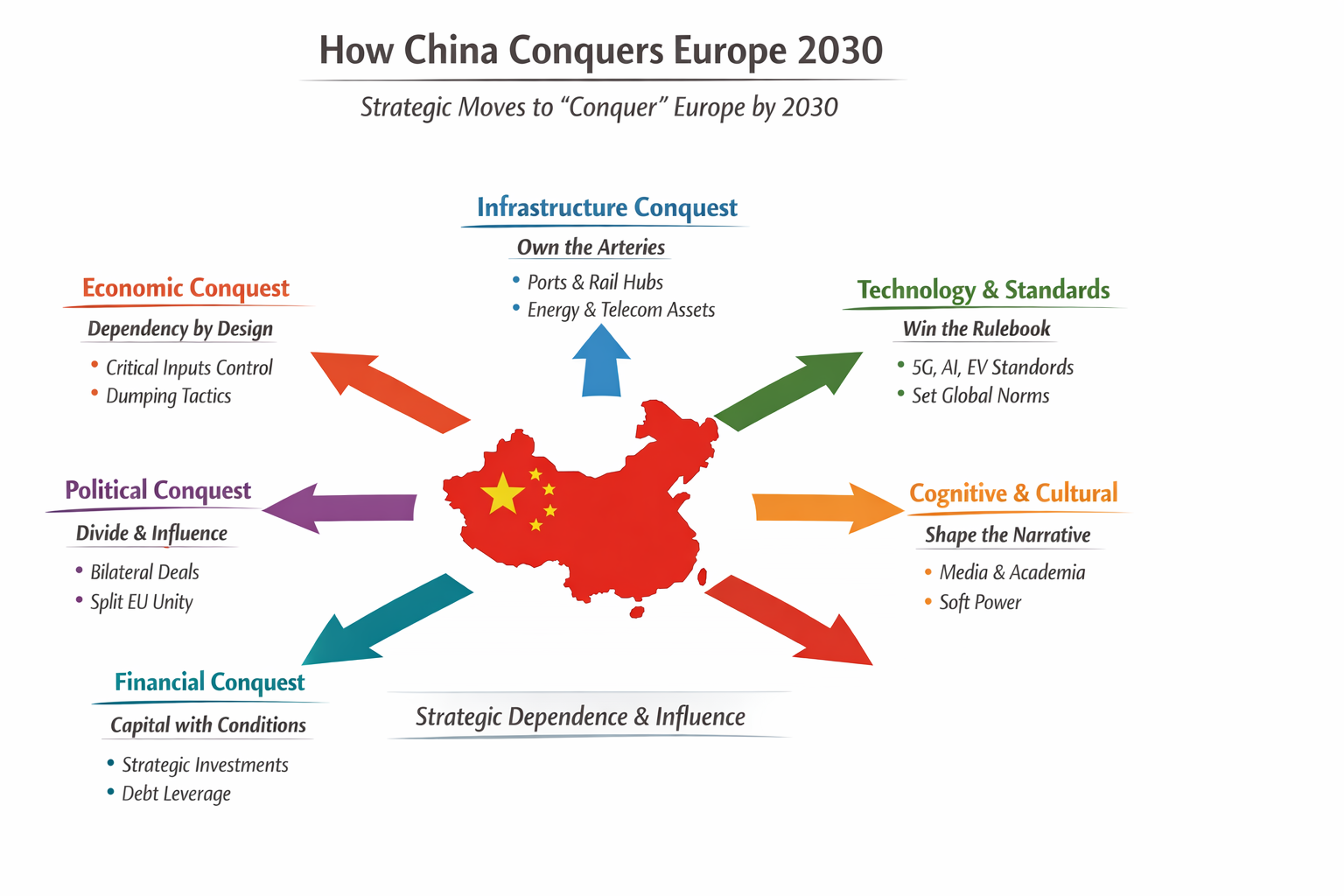
China doesn’t “take over Europe” in one move. The realistic pattern is incremental leverage: create dependencies, then convert them into bargaining power. Here’s a clear step-by-step map of how that leverage can grow—and what Europe can do to stop it.
The step-by-step playbook of leverage
1) Lock in industrial dependency (inputs Europe can’t quickly replace)
Target: critical raw materials, processed minerals, components (batteries, magnets, electronics), and key sub-supply chains.
Mechanism: scale + cost advantage + export controls (or the threat of them) → EU firms optimize for price → dependency deepens. Recent EU debate and reporting has focused heavily on critical raw materials and magnets specifically. Financial Times+2The Guardian+2
2) Win market share in “strategic transition sectors”
Target: EVs, solar, batteries, grid equipment—areas where Europe must invest at scale.
Mechanism: subsidized scale + aggressive pricing → pressure EU incumbents → political tension inside the EU about protection vs affordability. The EU’s anti-subsidy EV measures (tariffs/countervailing duties) are part of this battlefield. Bruegel+2Europäisches Parlament+2
3) Control logistics chokepoints and trade corridors
Target: ports, terminals, rail links, and “last-mile” logistics nodes that shape trade flow.
Mechanism: investment/ownership/long leases → data + routing influence + political leverage. Research and analysis frequently point to ports as strategic nodes (e.g., Piraeus; also broader BRI-linked port focus). Christopher Sanchez & Co.+2MDPI+2
4) Turn economic exposure into political fragmentation
Target: EU unity.
Mechanism: tailor benefits or pressure by country/sector (exports, tourism, specific industries) → governments split on “how tough to be.” This is a classic “divide the coalition” dynamic when member states face different pain points.
5) Expand standards and platform power
Target: technical standards, procurement ecosystems, digital platforms, and industrial “default settings.”
Mechanism: once a standard becomes embedded (hardware, software, interoperability), switching costs rise—dependency becomes structural.
6) Use trade disputes as signaling tools
Target: politically sensitive EU industries.
Mechanism: investigations/tariffs/market access tweaks to signal “costs” and encourage concessions. Recent EU-China trade friction has included retaliatory or parallel probes, while negotiations continue. Reuters+2Mercator Institut für Chinastudien+2
7) Acquire know-how via investment and partnerships where screening is weak
Target: dual-use tech, advanced manufacturing, energy tech, data-rich assets.
Mechanism: minority stakes, JVs, licensing, supplier integration—often easier than full takeovers. The EU has been tightening FDI screening and discussing stronger rules and coordination. Rat der Europäischen Union+2LawNow+2
8) Convert leverage into “policy outcomes”
Target: EU positions on sanctions, procurement rules, export controls, Taiwan posture, tech restrictions.
Mechanism: the implicit trade is: “stability of supply/market access” in exchange for softer positions or slower risk-mitigation.
What Europe can do (the counter-playbook)
- De-risk the few “single points of failure” first (magnets, battery materials, key chips, pharma precursors): reduce dependency where substitution time is longest. Financial Times+1
- Industrial capacity + demand-side tools: scale EU production and shape procurement so EU firms can survive the price war phase.
- Hard FDI screening + port/logistics scrutiny for assets that create systemic leverage. Rat der Europäischen Union+1
- EU unity mechanisms: joint purchasing (raw materials), compensation for the “most exposed” member states/industries to reduce fragmentation pressure. The Guardian+1
- Standards sovereignty: enforce interoperability and open standards so Europe can switch suppliers without ripping out whole systems.
- Measure coercion: build an internal “economic coercion dashboard” (dependencies, alternatives, stockpiles, switching time, political exposure) and trigger predefined responses.

EU pushes magnet recycling to cut reliance on China

EU looks at legally forcing industries to reduce purchases from China

China lowers EU pork tariffs in final ruling after 18-month probe
How China can gain leverage over Europe step-by-step (and how Europe Leverages its Power)
1) Dependency wedges (the quiet opener)
- Build critical import dependencies (components, rare earths/critical minerals, batteries, APIs/ingredients, solar supply chains).
- Result: Europe self-censors to avoid supply shocks; firms lobby against “risk” policy.
This is exactly why the EU frames its approach as “de-risking, not decoupling”—reduce vulnerabilities and critical dependencies. Trade and Economic Security
2) Technology capture (move from products to choke points)
- Compete aggressively in strategic tech (EVs, batteries, telecom equipment, AI hardware supply chains, industrial tooling).
- Gain position in standards, patents, and platform ecosystems.
- Result: European companies become “price takers” and lose strategic autonomy.
3) Infrastructure positioning (ports, logistics, energy nodes)
- Acquire/operate or strongly influence logistics nodes (ports, terminals, rail-linked hubs), plus upstream suppliers.
- Result: bargaining power in trade flows and political pressure via “jobs and investment” narratives.
4) Political fragmentation exploitation (27 doors instead of one)
- Work bilaterally with member states, regions, cities, companies.
- Reward “friendly” jurisdictions with market access; punish others informally.
- Result: EU unity erodes; policy becomes slow and inconsistent.
This is why the EU is reinforcing FDI screening across all member states to better handle security/public-order risks. Rat der Europäischen Union+2Reuters+2
5) Coercion-by-market-access (the pressure tool)
- Use trade/market access restrictions or informal boycotts as leverage.
- Result: companies and governments push for “pragmatic” compromise.
The EU has built a direct response instrument for this: the Anti-Coercion Instrument, in force since 27 Dec 2023. Trade and Economic Security+1
6) Information shaping + elite capture (narrative terrain)
- Influence operations, lobbying networks, “research partnerships,” paid supplements, social amplification.
- Result: confusion, polarization, and normalization of self-censorship (“let’s not upset Beijing”).
7) Security spillover (grey-zone signaling)
- Incidents and signaling around EU/NATO missions can raise pressure and uncertainty.
- Example: Germany accused China of a laser incident involving an EU mission aircraft (2025). Reuters
Leveraging the EU’s democracy power against authoritarian leverage
Think of democracy as a force multiplier if used deliberately:
A) Make “openness” conditional and strategic (not naive)
- Keep trade open but protect choke points:
- harden FDI screening (strategic sectors, dual-use, critical infrastructure). Rat der Europäischen Union+1
- use the EU’s economic security toolkit (promote/protect/partner) rather than ad-hoc bans. Trade and Economic Security+1
B) Build a “De-risking Scoreboard” (so politics can’t hide behind fog)
A simple public dashboard (EU + member state + major firms):
- % dependency in critical inputs (top 20 items)
- supplier concentration
- substitution lead time
- strategic stock coverage
- exposure to coercion (revenue-at-risk in single market)
This operationalizes the EU’s stated de-risking logic. Trade and Economic Security+1
C) Unite the 27 with one rulebook
- Minimum common standards for:
- investment screening
- export controls on sensitive tech
- procurement security requirements
- Goal: remove the “27 doors” advantage. Rat der Europäischen Union+1
D) Use the EU’s biggest weapon: the Single Market
- Europe’s market access is huge—use it to set standards (security, transparency, traceability).
- If a firm benefits from the EU market, it must accept EU-grade disclosure and compliance.
E) Compete where democracies win: trust + reliability
- Stable rule-of-law contracting, predictable regulation, anti-corruption enforcement.
- “Trusted supplier” ecosystems with Japan/Korea/Taiwan/US/Canada/UK and Global South partners—diversify, don’t isolate.
F) Civic resilience (the real “democracy power”)
- Transparency in lobbying and funding
- Media literacy + provenance labeling (who funded, who benefits)
- Political accountability: decisions tied to data (Scoreboard), not slogans
A practical EU counter-strategy in 7 moves (board-level)
- Map dependencies (90 days)
- Screen & block strategic acquisitions (continuous) Rat der Europäischen Union
- Diversify suppliers (12–24 months)
- Build EU capacity in key nodes (2–5 years)
- Trigger Anti-Coercion when pressured (fast response) Trade and Economic Security
- Standard-set via Single Market rules (continuous)
- Narrative discipline: publish the Scoreboard quarterly (so citizens see reality)