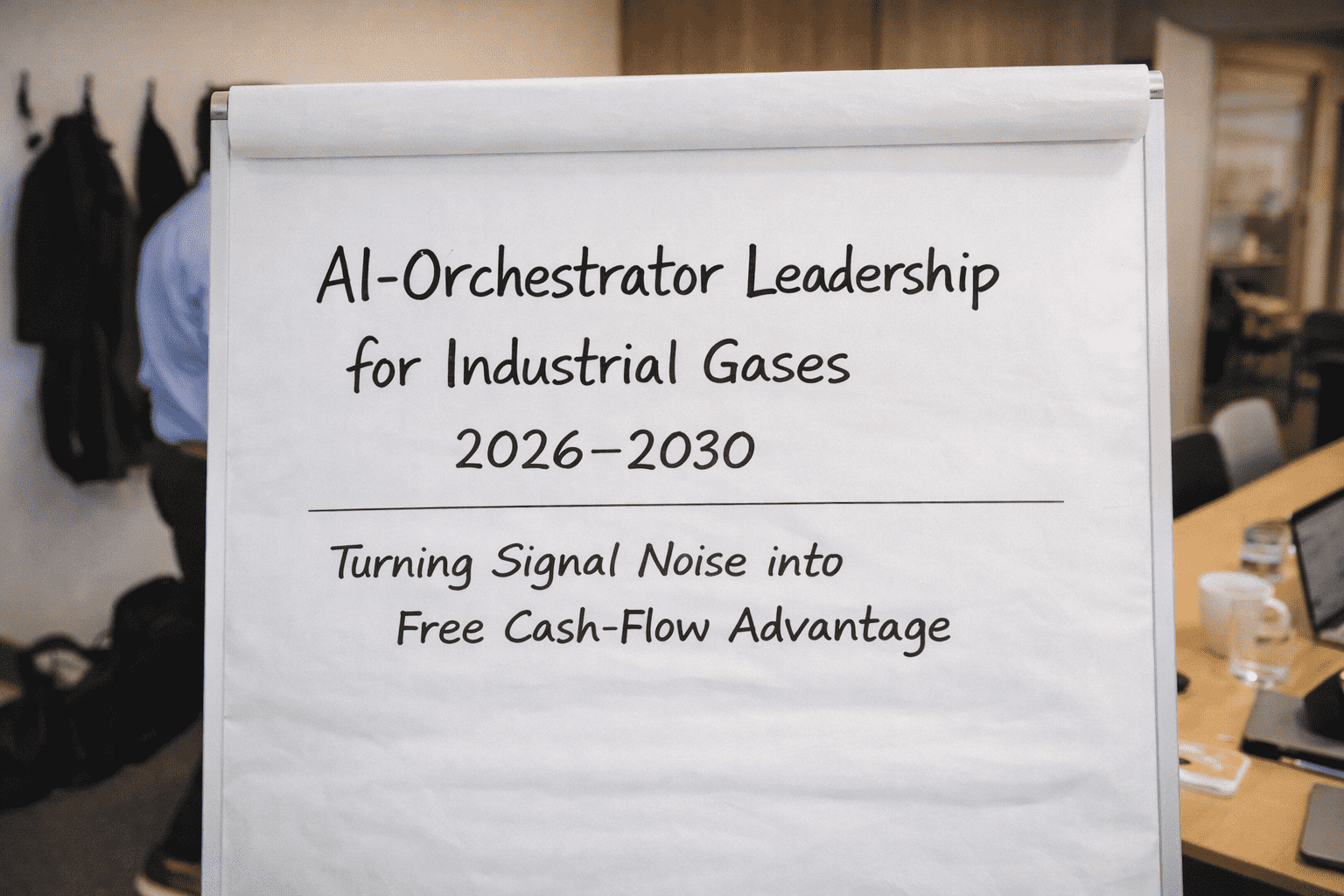
AI-Orchestrator Leadership vs Traditional Industrial Gas Leadership (2026–2030)
Using:
• Free Cash Flow
• ROICE (%) – Return on Innovation, Convenience & Efficiency
This is exactly the right strategic lens.
We structure this cleanly.
A) Define the Two Leadership Models
1️⃣ Traditional Industrial Gas Leadership Model
Focus:
• Volume growth
• Capacity expansion
• Long-term contracts
• Energy pass-through (lagged)
• Incremental efficiency
• Annual budgeting cycles
Characteristics:
• Decision latency moderate-high
• Capital heavy
• Reactive pricing
• Limited AI integration
• Optimization local, not systemic
2️⃣ AI-Orchestrator Leadership Model
Focus:
• Volatility-adjusted ROCE
• Dynamic capital reallocation
• Real-time energy optimization
• Decision velocity compression
• Structural exposure mapping
• AI-integrated scheduling + maintenance
Characteristics:
• Reduced amplification risk
• Faster pass-through discipline
• Modular capital deployment
• Cross-regional energy arbitrage
• 90-day intervention cycles
B) Business Case Assumptions (Mid-Size Operator)
Revenue: €600M
EBITDA margin baseline: 22%
Capex intensity: 15% of revenue
Energy share of operating cost: 30%
Period: 2026–2030
Volatility environment: Persistent energy swings + carbon pressure
C) Financial Dynamics Under Volatility
Scenario Stress Inputs
Energy volatility ±15%
Carbon cost +20%
3-month pricing lag
5% demand variability
D) Traditional Leadership Financial Path
Typical effects:
• 3-month lag → margin compression
• Partial pass-through (α ≈ 0.7)
• Deferred maintenance
• Slow capital reallocation
• High fixed cost absorption
Result:
Average EBITDA margin drops from 22% → 18–19% in volatile years.
Free Cash Flow impact:
Energy shock year reduces FCF by ~25–35%.
5-year cumulative FCF (2026–2030):
≈ €420–450M (normalized scenario)
ROICE (Innovation + Efficiency return):
Traditional incremental improvement yields ~6–8%.
E) AI-Orchestrator Leadership Financial Path
Structural differences:
• Pass-through α improved to 0.85–0.9
• Lag reduced from 3 months to 1 month
• Energy optimization savings 2–4%
• Downtime reduction 1–3%
• Faster capital redeployment
• Working capital release 3–5%
Result:
EBITDA margin stabilizes at 21–23% despite volatility.
Free Cash Flow impact:
Shock year FCF drop limited to 10–15%.
5-year cumulative FCF:
≈ €520–560M
Difference vs Traditional:
+€100–120M incremental FCF over 5 years.
F) ROICE Comparison (2026–2030)
Traditional Model
Innovation limited to incremental digitalization.
ROICE ≈ 6–8%
AI-Orchestrator Model
Innovation integrated across:
• Energy optimization
• Decision velocity compression
• Capital redeployment
• Scheduling AI
• Exposure reduction
ROICE ≈ 15–20%
Because:
Efficiency gains + risk reduction + capital productivity combine.
G) Structural Economic Difference
| Metric | Traditional | AI-Orchestrator |
|---|---|---|
| Avg EBITDA Margin | 18–19% | 21–23% |
| 5-Year FCF | €420–450M | €520–560M |
| FCF Volatility | High | Moderate |
| ROICE | 6–8% | 15–20% |
| Capital Flexibility | Low | Moderate–High |
| Volatility Amplification | High | Reduced |
H) Why This Divergence Occurs
The difference is not:
Technology alone.
It is:
Reduced amplification × Faster reaction × Smarter capital allocation.
Volatility punishes rigidity.
AI-Orchestrator Leadership reduces rigidity.
I) Strategic Conclusion
Between 2026–2030:
Industrial Gas operators applying Traditional Leadership will:
Survive volatility.
Industrial Gas operators applying AI-Orchestrator Leadership will:
Compound advantage.
Difference in 5-year FCF can exceed 20–25%.
That is structural separation.- Josef David
“We provide the first AI-Orchestrator Leadership Model engineered to improve Free Cash Flow and ROICE under 2026–2030 volatility conditions specifically for Industrial Gas operators.”
Leave a Reply