Interpretation: I’m treating “Week 14” as the strategic outlook going into April 2026, based on developments visible as of March 27, 2026.
Executive headline
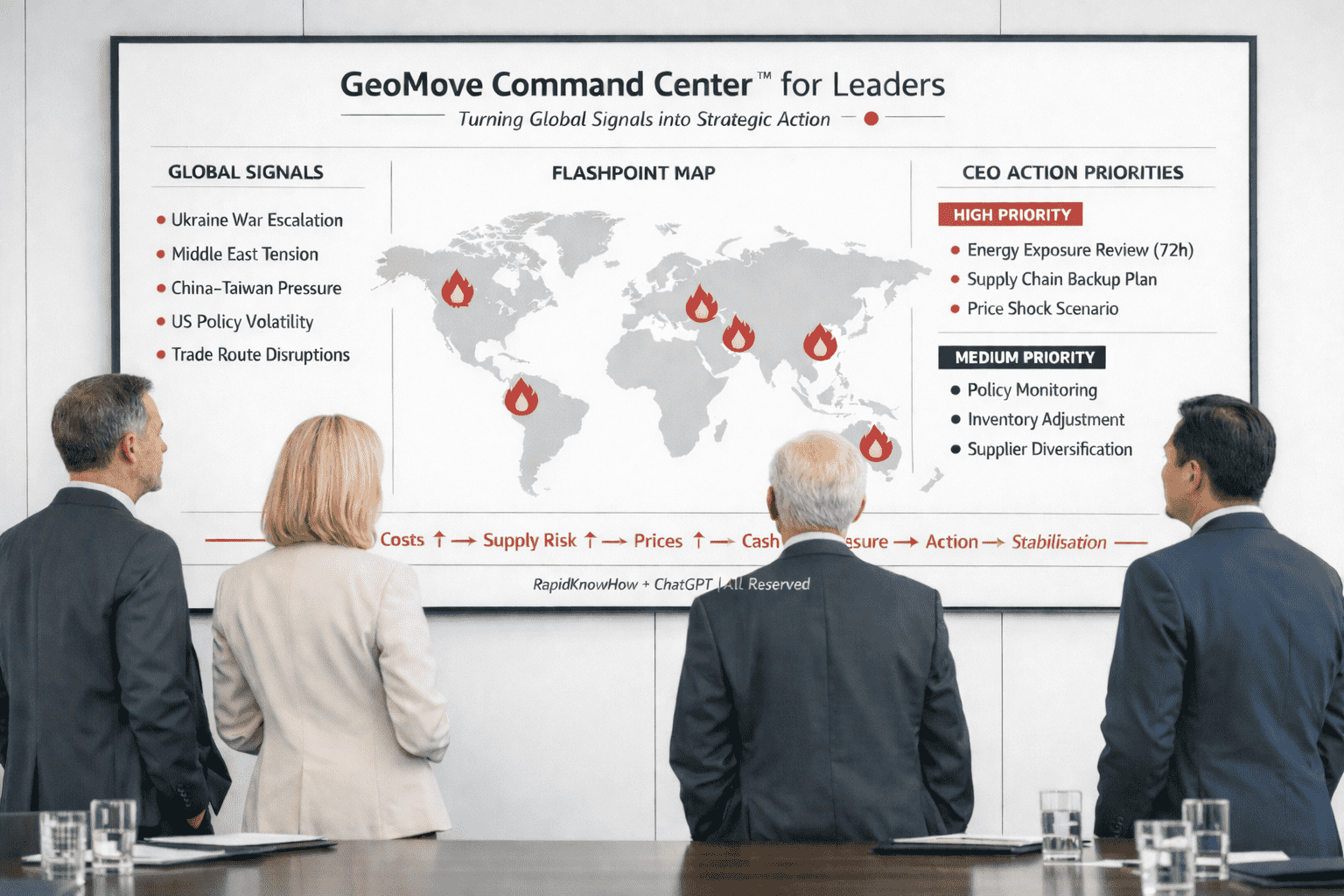
April 2026 opens with five linked pressure points:
- Middle East war / Iran risk driving energy and inflation stress.
- Russia’s spring push in Ukraine while Western focus is split.
- European energy and defence hardening under higher geopolitical risk.
- US–China tension without full rupture, but with higher Taiwan risk.
- South China Sea militarisation expanding through new defence alignments.
PowerBoard conclusion
For April, the base case is not de-escalation, but managed instability: no immediate systemic collapse, yet more volatility in energy, trade, security, inflation expectations, and alliance behaviour. Europe is particularly exposed because the Middle East conflict is feeding directly into gas storage, prices, consumer sentiment, and ECB risk.
B) PowerBoard — Strategic Heat Map
1. Middle East / Iran
Status: Highest global escalation driver.
The U.S. has extended its pause on strikes against Iranian energy infrastructure only until April 6, while the wider war has already lifted oil prices sharply and disrupted energy flows through Hormuz. This is the single biggest April trigger because it affects inflation, shipping, fertilizer, gas, and broader market psychology at once.
April watchpoints
- April 6 decision on the U.S. pause
- Any reopening or renewed disruption around Hormuz
- Further pressure on energy and fertilizer prices
- Spillover into central-bank rhetoric and European demand
GeoMove rating: RED
2. Ukraine / Russia
Status: High military pressure, rising political divergence.
Reuters and AP reporting point to an expected Russian spring offensive, while Ukraine is increasing strikes on Russian oil export infrastructure. At the same time, EU leaders are warning against territorial concessions under pressure from Washington. That means April is likely to combine harder fighting with more conflict inside the Western negotiation camp.
April watchpoints
- Russian gains in eastern and northeastern sectors
- Ukrainian strikes on oil export nodes
- Any U.S. proposal tied to Donbas concessions
- EU internal cohesion, especially Hungary-related friction
GeoMove rating: RED
3. Europe: Energy, inflation, defence
Status: Europe is in defensive mode.
The European Commission is urging countries to start filling gas storage early in April, because storage is low and prices have surged. At the same time, NATO reports a major increase in European and Canadian defence spending, while ECB officials are openly discussing whether an April 29–30 rate increase could be necessary if geopolitical inflation persists.
April watchpoints
- EU gas storage refill pace
- Dutch and Central European storage vulnerability
- ECB tone into April 29–30
- Whether consumer weakness starts to outweigh inflation fear
GeoMove rating: AMBER-RED
4. US–China / Taiwan
Status: Controlled rivalry, but April distraction risk is real.
China signalled willingness to strengthen trade cooperation with the U.S., which lowers immediate trade-breakdown risk. But Taiwan is openly worried that China could exploit U.S. distraction caused by the Middle East war, and Taipei says Washington is trying to accelerate weapons deliveries. That creates a mixed April picture: economic signalling stays open, military signalling stays tense.
April watchpoints
- Chinese military signalling near Taiwan
- U.S. delivery speed for Taiwanese systems
- Any new U.S. trade moves under Section 301 logic
- Whether Beijing separates trade détente from military pressure
GeoMove rating: AMBER
5. South China Sea / Indo-Pacific
Status: Alliance-building is accelerating.
The Philippines and France signed a visiting forces agreement, adding to Manila’s growing network with the U.S., Australia, Japan, and New Zealand. This matters because it shows April is likely to bring more counter-balancing coalitions around China, not less.
April watchpoints
- Further unsafe encounters at sea
- More bilateral or mini-lateral military agreements
- Chinese response around Thitu, Scarborough, or the Spratlys
GeoMove rating: AMBER
C) April 2026 PowerBoard Scenario View
Scenario 1 — Managed Instability
The Iran war stays contained, Ukraine remains intense but without major breakthrough, Europe absorbs the energy shock, and China avoids a Taiwan escalation spike. This is the most plausible April base case.
Scenario 2 — Energy Shock Escalation
If the April 6 pause ends and attacks on Iranian energy assets resume, oil, gas, shipping and inflation could all jump again. Europe would feel this fastest through storage, industrial costs and consumer sentiment.
Scenario 3 — Ukraine Strategic Fracture
If military pressure on Ukraine rises while Western political unity weakens, April could shift from “support under strain” to “support under conditions,” especially around territory and air defence.
Scenario 4 — Indo-Pacific Opportunism
If Beijing reads U.S. attention as overstretched, it may increase grey-zone pressure around Taiwan or maritime friction in the South China Sea without crossing into outright war.
D) CEO/Board Actions for April 2026
1. Energy-risk first
Treat Middle East escalation as the lead variable for April planning, especially if your exposure includes transport, chemicals, fertilizers, metals, industrial gases, or imported feedstocks.
2. Build two Europe cases
Run one model for “high prices, low growth” and one for “temporary price spike, softer Q2 demand.” Both are now plausible for the euro area.
3. Recheck supply-chain maps
South China Sea friction, Panama-related maritime tension, and Hormuz disruption all argue for route redundancy and inventory discipline.
4. Watch alliance politics, not just battlefields
April risk is increasingly shaped by whether coalitions stay aligned: EU on Ukraine, NATO on burden-sharing, and Indo-Pacific partners on maritime deterrence.
- Energy prices and storage
- Ukraine front-line and negotiation drift
- ECB / inflation / growth trade-off
- Taiwan deterrence and delivery risk
- South China Sea alliance reaction
HOW the Board should manage the GeoMove Simulation — step by step
Purpose
The Board should use the simulation as a decision discipline, not as a presentation toy. For April 2026, that matters because the main risk drivers are unusually linked: Middle East energy shock risk, Europe’s gas and inflation exposure, Ukraine battlefield pressure, and Indo-Pacific deterrence stress. Reuters reports that the U.S. pause on strikes against Iranian energy plants runs only until April 6, 2026; the ECB’s next key meeting is April 29–30, 2026; and Taiwan says the U.S. has a “high” sense of urgency on weapons deliveries.
Step 1 — Open with one clear Board question
The Chair starts with one sentence:
“What could change our risk, cash, supply, and decision speed in April 2026?”
That keeps the simulation focused on action, not commentary.
Board rule:
Do not start with opinions. Start with the 5 signals:
- Middle East / Iran
- Ukraine / Russia
- Europe energy / inflation
- US–China / Taiwan
- South China Sea
Step 2 — Assign signal ownership
Each signal gets one owner before the session starts:
- CEO / Chair: overall decision frame
- CFO: inflation, liquidity, margin, demand
- COO / Supply Chain lead: logistics, routing, inventory, continuity
- Commercial lead: customer demand, pricing pass-through, contract exposure
- Strategy / Risk lead: geopolitical interpretation and scenario logic
Why this matters:
The Board must prevent “everyone talks, nobody owns.”
Each owner brings:
- current score
- what changed since last week
- what that means operationally
- one action trigger
Step 3 — Set the base case first
Before stress-testing, the Board agrees the base case.
For April 2026, the base case is best treated as Managed Instability:
- no immediate systemic collapse,
- but persistent volatility in energy, inflation expectations, alliances, and supply chains.
That framing is supported by the OECD’s downgraded growth outlook tied to the Iran war and by ECB concern that higher energy prices could force tighter policy.
Board action:
Enter the base scores first, without exaggeration.
A practical starting point:
- Middle East / Iran = 4
- Ukraine / Russia = 4
- Europe energy / inflation = 4
- US–China / Taiwan = 3
- South China Sea = 3
Then ask:
“What would make any one of these move by +1 within 7 days?”
Step 4 — Run the simulation in 3 rounds
The Board should not do one pass only. It should run three rounds.
Round 1: Base case
Question:
“If nothing dramatic changes, what is our April operating environment?”
Output:
- total score
- risk band
- board interpretation
- default action set
Round 2: Shock case
Question:
“What if one trigger breaks against us?”
For April 2026, the first shock case should be:
Energy Shock Escalation
because the Iran conflict is already hitting energy flows and inflation risk. Reuters and OECD reporting both point to energy disruption as the key transmission channel into growth and prices.
Round 3: Secondary spillover case
Question:
“If the first shock happens, where does it hit us next?”
Examples:
- energy shock → customer demand slowdown
- Ukraine escalation → industrial confidence weakens
- Taiwan stress → supply-chain and shipping delays
- South China Sea friction → maritime insurance and routing risk
B) HOW the Board should score the simulation properly
Step 5 — Score facts, not emotions
For each signal, the owner must answer 4 questions:
- What changed?
- How certain is it?
- What business channel does it hit?
- What is the next trigger date?
For April 2026, examples of trigger dates and channels include:
- April 6: U.S. pause on striking Iranian energy plants expires.
- April 29–30: ECB meeting, with Nagel saying a rate hike is “an option.”
- Ongoing Taiwan arms-delivery urgency and Indo-Pacific military alignment.
Board scoring rule:
- 1 = low near-term impact
- 2 = watch
- 3 = material but contained
- 4 = high risk / actionable
- 5 = immediate escalation / activate response
Step 6 — Translate each score into business exposure
This is the most important step.
The Board should ask for each signal:
“What does this do to us in practice?”
Example translation table:
- Middle East / Iran
Impact: energy costs, chemicals, shipping, inflation, pricing pressure - Ukraine / Russia
Impact: industrial sentiment, European policy cohesion, regional demand, sanctions environment - Europe energy / inflation
Impact: rates, margins, customer budgets, refinancing conditions - US–China / Taiwan
Impact: electronics, capital equipment timing, export exposure, confidence - South China Sea
Impact: freight, routing, insurance, supplier resilience
So the Board never leaves a score floating in abstraction.
Step 7 — Define trigger thresholds before discussion drifts
The Board should pre-agree the thresholds:
- Total 10–14 = AMBER
Increase monitoring - Total 15–19 = AMBER-RED
Weekly Board review + dual scenario plan - Total 20+ = RED
Activate crisis governance
Then define action thresholds:
- If Middle East / Iran ≥ 4
review energy hedging and supply continuity - If Europe energy / inflation ≥ 4
update pricing, margin, and working-capital assumptions - If Ukraine / Russia ≥ 4
reassess Europe demand and exposure by region - If US–China / Taiwan ≥ 4
review single-source dependencies - If South China Sea ≥ 4
test shipping-route and inventory fallback plans
Step 8 — Force the Board to choose one primary scenario
Do not let the Board keep 4 scenarios alive as equal possibilities.
It must choose one:
- Managed Instability
- Energy Shock Escalation
- Ukraine Strategic Fracture
- Indo-Pacific Opportunism
For April 2026, Energy Shock Escalation deserves special attention because OECD and ECB-linked reporting already tie the Iran war to weaker growth and higher inflation.
Board discipline:
Choose:
- one base scenario
- one downside scenario
- one immediate trigger
That is enough.
C) HOW the Board should close the simulation and turn it into action
Step 9 — End with 3 Board decisions
Every simulation session must end with exactly 3 outputs:
1. What do we believe now?
Example:
“April is a managed-instability month with elevated energy-shock risk.”
2. What do we do now?
Example:
“Protect margin, secure supply, update pricing and run weekly trigger review.”
3. What would make us change view?
Example:
“Any deterioration around April 6 on Iranian energy infrastructure, or a rapid further energy-price spike.”
Step 10 — Convert decisions into an owner-based action sheet
Each decision needs:
- owner
- action
- deadline
- escalation threshold
Example:
- CFO — update April margin case by Monday
- COO — review top 10 supply vulnerabilities
- Commercial lead — prepare customer pricing-response ladder
- CEO — brief top customers and key investors if risk band turns RED
Step 11 — Re-run weekly, not daily
For Board-level use, the simulation should run:
- once per week normally
- within 24 hours if a major trigger breaks
That cadence fits the kind of event risk visible now: energy-war spillovers, ECB policy timing, and military developments that can reprice expectations quickly but do not require hourly Board meetings.
Step 12 — Keep the Chair’s final question brutally simple
Before closing, the Chair should ask:
“What is the one move we regret not making if April turns worse?”
That question usually reveals the real decision:
- hedge sooner,
- secure supply sooner,
- raise prices sooner,
- cut exposure sooner,
- communicate sooner.
Best-practice flow for the Board meeting
- Open with one Board question
- Review the 5 signals
- Score the base case
- Run one shock case
- Pick one primary scenario
- Translate risk into business impact
- Define thresholds
- Make 3 decisions
- Assign owners and deadlines
- Re-run weekly
One-line rule:
The Board should use the simulation to decide earlier, not to discuss longer.
Board Operating GeoMove Guide — EXECUTIVE VERSION (for Leaders & Boards)
Purpose (ONE sentence)
Use GeoMove to turn geopolitical signals into fast, measurable business decisions—weekly, disciplined, and action-driven.
1. BOARD OPERATING FLOW (5–15 Minute Discipline)
Step 1 — Define the Board Question (Chair, 30 sec)
“What could change our cash, supply, demand, or decision speed this month?”
Step 2 — Review the 5 GeoMove Signals (3 min)
Each signal owner reports:
| Signal | Owner | What to report |
|---|---|---|
| Middle East / Iran | COO / Energy | Price + supply risk |
| Ukraine / Russia | Strategy | Europe exposure |
| Europe Energy / Inflation | CFO | Margin + demand |
| US–China / Taiwan | Strategy | Supply chain |
| South China Sea | COO | Logistics |
Rule:
👉 Only what changed + what it means + next trigger
Step 3 — Score the Reality (2 min)
Each signal = 1 to 5
- 1 = Stable
- 3 = Material risk
- 5 = Immediate action
👉 Add total → defines Board Risk Level
Step 4 — Select ONE Scenario (2 min)
The Board MUST choose:
- Managed Instability (base case)
- Energy Shock Escalation
- Ukraine Strategic Fracture
- Indo-Pacific Opportunism
Rule:
👉 No multi-scenario confusion — ONE base + ONE downside
Step 5 — Translate into Business Impact (3 min)
For each high score (≥4), answer:
- What does it hit?
→ Cost / Demand / Supply / Financing - How fast?
→ Immediate / 30 days / 90 days
2. DECISION ENGINE (CORE OF THE SYSTEM)
Step 6 — Apply Threshold Logic
| Score | Risk Level | Board Mode |
|---|---|---|
| 10–14 | AMBER | Monitor |
| 15–19 | AMBER-RED | Weekly action |
| 20+ | RED | Crisis mode |
Step 7 — Trigger-Based Actions (CRITICAL)
If Middle East ≥ 4
→ Secure energy supply + hedge
If Europe ≥ 4
→ Adjust pricing + margin
If Ukraine ≥ 4
→ Reassess EU demand
If US–China ≥ 4
→ Check supply dependencies
If South China Sea ≥ 4
→ Secure logistics routes
3. BOARD OUTPUT (MANDATORY)
Every session ends with 3 decisions only
1. What do we believe now?
→ Clear situation statement
2. What do we do now?
→ Immediate actions
3. What changes our view?
→ Trigger events
4. EXECUTION CONTROL (NO EXCEPTIONS)
Each action must have:
- Owner
- Deadline
- Measurable outcome
- Escalation trigger
Example:
- CFO → Update margin scenario → Monday
- COO → Check top 10 supply risks → 72h
- CEO → Inform key customers → immediate
5. BOARD CADENCE
- Weekly simulation (standard)
- Immediate rerun if trigger hits
👉 Example triggers:
- Energy escalation
- Central bank shift
- Military escalation
6. CHAIR FINAL QUESTION (MOST POWERFUL)
“What move will we regret NOT making if this worsens?”
👉 This forces real decisions.
👉 The GeoMove Guide is not about predicting the world — it is about deciding faster than competitors when the world changes. Josef David
Board Operating GeoMove Guide — V2 Interactive Board Command Center
This V2 turns the guide into a working Board tool with 4 operating zones:
- Signal scoring
- Scenario selection
- Board decision output
- Execution tracker
It is designed for the April 2026 environment, where Board attention should center on energy-shock spillovers from the Iran conflict, ECB inflation/rate risk into the April 29–30 meeting, Taiwan deterrence stress, and Europe’s broader geopolitical exposure.
How the Board should use it
- Start with the 5 signal sliders.
- Select the primary scenario.
- Run the command center.
- Read the Board verdict.
- Confirm 3 decisions only: belief, action, trigger.
- Assign owners and deadlines before closing.
Chair rule:
Use the tool to decide earlier, not to discuss longer.
| Owner | Action | Deadline | Status |
|---|---|---|---|
- Review energy and supply exposure
- Update Europe pricing and demand assumptions
- Test logistics fallback routes