
The hidden Industrial Gas asset lever many leaders underestimate
In Industrial Gas, cylinders are not just containers.
They are mobile capital.
Every cylinder has a cost, a location, a customer, a product, a refill cycle, a rental logic, a handling cost, and an opportunity cost.
When cylinders turn fast, they create value.
When cylinders sit idle, disappear, are undercharged, or move inefficiently, they trap cash.
The Core Question
Industrial Gas leaders should ask:
How many cylinders are creating value today — and how many are silently destroying free cash flow?
This question matters because cylinder productivity affects:
Working capital
Replacement investment
Depot efficiency
Customer service
Delivery planning
Rental revenue
Asset utilization
ROCE
Free cash flow
The Cylinder Turn Problem
A typical Industrial Gas business may have thousands or millions of cylinders moving across customers, depots, trucks, filling sites, and service points.
The problem is that many cylinders are not truly “moving.”
Some sit too long at customer sites.
Some are poorly tracked.
Some are not charged correctly.
Some are linked to customers who order too rarely.
Some are returned late.
Some are in the wrong region.
Some are used for products with weak margins.
Each case reduces asset productivity.
The Financial Impact
Slow cylinder turns create several hidden costs:
More cylinders are needed to serve the same revenue
Replacement capital increases
Depot handling becomes inefficient
Stock availability problems increase
Emergency deliveries rise
Customers receive free asset use
Rental revenue is lost
ROCE declines
This is why cylinder turns are a powerful free-cash-flow lever.
Improving cylinder productivity can release cash without needing new sales.
The AI-Orchestrator Approach
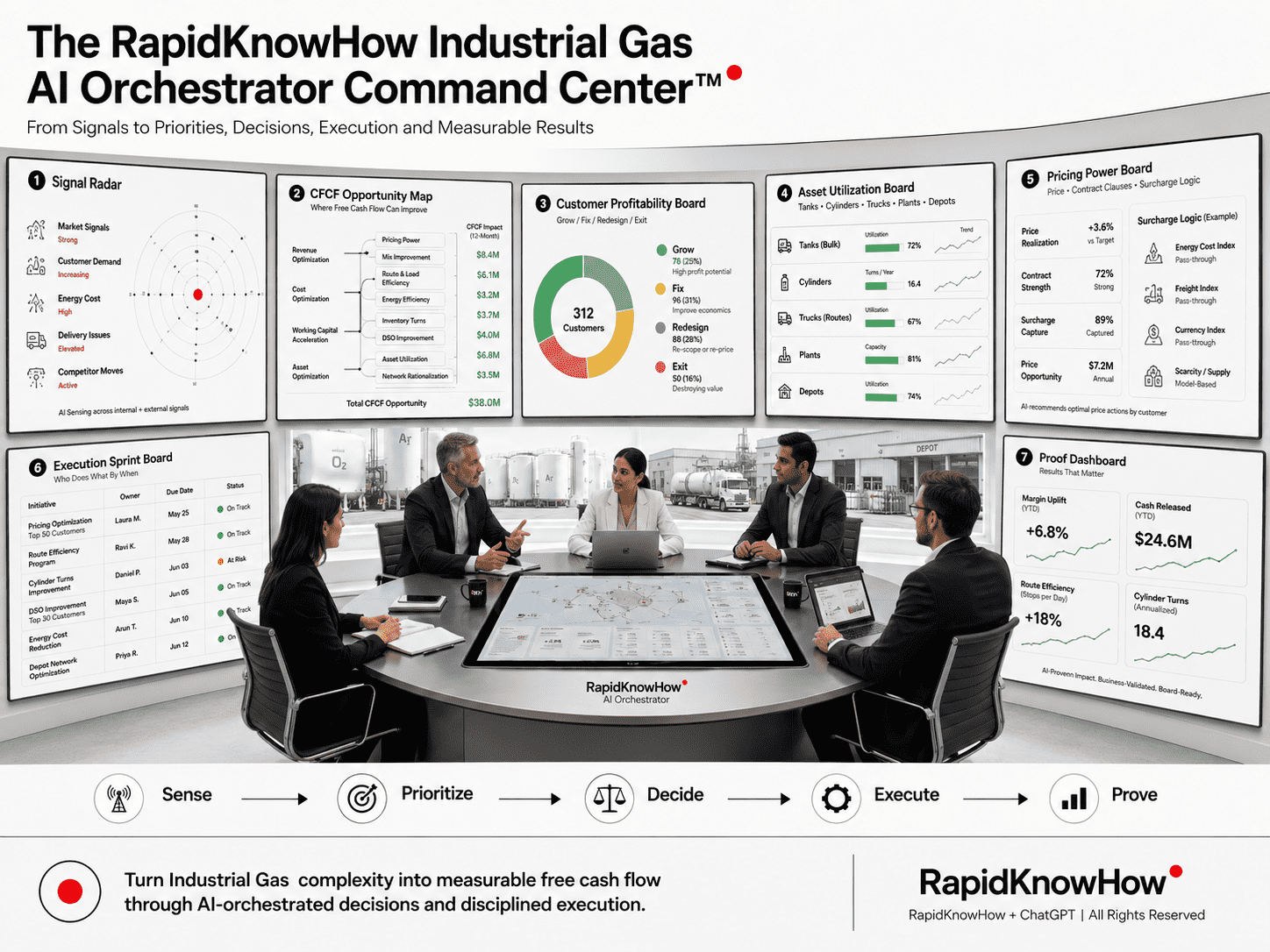
The RapidKnowHow Industrial Gas AI-Orchestrator Command Center™ uses cylinder data to answer five practical questions:
1. Where are cylinders idle too long?
By customer, region, product, depot, and contract type.
2. Which customers use too many cylinders for too little contribution?
This links asset use to customer profitability.
3. Where is rental or deposit discipline weak?
This identifies lost revenue and weak contract enforcement.
4. Which cylinders should be recovered or redeployed?
This turns analysis into operational action.
5. What is the cash-flow impact of faster turns?
This proves value in money, not theory.
The First 30-Day Action Sprint
A practical cylinder improvement sprint could look like this:
Week 1: Identify slow-turning cylinders by region and customer
Week 2: Rank customers by cylinder value, idle days, and margin contribution
Week 3: Recover, charge, redeploy, or renegotiate
Week 4: Measure cash released, rental improvement, and asset utilization impact
The Leadership Rule
Do not manage cylinders only as physical assets.
Manage them as cash-flow assets.
A cylinder sitting too long without proper contribution is not neutral. It is capital locked inside the business.
Leader Action Sentence
Improving cylinder turns is one of the fastest ways Industrial Gas leaders can release trapped cash, improve asset utilization, strengthen ROCE, and prove the value of AI-orchestrated execution.
Strategic Call-to-Action
Use the Industrial Gas AI-Orchestrator Command Center™ to launch a Cylinder Turn Acceleration Sprint: identify idle cylinders, rank customer asset use, recover or redeploy assets, enforce rental discipline, and measure the CFCF impact.