Precision Compounding in a Volatile Capital Environment
Einstein for Strategists™ | RapidKnowHow
Executive Summary
The global Industrial Gas sector — led by Linde plc, Air Liquide and Air Products — remains structurally strong.
High margins.
Strong cash conversion.
Defensive demand profile.
Yet 2026–2030 introduces a different challenge:
• Structural energy volatility
• Higher cost of capital
• Geopolitical fragmentation
• AI-driven operational asymmetry
In this environment, growth narratives alone are insufficient.
The decisive factor becomes:
Structural precision in Free Cash Flow generation.
This PowerReport outlines a disciplined architecture capable of delivering ~€730M incremental structural FCF in a moderate execution scenario — translating into ~€18B valuation impact at stable multiples.
Not through expansion.
Not through speculation.
But through capital precision.
1. The Shift from Expansion to Precision
The last decade rewarded:
• Scale expansion
• M&A consolidation
• Global footprint growth
• Large onsite project pipelines
The next cycle rewards:
• Cash visibility
• Margin protection
• Capital efficiency
• Volatility reduction
Industrial Gases is capital-intensive.
Small operational misalignment destroys FCF quietly.
Small operational precision compounds into durable value.
The architectural shift is subtle — but decisive.
2. Big-3 Benchmark Baseline (Composite Model)
Strategic composite baseline:
Revenue: €35B
Free Cash Flow: €6.0B
ROCE: ~18%
FCF Multiple: 25×
Market Value: €150B
The critical question:
How much structural FCF improvement is realistically achievable without heroic assumptions?
3. The 10 Structural FCF Multipliers
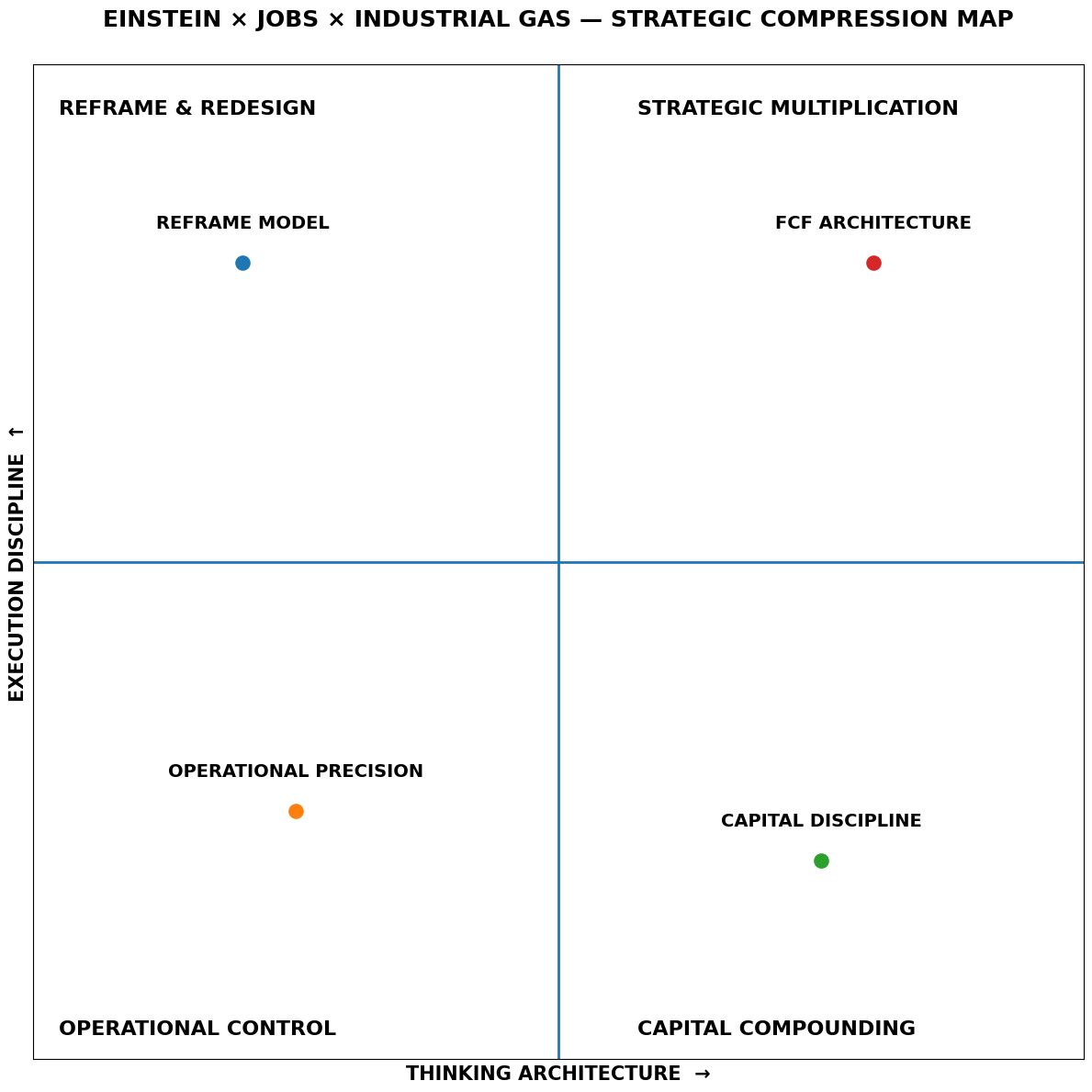
The Industrial Gas Multiplier Architecture identifies ten controllable precision levers:
- Energy Pass-Through Discipline
- Working Capital Compression
- Asset Utilization Improvement
- Portfolio Mix Optimization
- AI Demand Forecasting
- Predictive Maintenance
- Logistics & Cylinder Digitization
- Contract Pricing Discipline
- Capex Governance
- Capital Allocation Discipline
Each lever connects directly to:
Operational Precision → FCF Strength → Market Value Effect
4. Moderate Execution Scenario (Board-Safe)
Assumptions:
• 3-year implementation horizon
• 50% execution effectiveness
• Stable valuation multiple (25×)
• No speculative expansion
Result:
Structural FCF uplift ≈ €730M
New FCF ≈ €6.73B
Market value impact:
€6.0B × 25 = €150B
€6.73B × 25 = €168B
Δ ≈ €18B
Without acquisitions.
Without multiple expansion.
Without aggressive transformation claims.
Pure precision.
5. Why Precision Dominates 2026–2030
Three structural realities define the next cycle:
1️⃣ Capital Is No Longer Cheap
Disciplined allocation becomes a valuation differentiator.
2️⃣ Energy Remains Structurally Volatile
Pass-through lag silently erodes FCF.
3️⃣ AI Creates Operational Asymmetry
Those who integrate AI into governance outperform those who apply it cosmetically.
The winning formula is not technological hype.
It is disciplined orchestration.
6. From Management to Orchestration
The leadership requirement for 2026–2030 is architectural governance:
Signal → Prioritize → Act → Capture → Reinforce
Applied to:
• Energy cost monitoring
• Working capital cycles
• Asset utilization tracking
• Capex discipline
• Contract repricing
• Allocation timing
This is not a transformation narrative.
It is a reinforcement model.
7. The Compounding Principle
In capital-intensive industries:
+€100M structural FCF
× 25 multiple
= €2.5B valuation impact
Repeated across ten levers — even moderately — structural dominance emerges.
This is Einstein’s principle applied to capital markets:
Compounding small precision dominates linear expansion.
8. The Strategic Position 2026–2030
The next Industrial Gas winners will not be those who:
• Announce the largest hydrogen ambition
• Build the largest capex pipeline
• Communicate the loudest transformation story
They will be those who:
• Protect margins through discipline
• Govern capital rigorously
• Reduce volatility structurally
• Strengthen FCF visibility
Markets reward predictability.
Boards reward discipline.
Capital rewards precision.
9. Closing Architectural Statement
Industrial Gases does not require reinvention.
It requires structural refinement.
The 2026–2030 cycle will belong to companies that understand:
Operational precision compounds into Free Cash Flow strength.
Free Cash Flow strength compounds into durable market value.
This is not a growth story.
It is a capital architecture strategy. – Josef David
RapidKnowHow
Strategic Capital Architecture
February 2026