Who Shapes the Market, Controls the Economics and Captures the Value?
Status: 14 July 2026
Created by Josef David
RapidKnowHow® Industrial Gas AI-Orchestrator™
Executive Verdict
The DACH/CEE industrial-gas market is not controlled by one company.
It is shaped by an interconnected influence system consisting of:
- European and national policymakers;
- electricity and natural-gas markets;
- global industrial-gas producers;
- strategically important industrial customers;
- hydrogen, carbon-management and public-funding institutions;
- safety, environmental and competition regulators;
- technology, engineering and capital providers.
The decisive 2026 insight
Market power is moving from ownership of gas-production assets alone toward orchestration of energy, long-term contracts, customer decarbonisation, public funding, infrastructure and digital operating intelligence.
The strongest actor will not necessarily be the company with the most plants.
It will be the company that best controls:
- electricity exposure;
- energy pass-through;
- on-site customer relationships;
- asset-network density;
- access to state aid;
- hydrogen and carbon-management projects;
- operational data;
- investment discipline;
- regulatory positioning;
- capital allocation.
1. Geographic Scope
DACH
- Germany
- Austria
- Switzerland
Core CEE
- Poland
- Czechia
- Slovakia
- Hungary
- Slovenia
- Croatia
- Romania
- Bulgaria
- Serbia
The system can later be extended to:
- the Baltic states;
- Western Balkans;
- Ukraine reconstruction;
- Kazakhstan and adjacent Central Asian markets.
2. The Industrial Gas Influence System
CENTER: THE VALUE-CREATION ENGINE
Electricity
→ Production Cost
Long-Term Contract
→ Revenue Security
Pass-Through Formula
→ Margin Protection
Asset Density
→ Distribution Advantage
Customer Integration
→ Switching Barriers
Decarbonisation Project
→ New Growth
Capital Discipline
→ ROCE and Free Cash Flow
AI-Orchestrator
→ Faster, Better Decisions
3. Influence Map 2026
RING 1 — RULE SETTERS
These actors define the economic and regulatory boundaries of the market.
European Commission
Principal influence mechanisms:
- EU competition policy;
- state-aid approval;
- hydrogen regulation;
- emissions policy;
- carbon pricing;
- industrial decarbonisation funding;
- clean-technology incentives;
- energy-market policy.
The Clean Industrial Deal State Aid Framework has applied since 25 June 2025 and remains in force until 31 December 2030. It allows national support for clean energy, low-carbon fuels, industrial decarbonisation, clean-technology manufacturing and temporary electricity-price relief for eligible energy-intensive companies.
Influence Score: 95/100
Power position: System rule setter
Primary leverage: Regulation and funding permission
Confidence: High
National Governments
Germany, Austria, Switzerland and CEE governments influence:
- electricity-price relief;
- industrial policy;
- permits;
- infrastructure;
- state aid;
- taxation;
- hydrogen strategies;
- public procurement;
- healthcare-gas systems.
In April 2026, the European Commission approved electricity-price-relief schemes for energy-intensive companies in Germany, Bulgaria and Slovenia. The German scheme links relief to the objective of limiting relocation and supporting industrial decarbonisation.
Influence Score: 92/100
Power position: National value distributor
Primary leverage: Subsidies, permits and energy policy
Confidence: High
Energy Regulators, Grid Operators and Electricity Suppliers
Industrial-gas production—particularly air separation, hydrogen generation and compression—is electricity intensive.
These actors influence:
- delivered electricity prices;
- grid access;
- connection schedules;
- renewable-power availability;
- balancing costs;
- congestion;
- power-purchase agreements;
- energy-security risk.
Influence Score: 91/100
Power position: Margin gatekeeper
Primary leverage: Energy availability and price
Confidence: High
Competition, Safety and Environmental Authorities
These institutions determine:
- acquisition approval;
- plant authorisation;
- emissions compliance;
- transport requirements;
- gas classification;
- medical-gas compliance;
- industrial safety standards.
Their influence is normally less visible than price negotiations but can stop an acquisition, delay capacity or change the economics of an investment.
Influence Score: 82/100
Power position: Licence-to-operate controller
Primary leverage: Approval, prohibition and compliance
Confidence: High
4. RING 2 — INDUSTRIAL GAS MARKET ORCHESTRATORS
1. Linde
Linde remains the strongest overall industrial-gas influence actor in the region because it combines:
- global industrial-gas scale;
- extensive on-site and merchant-gas operations;
- engineering and plant technology;
- hydrogen experience;
- capital strength;
- operational discipline;
- long-term customer contracts.
Linde reported 2025 sales of approximately $34 billion. Its portfolio spans chemicals and energy, manufacturing, metals, mining, electronics, healthcare, food and beverage.
RapidKnowHow Influence Score: 90/100
| Influence Dimension | Assessment |
|---|---|
| Capital strength | 95 |
| Installed asset base | 95 |
| Engineering capability | 94 |
| Customer integration | 93 |
| Regulatory access | 86 |
| DACH/CEE strategic relevance | 91 |
| AI-Orchestrator potential | 87 |
Strategic Position
Incumbent system leader
Main Advantage
Ability to combine gas supply, engineering, technology and capital in large long-term projects.
Main Vulnerability
The scale and return requirements of a global market leader may make smaller or locally specialised opportunities less attractive.
2. Air Liquide
Air Liquide combines:
- substantial European network density;
- strong large-industry relationships;
- healthcare gases;
- hydrogen and carbon-management capabilities;
- engineering and technology;
- strong institutional positioning in Europe.
Air Liquide reported 2025 revenue of €26.94 billion, with Gas & Services accounting for approximately 97% of group sales. The company also reported record efficiencies of €631 million for the year.
RapidKnowHow Influence Score: 87/100
| Influence Dimension | Assessment |
|---|---|
| Capital strength | 91 |
| Installed asset base | 91 |
| European network position | 94 |
| Customer integration | 91 |
| Healthcare influence | 92 |
| Regulatory access | 88 |
| DACH/CEE strategic relevance | 85 |
Strategic Position
European system challenger
Main Advantage
Strong integration of industrial, healthcare and decarbonisation capabilities.
Main Vulnerability
Complexity of a large European portfolio and strong competition for priority capital.
3. Messer
Messer has a particularly important position in DACH and CEE because it combines:
- German ownership and heritage;
- strong regional relationships;
- industrial and medical gases;
- family-controlled strategic continuity;
- substantial European infrastructure;
- greater potential agility than the two largest global competitors.
Messer reported 2025 revenue of €4.5 billion, EBITDA of €1.4 billion and investment of €747 million. The company stated that European revenues benefited from demand in food, beverage and healthcare markets.
In July 2026, Messer and Lhyfe announced a ten-year renewable-hydrogen agreement under which Messer would also take a 30% equity interest in four hydrogen-production sites. This represents a visible move from traditional gas supply toward contracted hydrogen-network participation.
RapidKnowHow Influence Score: 85/100
| Influence Dimension | Assessment |
|---|---|
| DACH/CEE position | 94 |
| Regional relationships | 92 |
| Capital strength | 78 |
| Strategic agility | 90 |
| Hydrogen growth potential | 88 |
| Family ownership continuity | 93 |
| AI-Orchestrator potential | 94 |
Strategic Position
Best-positioned regional orchestrator challenger
Main Advantage
Strong regional identity combined with meaningful industrial scale and decision agility.
Main Vulnerability
Lower capital capacity than Linde or Air Liquide for very large global megaprojects.
RapidKnowHow Opportunity
Messer may represent the strongest potential candidate for establishing a distinctive DACH/CEE AI-Orchestrator Leadership System.
4. Air Products
Air Products remains a technologically and financially relevant participant, particularly in:
- large on-site gas projects;
- hydrogen;
- process gases;
- large-industry supply;
- energy-transition projects.
Air Products reported that more than 90% of its fiscal 2025 sales originated from its regional industrial-gases businesses. In the first quarter of fiscal 2026, European sales were $782 million, up 12% year over year, including currency effects and higher volumes.
RapidKnowHow Influence Score: 73/100
Strategic Position
Global technology player with selective regional influence
Main Advantage
Large-project and hydrogen capabilities.
Main Vulnerability
Less comprehensive DACH/CEE market density than the leading regional actors.
5. SIAD and SOL
SIAD and SOL represent an important tier of privately influenced and regionally grounded European gas groups.
Their combined strategic importance lies in:
- local market access;
- medical and industrial gases;
- flexibility;
- regional management relationships;
- potential partnerships;
- selective acquisition opportunities;
- customer segments below global megaproject scale.
SOL reported 2025 group revenues of approximately €1.776 billion and operates across technical gases, medical gases, healthcare services and related technologies.
RapidKnowHow Influence Score
- SOL: 69/100
- SIAD: 67/100
Strategic Position
Regional consolidators and partnership candidates
Main Advantage
Closer customer relationships and greater ability to address selected regional niches.
Main Vulnerability
Lower investment and technology scale than the global leaders.
RapidKnowHow Opportunity
These companies may be better prospective clients for a high-value AI-Orchestrator system because the relative strategic impact could be greater than for an already highly optimised global leader.
5. RING 3 — DEMAND-SIDE POWER CENTRES
Industrial-gas customers are not passive buyers.
Large customers determine where plants are built, how capital is committed and how contracts allocate risk.
Chemicals and Refining
Influence through:
- hydrogen demand;
- oxygen and nitrogen volumes;
- pipeline integration;
- carbon-capture requirements;
- long-term take-or-pay contracts.
Influence Score: 87/100
Steel and Metals
Influence through:
- oxygen demand;
- hydrogen-based direct reduction;
- decarbonisation projects;
- large on-site plant requirements;
- political importance of industrial employment.
Influence Score: 88/100
Automotive and Advanced Manufacturing
Influence through:
- welding and cutting gases;
- heat treatment;
- batteries;
- electronics;
- supplier localisation;
- quality and reliability requirements.
Influence Score: 76/100
Healthcare Systems
Influence through:
- medical oxygen;
- hospital contracts;
- emergency resilience;
- home care;
- pharmaceutical regulation;
- public procurement.
Influence Score: 80/100
Semiconductor and Electronics Customers
Influence through:
- ultra-high-purity gases;
- specialised gas mixtures;
- long-term facility investments;
- high switching costs;
- strategic technology policy.
Influence Score: 82/100
Food and Beverage
Influence through:
- carbon dioxide;
- nitrogen;
- freezing and cooling applications;
- packaging;
- regional distribution networks.
Influence Score: 69/100
6. RING 4 — INFLUENCE AMPLIFIERS
European Industrial Gases Association
EIGA supports:
- industry safety standards;
- technical harmonisation;
- regulatory representation;
- hydrogen positioning;
- communication of the sector’s strategic role.
EIGA argues that industrial gases underpin industrial decarbonisation, including low-carbon hydrogen and oxygen-based processes, and provide resilience through networked production and specialist safety management.
Influence Score: 78/100
Role: Collective sector voice
Limit: It represents common industry interests rather than the competitive interest of one company.
EU Funding Institutions
Relevant funding systems include:
- European Hydrogen Bank;
- Innovation Fund;
- Modernisation Fund;
- national CISAF schemes;
- recovery and resilience funding.
The third European Hydrogen Bank auction, conducted between December 2025 and February 2026, awarded more than €1 billion to nine hydrogen projects. The Modernisation Fund supports energy-system modernisation in CEE countries including Poland, Czechia, Slovakia, Hungary, Romania, Bulgaria, Slovenia and Croatia.
Influence Score: 84/100
Role: Project-economic enabler
Primary leverage: Reduction of capital and operating-cost risk.
Technology and Engineering Partners
These include providers of:
- electrolysers;
- compressors;
- process controls;
- carbon-capture systems;
- renewable-power technology;
- energy-management systems;
- industrial AI;
- predictive maintenance;
- digital twins.
Influence Score: 72/100
Their power increases when industrial-gas companies shift from commodity supply toward integrated decarbonisation solutions.
Banks, Investors and Capital Markets
They influence:
- cost of capital;
- acquisition capacity;
- project finance;
- return thresholds;
- portfolio strategy;
- valuation;
- management incentives.
Influence Score: 70/100
Capital providers normally cannot operate gas assets, but they influence which assets and projects are financed.
7. Country Influence Zones
Germany
Influence Level: Very High
Germany has the greatest concentration of:
- industrial demand;
- gas-production assets;
- engineering capability;
- energy-policy intervention;
- hydrogen projects;
- state aid;
- large chemical, steel and manufacturing customers.
Germany received approval in 2026 for a €5 billion industrial-decarbonisation scheme, a €3 billion clean-technology manufacturing scheme and temporary electricity-price relief for eligible energy-intensive industries.
Strategic Meaning
Germany will remain the central DACH/CEE battleground for:
- energy pass-through;
- hydrogen;
- industrial decarbonisation;
- restructuring;
- investment allocation;
- consolidation.
Austria
Influence Level: Medium to High
Key characteristics:
- concentrated industrial customer base;
- steel and manufacturing importance;
- strong healthcare demand;
- high dependence on European energy and regulatory decisions;
- strategic geographic bridge between DACH and CEE.
Strategic Meaning
Austria is not the largest market, but it is an effective pilot market for a regional AI-Orchestrator system.
Switzerland
Influence Level: High-Value, Lower-Volume
Key characteristics:
- pharmaceuticals;
- life sciences;
- high-purity applications;
- advanced manufacturing;
- strong capital base;
- regulatory independence from the EU.
Strategic Meaning
The opportunity is premium value rather than volume leadership.
Poland
Influence Level: High Growth / High Transition Risk
Key characteristics:
- substantial manufacturing base;
- steel, chemicals, refining and food;
- large energy-transition requirement;
- EU funding availability;
- continued carbon and electricity exposure.
Strategic Meaning
Poland offers one of the strongest growth opportunities, but project economics depend heavily on energy and public-policy execution.
Czechia, Slovakia and Hungary
Influence Level: Strategic Manufacturing Corridor
Key characteristics:
- automotive and manufacturing concentration;
- energy-intensive industry;
- cross-border supply networks;
- regional production hubs;
- exposure to German industrial cycles.
Strategic Meaning
The corridor is attractive for:
- network optimisation;
- merchant-gas density;
- automotive applications;
- consolidation;
- digital logistics.
Slovenia, Croatia, Romania and Bulgaria
Influence Level: Emerging Consolidation Zone
Key characteristics:
- infrastructure development;
- medical-gas demand;
- industrial modernisation;
- EU funding;
- market fragmentation;
- stronger relative role of local political relationships.
Strategic Meaning
These markets offer selective acquisition, partnership and network-building opportunities.
Serbia and the Western Balkans
Influence Level: Emerging Strategic Option
Key characteristics:
- non-EU regulatory conditions;
- industrial investment;
- infrastructure needs;
- political and energy exposure;
- strategic location between EU markets and Southeastern Europe.
Strategic Meaning
Growth potential is meaningful, but governance and geopolitical risk require stronger due diligence.
8. The Real 2026 Influence Hierarchy
| Rank | Actor or System | Influence Score | Primary Power |
|---|---|---|---|
| 1 | European Commission | 95 | Rules and funding permission |
| 2 | National governments | 92 | Subsidies, energy policy, permits |
| 3 | Energy suppliers and grids | 91 | Production economics |
| 4 | Linde | 90 | Scale, assets, engineering |
| 5 | Steel and strategic industry customers | 88 | Contracted demand and political weight |
| 6 | Air Liquide | 87 | European network and customer integration |
| 7 | Chemicals and refining customers | 87 | Hydrogen and on-site demand |
| 8 | Messer | 85 | DACH/CEE position and agility |
| 9 | EU funding institutions | 84 | Project bankability |
| 10 | Competition, safety and environmental authorities | 82 | Licence to operate |
| 11 | Semiconductor and electronics customers | 82 | Purity, technology and switching barriers |
| 12 | Healthcare systems | 80 | Procurement and resilience |
| 13 | EIGA | 78 | Industry standards and representation |
| 14 | Automotive and advanced manufacturing | 76 | Regional demand networks |
| 15 | Air Products | 73 | Large projects and hydrogen |
| 16 | Technology partners | 72 | Decarbonisation capability |
| 17 | Capital providers | 70 | Cost and availability of capital |
| 18 | SOL | 69 | Regional and healthcare position |
| 19 | Food and beverage customers | 69 | Merchant and CO₂ demand |
| 20 | SIAD | 67 | Flexible regional presence |
Assessment Qualification
These are RapidKnowHow analytical influence scores, not audited market-share measurements.
They assess the ability to shape:
- market economics;
- capital allocation;
- regulatory outcomes;
- customer decisions;
- regional development;
- future competitive position.
9. Who Wins in 2026–2030?
Likely Winners
1. Network-Dense Producers
Companies able to optimise several plants, pipelines, filling centres and customer clusters as one integrated system.
2. Energy-Orchestrated Producers
Companies with:
- effective pass-through;
- power-purchase agreements;
- renewable-energy access;
- flexible operating capability;
- energy forecasting.
3. Customer-Decarbonisation Partners
Companies that move beyond selling molecules and deliver:
- hydrogen;
- oxygen-enhanced processes;
- carbon capture;
- electrification support;
- engineering;
- operating optimisation.
4. Regionally Agile Challengers
Companies that can make faster local decisions than global organisations.
5. AI-Orchestrator Leaders
Companies that integrate:
- commercial intelligence;
- energy intelligence;
- asset intelligence;
- regulatory intelligence;
- investment intelligence;
- customer decarbonisation.
10. Who Loses?
Traditional Commodity Suppliers
Companies competing mainly through delivered-gas price.
Poor Pass-Through Operators
Companies unable to recover electricity and logistics costs rapidly.
Isolated Asset Owners
Plants without sufficient network or customer-cluster density.
Subsidy-Dependent Projects Without Demand
Hydrogen assets that have public support but no bankable long-term customer.
Capital-Intensive Followers
Companies investing after the best customers, sites, grid connections and funding have already been secured.
Data-Rich but Decision-Slow Organisations
Companies possessing extensive information but lacking an AI-Orchestrator governance system.
11. The Critical Influence Battles
Battle 1 — Electricity Relief
Who qualifies?
Who receives relief?
How much must be reinvested in decarbonisation?
Battle 2 — Hydrogen Bankability
Who controls:
- subsidised production;
- customer offtake;
- transport;
- certification;
- long-term price risk?
Battle 3 — Steel Decarbonisation
Which industrial-gas company becomes the integrated oxygen, hydrogen and carbon-management partner?
Battle 4 — Regional Consolidation
Who acquires local assets before market values increase?
Battle 5 — Medical-Gas Resilience
Who controls emergency capacity, logistics and public procurement?
Battle 6 — AI-Orchestrator Leadership
Who converts operating, commercial, energy and regulatory data into superior decisions first?
12. RapidKnowHow® Strategic Opportunity
Do Not Compete as Another Market-Research Publisher
RapidKnowHow should own the decision layer above traditional market information.
RapidKnowHow® Industrial Gas Influence Intelligence System™
The System Answers
- Who is shaping the market?
- What influence mechanism is being used?
- Which company benefits?
- Which country becomes more attractive?
- Where is FCF at risk?
- Which projects will be bankable?
- Which acquisition target is undervalued?
- What should the executive do now?
13. Commercial Product Ladder
Free
Three Evidence-Based PowerPosts™
- Who Really Shapes the DACH/CEE Industrial Gas Market?
- The Electricity Pass-Through Battle 2026
- Hydrogen Projects: Who Wins and Who Loses?
€149
Industrial Gas DACH/CEE Influence Map 2026™
Executive PowerReport
€490
DACH/CEE Influence Action Guide™
Including:
- company scorecards;
- country priorities;
- opportunity radar;
- threat radar;
- top 10 actions.
€2,500–€5,000
Company Influence Assessment™
Applied to:
- Messer;
- SIAD;
- SOL;
- Air Products;
- selected local or regional participant.
€15,000–€30,000
Industrial Gas AI-Orchestrator Opportunity Sprint™
Four-week decision engagement.
€2,000–€5,000 Per Month
DACH/CEE Industrial Gas Decision Command Center™
Recurring modules:
- Energy Exposure Radar
- Pass-Through Effectiveness
- Competitor Moves
- Hydrogen Project Radar
- Regulatory Influence Map
- Consolidation Watch
- ROCE and FCF Risk
- Executive Actions
€35,000–€150,000 Annually
Enterprise IP Licence
The client licenses the:
- method;
- scorecard;
- dashboards;
- decision process;
- intelligence updates;
- AI-Orchestrator operating model.
14. Top Five RapidKnowHow Launch Actions
Priority 1
Publish the Industrial Gas DACH/CEE Influence Map 2026™ PowerReport.
Priority 2
Create individual influence scorecards for:
- Linde;
- Air Liquide;
- Messer;
- Air Products;
- SIAD;
- SOL.
Priority 3
Launch the first commercial case:
Messer—From Regional Gas Leader to DACH/CEE AI-Orchestrator Leader 2030™
Priority 4
Build the WordPress Decision Command Center with five executive dashboards.
Priority 5
Convert the first assessment into:
- recurring intelligence;
- enterprise licence;
- documented proof case;
- sector benchmark.
Final Strategic Verdict
Highest Overall Market Influence
Linde
Strongest European System Challenger
Air Liquide
Strongest DACH/CEE AI-Orchestrator Opportunity
Messer
Strongest Regional Partnership and Consolidation Candidates
SIAD and SOL
Strongest External Economic Influence
Electricity Policy and Public Decarbonisation Funding
Strongest RapidKnowHow Opportunity
Own the Decision Intelligence Layer Connecting All Actors
RapidKnowHow® Power Sentence
The company that controls the gas plant controls production.
The company that controls energy, contracts, customer decarbonisation, intelligence and capital allocation controls the market.
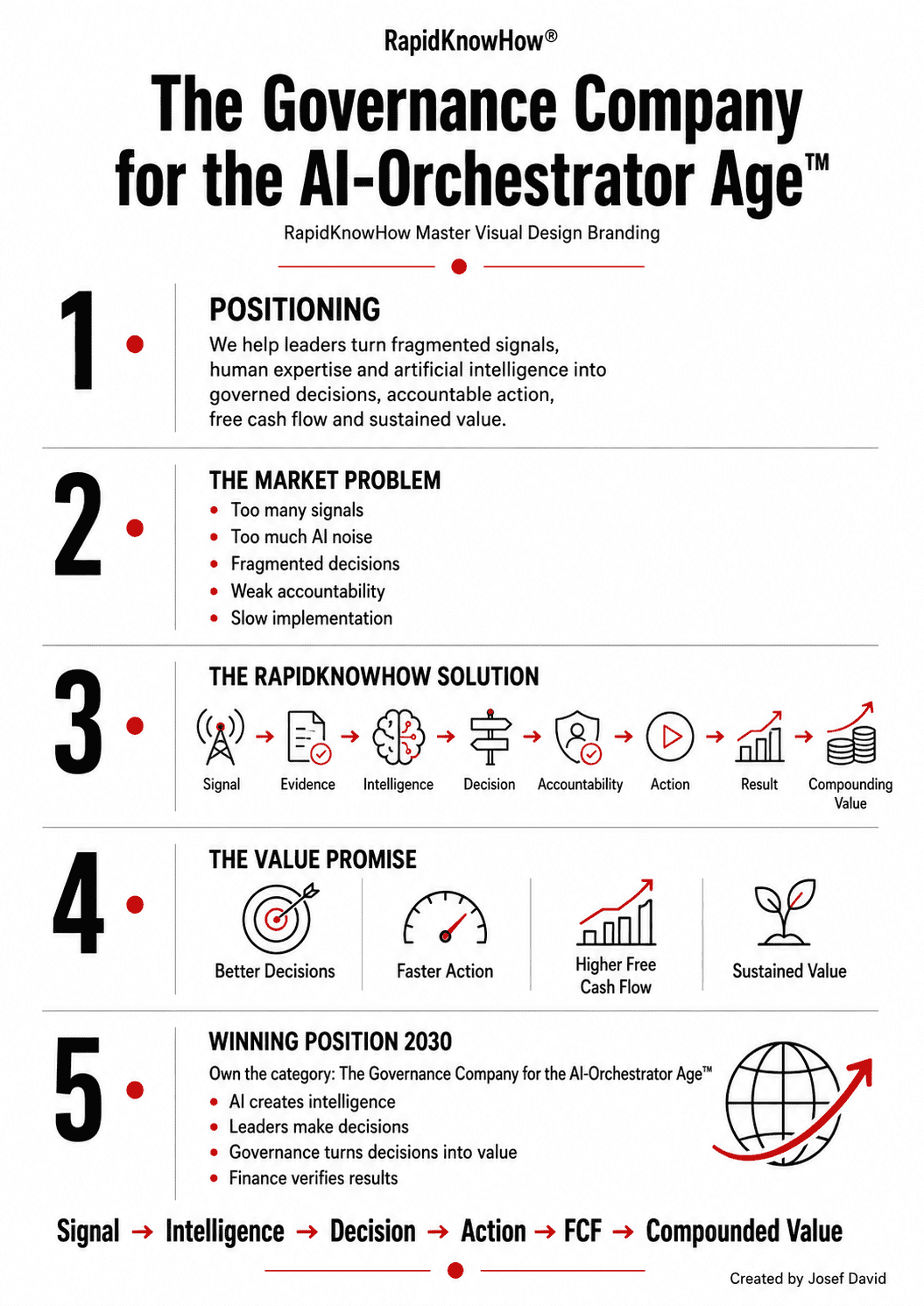
Signal → Influence → Decision → Action → FCF → Compounded Value
RapidKnowHow® — Making Industrial Gas Influence Visible™
RapidKnowHow® — THE DECISION COMPANY™
Industrial Gas Leadership 2030
PROVE VALUE. THEN SCALE.
Watch the 60-second roadmap: 10 strategic actions for DACH and CEE, 2026–2030.
Start with ONE customer challenge. Use the Industrial Gas Action Guide to turn your first action into a measurable result.
RapidKnowHow® — Leading Industrial Gas Opportunity Signal Identifier in DACH & CEE