
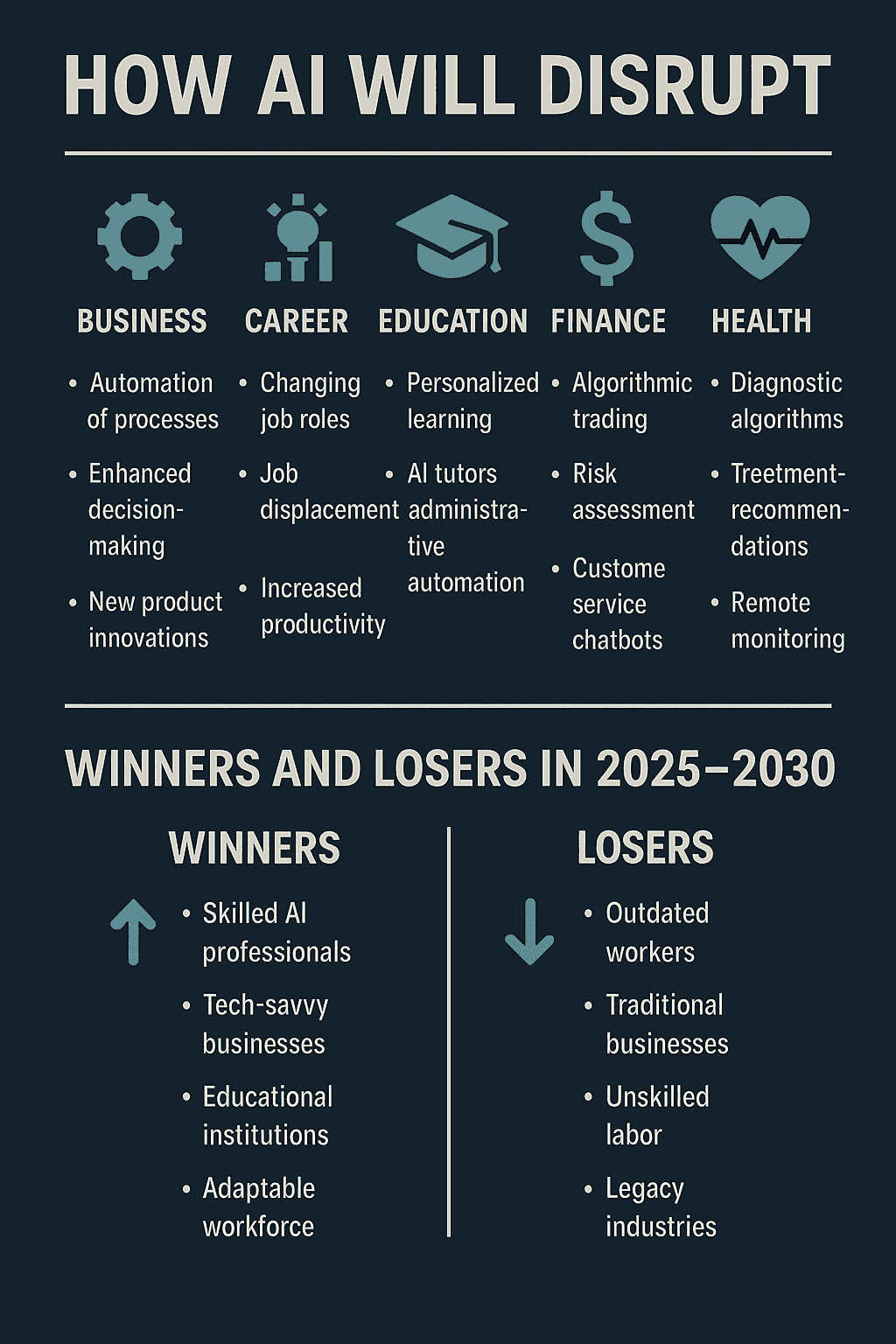
WINNERS TURN KNOW-HOW INTO VERIFIED CASH FLOW.
The next competitive advantage: combine human judgment, AI and customer trust into one measurable value system.
Who is likely to win between 2026 and 2030?
Our strategic thesis: businesses that identify an expensive customer problem, make a sound decision and prove the economic result will be better positioned than businesses that merely produce more information.
This is a scenario for business models, not a ranking of companies or a prediction of investment returns.
THE SIGNAL: TWO TRANSFORMATIONS MEET
The World Economic Forum’s Future of Jobs Report 2025 records employers’ expectation that 39% of workers’ existing skills will change or become outdated by 2030. Analytical thinking remains a leading core skill, alongside rising demand for AI skills.
The IEA’s Energy and AI report highlights reliable electricity as a crucial condition for AI development.
RapidKnowHow® interpretation: digital capability and physical reliability must advance together. AI can support a decision; people remain accountable for its quality and consequences.
FIVE LOSING MODELS — FIVE WINNING MOVES
| Model under pressure | Better-positioned model | What must be proved |
| Generic information sold without a distinct application | Industrial know-how converted into a reusable decision system | A customer makes a better decision |
| AI pilots measured by usage alone | AI embedded in an accountable operating process | Net benefit after costs and errors |
| Supplier–customer silos optimizing separate budgets | Partners working from shared facts and total cost | Lower total cost without shifting hidden costs |
| Sales growth that absorbs more cash than it generates | Growth governed by cash conversion and capital discipline | Recurring cash improvement |
| One-off projects dependent on one expert | Documented systems supported by repeatable proof | Customers adopt, renew and expand |
These are choices, not permanent identities. A business can move from the left column to the right.
THE INDUSTRIAL GAS EXAMPLE
A supplier wins an order by reducing the price per unit. Yet the customer still experiences emergency deliveries, excess stock and production interruptions.
The lower invoice price does not automatically mean lower total cost.
A stronger approach combines supplier expertise, customer operating data and AI-assisted analysis to improve replenishment.
Measure deliveries, stock, downtime and consumption against an agreed baseline. Include sensors, software, service and implementation costs. Establish which gains are attributable to the intervention.
Then separate the result:
- Recurring operating savings can improve annual cash generation.
- Inventory reduction releases cash once; it is not recurring annual savings.
- Avoided downtime has economic value only when the assumptions are supported.
- A renewal becomes credible when the customer can verify the benefit.
The winning offer is a reliable operating result with transparent economics.
ONE DECISION
Choose one customer cash leak and prove its improvement within 90 days before expanding the system.
TOP 3 ACTIONS
1. FIND THE GAP — DAYS 1–15
Select one replenishment, inventory, downtime or collection problem. Agree the baseline, data source and accountable owner.
2. MAKE THE DECISION — DAYS 16–30
Compare options. Select one intervention. Set a budget, target and review date. Define how supplier and customer will share verified value.
3. PROVE THE CASH — DAYS 31–90
Implement, track actual results and subtract incremental costs. Separate recurring benefits from one-time releases. Expand only when the evidence supports it.
MEASURABLE VALUE DELIVERED
Use a compact scorecard:
Net recurring cash benefit • One-time cash release • Service reliability • Customer adoption • Renewal decision
No verified result? Improve the intervention before scaling.
THE RAPIDKNOWHOW® COMMERCIAL CONNECTION
Start with the self-directed decision journey.
When additional structure is needed, choose the relevant Action Guide in the shop: Find the Cash GAP™, Make the Board Decision™, or Start the 90-Day CASH PROOF™.
When a proven system is ready for repeatable use across teams or sites, assess the licensing path.
SIGNAL → ONE DECISION → TOP 3 ACTIONS → VERIFIED RESULT → REPEATABLE VALUE
ACTION CHECKLIST
- One material customer problem selected.
- Baseline and measurement method agreed.
- Human owner and budget assigned.
- Supplier–customer value-sharing terms clear.
- Day-30 and day-90 reviews scheduled.
- Costs, recurring gains and one-time releases separated.
- Relevant guide or license offer accessible on mobile.
- Final PASS: verified improvement justifies the next commitment.
The winners of 2030 will earn their position by proving customer value repeatedly. Start with one decision today.
RapidKnowHow® — THE DECISION COMPANY™
Sources and customer next steps
World Economic Forum, The Future of Jobs Report 2025, published 7 January 2025:
https://www.weforum.org/publications/the-future-of-jobs-report-2025/digest/
IEA, Energy and AI, 2025:
https://www.iea.org/reports/energy-and-ai/executive-summary
Action Guides: https://www.rapidknowhow.com/shop/
Licensing: https://www.rapidknowhow.com/decision-governance-licensing-system/