
POWER REPORT 2026–2030
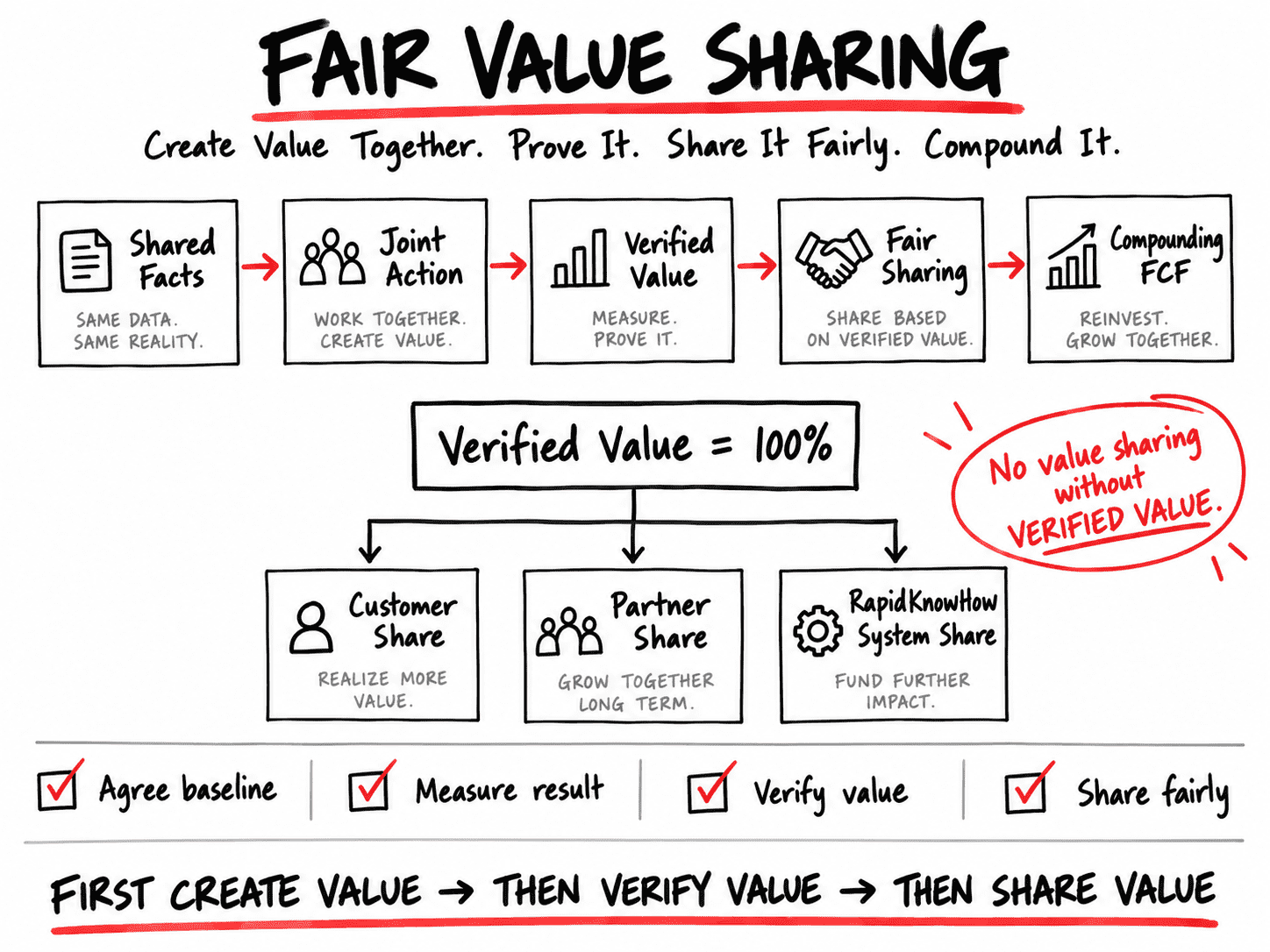
CREATE VALUE TOGETHER. PROVE IT. SHARE IT FAIRLY. COMPOUND IT.
EXECUTIVE MESSAGE
Most supplier–customer relationships still negotiate price.
High-performing ecosystems manage Total Value.
The RapidKnowHow® FAIR VALUE SHARING™ System moves the relationship from:
PRICE NEGOTIATION → SHARED VALUE CREATION → VERIFIED VALUE → FAIR VALUE SHARING → REPEAT → SCALE → COMPOUND
The central principle is simple:
No value sharing without verified value creation.
The objective is not to transfer value from one party to another.
The objective is to increase the total economic value first — then agree transparently how the created value is shared.
1. THE PROBLEM
Traditional commercial relationships often become zero-sum.
Supplier wants:
Margin ↑
Volume ↑
Retention ↑
Share of Wallet ↑
FCF ↑
Customer wants:
Price ↓
TCO ↓
Productivity ↑
Reliability ↑
FCF ↑
This creates a predictable negotiation:
SUPPLIER PRICE ↑ ←→ CUSTOMER PRICE ↓
Both sides concentrate on dividing the existing economic pie.
The bigger opportunity is often ignored:
MAKE THE PIE BIGGER.
2. THE FAIR VALUE SHARING PRINCIPLE
RapidKnowHow® separates three questions:
1. WHAT VALUE WAS CREATED?
Determine the measurable economic improvement.
2. WHO CONTRIBUTED TO THE VALUE?
Identify supplier, customer and joint contributions.
3. HOW SHOULD THE VERIFIED VALUE BE SHARED?
Apply a pre-agreed commercial formula.
Therefore:
VALUE CREATED ≠ VALUE CLAIMED
Only:
VERIFIED VALUE
should enter the sharing mechanism.
3. THE RAPIDKNOWHOW® VALUE FLOW
MULTIPLE STAKEHOLDERS
↓
SHARED FACTS
↓
BASELINE
↓
VALUE OPPORTUNITY
↓
JOINT ACTION
↓
MEASURE RESULT
↓
VERIFY ECONOMIC VALUE
↓
SHARE VALUE FAIRLY
↓
REINVEST + SCALE
↓
COMPOUND FCF
4. DEFINE THE BASELINE FIRST
Fair sharing becomes impossible without an agreed starting point.
Before implementation, establish:
BASELINE COST
Current total economic cost.
BASELINE PERFORMANCE
Reliability, productivity, consumption, downtime, logistics, inventory.
BASELINE CASH FLOW
Working capital and operating cash impact.
BASELINE VOLUME / ACTIVITY
Production, consumption or service volume.
BASELINE PERIOD
Usually an agreed historical operating period.
The baseline must be accepted by all relevant parties before the improvement program begins.
5. CALCULATE TOTAL VERIFIED VALUE
RapidKnowHow® looks beyond purchasing savings.
TOTAL VALUE CREATED™
=
Operating Cost Reduction
Productivity Improvement
Downtime Avoided
Working Capital Released
Logistics Savings
Energy / Resource Savings
Quality Improvement
Risk Cost Avoided
Revenue / Throughput Contribution
−
Implementation Cost
6. EXAMPLE — INDUSTRIAL GAS
A manufacturing customer currently incurs:
Annual Industrial Gas TCO:
€5.0 million
A joint supplier/customer optimization program produces:
Consumption improvement
€250,000
Reduced emergency deliveries
€100,000
Lower downtime
€300,000
Working-capital release
€150,000
Logistics optimization
€100,000
Implementation cost
−€100,000
VERIFIED ECONOMIC VALUE
€800,000
The discussion is no longer:
“Can we reduce the gas price another 3%?”
It becomes:
“We jointly created €800,000 of verified economic value. How should this value be shared?”
That is a fundamentally different commercial conversation.
7. FAIR VALUE SHARING FORMULA™
A simple starting architecture:
VERIFIED VALUE CREATED
€800,000
↓
CUSTOMER VALUE SHARE
Example: 70%
€560,000
VALUE CREATION PARTNER SHARE
Example: 20%
€160,000
RAPIDKNOWHOW® / SYSTEM SHARE
Example: 10%
€80,000
The percentages are not universal rules.
They should be contractually determined according to:
Contribution
Capital employed
Risk assumed
IP supplied
Execution responsibility
Measurement confidence
Duration
Scalability
The critical principle is:
AGREE THE RULE BEFORE THE RESULT.
8. THE FOUR FAIRNESS TESTS™
Every value-sharing arrangement should pass four tests.
TEST 1 — VALUE TEST
Was additional economic value actually created?
TEST 2 — PROOF TEST
Can Finance or another agreed independent authority verify it?
TEST 3 — CONTRIBUTION TEST
Can the major contributors to the result be identified?
TEST 4 — SHARING TEST
Does each participant receive enough value to continue supporting the system?
If one test fails:
DO NOT SCALE YET.
9. FROM PROCUREMENT TO VALUE PARTNERSHIP
TRADITIONAL MODEL
Supplier
↓
Product
↓
Price
↓
Negotiation
↓
Purchase Order
FAIR VALUE SHARING MODEL
Supplier + Customer + Value Orchestrator
↓
Shared Opportunity
↓
Joint Baseline
↓
Improvement
↓
Verified Value
↓
Fair Sharing
↓
Repeat
↓
Multi-Site Scale
↓
Recurring FCF
The commercial relationship moves from:
TRANSACTIONAL
to
ECONOMIC PARTNERSHIP
10. RAPIDKNOWHOW® ROLE
RapidKnowHow® does not need to own the operating assets.
Its role is to provide the independent decision and value architecture.
RapidKnowHow®:
SEE
Identify the value opportunity.
ALIGN
Bring stakeholder interests into one economic picture.
DECIDE
Define the highest-value actions.
PROVE
Establish baseline, formula and verification.
SHARE
Apply the agreed sharing model.
PRESERVE
Turn the proven method into reusable IP.
SCALE
License the proven system across sites, businesses and regions.
THE RAPIDKNOWHOW® COMMERCIAL MODEL
SMALL UPFRONT
Covers:
Value Scan
Baseline
Data preparation
Decision System
Opportunity Map
↓
VERIFIED VALUE SHARE
RapidKnowHow® participates in measurable value delivered.
↓
ANNUAL LICENSE
The customer licenses the proven system.
↓
EXPANSION
Plant → Multi-Site → Country → Region → Enterprise
↓
RENEWAL
Recurring system value.
↓
COMPOUNDING FCF + IP VALUE
11. GOVERNANCE
Fair Value Sharing requires clear governance.
Before launch, agree:
1. Baseline
What is today’s economic position?
2. Value Formula
Exactly how will value be calculated?
3. Attribution
Which improvements count?
4. Verification
Who confirms the result?
5. Time Period
When is value measured?
6. Sharing Formula
Who receives what?
7. Payment Trigger
When does the value share become payable?
8. Dispute Mechanism
How are disagreements resolved?
9. Scale Rights
How may the system be reused?
10. IP Rights
Who owns the methodology, operating improvements and reusable system IP?
12. THE STRATEGIC CHOKEPOINT
The hardest part is rarely:
CREATING THE IDEA.
The chokepoint is:
PROVING THE VALUE CREDIBLY ENOUGH THAT EVERY PARTY ACCEPTS THE NUMBER.
Therefore the strongest RapidKnowHow® asset is not merely a value calculator.
It is the:
TRUSTED VALUE VERIFICATION SYSTEM™
Once the verified number is trusted, fair sharing becomes much easier.
13. ONE TOTAL VALUE SYSTEM™
Fair Value Sharing becomes even more powerful when extended beyond buyer and seller.
SUPPLIER MANAGEMENT
Profitable growth + FCF
SUPPLIER SALES
Customer growth + retention
SUPPLIER OPERATIONS
Asset productivity + service efficiency
CUSTOMER MANAGEMENT
Business performance + FCF
PROCUREMENT
TCO + transparency
OPERATIONS
Reliability + productivity
FINANCE
Verified economic impact
RAPIDKNOWHOW®
Independent value orchestration + reusable IP
All stakeholders operate around:
ONE SHARED VALUE CASE.
14. BOARD DASHBOARD
The board does not need 50 KPIs.
Use five.
| KPI | Board Question |
|---|---|
| VALUE OPPORTUNITY | How much value could we create? |
| VERIFIED VALUE | How much was actually delivered? |
| CUSTOMER SHARE | How much value remains with the customer? |
| PARTNER SHARE | How much rewards the value creators? |
| COMPOUNDING FCF | How much recurring FCF is created? |
The key ratio:
VERIFIED VALUE / VALUE OPPORTUNITY
shows whether the system converts opportunity into real economic results.
15. THE 10-MINUTE BOARD DECISION
SIGNAL
Large supplier/customer relationship with unexploited Total Value.
DECISION
Replace price-only negotiation with a verified Fair Value Sharing model.
WHY NOW
Price pressure alone increasingly destroys potential joint value.
TOP 3 ACTIONS
1. Establish ONE agreed baseline.
2. Select ONE high-value improvement opportunity.
3. Agree the verification and sharing formula before implementation.
30-DAY RESULT
One pilot value case with:
Baseline
Opportunity
Actions
Measurement Formula
Verification Owner
Sharing Formula
FAIR VALUE SHARING™ — 10-CARD SYSTEM
1 — IDENTIFY
Find the high-value opportunity.
2 — ALIGN
Bring the stakeholders together.
3 — BASELINE
Agree the starting economics.
4 — DESIGN
Define the improvement.
5 — ACT
Execute the value move.
6 — MEASURE
Capture economic impact.
7 — VERIFY
Confirm the result independently.
8 — SHARE
Distribute created value fairly.
9 — SCALE
Repeat across applications and sites.
10 — COMPOUND
Convert verified value into recurring FCF.
RAPIDKNOWHOW® FAIR VALUE SHARING™ MASTER EQUATION
SHARED FACTS
JOINT ACTION
VERIFIED VALUE
FAIR SHARING
REUSABLE SYSTEM
=
TRUST + RECURRING FCF + COMPOUNDING ENTERPRISE VALUE
ACTION CHECKLIST
☐ Select ONE supplier–customer value case
☐ Establish the economic baseline
☐ Define the Total Value formula
☐ Identify stakeholder contributions
☐ Agree measurement rules
☐ Nominate the verification authority
☐ Agree the sharing mechanism before execution
☐ Execute the Top 3 value actions
☐ Verify delivered FCF
☐ Share the verified value
☐ Convert the proven model into an annual licence
☐ Expand to the next site or application
☐ Review the single biggest chokepoint before scaling
FINAL PASS / FAIL TEST
Ask one question:
Can every major stakeholder see, understand and independently verify the value created and the value they receive?
YES → SCALE
NO → FIX THE VALUE PROOF SYSTEM FIRST
RAPIDKNOWHOW® POSITIONING
FROM:
“How much discount can we get?”
TO:
“How much additional value can we create together?”
TO:
“How much verified value did we deliver?”
TO:
“How should we share it fairly?”
TO:
“HOW DO WE COMPOUND IT?”
RapidKnowHow® FAIR VALUE SHARING™
CREATE VALUE TOGETHER.
PROVE IT.
SHARE IT FAIRLY.
COMPOUND IT.
The commercial principle:
FIRST CREATE THE VALUE.
THEN VERIFY THE VALUE.
THEN SHARE THE VALUE.
THEN SCALE THE SYSTEM.
RapidKnowHow® — THE DECISION COMPANY™
Industrial Gas Leadership 2030
PROVE VALUE. THEN SCALE.
Watch the 60-second roadmap: 10 strategic actions for DACH and CEE, 2026–2030.
Start with ONE customer challenge. Use the Industrial Gas Action Guide to turn your first action into a measurable result.
RapidKnowHow® — Leading Industrial Gas Opportunity Signal Identifier in DACH & CEE
Leave a Reply