What if Power Moves at the Top 3 Global Flashpoints?
What Happens Next? Tit-for-Tat — by Who, Why, and What Result?
Forecast Week: 8–14 June 2026
Status Date: 6 June 2026
Method: RapidKnowHow GeoMove™
Core Logic: Power Move → Countermove → Chain Reaction → Strategic Result
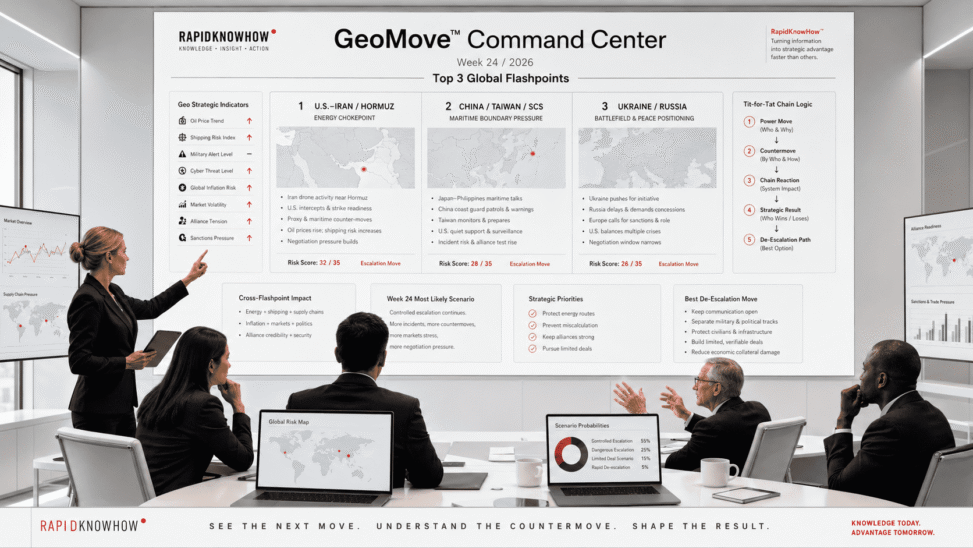
GeoMove™ Week 24/2026: Top 3 Global Flashpoints and the Next Tit-for-Tat Power Moves
RapidKnowHow forecast of the next strategic reactions in U.S.–Iran/Hormuz, China–Taiwan/South China Sea, and Ukraine–Russia.
Strategic Call-to-Action
For Week 24, leaders should not react to headlines. They should map the next three countermoves before deciding:
Who benefits? Who retaliates? Who pays? Who can de-escalate?
1. Flashpoint One — U.S.–Iran / Strait of Hormuz
Core GeoMove™: Energy Chokepoint Becomes War Leverage
Current Power Move
Iran launched multiple drones toward the Strait of Hormuz on 5 June 2026, and U.S. aircraft intercepted at least four of them. Reuters also reported that U.S. forces struck Iranian radar sites after the drone launch, targeting surveillance positions around Goruk and Qeshm Island.
A separate Reuters report on 6 June 2026 describes this as part of a broader Gulf flare-up, with U.S. strikes on Iranian coastal radar sites and Iranian-linked responses affecting regional bases and maritime traffic.
Who Moves?
Iran moves by using drones, radar, maritime pressure, and Hormuz leverage.
The U.S. responds with interception, strikes on radar/surveillance sites, naval protection, and political pressure.
Gulf states, Israel, Hezbollah, shipping firms, insurers, oil traders, and central banks are pulled into the consequence chain.
Why?
Iran uses Hormuz because it is not just a waterway. It is a global economic pressure point. If shipping risk rises, oil risk rises; if oil risk rises, inflation risk rises; if inflation risk rises, political pressure rises in the U.S., Europe, and Asia.
The U.S. acts because it must protect maritime traffic, show deterrence credibility, and prevent Iran from converting regional escalation into economic blackmail. Reuters has also reported that Iran is seeking sanctions relief and concessions in the context of indirect talks.
Tit-for-Tat Forecast — Week 24
| Move | Actor | Likely Action | Strategic Purpose |
|---|---|---|---|
| 1 | Iran | More drone, radar, fast-boat, or proxy pressure near Hormuz | Raise cost for U.S. and Gulf states |
| 2 | U.S. | Defensive strikes on launch, radar, drone-control or surveillance sites | Restore deterrence and protect shipping |
| 3 | Iran | Proxy response through Hezbollah, Iraq/Syria militias, or maritime harassment | Avoid direct full-scale war while keeping pressure |
| 4 | Oil markets | Price in higher risk premium | Convert conflict into economic pressure |
| 5 | Gulf states | Quiet pressure on Washington and Tehran | Avoid economic and infrastructure damage |
| 6 | China / India / EU | Push for shipping stability | Protect energy imports and industrial cost base |
| 7 | U.S. / Iran negotiators | Explore limited deal | Freeze escalation without full settlement |
GeoMove™ Chain
Iran drone move
→ U.S. interception and radar strikes
→ Iranian proxy and maritime countermoves
→ Oil and shipping risk rises
→ U.S. domestic price pressure increases
→ Backchannel talks become more urgent
→ Limited Hormuz-for-relief deal becomes possible
Likely Result in Week 24
Most likely result:
Controlled escalation with transactional negotiation.
The conflict will probably not immediately become a full U.S.–Iran war, because both sides still benefit from keeping escalation below the point of irreversible damage. However, the risk is high because Hormuz connects military escalation, energy prices, shipping insurance, inflation, and domestic politics.
Risk Score
32 / 35 — Systemic Danger Move
| Factor | Score |
|---|---|
| Military escalation risk | 5 |
| Energy disruption risk | 5 |
| Global market impact | 5 |
| Domestic political pressure | 5 |
| De-escalation potential | 3 |
| Proxy-chain risk | 5 |
| Miscalculation risk | 4 |
Hidden Beneficiaries
Potential beneficiaries include:
Energy traders gaining from volatility.
Defense suppliers benefiting from regional militarization.
Hardliners in Iran using external pressure to justify internal control.
U.S. political actors using confrontation to signal strength.
Alternative oil suppliers gaining pricing power.
Strategic Recommendation
Best De-escalation Move:
Create a limited Hormuz-for-Relief Framework:
Iran keeps shipping open
→ U.S. pauses selected pressure measures
→ Gulf states monitor maritime safety
→ China, India, and EU support shipping neutrality
→ Nuclear and sanctions negotiations move to a second track
RapidKnowHow Conclusion:
This is the most dangerous flashpoint for Week 24 because it can hit households, businesses, oil prices, inflation, shipping costs, and political stability within days.
2. Flashpoint Two — China / Taiwan / Japan / Philippines
Core GeoMove™: Maritime Boundary Talks Become Alliance Test
Current Power Move
China’s Coast Guard patrolled waters east of Taiwan after Japan and the Philippines announced maritime border talks in areas that overlap with Chinese claims. Taiwan reported Chinese vessels southeast of Orchid Island, while China condemned the Japan–Philippines talks as illegal and asserted sovereignty claims.
Reuters also reported that the Philippines remains under “severe threat” from China, according to the Philippine defence minister, despite a recent thaw in U.S.–China relations after the Trump–Xi summit.
Who Moves?
Japan and the Philippines move by discussing maritime delimitation and strengthening legal/strategic coordination.
China responds with coast guard patrols, military signaling, legal rejection, and sovereignty messaging.
Taiwan monitors and prepares defensive support.
The U.S. remains the background security guarantor.
Why?
China wants to prevent Japan–Philippines coordination from becoming a normalized anti-China maritime structure near Taiwan and the South China Sea.
Japan and the Philippines want to build a stronger legal, diplomatic, and security position before Chinese pressure becomes irreversible.
Taiwan wants to prevent being strategically surrounded by Chinese coast guard and naval activity.
The U.S. wants to preserve alliance credibility without triggering direct war.
Tit-for-Tat Forecast — Week 24
| Move | Actor | Likely Action | Strategic Purpose |
|---|---|---|---|
| 1 | Japan / Philippines | Continue maritime talks | Build legal and strategic coordination |
| 2 | China | Increase coast guard patrols and warnings | Challenge normalization early |
| 3 | Taiwan | Increase monitoring and readiness | Avoid surprise and signal sovereignty |
| 4 | U.S. | Quiet support, surveillance, possible freedom-of-navigation messaging | Reassure allies without direct escalation |
| 5 | China | Air/naval exercises or legal statements | Raise cost of coordination |
| 6 | Philippines / Japan | Request stronger allied coordination | Internationalize the issue |
| 7 | Markets | Price low immediate risk but rising long-term risk | Watch supply chain and chip exposure |
GeoMove™ Chain
Japan–Philippines maritime coordination
→ China coast guard patrols east of Taiwan
→ Taiwan monitors and warns
→ U.S. and allies strengthen surveillance
→ China frames this as containment
→ More patrols and exercises follow
→ Incident risk rises
Likely Result in Week 24
Most likely result:
Deterrence game with high miscalculation risk.
This is not likely to explode immediately in Week 24, but the trend is dangerous because China uses coast guard, navy, lawfare, and pressure tactics in overlapping zones. That creates ambiguity: is an incident a law-enforcement event, a sovereignty challenge, or a military escalation?
Risk Score
28 / 35 — Escalation Move
| Factor | Score |
|---|---|
| Military escalation risk | 4 |
| Maritime incident risk | 5 |
| Alliance credibility risk | 4 |
| Economic/supply-chain risk | 4 |
| De-escalation potential | 3 |
| Legal conflict risk | 4 |
| Miscalculation risk | 4 |
Hidden Beneficiaries
Potential beneficiaries include:
Defense contractors in Japan, U.S., Taiwan, Australia, and the Philippines.
Nationalist political actors using maritime pressure to strengthen domestic legitimacy.
Strategic competitors benefiting if U.S. attention is split between the Middle East, Ukraine, and East Asia.
Alternative manufacturing hubs if Taiwan risk accelerates supply-chain diversification.
Strategic Recommendation
Best De-escalation Move:
Create a Maritime Incident Separation Protocol:
Coast guard incidents stay coast guard incidents
→ Military forces stay behind defined escalation lines
→ Hotlines remain active
→ Japan–Philippines legal talks continue but avoid military symbolism
→ Taiwan maintains readiness without provocative declaration
RapidKnowHow Conclusion:
This is the most important long-term flashpoint. Week 24 may not bring open conflict, but each patrol, warning, and exercise builds the chain that could later produce a crisis.
3. Flashpoint Three — Ukraine / Russia
Core GeoMove™: Battlefield Window Meets Peace-Talk Positioning
Current Power Move
Zelenskiy has sought progress on peace talks before winter and has also called for tougher sanctions on Russia. Reuters reported that a senior Ukrainian commander said Ukraine had a six-month window to seize battlefield initiative and improve its position for peace talks.
Reuters also reported Putin’s recent statements on Ukraine, peace, Trump, and power from a meeting with senior editors in St. Petersburg on 4 June 2026, showing that Russia is still framing the war around territorial control, compromise conditions, and long-term political positioning.
Who Moves?
Ukraine moves by pressing for battlefield advantage, sanctions pressure, and peace-talk positioning.
Russia moves by holding territory, delaying, demanding terms, and testing Western fatigue.
Europe moves through sanctions, military support, and diplomatic involvement.
The U.S. remains decisive but is distracted by Iran/Hormuz and China/Taiwan.
Why?
Ukraine wants to strengthen its negotiating position before winter and before Western political patience weakens.
Russia wants to convert time, attrition, and territorial control into political leverage.
Europe wants to avoid a Russian victory but also fears long-war fatigue, budget pressure, energy pressure, and political fragmentation.
The U.S. wants leverage but is forced to divide attention across multiple global fronts.
Tit-for-Tat Forecast — Week 24
| Move | Actor | Likely Action | Strategic Purpose |
|---|---|---|---|
| 1 | Ukraine | Push battlefield initiative and peace-talk momentum | Improve negotiating position |
| 2 | Russia | Delay, intensify selected attacks, demand concessions | Avoid negotiating from weakness |
| 3 | Europe | Call for sanctions and inclusion in talks | Maintain relevance and pressure |
| 4 | U.S. | Balance Ukraine support with Iran and China priorities | Avoid strategic overstretch |
| 5 | Russia | Information campaign on Western fatigue | Weaken support coalition |
| 6 | Ukraine | Ask for air defense, missiles, finance | Sustain battlefield and civilian resilience |
| 7 | Markets / citizens | React to war-cost fatigue | Increase political pressure on governments |
GeoMove™ Chain
Ukraine seeks peace leverage before winter
→ Russia delays and hardens conditions
→ Europe demands role and sanctions pressure
→ U.S. attention is divided by Hormuz and China
→ Russia tests Western fatigue
→ Ukraine pushes for more weapons and guarantees
→ Negotiation window narrows unless ceasefire design becomes credible
Likely Result in Week 24
Most likely result:
Stalemate with negotiation pressure.
The war is unlikely to end in Week 24. The more likely development is a contest over the conditions of negotiation: who enters talks stronger, who gets security guarantees, who controls territory, and who bears reconstruction and sanctions costs.
Risk Score
26 / 35 — Escalation Move
| Factor | Score |
|---|---|
| Military escalation risk | 4 |
| Sanctions escalation risk | 4 |
| Western fatigue risk | 5 |
| Negotiation potential | 3 |
| Civilian/economic harm | 4 |
| Miscalculation risk | 3 |
| Long-war risk | 3 |
Hidden Beneficiaries
Potential beneficiaries include:
Defense industries receiving sustained demand.
Energy exporters benefiting from continued European insecurity.
Political hardliners on both sides gaining from fear and mobilization.
Reconstruction players positioning for post-war contracts.
Strategic rivals of Europe benefiting from European distraction, cost pressure, and industrial weakness.
Strategic Recommendation
Best De-escalation Move:
Create a Security-for-Ceasefire Roadmap:
Verified ceasefire line
→ International monitoring
→ Security guarantees for Ukraine
→ Phased sanctions mechanism
→ Reconstruction fund
→ No recognition of forced territorial change without final settlement
RapidKnowHow Conclusion:
Ukraine/Russia remains a grinding strategic exhaustion game. The key question in Week 24 is not “peace or no peace?” but who improves their bargaining position before the next negotiation window closes?
4. GeoMove™ Cross-Flashpoint System Map
The Top 3 flashpoints are connected.
| Flashpoint | Main Power Lever | Main Countermove | Systemic Spillover |
|---|---|---|---|
| U.S.–Iran / Hormuz | Energy chokepoint | U.S. military strikes and shipping protection | Oil, inflation, shipping, domestic politics |
| China / Taiwan / Philippines / Japan | Maritime sovereignty pressure | Allied coordination and surveillance | Chip supply, alliance credibility, Indo-Pacific risk |
| Ukraine / Russia | Battlefield and sanctions leverage | Delays, escalation, negotiation positioning | European security, budgets, energy, political fatigue |
5. The Week 24 Tit-for-Tat Pattern
The pattern is:
1. Direct military move
Iran drones / Russia attacks / China patrols
2. Defensive countermove
U.S. strikes / Ukraine defense / allied surveillance
3. Narrative move
Each side claims legitimacy, defense, sovereignty, or deterrence
4. Economic consequence
Oil, insurance, inflation, sanctions, industrial costs
5. Political pressure
Citizens, voters, markets, business leaders demand clarity
6. Negotiation pressure
Backchannels become necessary because full escalation becomes too costly
6. GeoMove™ Week 24 Executive Risk Ranking
| Rank | Flashpoint | Risk Score | Risk Category | Why It Matters Most |
|---|---|---|---|---|
| 1 | U.S.–Iran / Hormuz | 32/35 | Systemic Danger | Connects war, oil, inflation, shipping, U.S. politics |
| 2 | China / Taiwan / South China Sea | 28/35 | Escalation Move | High miscalculation risk in contested maritime zones |
| 3 | Ukraine / Russia | 26/35 | Escalation Move | Long-war fatigue plus narrowing negotiation window |
7. What Happens Next? Week 24 Forecast
Most Likely Scenario
Controlled escalation continues.
No full global war, but more incidents, more counter-incidents, more sanctions pressure, more narrative warfare, and more economic spillovers.
Dangerous Scenario
Hormuz incident triggers oil shock.
A tanker attack, drone hit, mine incident, or U.S.–Iran strike cycle could push oil and insurance costs higher, forcing central banks and governments into crisis-management mode.
Strategic Opportunity Scenario
Limited de-escalation deal emerges.
A narrow deal on Hormuz shipping could reduce market pressure without solving the Iran nuclear issue. This would be the most practical immediate stabilizer.
8. RapidKnowHow GeoMove™ Final Strategic Assessment
The Most Dangerous Flashpoint
U.S.–Iran / Strait of Hormuz
Because it connects:
Military escalation + energy supply + global inflation + shipping insurance + domestic politics
The Most Important Long-Term Flashpoint
China / Taiwan / South China Sea
Because it connects:
Sovereignty + alliance credibility + chip supply + sea lanes + U.S.–China rivalry
The Most Exhausting Flashpoint
Ukraine / Russia
Because it connects:
territory + sanctions + European security + reconstruction + Western fatigue
9. Strategic Action Sentence
In Week 24/2026, the winning strategy is not to react faster to headlines, but to see the next three countermoves earlier than others — because the real danger lies where military pressure, economic cost, and political emotion combine.
10. RapidKnowHow Product Offer
Turn this into a repeatable weekly product:
GeoMove™ Weekly — Top 3 Flashpoints
Each weekly edition should include:
- Top 3 Power Moves
- Who moves and why
- Expected Tit-for-Tat chain
- Risk score
- Hidden beneficiaries
- Most likely result
- Best de-escalation move
- Board / investor / citizen action sentence
- Command Center HTML version
- Denkposter PNG version
Final RapidKnowHow Conclusion
Week 24/2026 is a week of controlled but dangerous escalation.
The central risk is not one isolated war. The central risk is the interaction of three power systems:
Hormuz energy war pressure
- Taiwan maritime alliance pressure
- Ukraine long-war negotiation pressure
Together, they create a world where every major power move triggers a countermove, every countermove creates market stress, and every market stress creates political pressure.
GeoMove™ is the right RapidKnowHow IP tool because it helps leaders see the chain before the chain hits them.