“Less, but Better → AI, but Orchestrated.”
A) FOUNDATION — FROM BRAUN DESIGN TO AI-ORCHESTRATION


The DNA of Braun is not technology—it is system thinking through design. Under Dieter Rams, Braun transformed industrial products into clear, usable systems driven by one principle:
“Less, but better.”
This philosophy redefined design globally. Braun products were:
- Functional before decorative
- Simple yet powerful
- Timeless, not trendy
- Systematically structured
Rams translated Bauhaus thinking into operational reality:
- Form follows function
- Design must be understandable
- Design must be long-lasting
👉 The breakthrough:
Braun didn’t design products. It designed SYSTEMS people could instantly understand and use.
B) THE SHIFT — FROM DESIGN SYSTEM → AI-ORCHESTRATOR SYSTEM
Today, we face a similar inflection point:
| THEN (Braun Era) | NOW (AI Era) |
|---|---|
| Product complexity | Data complexity |
| Hardware systems | AI ecosystems |
| User confusion | Decision overload |
| Design as clarity | AI-Orchestration as clarity |
The modern equivalent of Braun design is:
AI-Orchestrator System = Making complex AI ecosystems simple, usable, and value-driven
C) THE BRAUN AI-ORCHESTRATOR PRINCIPLES (RAPIDKNOWHOW ADAPTATION)
We translate Rams’ 10 principles into AI leadership:
1. Innovative → AI must create new value
Not AI for automation only → AI for strategic advantage
2. Useful → AI must drive measurable outcomes
FCF, ROCE, speed-to-value—not experiments
3. Aesthetic → AI UX must be intuitive
If users need training → system failed
4. Understandable → AI must explain itself
Black box = no trust = no adoption
5. Unobtrusive → AI must disappear into workflow
No friction, no noise
6. Honest → AI must show real impact
No hype dashboards—real metrics
7. Long-lasting → AI must scale and adapt
Avoid short-lived tools
8. Thorough → AI must cover end-to-end value chain
No silos
9. Sustainable → AI must reduce cost + waste
Efficiency is core
10. As little design as possible → AI minimalism
👉 Only what drives value remains
D) THE BRAUN AI-ORCHESTRATOR SYSTEM ARCHITECTURE
RapidKnowHow System Model
1. INPUT LAYER — SIGNAL CAPTURE
- Market signals
- Operational data
- Customer behavior
- Financial flows
👉 “Understand reality simply”
2. ORCHESTRATION LAYER — AI ENGINE
Core modules:
- Prediction AI (forecast demand, risk)
- Optimization AI (cost, logistics, pricing)
- Decision AI (recommend actions)
👉 Not many tools—ONE orchestrated system
3. EXECUTION LAYER — ACTION SYSTEM
- Automated workflows
- Smart scheduling
- Real-time decisions
👉 Speed replaces complexity
4. VALUE LAYER — FCF ENGINE
Output:
- Higher Free Cash Flow
- Faster ROCE
- Higher valuation multiple
👉 Braun Principle Applied: Design = Measurable Value
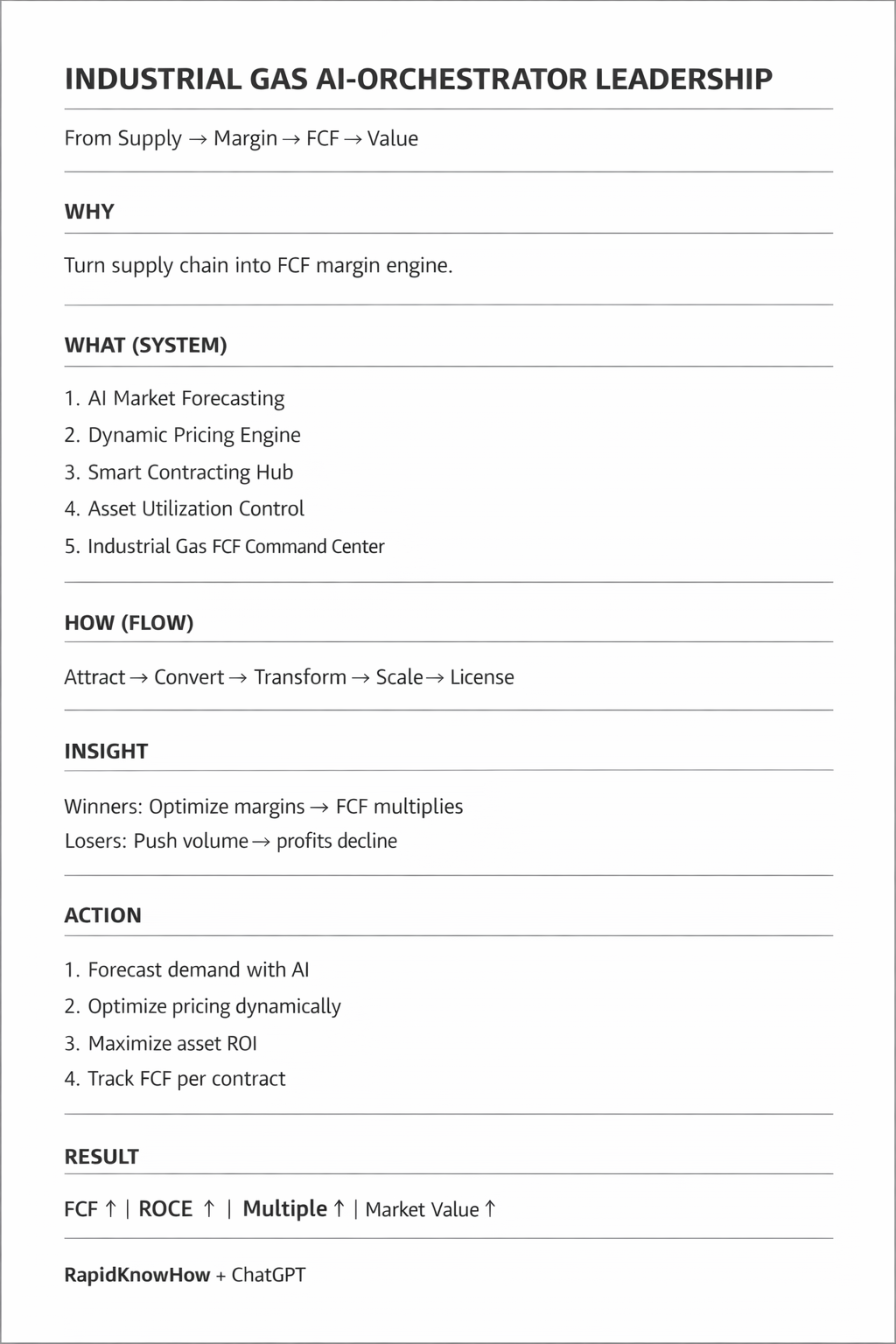
E) APPLYING THE SYSTEM — INDUSTRIAL GAS CASE
RapidKnowHow’s core domain.
TRADITIONAL MODEL
- Fragmented systems (ERP, SCADA, CRM)
- Manual decisions
- Delayed response
- Hidden inefficiencies
AI-ORCHESTRATOR MODEL
1. Demand AI
- Predict customer consumption
2. Supply AI
- Optimize production + logistics
3. Pricing AI
- Dynamic margin optimization
4. Cash Flow AI
- Optimize working capital
👉 RESULT:
| KPI | Traditional | AI-Orchestrator |
|---|---|---|
| Speed | Slow | Real-time |
| Cost | High | Optimized |
| FCF | Volatile | Compounding |
| ROCE | Moderate | High |
F) THE CEO SYSTEM — 15-SECOND RapidKnowHow System
Simplicity Delivered to leadership:
ONE SCREEN ONLY:
1. SIGNAL
What changed?
2. INSIGHT
What does it mean?
3. ACTION
What do we do now?
4. RESULT
What value do we capture?
👉 If it takes longer than 15 seconds →
System is too complex
G) COMPETITIVE IMPACT — LEADERS VS LAGGARDS
LEADERS (“RapidThrivers”)
- Simplify AI into systems
- Focus on value
- Design for usability
👉 Result: Compounding advantage
LAGGARDS
- Tool overload
- No orchestration
- No clear value
👉 Result: Complexity collapse
LOSERS
- Ignore AI
- Stay in legacy systems
👉 Result: Market exit
H) STRATEGIC INSIGHT
The biggest mistake today:
Companies adopt AI like features—not like systems.
Dieter Rams teaches us:
The winner is not who has more technology—
but who makes technology usable, scalable, and valuable.
I) CEO/BOARD ACTIONS (RAPIDKNOWHOW)
1. SIMPLIFY FIRST
Remove 30–50% of system complexity
2. BUILD ONE ORCHESTRATOR
Not 10 tools → 1 system
3. DESIGN UX FOR DECISION-MAKING
15-second clarity rule
4. FOCUS ON FCF IMPACT
Every AI must show:
- Cash
- Speed
- Efficiency
5. SCALE SYSTEM-WIDE
From pilot → ecosystem
J) FINAL INSIGHT
Braun – Dieter Ram’s legacy is not design—it is:
System clarity in a complex world
In the AI age:
AI-Orchestrator Leadership = Braun Design applied to business systems
K) ONE-LINE SUMMARY
“The future belongs to leaders who turn AI complexity into simple, value-driven systems—Less AI, but Better Orchestrated.” – Josef David