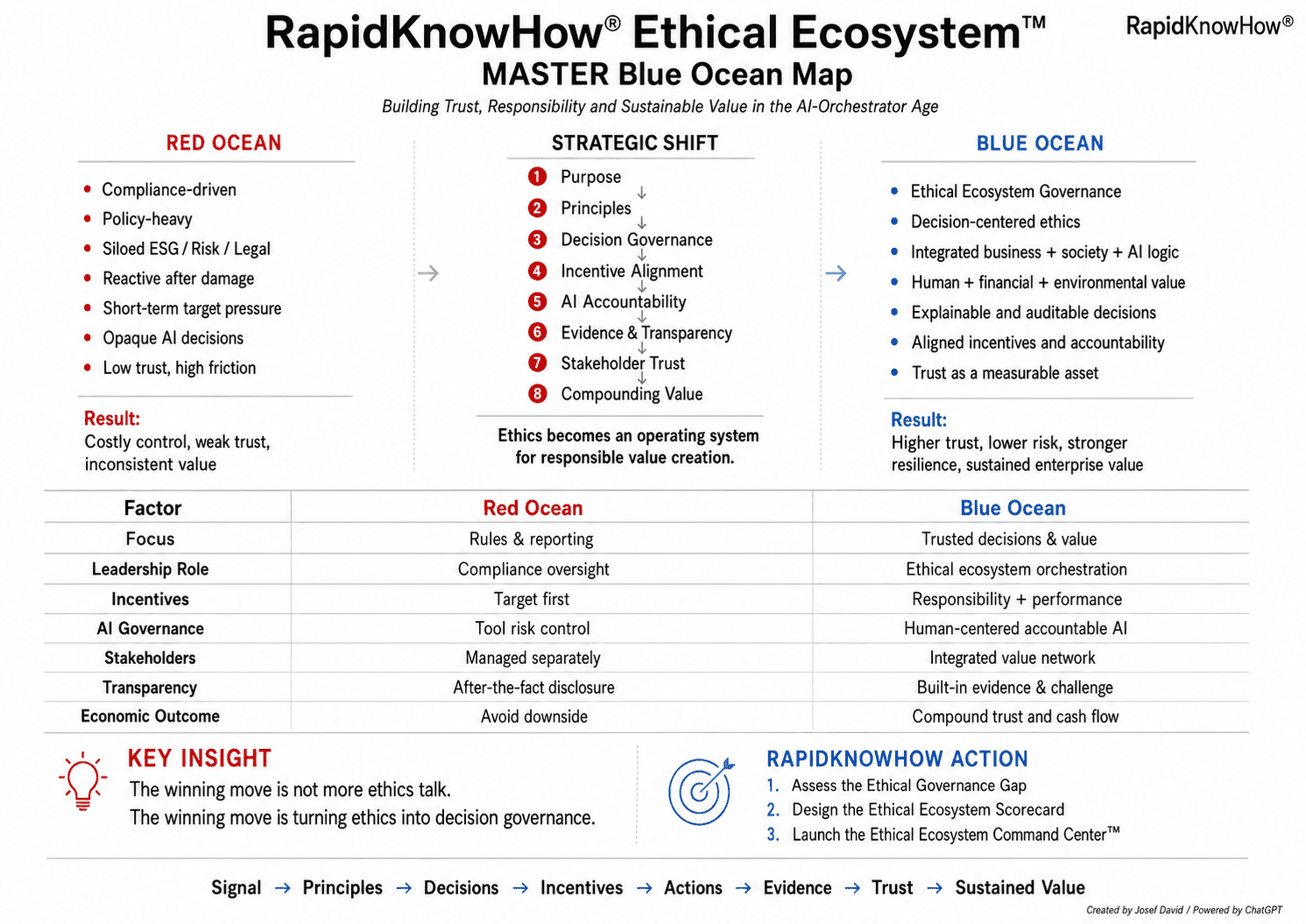
Building Trust, Responsibility and Sustainable Value in the AI-Orchestrator Age
1. The Strategic Idea
The Ethical Ecosystem™ is a proprietary RapidKnowHow® governance system that helps leaders, companies, institutions, and AI systems make decisions that are:
- economically viable,
- socially responsible,
- legally defensible,
- environmentally sustainable,
- technologically transparent,
- and ethically trustworthy.
The system moves ethics beyond declarations, compliance manuals, and corporate values statements.
It translates ethical intent into:
Principles → Decisions → Incentives → Actions → Evidence → Trust → Sustained Value
2. The Problem
Most organizations treat ethics as a separate compliance activity.
Typical weaknesses include:
- values that are not connected to operational decisions,
- incentives that reward results regardless of consequences,
- AI systems that cannot explain their recommendations,
- fragmented responsibility across departments,
- delayed responses to ethical risks,
- sustainability claims without measurable evidence,
- and governance systems that react only after damage occurs.
The result is an Ethical Governance Gap™ between what an organization promises and what it actually does.
This gap creates:
- reputational damage,
- regulatory exposure,
- employee distrust,
- customer loss,
- investor uncertainty,
- strategic inconsistency,
- and destruction of enterprise value.
3. The RapidKnowHow® Solution
The Ethical Ecosystem™ integrates ethics directly into the organization’s decision architecture.
It answers six executive questions:
- What principles govern our decisions?
- Who benefits and who carries the risks?
- Which incentives influence the decision?
- What consequences could emerge?
- How can the decision be verified and challenged?
- Does the decision create sustainable value over time?
The Ethical Ecosystem™ is therefore not simply an ethics framework.
It is an AI-enabled ethical governance operating system.
4. The Ethical Ecosystem™ Architecture
Layer 1 — Ethical Purpose
Define the organization’s non-negotiable purpose and responsibilities.
Core questions:
- Why does the organization exist?
- Which human and societal needs does it serve?
- What will it never do, even when profitable?
- Which long-term responsibilities must it protect?
Output: Ethical Purpose Charter™
Layer 2 — Ethical Principles
Translate purpose into clear decision principles.
Recommended principles:
- Human dignity
- Fairness
- Transparency
- Accountability
- Non-maleficence
- Sustainability
- Privacy
- Security
- Inclusion
- Intergenerational responsibility
Output: Ethical Principles Map™
Layer 3 — Stakeholder Impact
Identify the people, groups, institutions, and ecosystems affected by each decision.
Stakeholders may include:
- customers,
- employees,
- suppliers,
- communities,
- investors,
- governments,
- future generations,
- and the natural environment.
Output: Stakeholder Impact Map™
Layer 4 — Decision Governance
Integrate ethical tests into strategic and operational decisions.
Each major decision is assessed through five lenses:
Economic Lens
Does the decision create financially sustainable value?
Human Lens
Does it respect dignity, safety, autonomy, and fairness?
Societal Lens
Does it strengthen or weaken social trust and stability?
Environmental Lens
Does it protect or damage long-term ecological systems?
Governance Lens
Can the decision be explained, challenged, audited, and corrected?
Output: Ethical Decision Scorecard™
Layer 5 — Incentive Alignment
Examine whether compensation, targets, budgets, algorithms, and performance systems support ethical conduct.
The decisive question is:
Are people rewarded for creating sustainable value—or merely for reaching short-term targets?
Output: Ethical Incentive Alignment System™
Layer 6 — AI and Technology Governance
Ensure that AI-supported decisions remain human-centered, explainable, secure, and accountable.
Key controls:
- clear human ownership,
- traceable data sources,
- bias assessment,
- explainability,
- privacy protection,
- escalation procedures,
- human override,
- and continuous monitoring.
Output: Ethical AI-Orchestrator Governance Standard™
Layer 7 — Evidence and Transparency
Provide evidence that stated principles are being applied.
Evidence may include:
- decision records,
- impact assessments,
- audit trails,
- stakeholder feedback,
- ethical incident reports,
- corrective actions,
- and governance performance indicators.
Output: Ethics Evidence Ledger™
Layer 8 — Trust and Compounding Value
Trust becomes the economic and institutional result of consistent ethical governance.
Ethical decisions can compound value by strengthening:
- customer loyalty,
- employee engagement,
- supplier relationships,
- regulatory confidence,
- investor trust,
- resilience,
- brand value,
- and the organization’s license to operate.
Output: Ethical Trust and Value Dashboard™
5. The Ethical Decision Formula™
Every significant decision is tested through the following sequence:
Signal
What ethical risk, tension, or opportunity has emerged?
Facts
What is known, unknown, assumed, or disputed?
Stakeholders
Who benefits, who pays, and who carries the risk?
Principles
Which ethical principles apply?
Consequences
What are the intended and unintended effects?
Decision
Which option creates the most responsible sustainable value?
Accountability
Who owns the decision and its consequences?
Evidence
How will the outcome be measured and verified?
Correction
How can the decision be challenged, improved, or reversed?
6. The Ethical Ecosystem™ Executive Score
Each organization or decision can be assessed across ten dimensions:
| Dimension | Executive Question |
|---|---|
| Purpose | Is the decision aligned with a legitimate purpose? |
| Human dignity | Does it protect people from harm and exploitation? |
| Fairness | Are benefits, costs, and opportunities distributed fairly? |
| Transparency | Can the decision be understood and explained? |
| Accountability | Is ownership clearly assigned? |
| Sustainability | Does it protect long-term economic and ecological value? |
| Privacy | Is personal information appropriately protected? |
| Security | Are people and systems protected from avoidable risks? |
| Stakeholder trust | Will affected stakeholders consider the process legitimate? |
| Correctability | Can errors be identified and corrected quickly? |
Scoring
- 80–100: Ethical Ecosystem Leader
- 60–79: Responsible but exposed
- 40–59: Material governance gaps
- Below 40: High ethical and enterprise-risk exposure
7. The Ethical Ecosystem™ Escalation Ladder
Level 1 — Ethical Awareness
The organization communicates principles and values.
Level 2 — Ethical Compliance
Rules, policies, and reporting systems are established.
Level 3 — Ethical Decision Governance
Ethical criteria are embedded in important decisions.
Level 4 — Ethical Incentive Alignment
Targets, compensation, and algorithms support ethical outcomes.
Level 5 — Ethical Ecosystem Leadership
The organization coordinates customers, suppliers, employees, investors, technology, and society around responsible value creation.
The strategic goal is not merely to avoid misconduct.
It is to become an Ethical Ecosystem Leader™.
8. Primary Applications
The Ethical Ecosystem™ can be applied to:
- artificial intelligence,
- industrial transformation,
- energy and industrial gases,
- healthcare,
- financial services,
- public governance,
- supply chains,
- mobility,
- media and information,
- education,
- investment decisions,
- mergers and acquisitions,
- restructuring,
- and geopolitical decision-making.
9. RapidKnowHow® Product System
Free PowerPosts™
Three evidence-based entry articles:
- Why Corporate Ethics Fails Without Decision Governance
- How AI Changes Accountability in Business
- From Compliance to Ethical Ecosystem Leadership
Pay-to-Download PowerReport™
The Ethical Ecosystem™ — Building Trust and Sustainable Value in the AI-Orchestrator Age
Ethical Ecosystem Assessment™
A structured evaluation of an organization, project, investment, or AI system.
Ethical Decision Scorecard™
A practical executive decision tool.
Ethical AI Governance Toolkit™
Templates, questions, controls, and escalation procedures.
Ethical Ecosystem Action Guide™
A step-by-step 90-day implementation program.
Executive Ethical Governance Session™
A focused leadership session for one critical decision.
Ethical Ecosystem Command Center™
An executive governance system for monitoring ethical risks, stakeholder impacts, decisions, evidence, and corrective actions.
Ethical Ecosystem License™
A sector-specific licensed governance system for enterprises, consultants, boards, and institutions.
10. Commercial Positioning
Category
Ethical Decision and Ecosystem Governance
Target Groups
- Boards
- C-suite executives
- investors
- AI leaders
- compliance and risk leaders
- public institutions
- industrial companies
- professional services firms
- and ecosystem orchestrators
Core Promise
Turn ethical principles into trusted decisions, measurable actions, and sustained enterprise value.
Strategic Differentiation
Traditional ethics systems focus on rules.
Traditional ESG systems focus on reporting.
Traditional compliance systems focus on legal exposure.
The Ethical Ecosystem™ focuses on governing the complete chain from principle to consequence.
11. The RapidKnowHow® Ethical Ecosystem Flywheel
Ethical Purpose
↓
Trusted Decisions
↓
Aligned Incentives
↓
Responsible Actions
↓
Verified Evidence
↓
Stakeholder Trust
↓
Lower Risk + Stronger Reputation + Higher Resilience
↓
Compounding Free Cash Flow and Sustained Enterprise Value
↓
Reinvestment in Ethical Ecosystem Leadership
12. The Ethical Ecosystem™ Power Sentence
Ethics becomes valuable when principles govern decisions, incentives reinforce responsibility, actions create evidence, and trust compounds into sustained value.
13. Recommended Brand Architecture
RapidKnowHow® AIS™
AI-Orchestrator Intelligence System
↓
RapidKnowHow® The Ethical Ecosystem™
↓
- Ethical Decision Governance™
- Ethical AI-Orchestrator Governance™
- Ethical Incentive Alignment™
- Ethical Stakeholder Intelligence™
- Ethical Trust and Value Dashboard™
- Ethical Ecosystem Command Center™
- Ethical Ecosystem Assessment™
- Ethical Ecosystem License™
14. Strategic Role for RapidKnowHow®
RapidKnowHow® is not a moral authority that tells organizations what to believe.
We are:
The Governance Company that makes ethical consequences visible, decisions accountable, and sustainable value measurable.
This preserves RapidKnowHow’s neutral executive-governance role while creating a credible, scalable, and commercially attractive intellectual-property system. – Josef David