
Industrial Gas AI-Orchestrator Decision Governance™
2026–2030 PowerReport
Turning Energy, Assets, Contracts, Customers and Capital into Governed Decisions, Compounding Free Cash Flow and Sustained Value
Including the strategic demonstration case:
Messer – From Regional Gas Leader to the DACH/CEE AI-Orchestrator Leader 2030™
Created by Josef David
RapidKnowHow® Industrial Gas AI-Orchestrator™
Status: 16 July 2026
Executive Decision
Industrial-gas companies do not suffer from a lack of data.
They operate with extensive information covering:
- energy consumption;
- plant performance;
- supply reliability;
- customer contracts;
- pricing and pass-through;
- distribution and logistics;
- investment projects;
- safety;
- sustainability;
- financial performance.
Yet information does not automatically produce superior decisions.
Critical decisions are frequently divided among:
- countries;
- business units;
- functions;
- plants;
- management levels;
- reporting systems;
- investment committees.
Energy teams optimise energy.
Operations optimise production.
Commercial teams optimise prices and volumes.
Finance reports the financial result.
Strategy assesses markets and investments.
But no single system consistently governs the complete decision from the first signal to the verified free-cash-flow outcome.
The Central Finding
The greatest industrial-gas value is often not created inside individual functions. It is created—or destroyed—between them.
RapidKnowHow® proposes a new leadership category:
Industrial Gas AI-Orchestrator Decision Governance™
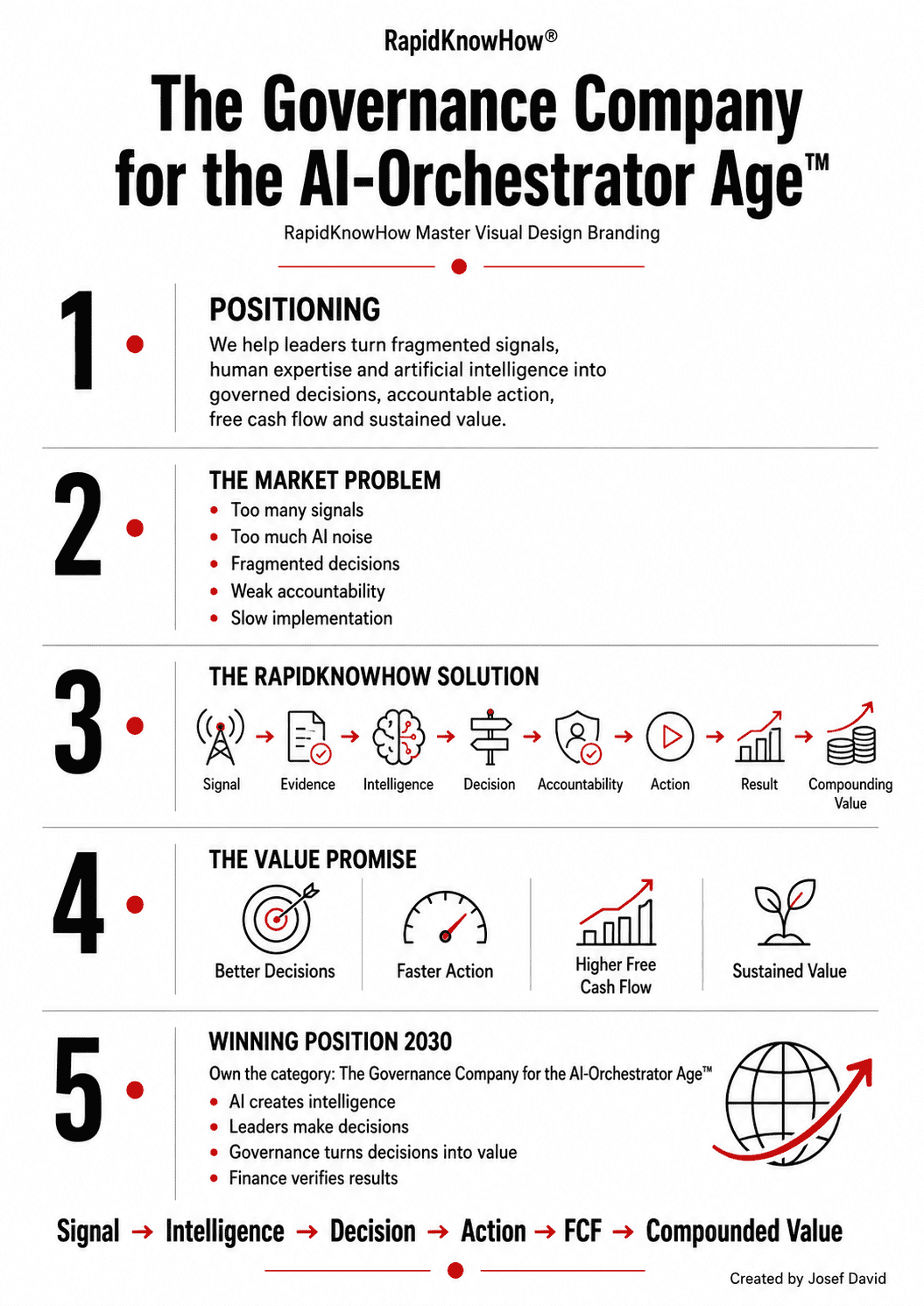
It connects:
Signal
→ Evidence
→ Intelligence
→ Decision
→ Accountability
→ Action
→ Financial Verification
→ Compounding Value
The strategic objective is not to replace experienced executives with artificial intelligence.
It is to strengthen executive judgement with:
- faster signal detection;
- cross-functional intelligence;
- explicit decision rights;
- disciplined implementation;
- transparent financial verification.
The 10-Second Executive Summary
The Problem
Industrial-gas intelligence is fragmented.
The Risk
Slow or disconnected decisions weaken margins, ROCE and free cash flow.
The Solution
One AI-supported Decision Governance System connecting energy, assets, contracts, customers and capital.
The Operating Model
Human leaders remain accountable. AI detects, compares, challenges and tracks.
The Financial Outcome
Better pass-through, stronger network utilisation, more disciplined investment and faster value capture.
The Strategic Opportunity
RapidKnowHow® becomes:
The AI-Orchestrator Decision Governance Solution for the Industrial Gases Sector™
1. Why Industrial Gas Needs a New Governance Model
Industrial gases is a highly specialised, capital-intensive and infrastructure-dependent industry.
Its economics are influenced simultaneously by:
- electricity and natural-gas costs;
- plant utilisation;
- supply density;
- logistics;
- long-term contracts;
- price indexation;
- customer production cycles;
- project execution;
- safety and reliability;
- regulation;
- capital allocation.
The sector’s leading companies demonstrate substantial scale. Linde reported approximately $34 billion of 2025 sales. Air Liquide reported €26.94 billion of 2025 revenue, with Gas & Services accounting for approximately 97% of group sales. Messer reported €4.5 billion of revenue and €1.4 billion of EBITDA for 2025. Air Products states that regional industrial gases represented more than 90% of its consolidated fiscal-2025 sales.
This confirms that industrial gas is not a small technical niche.
It is a major industrial infrastructure sector serving:
- chemicals;
- refining;
- steel and metals;
- manufacturing;
- healthcare;
- food and beverage;
- electronics;
- semiconductors;
- energy;
- environmental applications.
The European Industrial Gases Association describes industrial gases as important enablers of industrial decarbonisation, including low-carbon hydrogen and oxygen-based processes, while networked production assets also strengthen supply resilience.
The Governance Challenge
The sector operates through interconnected economic systems, but many decisions are still governed separately.
A pricing decision may ignore network cost.
A production decision may ignore customer profitability.
An energy decision may ignore contract pass-through.
A growth project may ignore the probability of bankable customer demand.
A country decision may optimise local EBITDA while reducing regional free cash flow.
A sustainability initiative may receive capital without a sufficiently clear economic pathway.
The result is not necessarily poor management.
The result is a governance model that was designed for functional control rather than cross-functional orchestration.
2. From Functional Management to Decision Orchestration
The Traditional Model
The traditional industrial-gas organisation manages through:
- functional expertise;
- operational responsibility;
- country accountability;
- annual budgets;
- capital approvals;
- monthly performance reporting.
This model remains necessary.
But it becomes insufficient when decisions cross several functions and change faster than the normal reporting cycle.
The AI-Orchestrator Model
The AI-Orchestrator model adds a horizontal decision layer.
It connects the relevant functions around one material decision.
Example
A sharp electricity-price increase is detected.
Traditional responses may occur separately:
- procurement reviews power contracts;
- operations adjust production;
- commercial teams assess price increases;
- finance updates forecasts;
- management receives several reports.
The AI-Orchestrator process asks one integrated question:
What combination of production shifts, procurement actions, customer repricing, logistics changes and capital decisions will protect the greatest free cash flow?
The system then defines:
- the evidence;
- the scenarios;
- the decision owner;
- the decision deadline;
- the selected action;
- the expected financial value;
- the verification date.
3. The RapidKnowHow® Decision Governance System™
The Eight-Stage Governance Flow
1. Signal
What has materially changed?
Examples:
- electricity prices;
- customer demand;
- competitor capacity;
- regulation;
- plant reliability;
- contract economics;
- project costs;
- working capital.
2. Evidence
Which information is reliable?
The system distinguishes:
- verified operational data;
- contracted information;
- external market evidence;
- management assumptions;
- scenarios;
- speculation.
3. Intelligence
What does the signal mean?
The analysis connects:
- operational impact;
- commercial impact;
- customer impact;
- financial impact;
- strategic impact.
4. Decision
What must management decide?
The decision must be expressed as a clear choice—not merely as a discussion topic.
5. Accountability
Who owns the decision and the result?
There should be:
- one accountable decision owner;
- named supporting functions;
- a defined escalation route;
- a fixed decision deadline.
6. Action
What happens next?
Every decision is translated into:
- action;
- owner;
- deadline;
- expected result;
- required resources.
7. Verification
Did the decision create the intended result?
Finance verifies:
- revenue;
- margin;
- EBITDA;
- working capital;
- capital expenditure;
- ROCE;
- free cash flow.
8. Compounding
Can the successful decision be repeated?
A one-time improvement becomes an institutional capability through:
- decision rules;
- templates;
- algorithms;
- playbooks;
- training;
- licensing;
- continuous learning.
4. Human Leadership and Artificial Intelligence
AI Does Not Govern the Company
AI can:
- detect anomalies;
- process large volumes of information;
- compare plants and countries;
- identify patterns;
- simulate scenarios;
- prioritise alerts;
- track implementation.
AI cannot carry executive accountability.
The OECD’s AI principles emphasise accountability for the proper functioning and use of AI systems. OECD work also highlights AI’s potential to support productivity, responsiveness and decision-making while warning that weak transparency and overreliance can undermine accountability.
Human Leaders Must:
- define the strategic question;
- assess evidence quality;
- challenge assumptions;
- balance financial, safety and customer considerations;
- make the final decision;
- accept accountability;
- verify consequences.
RapidKnowHow Principle
AI creates intelligence. Leaders make decisions. Governance converts decisions into value. Finance verifies the result.
5. The Six Industrial Gas Value Engines
Value Engine 1
Energy Orchestration™
Electricity is one of the most important cost drivers in air separation, compression and distribution.
European policy increasingly recognises energy affordability as a competitiveness issue for energy-intensive industry. The EU’s Clean Industrial Deal State Aid Framework, adopted on 25 June 2025, allows member states to support clean energy, industrial decarbonisation and certain temporary electricity-price-relief measures.
Governance Question
Are procurement, production, contracts and customer pricing being optimised as one energy-value system?
Required Intelligence
- electricity cost by plant;
- forecast and contracted power prices;
- plant efficiency;
- production flexibility;
- customer demand;
- liquid sourcing options;
- logistics costs;
- contract pass-through;
- renewable-power availability.
Priority Decisions
- produce, reduce or shift production;
- purchase externally or produce internally;
- negotiate or restructure power contracts;
- reprice customer contracts;
- invest in efficiency;
- change the regional supply pattern.
Principal KPIs
- electricity cost per unit;
- energy variance;
- pass-through recovery;
- plant utilisation;
- external purchases;
- margin at risk;
- free cash flow protected.
Value Engine 2
Commercial and Pass-Through Excellence™
Energy and transport cost increases only become manageable when contract mechanisms recover them rapidly and consistently.
Governance Question
Which customer contracts create value after energy, logistics, capital and service complexity are fully considered?
Required Intelligence
- net price;
- indexation mechanism;
- pass-through delay;
- contribution margin;
- transport cost;
- service cost;
- emergency-delivery frequency;
- working capital;
- renewal date;
- strategic customer value.
Priority Decisions
- reprice;
- renegotiate;
- redesign service;
- consolidate volumes;
- reduce complexity;
- exit value-destructive contracts;
- expand high-value relationships.
Principal KPIs
- pass-through effectiveness;
- price-cost gap;
- customer contribution;
- contract renewal quality;
- service cost;
- cash conversion;
- customer lifetime value.
Value Engine 3
Asset and Network Orchestration™
Industrial-gas value is created through systems of:
- air-separation units;
- hydrogen plants;
- CO₂ sources;
- pipeline systems;
- filling centres;
- storage;
- distribution;
- customer locations.
The strongest local answer is not always the strongest regional answer.
Governance Question
Is every customer being supplied through the economically strongest available regional configuration?
Required Intelligence
- plant capacity;
- operating efficiency;
- reliability;
- maintenance;
- inventory;
- distribution distance;
- cross-border availability;
- external supply;
- customer priority;
- emergency resilience.
Priority Decisions
- optimise plant loading;
- redirect supply;
- consolidate routes;
- change inventory;
- reduce external purchases;
- upgrade constrained assets;
- close or repurpose weak assets.
Principal KPIs
- network utilisation;
- cost per delivered unit;
- external purchase ratio;
- logistics kilometres;
- inventory turns;
- reliability;
- return on network assets.
Value Engine 4
Customer Productivity and Decarbonisation™
Industrial-gas companies increasingly support customers through:
- oxygen-enhanced processes;
- hydrogen;
- carbon management;
- freezing and cooling;
- inerting;
- water treatment;
- combustion optimisation;
- process productivity.
European policy continues to provide mechanisms for clean-energy and industrial-decarbonisation projects. The third European Hydrogen Bank auction awarded more than €1 billion to nine hydrogen-production projects, demonstrating both continuing public support and the importance of project selection and bankability.
Governance Question
Are customer projects being selected according to bankable demand and measurable customer value—or mainly according to technological attractiveness?
Required Intelligence
- customer production economics;
- emissions;
- energy use;
- application potential;
- customer credit;
- offtake commitment;
- infrastructure;
- public support;
- technology risk;
- return profile.
Priority Decisions
- select lighthouse customers;
- bundle gas and application expertise;
- secure long-term offtake;
- define performance-based offers;
- form partnerships;
- stop projects lacking credible demand.
Principal KPIs
- qualified opportunity value;
- conversion probability;
- contracted revenue;
- customer savings;
- emissions avoided;
- project ROCE;
- cash break-even date.
Value Engine 5
Capital Allocation Governance™
Industrial-gas growth requires substantial capital.
Messer invested €747 million in 2025 while reducing net debt from €3.6 billion to €3.2 billion, illustrating the need to balance investment, cash generation and balance-sheet strength.
Governance Question
Is capital directed to the highest risk-adjusted regional value—or allocated mainly through historical country and project structures?
Every Material Project Should Be Scored Against:
- contracted demand;
- customer credit;
- energy exposure;
- pass-through protection;
- network synergy;
- execution risk;
- project ROCE;
- free-cash-flow timing;
- strategic importance;
- downside resilience.
Capital Decision Categories
Sustain
Safety, reliability and licence to operate.
Optimise
Energy efficiency, productivity and network performance.
Scale
Proven growth with protected customer demand.
Transform
Selective hydrogen, carbon-management, digital and advanced-application platforms.
Stop
Projects without adequate demand, returns or strategic relevance.
Principal KPIs
- project ROCE;
- forecast versus realised cash flow;
- capital employed;
- time to positive FCF;
- investment-stage compliance;
- stopped or redesigned capital;
- portfolio economic value.
Value Engine 6
Influence and Opportunity Intelligence™
Industrial-gas companies operate within systems shaped by:
- energy policy;
- state aid;
- industrial investment;
- regulation;
- customer restructuring;
- infrastructure;
- technology;
- consolidation;
- geopolitical risk.
Governance Question
Which external signals require a decision before they become obvious to competitors?
Required Intelligence
- new customer projects;
- plant closures;
- government programmes;
- competitor investments;
- acquisitions;
- energy-policy changes;
- hydrogen mechanisms;
- major industrial restructuring;
- supply-chain risks.
Priority Decisions
- enter or avoid a project;
- approach a customer;
- acquire an asset;
- form a partnership;
- secure power;
- reserve a location;
- prepare a defensive response.
Principal KPIs
- opportunities identified early;
- decision lead time;
- opportunity conversion;
- avoided losses;
- acquisition pipeline;
- strategic option value.
6. The Industrial Gas AI-Orchestrator Command Center™
The Command Center is not another static dashboard.
It is the operating environment where signals become decisions and actions.
Dashboard 1 — Executive Signal Radar
Shows:
- top opportunities;
- top risks;
- material changes;
- decisions required;
- confidence level;
- decision deadline.
Dashboard 2 — Energy and Pass-Through
Shows:
- plant energy exposure;
- energy forecast;
- pass-through recovery;
- contracts at risk;
- required pricing actions;
- free cash flow exposed.
Dashboard 3 — Asset and Network
Shows:
- capacity;
- utilisation;
- reliability;
- external purchases;
- logistics;
- cross-border opportunities;
- network bottlenecks.
Dashboard 4 — Customer Value
Shows:
- customer revenue;
- economic contribution;
- contract status;
- service complexity;
- growth potential;
- churn risk;
- required executive action.
Dashboard 5 — Growth and Decarbonisation
Shows:
- projects;
- customer demand;
- funding;
- expected return;
- probability;
- milestones;
- stop/continue/accelerate decision.
Dashboard 6 — Capital and FCF
Shows:
- capital employed;
- approved capital;
- project ROCE;
- cash-flow forecast;
- forecast variance;
- working capital;
- portfolio priority.
Dashboard 7 — Decision and Action Governance
Shows:
- decision;
- accountable owner;
- supporting team;
- deadline;
- selected action;
- expected value;
- realised value.
7. The Decision Governance Meeting
Recommended Frequency
Weekly
A 60-minute decision meeting for high-priority signals and actions.
Monthly
A deeper value-verification and portfolio review.
Quarterly
A strategic review of capital, markets, customer sectors and external influence.
Weekly Meeting Structure
1. Signal
What changed during the last seven days?
2. Impact
What is the estimated operational and financial impact?
3. Decision
What must be decided today?
4. Accountability
Who owns the decision?
5. Action
What must happen by when?
6. Value
What EBITDA, ROCE or FCF result is expected?
7. Verification
When will Finance verify the result?
Meeting Rule
No item remains a general discussion.
It must become one of five outcomes:
- decide;
- investigate;
- escalate;
- stop;
- close.
8. Messer 2030 Demonstration Case
Strategic Starting Point
Messer reported 2025 revenue of €4.5 billion, EBITDA of €1.4 billion, a 31% EBITDA margin, investments of €747 million and more than 12,000 employees. Net debt declined to €3.2 billion.
Messer therefore should not be viewed as a weak or distressed company.
It is a substantial, profitable industrial-gas group with the opportunity to develop a differentiated regional leadership model.
The Strategic Question
Can Messer become the most decision-intelligent, regionally connected and commercially agile industrial-gas company in DACH/CEE?
Messer Should Not Compete Primarily By:
- copying the largest global competitors;
- maximising the number of AI tools;
- launching disconnected digital pilots;
- pursuing every hydrogen project;
- managing each country in isolation.
Messer Could Compete Through:
- regional customer proximity;
- local industrial knowledge;
- faster cross-country decisions;
- energy and pass-through discipline;
- network integration;
- selective customer decarbonisation;
- capital prioritisation;
- private-company continuity.
9. The Messer 2030 Governance Architecture
Strategic Position
The DACH/CEE AI-Orchestrator Leader™
Leadership Promise
Messer connects regional intelligence, industrial-gas expertise and AI-supported governance to make faster and more financially disciplined decisions than larger competitors.
Six Regional Decision Councils
1. Energy Council
Owns energy exposure, plant scheduling and pass-through implications.
2. Commercial Value Council
Owns customer economics, pricing and contract quality.
3. Network Council
Owns production, logistics, sourcing and supply resilience.
4. Customer Transformation Council
Owns applications, productivity and decarbonisation projects.
5. Capital Council
Owns project selection, ROCE and cash-flow discipline.
6. Influence and Opportunity Council
Owns external signals, competitors, regulation and acquisitions.
One Regional Executive Decision Board
Resolves cross-functional and cross-country choices.
10. Messer’s Potential Blue Ocean Position
Linde
Leads through global scale, technology, engineering and operating discipline.
Air Liquide
Leads through European network strength, innovation and integrated customer solutions.
Air Products
Competes strongly in large projects, hydrogen and core industrial gases.
Messer’s Distinctive Opportunity
Regional Intelligence + Decision Speed + Customer Proximity + Private Ownership
Messer should not claim that it is larger.
It should demonstrate that it can:
- see regional opportunities earlier;
- make decisions faster;
- adapt offers locally;
- connect countries more effectively;
- invest more selectively;
- embed itself more deeply in customer value creation.
RapidKnowHow Strategic Statement
Global scale controls more assets. Regional orchestration can control more relevant decisions.
11. The 100-Day Pilot
Objective
Prove that the governance system creates measurable economic value before full regional scaling.
Recommended Scope
Select:
- three to six countries;
- ten priority plants or networks;
- twenty major contracts;
- ten major capital projects;
- five customer-growth opportunities.
Days 1–20: Establish the Baseline
Measure:
- energy cost;
- pass-through;
- production cost;
- plant utilisation;
- external purchases;
- customer contribution;
- logistics;
- capital employed;
- free cash flow.
Days 21–40: Identify the Value Leakage
Create:
- top 20 value opportunities;
- top 10 margin risks;
- top five capital decisions;
- top five customer opportunities;
- top five network actions.
Days 41–60: Launch the Command Center
Implement:
- signal radar;
- energy dashboard;
- customer-value dashboard;
- capital dashboard;
- decision tracker.
Days 61–80: Make the Decisions
Each priority decision receives:
- accountable owner;
- decision date;
- action;
- expected value;
- verification date.
Days 81–100: Verify and Scale
Finance verifies:
- value realised;
- cash protected;
- capital avoided;
- implementation cost;
- lessons learned.
100-Day Scale Decision
Scale
If the system produces measurable value and leadership adoption.
Redesign
If the opportunity is valid but governance or data is insufficient.
Stop
If the pilot produces information without changed decisions or measurable value.
12. The 2026–2030 Roadmap
2026 — Demonstrate
- build the pilot;
- prove the value;
- establish governance;
- train the first AI-Orchestrator leaders.
2027 — Standardise
- common data definitions;
- regional decision rules;
- integrated dashboards;
- cross-country governance;
- monthly FCF verification.
2028 — Scale
- sector-specific customer solutions;
- broader network optimisation;
- customer decarbonisation;
- repeatable decision playbooks.
2029 — Orchestrate the Ecosystem
Connect:
- customers;
- power suppliers;
- technology partners;
- engineering;
- public funding;
- logistics;
- acquisition candidates.
2030 — Lead the Category
Demonstrate:
- faster executive decisions;
- higher pass-through effectiveness;
- superior network utilisation;
- stronger capital discipline;
- increased recurring FCF;
- sustained DACH/CEE leadership.
13. The Free-Cash-Flow Governance Model
FCF Is Not an Accounting Result Only
It is the cumulative consequence of decisions across the business.
Revenue Quality
- Price and Pass-Through
- Operating Productivity
– Energy and Logistics Leakage
– Working-Capital Absorption
– Poor Capital Allocation
= Free Cash Flow
Five FCF Questions
1. Revenue
Are we selecting and growing the right customers and applications?
2. Margin
Are energy, logistics and complexity being fully recovered?
3. Assets
Are plants and networks being used economically?
4. Working Capital
Are inventory and receivables consuming unnecessary cash?
5. Capital
Are projects producing adequate risk-adjusted returns?
RapidKnowHow FCF Rule
Every strategic decision must identify its expected cash-flow effect, accountable owner and verification date.
14. The Industrial Gas Decision Governance Score™
Score each dimension from 1 to 5.
1. Signal Detection
Can management detect material changes early?
2. Evidence Quality
Are facts, assumptions and scenarios clearly separated?
3. Cross-Functional Intelligence
Are energy, operations, commercial and finance connected?
4. Decision Clarity
Is the required choice explicitly defined?
5. Decision Rights
Is one leader accountable?
6. Decision Speed
Are time-sensitive decisions made fast enough?
7. Action Discipline
Are decisions converted into owned actions?
8. Financial Linkage
Is expected EBITDA, ROCE or FCF documented?
9. Verification
Does Finance confirm realised value?
10. Institutional Learning
Are successful decisions standardised and repeated?
Interpretation
10–19
Fragmented governance.
20–29
Functionally managed but weakly orchestrated.
30–39
Developing AI-Orchestrator capability.
40–45
Strong Decision Governance System.
46–50
Potential sector benchmark.
15. Executive Self-Assessment
Answer Yes, Partly or No.
- Do we have one view of the most important value signals?
- Are energy and commercial decisions governed together?
- Can we identify unrecovered cost by contract?
- Do we optimise production regionally rather than only locally?
- Is every major customer measured after full service and capital cost?
- Does every major investment have a clear FCF pathway?
- Are technology projects linked to executive decisions?
- Does one person own each material decision?
- Are actions tracked until completion?
- Does Finance verify realised value?
- Do we stop low-value projects quickly?
- Can we compare plants and countries through common definitions?
- Are customer decarbonisation projects commercially bankable?
- Can we detect external opportunities before competitors?
- Is AI strengthening judgement rather than creating additional noise?
Decision
If more than five answers are No, the organisation has a material Decision Governance opportunity.
16. What Makes the RapidKnowHow System Different?
Not Generic AI Consulting
The system begins with the executive decision—not the AI tool.
Not Another Dashboard
The Command Center connects information to ownership, action and verified value.
Not Traditional Strategy Consulting
The focus is on a repeatable governance system rather than a one-time recommendation.
Not Pure Software
Human leadership, industrial expertise and accountability remain central.
Not Report Publishing Only
The report leads to:
- assessment;
- implementation;
- Command Center;
- enterprise licensing.
17. The RapidKnowHow Commercial System
Level 1 — Evidence-Based PowerPosts™
Build attention and credibility.
Level 2 — PowerReport™
Provide the complete strategic framework.
Level 3 — Action Guide™
Help the executive apply the framework.
Level 4 — Opportunity Assessment™
Diagnose company-specific decision leakage.
Level 5 — AI-Orchestrator Opportunity Sprint™
Design and launch the first governance system.
Level 6 — Decision Command Center™
Provide recurring intelligence and action governance.
Level 7 — Enterprise IP Licence™
Embed the proprietary system across the organisation.
Commercial Flywheel
PowerPost
→ PowerReport
→ Assessment
→ Decision Sprint
→ Command Center
→ Enterprise Licence
→ Recurring FCF
→ Compounding IP Value
18. Recommended Executive Offer
Industrial Gas AI-Orchestrator Opportunity Sprint™
Four-Week Decision Engagement
Week 1 — Discover
- leadership priorities;
- decision bottlenecks;
- data landscape;
- value leakage.
Week 2 — Assess
- six value engines;
- governance maturity;
- top opportunities;
- strategic risks.
Week 3 — Design
- decision architecture;
- Command Center;
- scorecards;
- ownership;
- FCF logic.
Week 4 — Decide
- top five decisions;
- 100-day pilot;
- value targets;
- implementation roadmap.
Executive Deliverables
- Decision Governance Score;
- Value-Leakage Map;
- Six-Engine Assessment;
- Command Center Prototype;
- Top Five Decisions;
- 100-Day Action Plan;
- 2026–2030 Roadmap.
19. Critical Success Factors
Start With Decisions
Do not start with a software platform.
Focus on Material Value
Do not attempt to govern every operational decision initially.
Keep Human Accountability
AI should inform decisions, not hide responsibility.
Use Common Definitions
A regional system fails when countries calculate value differently.
Link Every Action to Finance
Identified value is not realised value.
Scale Proven Decisions
Do not multiply pilots without institutionalising the successful ones.
Protect Trust
The system must visibly distinguish:
- fact;
- analysis;
- scenario;
- decision;
- action.
20. Final Strategic Verdict
The next industrial-gas leader will not win through data alone.
It will not win through AI tools alone.
It will not win through scale alone.
It will win by connecting:
- industrial expertise;
- high-quality evidence;
- artificial intelligence;
- clear decision rights;
- accountable action;
- financial verification.
The Industrial Gas Leadership Shift
From:
Managing functions, plants and countries separately.
To:
Governing the decisions that connect them.
The Messer Opportunity
Messer can use its regional position, customer proximity, private ownership and industrial-gas capabilities to build a differentiated DACH/CEE AI-Orchestrator Leadership System.
The RapidKnowHow Opportunity
RapidKnowHow® can own the governance layer that turns industrial-gas intelligence into:
- better decisions;
- faster execution;
- stronger free cash flow;
- compounding enterprise value.
RapidKnowHow® Power Sentence
Data informs.
AI detects.
Leaders decide.
Governance delivers.
Finance verifies.
Signal → Evidence → Intelligence → Decision → Action → FCF → Compounded Value
RapidKnowHow®
The Governance Company for the AI-Orchestrator Age™
Sources and Confidence
Primary Corporate Sources
- Messer 2025 financial results and annual-report materials.
- Linde 2025 results and investor reporting.
- Air Liquide 2025 annual results and integrated reporting.
- Air Products 2025 annual report and investor materials.
Industry and Policy Sources
- European Industrial Gases Association materials on hydrogen, industrial decarbonisation and network resilience.
- European Commission Clean Industrial Deal State Aid Framework and energy-affordability measures.
- European Commission European Hydrogen Bank and hydrogen-market mechanisms.
- OECD AI governance, accountability and trustworthy-AI principles.
Confidence Assessment
Sector structure and company scale
High confidence — based primarily on current corporate reporting.
Energy, decarbonisation and hydrogen-policy direction
High confidence — based on official EU and industry sources.
Decision Governance diagnosis
Medium–High confidence — strategic inference based on the cross-functional economics of the sector; company-specific validation is required.
Messer AI-Orchestrator opportunity
Medium confidence — an independent strategic scenario based solely on public information, not internal Messer data.
Financial impact
Company-specific assessment required — no financial improvement should be claimed until operational data, contracts, projects and implementation results are verified.
Important Qualification
This PowerReport is an independent RapidKnowHow® strategic analysis based on publicly available information and proprietary Decision Governance concepts.
It is not commissioned, endorsed or approved by Messer, Linde, Air Liquide, Air Products or any other named industrial-gas company.
It does not contain confidential company information.
It is not an investment recommendation, financial forecast or guarantee of future performance.
Company-specific decisions require direct validation of:
- operational data;
- customer contracts;
- energy exposure;
- capital projects;
- governance arrangements;
- financial assumptions.
RapidKnowHow® — THE DECISION COMPANY™
Industrial Gas Leadership 2030
PROVE VALUE. THEN SCALE.
Watch the 60-second roadmap: 10 strategic actions for DACH and CEE, 2026–2030.
Start with ONE customer challenge. Use the Industrial Gas Action Guide to turn your first action into a measurable result.
RapidKnowHow® — Leading Industrial Gas Opportunity Signal Identifier in DACH & CEE