Cui Bono? Who Profits from Creating and Constantly Communicating Chaos
B) EXECUTIVE SNAPSHOT (15-second UX)
Thesis: Chaos is not only a condition; it is a strategy.
Finding: Those who profit most are not the loudest voices—but the actors who convert confusion into leverage: control of attention, rules, capital, and time.
Implication: The antidote is not more information, but predictive illumination—the Lighthouse.
C) WHY CHAOS PAYS (THE MECHANICS)
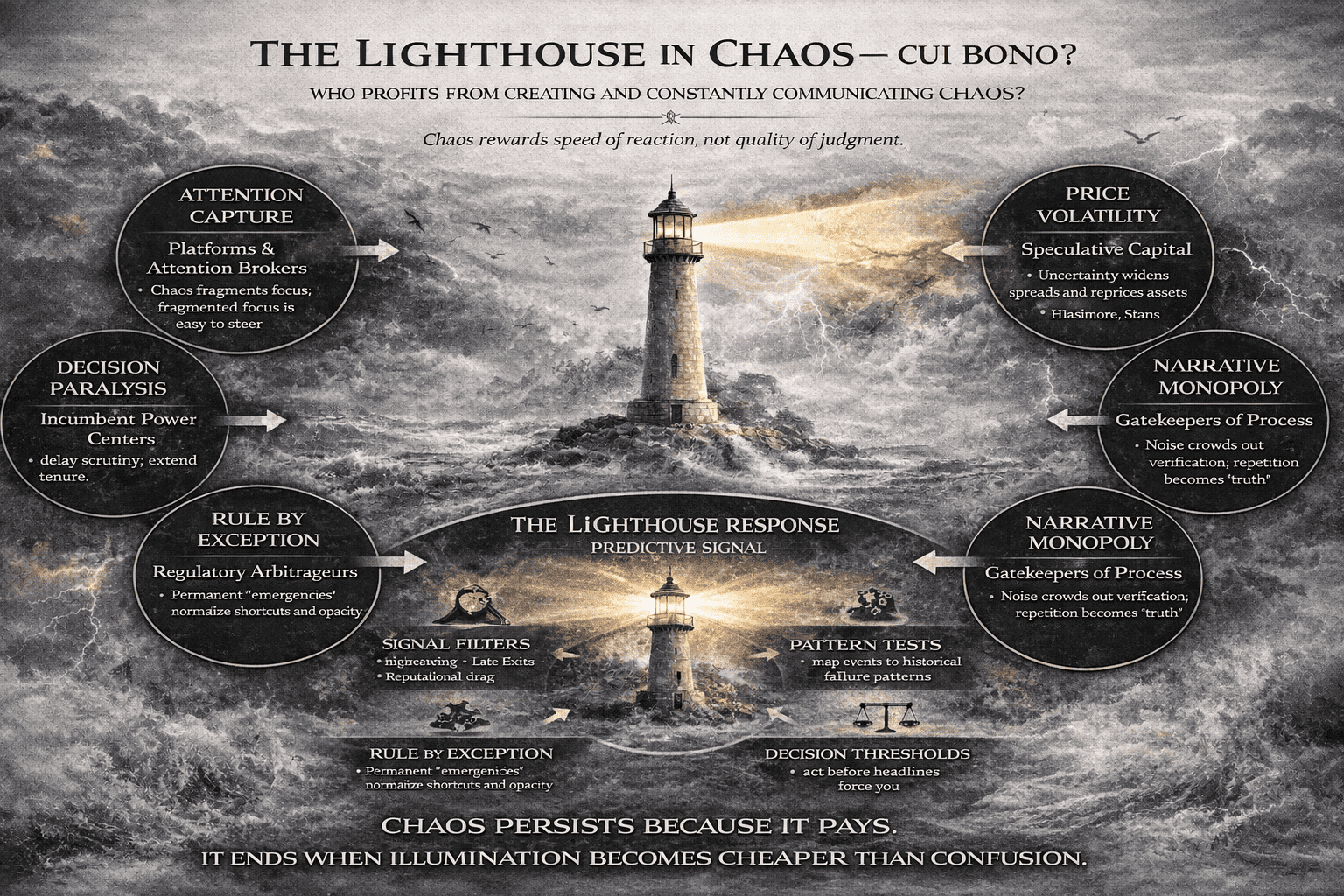
- Attention Capture
- Chaos fragments focus; fragmented focus is easy to steer.
- Constant alerts suppress long-horizon thinking.
Profit: platforms and actors monetizing clicks, outrage, and urgency.
- Decision Paralysis
- Overload delays action; delay preserves the status quo.
Profit: incumbents facing reform, accountability, or competition.
- Rule by Exception
- Permanent “emergencies” normalize shortcuts and opacity.
Profit: those who gain discretion when rules bend.
- Price Volatility
- Uncertainty widens spreads and reprices assets.
Profit: traders and intermediaries positioned for swings, not stability.
- Narrative Monopoly
- Noise crowds out verification; repetition becomes “truth.”
Profit: agenda setters who define frames while facts lag.
D) CUI BONO — BY ACTOR CLASS (FUNCTION, NOT ACCUSATION)
- Platforms & Attention Brokers: monetize volatility of emotion.
- Incumbent Power Centers: delay scrutiny; extend tenure.
- Regulatory Arbitrageurs: exploit grey zones created by haste.
- Speculative Capital: harvest swings amplified by fear.
- Gatekeepers of Process: gain relevance when clarity collapses.
Key insight: Chaos rewards speed of reaction, not quality of judgment.
E) THE COST OF CHAOS (HIDDEN, COMPOUNDING)
- Business: misallocation of capital; late exits; reputational drag.
- Geopolitics: legitimacy decay; escalation risk; brittle alliances.
- Wealth: higher tail risk; erosion of compounding via hidden liabilities.
Rule: What looks like agility in chaos often becomes expensive regret.
F) THE LIGHTHOUSE RESPONSE (FROM NOISE TO NAVIGATION)
Lighthouse 2.0 disciplines chaos into signal:
- Signal Filters — separate what changed from what’s loud.
- Pattern Tests — map events to historical failure patterns.
- Decision Thresholds — act before headlines force you.
- Ethical Multipliers — price opacity as future loss.
Light does not end chaos; it removes its profit margin.
G) PREDICTIVE ACTIONS (APPLICABLE NOW)
- Business: install crack indicators (incentives, silence zones); freeze growth lacking transparency.
- Geopolitics: track secrecy duration vs. trust decay; avoid exception-driven partners.
- Wealth: discount returns dependent on opacity; favor trust-dense cash flows.
H) CONCLUSION
Chaos persists because it pays.
It ends when illumination becomes cheaper than confusion.
The Lighthouse doesn’t shout into the storm.
It stands firm, filters the noise, and guides capital, policy, and ethics toward outcomes that last.