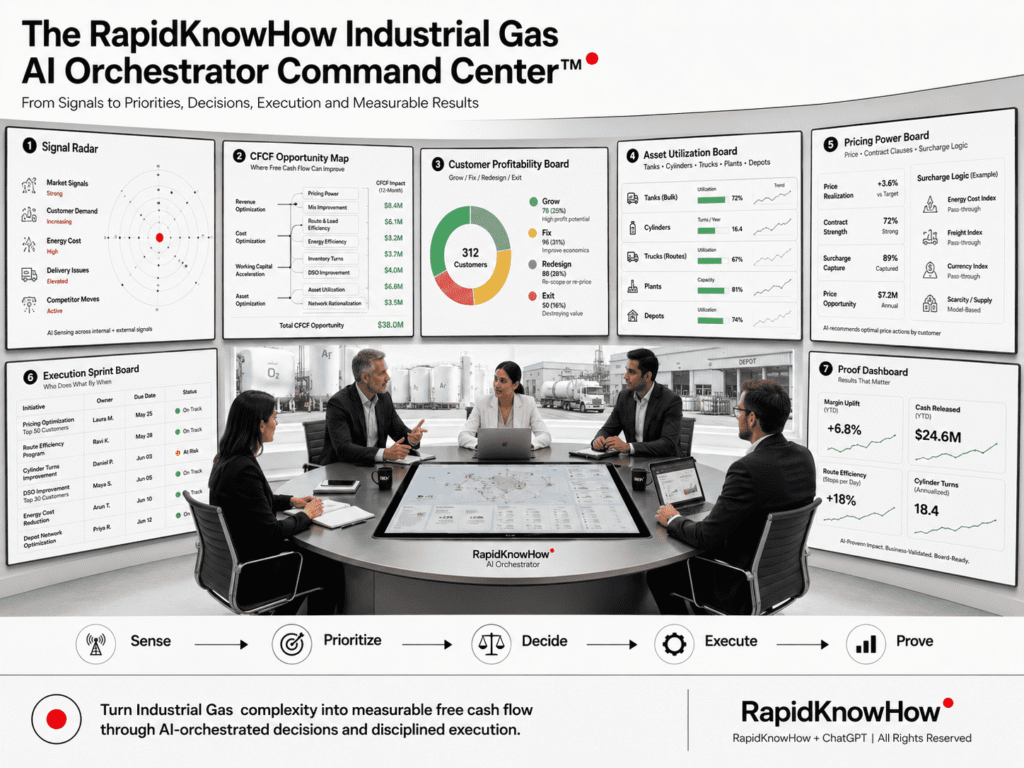
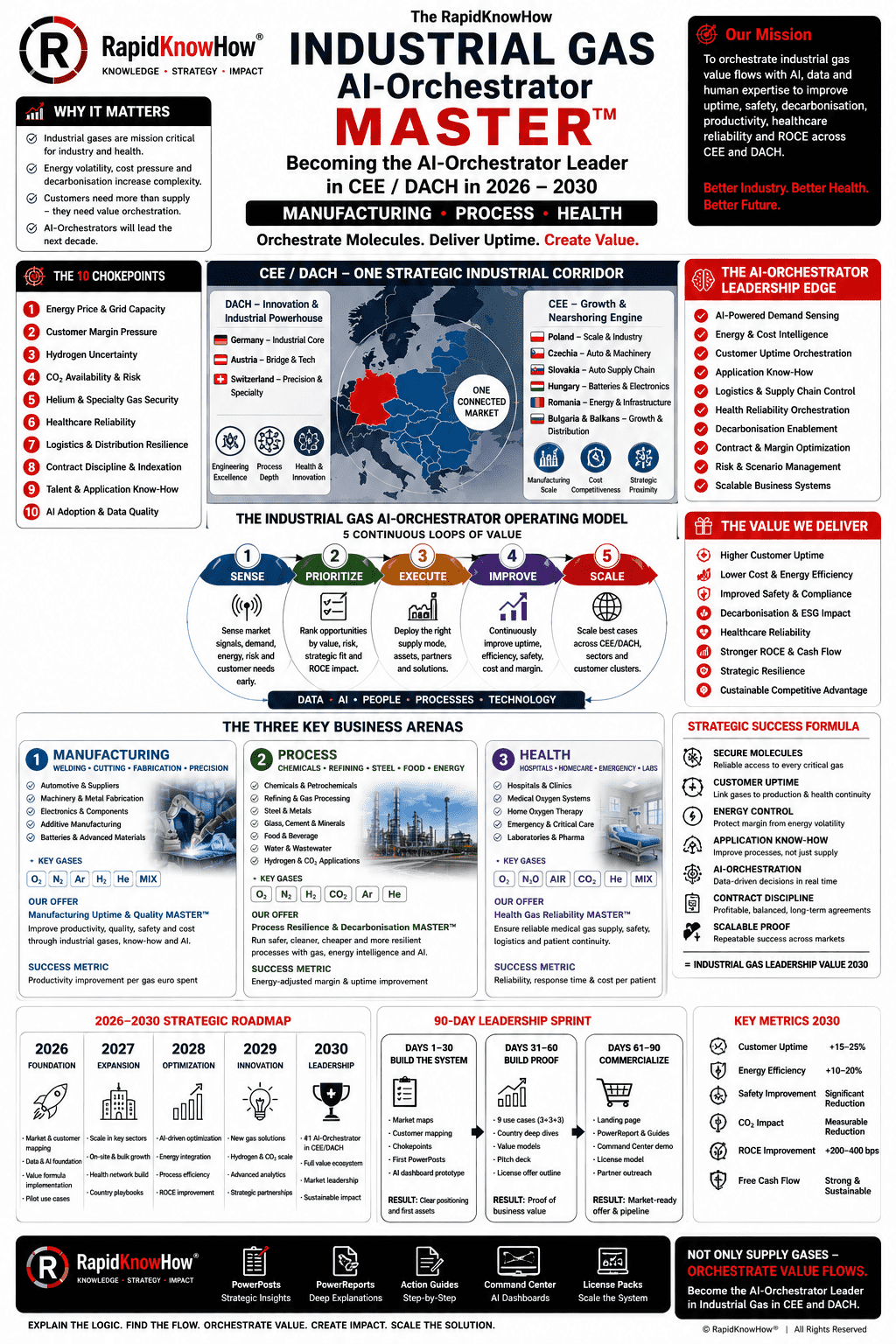
Becoming the AI-Orchestrator Leader in the Industrial Gas Sector in CEE and DACH
Key Business Areas: Manufacturing, Process and Health | 2026–2030 Power Report
1. Executive Core
Industrial Gas is one of the most important invisible operating systems of the modern economy.
Without oxygen, nitrogen, argon, hydrogen, carbon dioxide, helium, medical gases and specialty gases, the key sectors of CEE and DACH cannot operate reliably. Steel cannot be produced efficiently. Automotive suppliers cannot weld, cut, heat-treat or manufacture with precision. Food and beverage companies cannot freeze, package or carbonate at scale. Chemical and refining plants cannot run safely. Hospitals and homecare systems cannot provide respiratory and medical gas support. Advanced manufacturing cannot achieve the purity, safety and process control required for global competitiveness.
The industrial gas sector is therefore not only a supplier market. It is a strategic flow-control market.
The central RapidKnowHow question is:
Who will become the AI-Orchestrator Leader that controls industrial gas value flows across Manufacturing, Process and Health in CEE and DACH from 2026 to 2030?
The answer is not simply the company with the most plants, tanks, cylinders or trucks.
The winner will be the player that can combine:
- molecule security
- energy intelligence
- customer uptime
- contract discipline
- application know-how
- AI-driven demand sensing
- logistics optimisation
- health reliability
- decarbonisation support
- measurable ROCE and free cash flow impact
The RapidKnowHow conclusion is clear:
Industrial Gas 2030 means: not only supply gases — orchestrate strategic industrial and health flows.
2. Why CEE and DACH Matter
CEE and DACH form one of Europe’s most important industrial corridors.
DACH provides engineering depth, industrial brands, process industries, healthcare systems, automotive leadership, machinery, chemicals, pharmaceuticals and advanced manufacturing.
CEE provides manufacturing scale, nearshoring potential, automotive supplier depth, cost competitiveness, industrial renewal opportunities, logistics links, and strategic proximity to Eastern Europe, Ukraine and the Black Sea.
Together, CEE and DACH create a high-value industrial gas arena.
The region is strategically important because it combines:
1. Manufacturing density
Automotive, machinery, metalworking, fabrication, electronics, construction materials and export manufacturing all require industrial gas reliability.
2. Process industry intensity
Chemicals, refining, petrochemicals, glass, cement, steel, food processing, pharmaceuticals and water treatment require oxygen, nitrogen, hydrogen, CO₂, argon and specialty gases.
3. Healthcare and ageing demand
Hospitals, emergency systems, respiratory care, medical oxygen, homecare and specialty medical gases create stable and socially critical demand.
4. Energy and decarbonisation pressure
Industrial gas production is energy-intensive. Customers also need help reducing emissions, improving process efficiency and managing energy volatility.
5. Strategic autonomy
Europe wants to reduce dependency in energy, critical materials, technologies, health systems and industrial capability. Industrial gases are directly connected to this agenda.
CEE and DACH should therefore not be treated as separate sales regions. They should be treated as a connected industrial resilience platform.
3. The Three Key Business Areas
The RapidKnowHow INDUSTRIAL GAS AI-Orchestrator MASTER™ focuses on three business areas:
A. Manufacturing
Welding, cutting, fabrication, automotive, machinery, electronics, additive manufacturing
Manufacturing is the visible industrial base. It includes automotive suppliers, metal fabrication, machinery, electronics, precision components, batteries, defense supply chains and construction-related industries.
Industrial gas value in Manufacturing comes from:
- welding quality
- cutting speed
- heat treatment
- inerting
- laser applications
- additive manufacturing
- electronics purity
- safety
- productivity
- lower scrap
- lower rework
- better customer uptime
The AI-Orchestrator task in Manufacturing is to move from gas delivery to productivity control.
The key question is:
How can every molecule improve quality, speed, safety and cost per finished unit?
The winning offer is not “argon in a cylinder” or “nitrogen in a tank.” The winning offer is:
Manufacturing Uptime-as-a-Service powered by industrial gases, application know-how and AI.
B. Process
Chemicals, refining, steel, glass, food, water, hydrogen, CO₂, energy-intensive industry
Process industries use gases not as occasional inputs but as integrated operating conditions.
Oxygen supports combustion, oxidation, steel, wastewater treatment and medical use.
Nitrogen protects processes through inerting, blanketing and purging.
Hydrogen supports refining, chemicals, future green steel and decarbonisation.
CO₂ supports food, beverage, dry ice, greenhouse and selected chemical uses.
Argon supports high-value metallurgy and welding.
Specialty gases support laboratories, electronics and precision processes.
The AI-Orchestrator task in Process is to control reliability, energy cost, safety, compliance and decarbonisation.
The key question is:
How can industrial gas systems help customers run safer, cleaner, cheaper and more resilient processes?
The winning offer is:
Process Resilience-as-a-Service powered by oxygen, nitrogen, hydrogen, CO₂, energy intelligence and AI dashboards.
C. Health
Medical oxygen, hospitals, homecare, emergency care, respiratory support, healthcare logistics
Health is the most socially critical business area.
Medical gases are not ordinary commodities. They are life-support infrastructure.
The health gas system must deliver:
- medical oxygen reliability
- hospital pipeline safety
- cylinder and liquid logistics
- homecare oxygen support
- emergency response capability
- quality assurance
- regulatory compliance
- patient continuity
- cost control
- digital monitoring
The AI-Orchestrator task in Health is to improve reliability, safety, logistics and patient value.
The key question is:
How can medical gases help health systems provide safer, more reliable and more efficient care?
The winning offer is:
Health Gas Reliability-as-a-Service powered by medical gases, logistics control, compliance and AI-supported planning.
4. The Strategic Shift
The old industrial gas model is built around supply.
The new model is built around orchestration.
Old Model:
Produce gas → store gas → deliver gas → invoice customer.
New Model:
Sense demand → secure molecule → optimise energy → protect uptime → improve process → measure value → scale best cases.
This shift changes the entire business logic.
The industrial gas leader of 2030 will not simply ask:
“How many tons, cylinders or cubic meters did we sell?”
The leader will ask:
- Which customers are strategically important?
- Which sectors create the best ROCE?
- Where are energy costs destroying margin?
- Which applications improve customer productivity?
- Which hospitals need higher reliability?
- Which process customers require decarbonisation support?
- Where can AI reduce logistics cost?
- Which contracts need better indexation?
- Which assets should be built, leased, partnered or avoided?
- Which CEE/DACH clusters can be scaled repeatedly?
This is the core of the AI-Orchestrator role.
5. The Industrial Gas AI-Orchestrator Operating Model
The operating model has five continuous loops.
1. Sense
The AI-Orchestrator senses market signals before competitors react.
It tracks:
- customer demand
- plant utilisation
- cylinder and bulk volumes
- energy prices
- electricity grid stress
- hydrogen project status
- CO₂ availability
- helium and specialty gas supply risk
- hospital and homecare demand
- logistics bottlenecks
- customer credit risk
- competitor moves
- regulatory changes
- EU funding signals
- sector-level investment plans
The result is early warning.
Sense means: no blind flying.
2. Prioritize
The AI-Orchestrator ranks opportunities by value and risk.
It prioritizes by:
- margin potential
- strategic relevance
- contract quality
- customer solvency
- energy exposure
- asset intensity
- decarbonisation value
- health-critical importance
- scalability across CEE/DACH
- contribution to free cash flow and ROCE
Not every customer deserves the same attention. Not every project deserves capital. Not every hydrogen opportunity is bankable.
Prioritize means: capital discipline beats activity.
3. Execute
The AI-Orchestrator executes with the right supply mode.
Supply options include:
- on-site generation
- pipeline supply
- bulk liquid
- cylinder supply
- packaged specialty gases
- homecare logistics
- distributor partnerships
- asset-light service models
- long-term take-or-pay contracts
- application engineering projects
- digital monitoring and dashboards
The right answer depends on customer value, volume, risk, asset intensity and strategic importance.
Execute means: match the supply mode to the value logic.
4. Improve
The AI-Orchestrator improves performance continuously.
It reduces:
- customer downtime
- gas waste
- logistics cost
- energy exposure
- unsafe practices
- emergency deliveries
- contract leakage
- process inefficiency
- avoidable hospital disruption
- underperforming assets
It improves:
- yield
- quality
- safety
- customer productivity
- margin
- reliability
- decarbonisation
- customer trust
- free cash flow
Improve means: value must be measured, not assumed.
5. Scale
The AI-Orchestrator turns best cases into repeatable business assets.
It creates:
- PowerPosts
- PowerReports
- Action Guides
- customer dashboards
- CxO briefings
- sector playbooks
- license packs
- application templates
- CEE/DACH rollout models
- Commercial Center offers
- Command Center operating systems
The goal is to scale what works across countries, sectors and customer clusters.
Scale means: one success becomes a repeatable system.
6. Manufacturing: 2026–2030 Business Strategy
Manufacturing is the first major growth and resilience arena.
Key customer sectors:
- automotive suppliers
- machinery
- metal fabrication
- electronics
- battery components
- defense-related manufacturing
- precision engineering
- additive manufacturing
- construction materials
Key gases:
- oxygen
- nitrogen
- argon
- hydrogen
- acetylene
- shielding gas mixtures
- helium and specialty gases
Strategic offer:
Manufacturing Uptime & Quality MASTER™
Core value proposition:
“We help manufacturers in CEE and DACH improve uptime, welding quality, cutting performance, safety, scrap reduction and cost control through industrial gases, application know-how and AI-supported performance dashboards.”
Priority moves:
- Build customer sector maps by country.
- Identify top 100 manufacturing accounts in CEE/DACH.
- Rank them by margin, growth, strategic importance and gas intensity.
- Create welding, cutting and heat-treatment productivity audits.
- Offer usage dashboards and monthly improvement reports.
- Package best cases as proof reports.
- Convert proof into long-term contracts.
Manufacturing success metric:
Customer productivity improvement per gas euro spent.
7. Process: 2026–2030 Business Strategy
Process industries are the second major arena.
Key customer sectors:
- chemicals
- refining
- steel
- glass
- food processing
- pharmaceuticals
- water and wastewater
- energy-intensive industry
- hydrogen projects
- CO₂ users
Key gases:
- oxygen
- nitrogen
- hydrogen
- CO₂
- argon
- helium
- specialty gases
Strategic offer:
Process Resilience & Decarbonisation MASTER™
Core value proposition:
“We help process industry customers run safer, cleaner and more resilient operations through reliable gas supply, energy intelligence, decarbonisation support and AI-based process value monitoring.”
Priority moves:
- Build oxygen, nitrogen, hydrogen and CO₂ flow maps by country.
- Identify energy-exposed and decarbonisation-driven customers.
- Separate bankable hydrogen opportunities from speculative projects.
- Create pass-through and indexation discipline for energy volatility.
- Develop CO₂ availability risk dashboards.
- Build process efficiency cases for steel, glass, chemicals and food.
- Convert decarbonisation projects into long-term strategic contracts.
Process success metric:
Process uptime, energy-adjusted margin and decarbonisation value delivered.
8. Health: 2026–2030 Business Strategy
Health is the third major arena and the most trust-sensitive.
Key customer sectors:
- hospitals
- emergency services
- respiratory care
- home oxygen therapy
- elderly care
- rehabilitation
- laboratories
- medical device support
Key gases:
- medical oxygen
- nitrous oxide
- medical air
- nitrogen
- CO₂
- helium mixtures
- specialty medical gases
Strategic offer:
Health Gas Reliability MASTER™
Core value proposition:
“We help health systems, hospitals and homecare providers secure reliable medical gas supply, improve logistics, reduce avoidable disruption and support better patient continuity.”
Priority moves:
- Map medical oxygen demand by hospital and homecare cluster.
- Build reliability dashboards for hospital and homecare customers.
- Reduce emergency delivery dependency through predictive planning.
- Improve cylinder rotation and homecare logistics.
- Use AI to forecast respiratory and seasonal demand.
- Create compliance and safety documentation as customer value.
- Package Health Gas Reliability reports for hospital leaders and insurers.
Health success metric:
Reliability, safety, response time, patient continuity and cost per served patient.
9. CEE and DACH Priority Market Logic
The AI-Orchestrator Leader should treat CEE and DACH as one connected operating region with different roles.
DACH role:
Premium industrial base, process industry depth, engineering excellence, healthcare reliability, high-value customers, innovation pilots, board-level access.
CEE role:
Manufacturing growth, nearshoring, automotive suppliers, industrial renewal, cost competitiveness, selective healthcare growth, logistics expansion, resilience platform.
Country logic:
Germany — core industrial demand, process industry, automotive, healthcare, hydrogen pilots, premium applications.
Austria — DACH/CEE bridge, healthcare, manufacturing, specialty applications, regional command center potential.
Switzerland — specialty gases, pharma, healthcare, medtech, high-value precision.
Poland — CEE scale, manufacturing, hydrogen, refining, food, healthcare.
Czechia — automotive, machinery, electronics, manufacturing density.
Slovakia — automotive and export industry, high supplier exposure.
Hungary — batteries, electronics, automotive, process opportunities.
Romania — energy, infrastructure, healthcare, food, Black Sea relevance.
Bulgaria and Balkans — selective growth, distribution, healthcare and industrial services.
The strategic target is not to cover everything equally.
The target is to build country-sector-gas combinations with repeatable profit logic.
10. The 10 Chokepoints
The Industrial Gas AI-Orchestrator MASTER™ must monitor ten chokepoints.
- Energy price and grid capacity
Industrial gas production depends heavily on electricity and natural gas economics. - Customer margin pressure
Customers need gases but may resist price increases unless value is proven. - Hydrogen uncertainty
Hydrogen is strategic, but many projects require bankable demand and clear regulation. - CO₂ availability
Food, beverage and dry ice customers can face supply disruptions. - Helium and specialty gas security
Advanced manufacturing, research and healthcare depend on scarce gases. - Healthcare reliability
Medical gas failures create high reputational and societal risk. - Logistics resilience
Bulk and cylinder networks require depots, drivers, routing and emergency capacity. - Contract discipline
Energy pass-through, take-or-pay, indexation and risk clauses determine profitability. - Talent and application know-how
The AI-Orchestrator needs engineers, data analysts, commercial experts and sector specialists. - AI adoption and data quality
Bad data produces bad decisions. Clean operational data becomes a competitive asset.
11. The Value Formula
The RapidKnowHow Industrial Gas AI-Orchestrator Value Formula is:
Industrial Gas Leadership Value 2030 = Secure Molecules × Customer Uptime × Energy Control × Application Know-How × AI-Orchestration × Contract Discipline × Scalable Proof
This formula is the management code.
Each factor must be actively managed.
Secure Molecules means reliable access to oxygen, nitrogen, argon, hydrogen, CO₂, helium and specialty gases.
Customer Uptime means gases are linked to production continuity and healthcare reliability.
Energy Control means margins are protected against power and gas volatility.
Application Know-How means the supplier improves the customer process, not only the tank level.
AI-Orchestration means demand, logistics, margin, assets and risk are controlled through live dashboards.
Contract Discipline means long-term profitability is designed into the agreement.
Scalable Proof means each success becomes marketable evidence.
12. Commercial Product Ladder
To become the AI-Orchestrator Leader, RapidKnowHow should build a commercial product ladder.
1. Free Signal Post
Short market insight on Manufacturing, Process or Health.
2. PowerPost
One-page strategic insight with problem, cause, impact, action and result.
3. PowerReport
Deep explanation for boards, CxOs, investors and entrepreneurs.
4. Action Guide
Step-by-step implementation model for one use case.
5. Customer Dashboard
Simple management dashboard showing gas value, risk and action.
6. Command Center Prototype
HTML/WordPress demonstration of AI-orchestrated decision logic.
7. License Pack
Repeatable system for partners, consultants, distributors and sector specialists.
8. Strategic Advisory Offer
One-hour or project-based engagement for industrial gas leaders.
This ladder converts knowledge into commercial assets.
13. 90-Day Leadership Sprint
The first execution step should be a 90-day sprint.
Days 1–30: Build the System
Create:
- CEE/DACH market map
- Manufacturing sector map
- Process sector map
- Health sector map
- gas-flow map
- chokepoint list
- top customer types
- value formula
- first PowerPosts
- first PNG strategy maps
- first HTML Command Center prototype
Result:
Clear positioning and first sellable assets.
Days 31–60: Build Proof
Create:
- 3 Manufacturing use cases
- 3 Process use cases
- 3 Health use cases
- one CEE country deep dive
- one DACH country deep dive
- one AI dashboard mockup
- one ROCE/FCF value model
- one customer pitch deck
- one license offer outline
Result:
Proof that the system creates business value.
Days 61–90: Commercialize
Create:
- landing page
- WooCommerce product page
- consultation offer
- PowerReport PDF
- Action Guide PDF
- Command Center demo
- LinkedIn/WordPress campaign
- partner outreach pack
- license pricing model
Result:
A market-ready Industrial Gas AI-Orchestrator offer.
14. Strategic Positioning Statement
The RapidKnowHow INDUSTRIAL GAS AI-Orchestrator MASTER™ should be positioned as follows:
We help industrial gas leaders, investors, entrepreneurs and strategic partners in CEE and DACH transform industrial gases from commodity supply into AI-orchestrated value systems for Manufacturing, Process and Health — improving uptime, safety, decarbonisation, healthcare reliability, ROCE and free cash flow.
This statement makes the offer clear.
It is not a general consulting offer.
It is not a gas textbook.
It is not a dashboard gimmick.
It is a leadership system for a specific sector, specific regions and specific value outcomes.
15. Final Strategic Result
The industrial gas sector in CEE and DACH is entering a new phase.
The old game was volume, supply reliability and operational excellence.
The new game is value orchestration.
The leader will control the following flow:
Signals → Demand → Molecules → Energy → Applications → Customers → Uptime → Margin → ROCE → Market Value
The RapidKnowHow final line:
Not only supply gases — orchestrate industrial, process and health value flows.
The leadership mission for 2026–2030:
Become the AI-Orchestrator Leader in Industrial Gas by explaining the logic, finding the flow, orchestrating value, creating measurable impact and scaling the solution across CEE and DACH. – Josef David