How Traditional B2B Companies Can Transform into AI-Orchestrator Leadership Businesses 2026–2030
From product-selling and process control to AI-orchestrated value creation, free cash flow improvement, ROCE growth and scalable market leadership.
Strategic Call-to-Action
Stop treating AI as a tool. Build the AI-Orchestrator Leadership Business that senses, prioritizes, executes and scales measurable value.
A) The Core Thesis
Traditional B2B businesses were built for a slower world.
They were designed around products, plants, sales territories, process stability, annual planning, ERP systems, functional silos and human decision chains.
This model worked when markets moved predictably.
But from 2026 to 2030, B2B leaders face a new strategic reality:
- volatile energy and input costs
- geopolitical fragmentation
- supply chain risk
- rising customer pressure
- margin compression
- sustainability requirements
- AI-enabled competitors
- faster decision cycles
- shortage of skilled people
- increasing cost of complexity
The winners will not be the companies that simply “use AI.”
The winners will be the companies that rebuild their leadership model around AI-orchestrated sensing, decision-making, execution and scaling.
That is the shift:
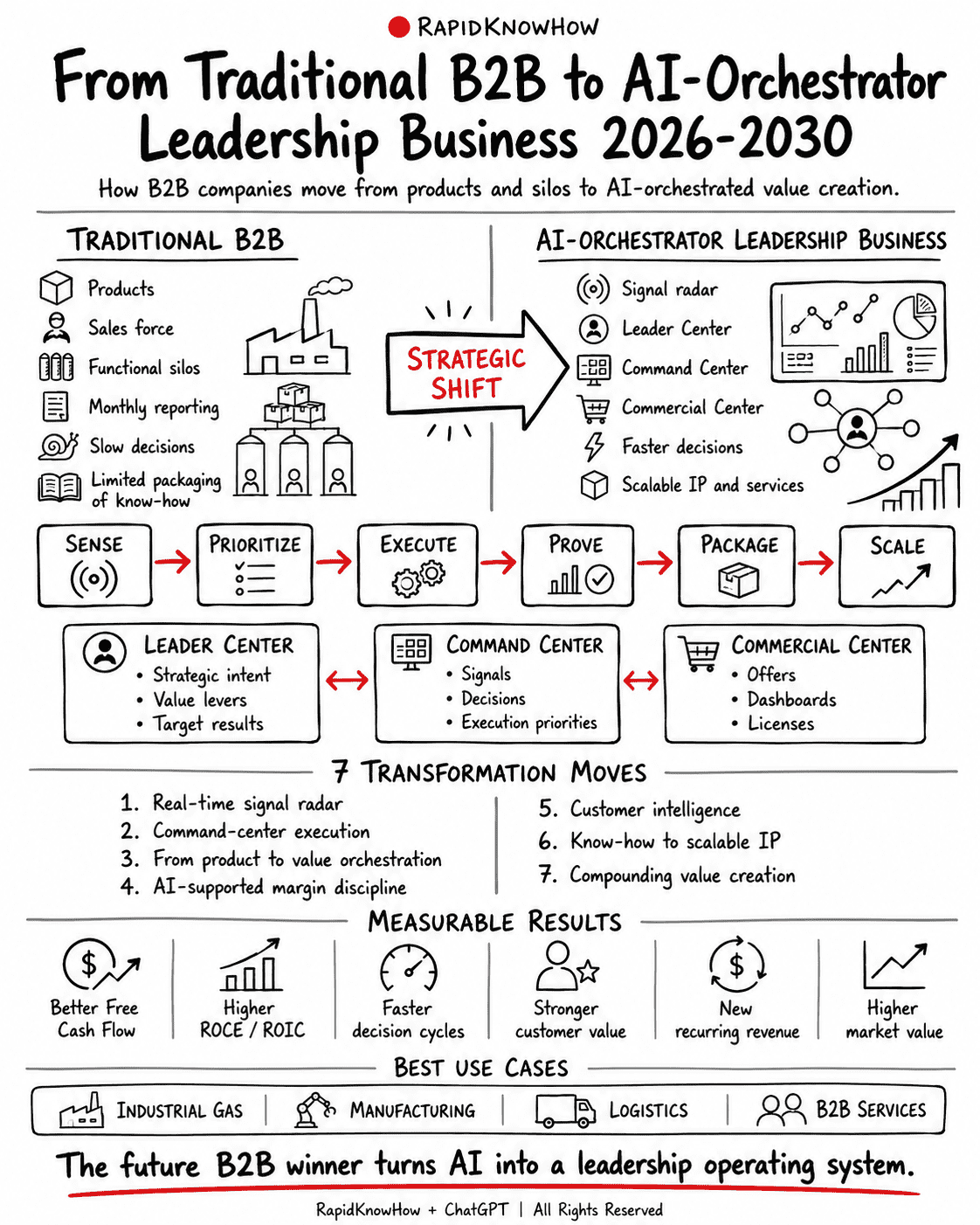
Traditional B2B → AI-Assisted B2B → AI-Orchestrator Leadership Business
The future B2B leader does not only sell products.
The future B2B leader orchestrates value systems.
B) The Traditional B2B Model
The traditional B2B model is built around five pillars:
- Product portfolio
- Sales force
- Operations and supply chain
- Finance and controlling
- Customer relationships
This model often produces stable revenues, long customer relationships and operational discipline.
But it also creates weaknesses:
- slow reaction to market signals
- fragmented data
- siloed decision-making
- delayed margin correction
- weak early-warning systems
- too much manual reporting
- insufficient customer profitability insight
- poor conversion of knowledge into scalable IP
The traditional B2B company knows a lot.
But it often cannot act fast enough.
C) The AI-Orchestrator Leadership Business
The AI-Orchestrator Leadership Business is different.
It does not start with technology.
It starts with leadership architecture.
The core question is:
How do we turn signals into decisions, decisions into action and action into measurable value faster than competitors?
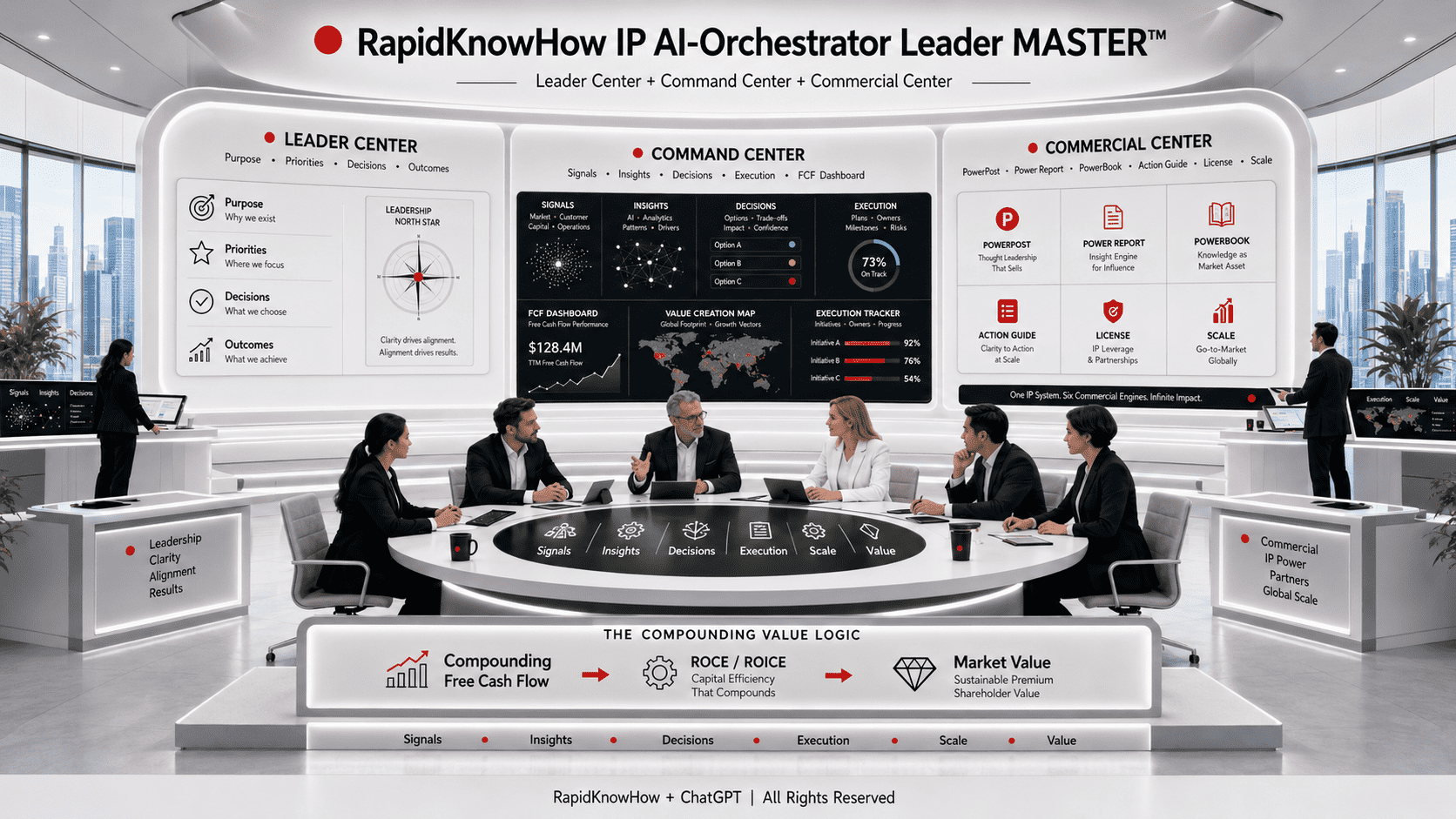
The AI-Orchestrator Leadership Business operates through three connected centers:
1. Leader Center
The Leader Center defines:
- strategic intent
- target markets
- value levers
- decision principles
- customer priorities
- financial result targets
- risk boundaries
It answers:
Where do we play? How do we win? What must improve?
2. Command Center
The Command Center senses, prioritizes and coordinates execution.
It tracks:
- customer demand
- margin signals
- pricing discipline
- energy cost
- supply reliability
- working capital
- competitor moves
- regulatory shifts
- sales pipeline
- operational bottlenecks
- cash-flow impact
It answers:
What is changing now? What matters most? What move must happen next?
3. Commercial Center
The Commercial Center turns proven value into scalable offers.
It packages:
- service bundles
- AI-enabled advisory products
- dashboards
- readiness checks
- customer value reports
- subscription services
- license models
- sector playbooks
- command-center-as-a-service offers
It answers:
How do we convert internal intelligence into market value?
D) The Strategic Transformation Formula
The transformation from Traditional B2B to AI-Orchestrator Leadership Business follows this formula:
Sense → Prioritize → Execute → Prove → Package → Scale
Sense
Detect signals early.
Prioritize
Focus only on the highest-value moves.
Execute
Coordinate people, AI, data and processes.
Prove
Measure financial and operational results.
Package
Turn successful methods into repeatable systems.
Scale
Deploy across customers, regions, business units and partners.
This is how B2B becomes faster, smarter and more valuable.
E) The 7 Transformation Moves 2026–2030
Move 1: From Reporting to Real-Time Signal Radar
Traditional B2B relies on monthly reports.
AI-Orchestrator B2B uses real-time signal radar.
Instead of asking, “What happened last month?”, the company asks:
What is changing now, and what must we do today?
Signal radar tracks:
- pricing gaps
- customer churn risk
- energy cost shocks
- supply delays
- competitor moves
- high-margin opportunities
- working capital pressure
- cash-flow risk
Result: faster response and fewer surprises.
Move 2: From Functional Silos to Command Center Execution
Traditional B2B separates sales, operations, finance, procurement and logistics.
AI-Orchestrator B2B connects them in one decision cockpit.
The Command Center makes visible:
- who must act
- what decision is needed
- what financial result is expected
- what risk must be controlled
- what customer impact matters
Result: less delay, better coordination, stronger execution discipline.
Move 3: From Product Selling to Value Orchestration
Traditional B2B sells products.
AI-Orchestrator B2B sells outcomes.
For example:
- not gases, but uptime and process reliability
- not equipment, but productivity improvement
- not spare parts, but lifecycle performance
- not consulting hours, but decision clarity
- not software, but measurable workflow acceleration
The value proposition changes from:
“Here is our product.”
to:
“Here is the measurable result we help you achieve.”
Result: stronger differentiation and higher pricing power.
Move 4: From Manual Pricing to AI-Supported Margin Discipline
Traditional B2B pricing is often slow, negotiated and inconsistent.
AI-Orchestrator B2B uses pricing intelligence:
- customer profitability
- pass-through effectiveness
- cost-to-serve
- elasticity
- competitor signals
- contract risk
- segment margins
- renewal timing
AI does not replace commercial judgment.
It strengthens it.
Result: better margins, fewer leakages, stronger free cash flow.
Move 5: From Standard Services to AI-Enabled Customer Intelligence
Traditional B2B customer management is relationship-driven.
AI-Orchestrator B2B adds intelligence-driven customer leadership.
The company can create customer-specific value maps:
- current pain points
- usage patterns
- process inefficiencies
- savings potential
- risk exposure
- sustainability impact
- productivity opportunities
- future demand signals
This turns sales conversations into strategic customer dialogues.
Result: higher trust, stronger retention and premium value positioning.
Move 6: From Internal Know-How to Scalable IP
Traditional B2B has deep know-how, but much of it remains locked in people’s heads.
AI-Orchestrator B2B captures and packages know-how.
It turns experience into:
- playbooks
- action guides
- dashboards
- checklists
- simulations
- training systems
- customer advisory products
- licensing models
This is a decisive shift.
The company no longer monetizes only products.
It monetizes knowledge systems.
Result: new revenue streams and higher strategic value.
Move 7: From Cost Control to Compounding Value Creation
Traditional B2B often treats digitalization as cost reduction.
AI-Orchestrator B2B treats AI as a compounding value engine.
The value chain becomes:
Better signals → better decisions → faster execution → stronger cash flow → higher ROCE → higher market value
This turns AI from a technology project into a leadership and value-creation system.
Result: stronger enterprise value and better strategic resilience.
F) The AI-Orchestrator B2B KPI Dashboard
The transformation must be measured.
Key performance indicators include:
Financial KPIs
- free cash flow improvement
- ROCE / ROIC improvement
- gross margin improvement
- EBITDA margin improvement
- working capital reduction
- price leakage reduction
- cost-to-serve reduction
Customer KPIs
- customer profitability
- retention rate
- share of wallet
- contract renewal quality
- service reliability
- customer value delivered
Operational KPIs
- decision-cycle time
- forecast accuracy
- supply reliability
- productivity per employee
- process automation level
- exception-resolution speed
AI-Orchestration KPIs
- number of workflows AI-supported
- percentage of decisions supported by signal radar
- number of command-center actions closed
- measurable value per AI use case
- AI governance maturity
- data reliability score
G) Strategic Application by Sector
Industrial Gas
AI-Orchestrator focus:
- energy cost pass-through
- merchant versus onsite portfolio balance
- cylinder logistics
- customer process uptime
- price discipline
- regional consolidation
- specialty gas growth
- healthcare and electronics demand
Best offer:
Industrial Gas AI-Orchestrator Command Center™
Manufacturing
AI-Orchestrator focus:
- predictive maintenance
- production planning
- supplier risk
- energy efficiency
- quality control
- workforce productivity
- customer delivery reliability
Best offer:
Manufacturing Performance Command Center™
Logistics
AI-Orchestrator focus:
- route optimization
- load balancing
- fuel cost
- fleet utilization
- delivery reliability
- warehouse productivity
- customer service visibility
Best offer:
Logistics Signal-to-Execution Center™
B2B Services
AI-Orchestrator focus:
- proposal speed
- client prioritization
- knowledge packaging
- expert productivity
- service margin
- recurring advisory offers
- license-based delivery
Best offer:
B2B Service IP Commercial Center™
H) Leadership Shift Required
The AI-Orchestrator Leadership Business needs a new type of leader.
Not only a manager.
Not only a technologist.
Not only a consultant.
It needs an orchestrator.
The orchestrator leader must:
- define the strategic question
- select the right signals
- focus the organization
- connect functions
- decide faster
- measure results
- package what works
- scale repeatable value
The leadership mantra becomes:
Float. See. Strike. Scale.
- Float through signals.
- See the whole system.
- Strike at the decisive point.
- Scale what works.
I) RapidKnowHow Transformation Path
Phase 1: Diagnose
Create an AI-Orchestrator Readiness Check.
Assess:
- data readiness
- leadership readiness
- workflow readiness
- customer value potential
- financial improvement potential
- implementation friction
- quick-win opportunities
Phase 2: Design
Build the Leader Center and Command Center blueprint.
Define:
- target use cases
- value levers
- KPIs
- workflows
- roles
- governance
- reporting cadence
Phase 3: Execute
Launch 3 to 5 priority use cases.
Examples:
- pricing discipline radar
- customer profitability dashboard
- energy cost pass-through tracker
- sales opportunity prioritizer
- working capital alert system
Phase 4: Prove
Measure results after 30, 60 and 90 days.
Track:
- cash-flow impact
- margin improvement
- speed gains
- customer impact
- decision quality
- management adoption
Phase 5: Scale
Package the system into a repeatable operating model.
Create:
- internal playbook
- dashboard template
- leadership routine
- customer-facing offer
- license model
- sector-specific Command Center
J) The Commercial Opportunity
Traditional B2B businesses will pay for results, not theory.
The strongest commercial offers are:
- AI-Orchestrator Readiness Check
- 90-Day Cash-Flow Command Sprint
- Pricing Discipline Radar
- Customer Profitability Command Center
- Industrial Gas AI-Orchestrator Command Center™
- B2B Turnaround Command Center™
- AI Asset Portfolio Ranking System
- Commercial Center License Pack
RapidKnowHow’s best entry offer is simple:
30-Minute AI-Orchestrator Value Check
Promise:
Identify one high-value AI-orchestrated business improvement opportunity in 30 minutes.
K) Final Strategic Message
The B2B transformation from 2026 to 2030 is not about replacing people with AI.
It is about replacing slow, fragmented operating models with AI-orchestrated leadership systems.
The companies that win will not merely automate tasks.
They will redesign how leadership works.
They will sense faster.
They will decide better.
They will execute with discipline.
They will prove value.
They will package what works.
They will scale repeatable systems.
One-Sentence Result
The future B2B winner is not the company with the most AI tools; it is the company that turns AI into a leadership operating system for cash flow, ROCE, customer value and scalable market leadership. -Josef David