
Scan Fast > Act Now > Scale What Works – Josef David
🅰️ OVERVIEW
Chapter 1 – The Strategic Shift
Chapter 2 – The Failure of Traditional Models
Chapter 3 – The AI-Orchestrator Model
Chapter 4 – The RapidFind Execution System
Chapter 5 – The 7 Value Loops in Industrial Gas
Chapter 6 – The AI Capital Allocator
Chapter 7 – The 1-Day Execution Playbook
Chapter 8 – Building the Value Engine
Chapter 9 – CEO War Room System
Chapter 10 – Scaling to Market Leadership
🅱️ CHAPTER 1 — THE STRATEGIC SHIFT
From Industrial Operator → Value Orchestrator
The Industrial Gas industry is transitioning from:
- Asset-heavy operations
- Linear value chains
- Slow decision-making
👉 Toward:
- AI-driven orchestration
- Real-time value optimization
- Continuous execution loops
Core Insight
👉 The competitive advantage is no longer scale — but speed of value creation
🅲 CHAPTER 2 — WHY TRADITIONAL MODELS FAIL
1. Silo Thinking
Departments operate independently → value leaks
2. Delayed Decisions
Quarterly thinking → missed opportunities
3. Static Pricing
No real-time adjustment → margin erosion
4. Asset Inefficiency
Idle cylinders/tanks → low ROCE
Result
👉 FCF stagnates while complexity increases
🅳 CHAPTER 3 — THE AI-ORCHESTRATOR MODEL
The New Operating System
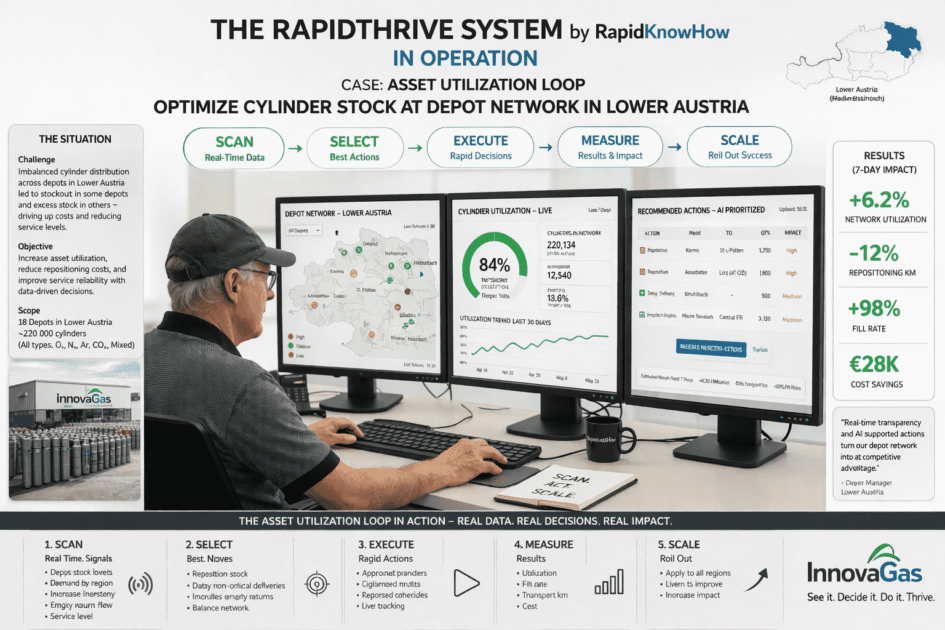
SCAN → SELECT → EXECUTE → MEASURE → SCALE
Applied across:
- Pricing
- Production
- Logistics
- Sales
- Service
AI-Orchestrator Role
- Connects all functions
- Prioritizes high-value actions
- Drives execution speed
Feynman Sentence
👉 “The AI-Orchestrator turns signals into cash flow.”
🅴 CHAPTER 4 — THE RAPIDFIND SYSTEM
Execution Engine
Search → Select → Learn → Apply → Do → Measure → Refine → Scale
Key Advantage
- Eliminates overthinking
- Forces action
- Builds learning loops
Rule
👉 One action. One result. One improvement.
🅵 CHAPTER 5 — THE 7 VALUE LOOPS
1. Pricing Loop
→ Fix margin leaks
→ Increase FCF immediately
2. Asset Utilization Loop
→ Optimize tank/cylinder use
→ Increase ROCE
3. Fill Rate Loop
→ Improve delivery reliability
→ Reduce churn
4. Sales Mix Loop
→ Focus on high-value customers
→ Improve margins
5. Automation Loop
→ Remove manual processes
→ Reduce cost
6. Lock-in Loop
→ Smart assets + contracts
→ Increase recurring revenue
7. AI-Orchestrator Loop
→ Synchronize all loops
→ Maximize total value
🅶 CHAPTER 6 — THE AI CAPITAL ALLOCATOR
The Leadership Shift
👉 From managing operations → to allocating value
Scoring Model
Each loop is evaluated by:
- Impact
- Speed
- Ease
- Learning
- Scale
Decision Rules
- Top 20% → SCALE
- Mid 60% → IMPROVE
- Bottom 20% → STOP
Outcome
👉 Capital flows only to value creation
🅷 CHAPTER 7 — THE 1-DAY EXECUTION PLAYBOOK
Principle
👉 Start small. Move fast. Measure immediately.
Example
WHAT: Improve pricing
HOW: Identify top leaks
DO: Adjust prices today
MEASURE: FCF impact in days
Result
- Immediate value
- Fast feedback
- Momentum
🅸 CHAPTER 8 — BUILDING THE VALUE ENGINE
From Activities → System
Traditional:
- Tasks
- Projects
- Departments
New:
- Loops
- Flows
- Systems
Value Engine Logic
Each loop contributes to:
👉 FCF → ROCE → Market Value
Compounding Effect
Small improvements → repeated → exponential growth
🅹 CHAPTER 9 — CEO WAR ROOM SYSTEM
Purpose
👉 Real-time decision-making environment
Core Elements
- KPI dashboard (FCF / ROCE / Speed)
- Loop performance ranking
- AI recommendations
- Action tracking
CEO Role
👉 Decide fast. Allocate resources. Scale winners.
🅺 CHAPTER 10 — SCALING TO VALUE LEADERSHIP
Phase 1 — Activate Loops
Start with 3–5 loops
Phase 2 — Measure & Learn
Track results daily/weekly
Phase 3 — Scale Winners
Expand high-performing loops
Phase 4 — Build System
Integrate into full organization
Final Outcome
- Market leadership
- Superior margins
- Strong cash flow
- Sustainable growth
🔴 FINAL CEO MESSAGE
👉 “Do not build a better process.”
👉 “Build a faster value creation system.”
⚡ FINAL RapidKnowHow SUMMARY
👉 “Scan fast. Act now. Scale what works.” – Josef David




Leave a Reply
You must be logged in to post a comment.