
RapidKnowHow® POWERPOST · ONE ALGORITHM™ · 4 OCTOBER 2026
AUSTRIA: TURN CAPACITY INTO HIGHER PRODUCTIVITY.
VIENNA: CONNECT JOB CREATION, RESIDENT EMPLOYMENT AND SUSTAINABLE FINANCES.
One signal. One decision. One verified result. This PowerPost applies the RapidKnowHow® ONE ALGORITHM™ to economic performance and public delivery in Austria and Vienna, with Switzerland (CH) and Denmark (DK) as benchmarks.
Method: SIGNAL → INTERPRET → DECIDE → ACT → VERIFY → COMPOUND.
Evidence boundary: Data available as at 4 October 2026. Full-year 2026 outcomes are not yet available. Country indicators are compared at national level; Vienna is assessed separately as a city and federal province. Revision dates, accounting definitions and labour-market measures differ. Conclusions below are analytical judgments, not an official country ranking.
01 — SIGNAL: What do the facts show?
| Indicator | Austria | Switzerland | Denmark |
|---|---|---|---|
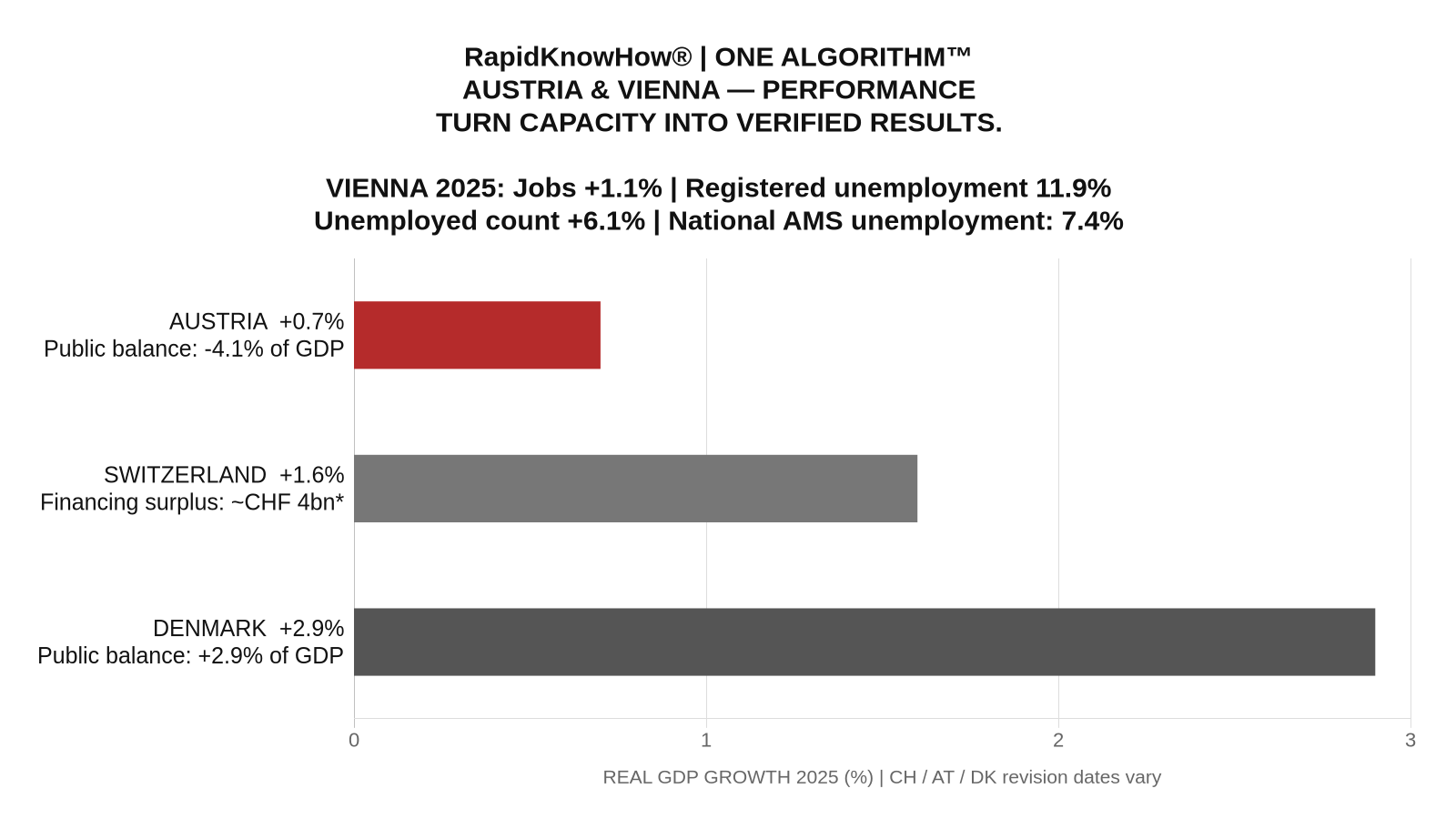
| Real GDP growth, 2025 | +0.7% [1] | +1.6% [3] | +2.9% [5] |
| Public finances, 2025 | Deficit: 4.1% of GDP [2] | Estimated financing surplus: CHF 4bn [4] | Surplus: 2.9% of GDP [5] |
| Structural issue | Productivity and business renewal | Broaden productivity gains | Spread multinational success into the domestic economy |
Dashboard reading note: The bars show real GDP growth, not a combined performance score. The Swiss financing surplus is an estimate and uses a different presentation from EU general-government balances. National source dates are September 2026 for Austria, August 2026 for Switzerland and May 2026 for Denmark; figures remain subject to revision.
Austria returned to annual growth in 2025, but the official national-accounts page reports a 0.1% quarterly contraction in Q2 2026. One positive annual result therefore does not establish a sustained recovery. [1]
Vienna: job growth and unemployment rose together
| Vienna measure | Result | Interpretation |
|---|---|---|
| Registered employee jobs, 2025 | 933,430; +1.1% | Above Austria’s +0.1% job growth |
| Registered unemployment rate, 2025 | 11.9%; Austria: 7.4% | A substantial resident employment gap |
| Registered unemployed, 2025 | 125,525; +6.1% | More jobs did not prevent rising unemployment |
| Inward commuting, 2023 | 26% of jobs held by residents of other provinces | Jobs located in Vienna and resident outcomes differ |
Source: AMS, Vienna labour-market profile. These administrative unemployment measures are suitable for Vienna–Austria comparison; they must not be ranked directly against international labour-force-survey unemployment rates. [6]
02 — INTERPRET: Locate the chokepoints
Austria — competitiveness and resource allocation
The OECD identifies rising labour and energy costs, weak productivity growth and declining business dynamism. Its proposed remedies include easing regulation, accelerating digitalisation and strengthening competition. [7]
Our interpretation: Austria needs a higher return on its existing skills, investment and public expenditure. Keeping activity alive is insufficient if the activity does not improve productivity, customer value or public outcomes. Programmes should be tested for results and adjusted when evidence is weak.
Fiscal consolidation creates a second constraint. Expenditure must become more effective while essential services and productive investment are protected. Across-the-board reductions can undermine the growth needed to strengthen public finances; an outcome-based review is a more useful starting point.
Vienna — converting opportunity into resident participation
Job growth alongside rising unemployment points to a need for deeper analysis of who gains access to employment. Skills, qualifications, childcare, recruitment, accessibility and workforce composition all warrant investigation.
Diagnostic hypothesis, not established causation: the aggregate figures cannot identify whether mismatch, population growth, discrimination or another factor dominates. The next decision should be based on linked programme and employment evidence, not assumptions about groups of residents.
The city’s January preliminary accounts announcement put the 2025 deficit at €2.8bn and expected year-end debt at €14.4bn. These are preliminary figures from that announcement, not presented here as a fresh audit of final accounts. They show fiscal pressure but do not prove that the entire deficit reflects waste: investment, service responsibilities and financing structure must be examined separately. [10]
Switzerland — resilience with unfinished reform
The OECD’s September 2026 survey finds that Switzerland weathered recent shocks comparatively well. It still recommends stronger competition and simpler, more digital administrative processes so productivity gains extend beyond export-oriented and larger firms. [8]
Lesson: combine fiscal discipline with competition and practical administrative reform. Switzerland offers useful mechanisms to study; it is not a model without weaknesses.
Denmark — strong results with concentrated growth engines
The OECD describes a favourable business environment, a strong labour market and sound public finances. It also describes a two-speed economy: multinationals drive much of the success while domestic productivity and demand have been weaker. Pharmaceuticals and shipping create exposure to sector-specific shocks. [9]
Lesson: build internationally competitive value creation and test whether its benefits reach domestic firms and workers. Headline GDP growth alone cannot demonstrate broad-based improvement.
03 — DECIDE: What should Austria and Vienna learn?
| Question | Assessment | Decision implication |
|---|---|---|
| Stronger 2025 aggregate growth? | DK, then CH, then AT on the cited figures | Examine the source and breadth of growth |
| Stronger fiscal position? | CH and DK versus AT, with definition caveats | Preserve capacity to respond to shocks |
| Austria’s priority? | Productivity and business renewal | Reduce barriers and verify outcomes |
| Vienna’s priority? | Resident employment and effective service delivery | Track resident outcomes alongside city jobs |
| Copy a whole national model? | No | Adapt one mechanism and test it |
A comprehensive “best country” judgment would also require comparable household income, housing affordability, health, education, environmental and service-quality evidence. This economic assessment does not establish superiority across those dimensions.
ONE DECISION: ONE OWNER. ONE BASELINE. ONE MEASURABLE OUTCOME. ONE REVIEW DATE.
Introduce a results-based review for selected public and business processes. Start with a bounded application and demonstrate improvement before scaling.
04 — ACT: TOP 3 ACTIONS
1. BUSINESS ADMINISTRATION: Shorten one high-volume approval process. Measure median processing time, slowest-case time, applicant effort, error rates and compliance quality.
2. VIENNA EMPLOYMENT: Connect one training programme to documented employer demand. Measure sustained employment after six and twelve months, earnings progression and cost per sustained placement—not just course completion.
3. PUBLIC PROCUREMENT: Review one recurring spending category using total cost, reliability and service quality. Verify actual expenditure avoided after implementation costs, without degrading access or quality.
These are proposed actions, not claims of implementation or proven savings.
Need a practical execution guide? Choose the relevant Action Guide in the RapidKnowHow® Shop →
05 — RESULT: Verify before scaling
30-day result: establish baselines, owners, targets and agreed evidence. 90-day result: verify initial delivery improvements. Sustained employment and structural fiscal outcomes require longer follow-up.
Scale only when: a better outcome is demonstrated, quality remains acceptable, total resource requirements improve and another team can repeat the result.
For business applications, distinguish capacity released from realised cash. For public services, evaluate financial effects alongside access, fairness and quality. Do not count a forecast saving as an achieved result.
Need to apply the method across teams or sites? Explore the Decision Governance Licensing System →
06 — COMPOUND: Preserve the proven method
Verified case → reusable know-how → independently repeated application → better benchmarks → stronger decisions. Preserve evidence, assumptions and version history so the next team can distinguish what worked from what was merely expected.
Conclusion
Austria’s strongest opportunity is higher productivity through better allocation and execution. Vienna’s strongest opportunity is turning economic activity into sustained resident employment and demonstrably effective services.
RapidKnowHow® contributes the decision and verification method. Its commercial value becomes credible when a budget owner commissions a defined application, results are checked and another team can repeat the improvement.
ACTION CHECKLIST — PASS / FAIL
SETUP: one process, one owner, one baseline and reliable data.
CORE: one decision and three actions with deadlines.
VALUE: compare outcomes, costs and quality with the baseline.
USER JOURNEY: clear next action, accessible guides and relevant licensing route.
MOBILE / BRANDING: readable dashboard, clear text and accessible tables.
TRUST: keep facts, hypotheses, targets and verified results separate.
PASS: another team can reproduce the improvement with acceptable quality.
FIRST REVIEW: fix the strongest chokepoint before adding functions.
Sources and measurement notes
Primary sources are listed below. 2025 figures may be revised. OECD structural assessments are dated 2026; the Danish Commission release is dated May 2026. The Swiss financing surplus is estimated and differs in presentation from EU general-government balances. Vienna’s AMS data are administrative measures, not an international unemployment ranking.
- Statistics Austria — national accounts, September 2026
- Statistics Austria — public deficit / surplus
- Swiss FSO / SECO — GDP release, 25 August 2026
- Swiss Federal Finance Administration — financial statistics, 27 August 2026
- European Commission — Denmark assessment, 21 May 2026
- AMS — Vienna labour-market profile, 2025
- OECD — Economic Survey of Austria 2026
- OECD — Economic Survey of Switzerland 2026
- OECD — Economic Survey of Denmark 2026
- City of Vienna — preliminary 2025 accounts announcement, 25 January 2026
RapidKnowHow® — THE DECISION COMPANY™ · Analysis: Josef David / RapidKnowHow® with AI-assisted research and drafting. Analytical conclusions are interpretations of the cited evidence.