Assessment through the RapidKnowHow IP AI-Orchestrator B2B Leader Lens
Automotive Supplier Transformation + Thermal Management + Electrification + FCF Discipline
Author: Josef David
RapidKnowHow + ChatGPT
Executive Summary
MAHLE is a strong B2B transformation case because it sits directly inside one of the most difficult industrial transitions of the 21st century: the transformation of the automotive supplier industry from combustion-engine dependency toward electrification, thermal management, software-enabled efficiency and climate-neutral mobility.
MAHLE is not a simple growth story. It is a restructuring, repositioning and value-orchestration case.
In 2025, MAHLE reported revenue of €11.3 billion, adjusted EBIT of €442 million and an adjusted EBIT margin of 3.9%. The company described its 2030+ strategy as focused on three fields: electrification, thermal management and components for efficient and clean internal combustion engines.
Through the RapidKnowHow IP AI-Orchestrator B2B Leader Lens, the core question is:
Can MAHLE turn automotive transition pressure into a focused, cash-generative, capital-disciplined transformation model?
The strategic value chain is:
Portfolio Focus → Thermal Management + Electrification → Operational Restructuring → Customer Value → Free Cash Flow → ROCE / ROICE → Strategic Market Value
The RapidKnowHow assessment is clear:
MAHLE wins if it orchestrates the transition faster than complexity, cost pressure and declining legacy markets destroy value.
1. Why MAHLE Matters
MAHLE is a leading international development partner and supplier to the automotive industry. Its customer base covers passenger cars and commercial vehicles, and its technology focus includes electrification, thermal management, fuel cells and efficient combustion engines that can also run on renewable fuels such as hydrogen.
This makes MAHLE important because the automotive supplier sector faces a brutal transformation challenge:
- EV ramp-up is volatile.
- Combustion-engine markets are declining unevenly.
- Hybrid solutions remain relevant longer than expected in some markets.
- Chinese competition is rising.
- OEM pricing pressure remains high.
- Energy and labor costs pressure margins.
- Restructuring is painful, especially in Europe.
- Capital allocation mistakes can destroy returns quickly.
MAHLE therefore represents a classic B2B transformation problem:
How can a supplier protect cash from legacy businesses while investing in future technologies?
2. RapidKnowHow AI-Orchestrator Lens
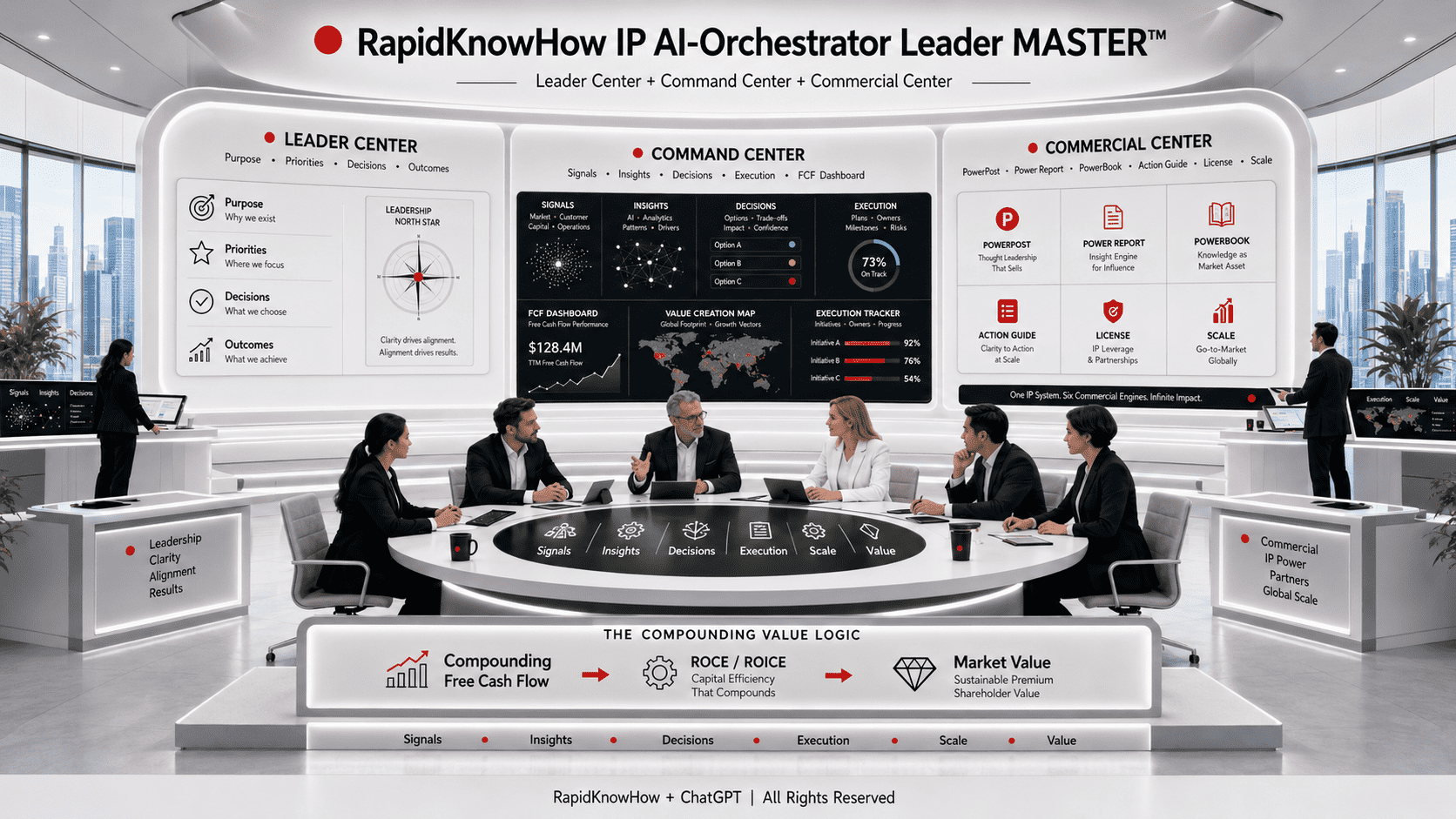
The RapidKnowHow lens assesses MAHLE through six dimensions:
- Leader Center – strategic focus, portfolio direction, restructuring discipline.
- Command Center – operational intelligence, cost, plant performance, customer orders, technology roadmap.
- Commerce Center – customer value propositions, system offers, aftermarket, thermal/electrification growth packages.
- Free Cash Flow – cash generation from restructuring, productivity and profitable orders.
- ROCE / ROICE – capital productivity in plants, platforms, R&D and new technologies.
- Strategic Market Value – long-term value as a focused mobility technology supplier.
The question is not whether MAHLE has technologies. It does.
The question is whether MAHLE can orchestrate them into a profitable, scalable transformation system.
3. Leader Center Assessment
The Leader Center of MAHLE is defined by the 2030+ strategy.
MAHLE’s strategic focus is built around:
1. Electrification
High-power electronics, electric drive systems and components for electric vehicles.
2. Thermal Management
Battery thermal management, cabin climate systems, cooling modules, e-compressors and integrated heat-pump-related systems.
3. Efficient Internal Combustion Engines
Components for clean combustion engines, including technologies relevant for hybrids and renewable fuels.
This portfolio logic is realistic because the transition is not linear. Pure EV growth exists, but hybrid and efficient combustion technologies still matter across many markets. MAHLE’s 2025 new orders from OEMs represented average annual sales of €1.9 billion, with contributions from high-power electronics, electric drive systems, air conditioning systems with integrated electric heaters, cooling modules, exhaust gas heat exchangers, e-compressors, air intake modules and piston systems.
Leader Center Score: 8/10
The strategic direction is clear. The main leadership risk is execution complexity: MAHLE must manage decline, growth, restructuring and innovation at the same time.
4. Command Center Assessment
MAHLE needs a powerful Command Center because transformation pressure is operationally intense.
The Command Center should monitor:
- Order intake by technology field
- EV, hybrid and combustion exposure
- Plant utilization
- Product profitability
- Customer profitability
- R&D allocation
- Restructuring progress
- Cost reduction
- Labor cost pressure
- Energy cost exposure
- Supply chain disruption
- Regional competitiveness
- China competition
- Free Cash Flow impact
The company’s 2025 results show the need for operational discipline: revenue was €11.3 billion, organic growth was 0.6%, adjusted EBIT improved to €442 million, and adjusted EBIT margin improved to 3.9%. MAHLE cited productivity improvements and sales price adjustments as important contributors to better operating results.
A RapidKnowHow MAHLE Command Center would operate with this logic:
Sense market shift → rank portfolio exposure → control cost → protect margin → prioritize profitable orders → measure FCF → scale future technologies
The Command Center is essential because MAHLE’s transformation cannot be managed by yearly strategy slides. It requires weekly operating discipline.
Command Center Score: 8/10
The key opportunity is to create a single visible transformation cockpit connecting technology, plants, customers, restructuring and cash.
5. Commerce Center Assessment
The Commerce Center is where MAHLE must turn technology into customer business value.
MAHLE’s strongest commercial themes are:
1. Thermal Management as EV Performance Lever
Thermal management is no longer an auxiliary function. It directly affects EV range, charging performance, battery safety, cabin comfort, system efficiency and total vehicle performance. MAHLE’s thermal management strategy includes system integration from cabin air conditioning to battery thermal management and e-drive cooling.
2. Electrification Components
Power electronics, electric drives, e-compressors and integrated systems can become high-value customer solutions if linked clearly to efficiency, range, cost and platform performance.
3. Hybrid and Clean ICE Bridge
MAHLE can still capture value from efficient combustion and hybrid platforms while the global transition remains uneven.
4. Aftermarket Strength
Aftermarket can support cash flow through maintenance, replacement parts, workshop trust and lifecycle services.
5. Commercial Vehicle and Heavy-Duty Applications
Thermal, fuel-cell, hydrogen and efficient combustion solutions remain relevant for heavy-duty use cases.
The Commerce Center must package these into simple customer outcomes:
- Improve EV range.
- Reduce system cost.
- Increase energy efficiency.
- Improve battery safety.
- Support hybrid transition.
- Reduce emissions.
- Improve platform reliability.
- Reduce lifecycle cost.
Commerce Center Score: 8/10
Main challenge: MAHLE must translate engineering excellence into clear, measurable customer-value propositions.
6. Free Cash Flow Lens
Free Cash Flow is the truth number for MAHLE because supplier transformation consumes cash.
R&D, restructuring, plant adjustments, new technology ramp-up and legacy decline all compete for capital. MAHLE must prove that transformation is not only strategically correct, but financially sustainable.
FCF improves when MAHLE:
- Raises productivity
- Improves pricing discipline
- Reduces indirect costs
- Stops low-return activities
- Prioritizes profitable customer orders
- Improves plant utilization
- Controls restructuring cash costs
- Reduces working capital
- Focuses R&D on winning platforms
- Scales thermal and electrification technologies
- Protects aftermarket cash contribution
The company’s 2025 improvement in adjusted EBIT is positive, but the broader transformation remains demanding. Reports on restructuring and site closures show that cost pressure and capacity adjustment remain significant issues in Europe.
FCF Potential Score: 7.5/10
The upside is real, but cash discipline must be relentless.
7. ROCE / ROICE Lens
MAHLE’s ROCE / ROICE challenge is capital productivity.
The supplier must avoid spreading capital too broadly across too many technologies, customers and regions. Every euro invested in R&D, production capacity, tooling or restructuring must support a clear return path.
The RapidKnowHow ROCE / ROICE question is:
Which technologies and customer platforms create the best return on invested capital over the next 5–10 years?
MAHLE improves ROCE / ROICE by:
- Concentrating on thermal management leadership
- Scaling electrification components with strong order quality
- Avoiding low-margin commodity production
- Reducing overcapacity in declining legacy segments
- Increasing modular system solutions
- Improving asset utilization
- Using aftermarket to stabilize returns
- Tightening R&D allocation
- Building customer platforms with repeatable components
The restructuring logic must be linked directly to ROCE improvement, not only cost reduction.
ROCE / ROICE Potential Score: 7.5/10
8. Multiple and Strategic Market Value Lens
MAHLE is not a listed stock-market multiple case in the same way as Siemens or Schneider. But strategic market value still matters for creditors, bond investors, customers, partners and potential strategic options.
Its strategic value increases if MAHLE proves:
- The 2030+ strategy works.
- Thermal management becomes a growth engine.
- Electrification orders convert into profitable revenue.
- Legacy ICE cash is harvested intelligently.
- Restructuring reduces fixed-cost pressure.
- FCF becomes more reliable.
- Debt and financing strength improve.
- Customer trust remains strong.
The market-value narrative should be:
From pressured automotive supplier to focused mobility technology orchestrator.
Strategic Market Value Potential Score: 7.5/10
9. Strategic Risks
Risk 1: Slow EV Ramp-Up
If EV adoption remains uneven, electrification investment payback becomes slower.
Risk 2: Legacy Decline
Combustion-related business may decline faster in some regions than MAHLE can replace it.
Risk 3: Cost Pressure from Asia
Asian competitors can pressure margins in Europe and global OEM supply chains.
Risk 4: Restructuring Friction
Plant closures, job reductions and union resistance can slow transformation and consume cash.
Risk 5: R&D Dilution
Too many technology bets can weaken capital productivity.
Risk 6: OEM Pricing Pressure
Automotive suppliers often struggle to fully pass through costs.
The RapidKnowHow warning:
MAHLE wins if focus beats fragmentation.
10. Strategic Recommendation
MAHLE should be assessed through this RapidKnowHow value chain:
Leader Center → Command Center → Commerce Center → Free Cash Flow → ROCE / ROICE → Strategic Market Value
Leader Center
Sharpen the 2030+ strategy around thermal management, electrification and profitable bridge technologies.
Command Center
Build a transformation cockpit for order quality, plant utilization, cost, R&D allocation, restructuring, customer profitability and FCF.
Commerce Center
Package thermal and electrification capabilities into clear OEM value offers: range, efficiency, safety, system cost, platform performance and lifecycle value.
Free Cash Flow
Measure transformation by cash, not only order intake or technology announcements.
ROCE / ROICE
Allocate capital only to platforms and technologies with visible return paths.
Strategic Market Value
Build the narrative: focused mobility technology supplier with strong thermal management and electrification relevance.
Final Strategic Fazit
MAHLE is a highly relevant B2B transformation case because it represents the real industrial difficulty of the mobility transition.
The company has a credible strategy, strong engineering competence and meaningful growth fields in thermal management and electrification. But the transformation is demanding because MAHLE must fund the future while restructuring the past.
Through the RapidKnowHow IP AI-Orchestrator B2B Leader Lens, the decisive point is:
MAHLE wins if it turns transition pressure into orchestrated portfolio focus, operational discipline, customer-value packages, Free Cash Flow and improved capital productivity.
The strategic line is:
Thermal Management + Electrification + Clean ICE Bridge → Customer Outcomes → Free Cash Flow → ROCE / ROICE → Strategic Market Value. -Josef David