Traditional Industrial Functional Organisation
vs
AI-Orchestrator Leadership Model
(Industrial Gas / Capital-Intensive Industry Context)
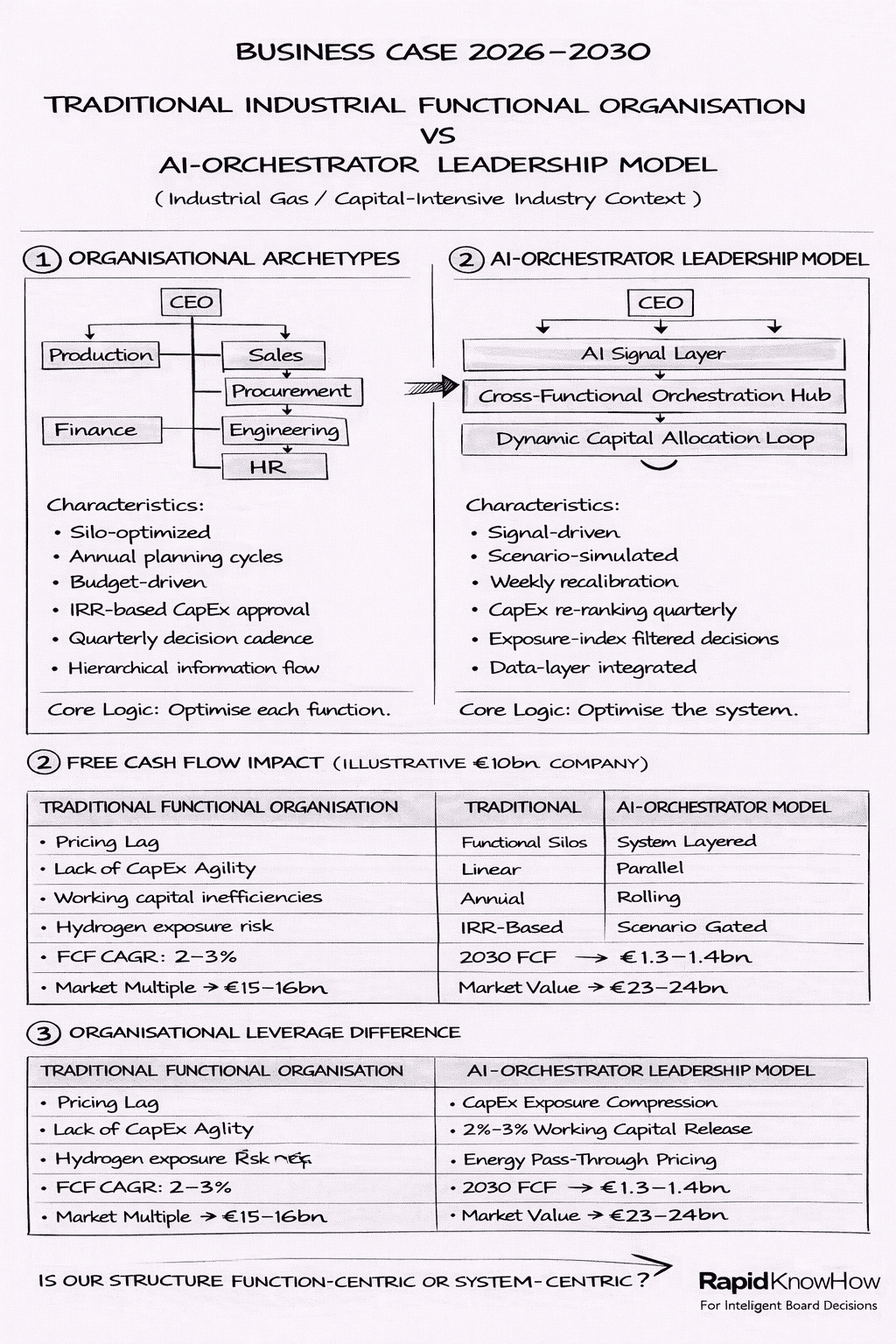
A) ORGANISATIONAL ARCHETYPES
1️⃣ Traditional Industrial Functional Organisation
Structure:
CEO
→ Production
→ Sales
→ Procurement
→ Finance
→ Engineering
→ HR
Characteristics:
- Silo-optimized
- Annual planning cycles
- Budget-driven
- IRR-based CapEx approval
- Quarterly decision cadence
- Hierarchical information flow
Core Logic:
Optimise each function.
Blind Spot:
System volatility across functions.
2️⃣ AI-Orchestrator Leadership Model
Structure:
CEO
→ AI Signal Layer
→ Cross-Functional Orchestration Hub
→ Dynamic Capital Allocation Loop
Characteristics:
- Signal-driven
- Scenario-simulated
- Weekly recalibration
- CapEx re-ranking quarterly
- Exposure-index filtered decisions
- Data-layer integrated
Core Logic:
Optimise the system.
B) DECISION SPEED & CAPITAL FLOW
Traditional Model
Energy shock occurs.
Step 1: Production impact analysis
Step 2: Finance review
Step 3: Sales pricing adjustment
Step 4: Board update
Time: 6–12 weeks.
Margin compression happens before reaction.
AI-Orchestrator Model
Energy signal detected.
AI Signal Engine →
Scenario simulation (24–48h) →
Cross-functional war-room →
Pricing adjustment within 5–7 days.
Result:
Margin protected.
Decision compression = FCF protection.
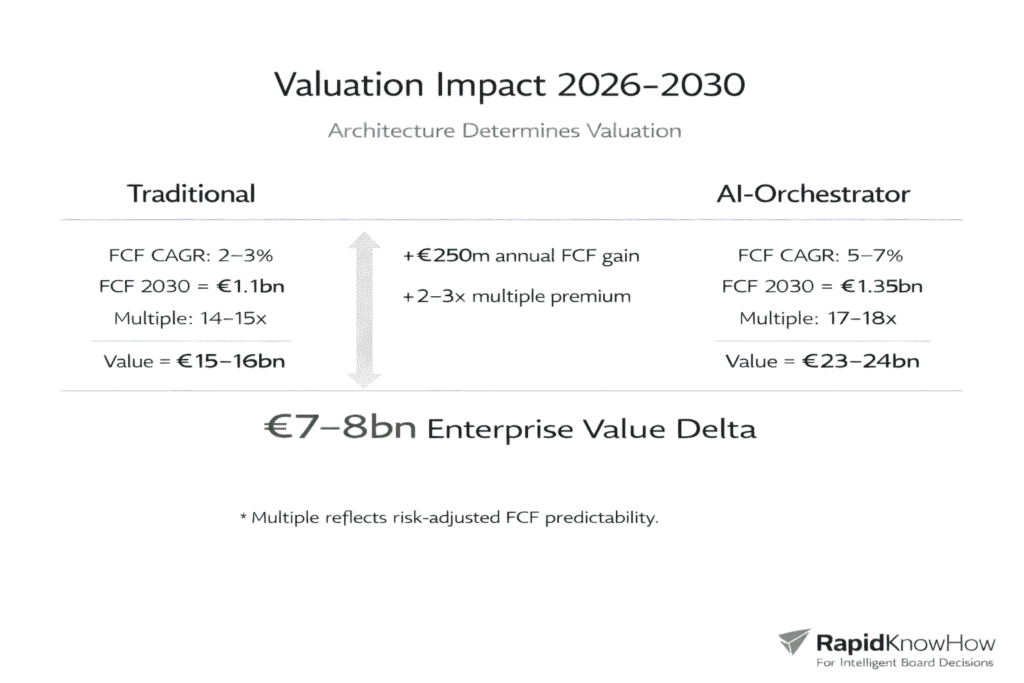
C) FREE CASH FLOW IMPACT (ILLUSTRATIVE €10bn COMPANY)
Baseline FCF: €1bn
Traditional Functional Organisation
- Pricing lag
- CapEx rigidity
- Working capital inefficiencies
- Hydrogen exposure risk
FCF CAGR: 2–3%
2030 FCF ≈ €1.1bn
Market Multiple: 14–15×
Market Value ≈ €15–16bn
AI-Orchestrator Leadership Model
- Exposure-index filtered CapEx
- Working capital release 2–3%
- Energy pass-through compression
- AI-prioritized revenue focus
FCF CAGR: 5–7%
2030 FCF ≈ €1.3–1.4bn
Multiple expansion: 17–18×
Market Value ≈ €23–24bn
D) ORGANISATIONAL LEVERAGE DIFFERENCE
| Dimension | Traditional | AI-Orchestrator |
|---|---|---|
| Structure | Functional Silos | System Layered |
| Decision Flow | Linear | Parallel |
| Planning | Annual | Rolling |
| CapEx Logic | IRR-based | Scenario-gated |
| Pricing | Reactive | Predictive |
| Risk Management | Post-event | Pre-signal |
| FCF Volatility | High | Reduced |
| Enterprise Value 2030 | ~€16bn | ~€23–24bn |
E) STRATEGIC GAP
The difference is not technology.
It is architecture.
Functional organisations optimise departments.
AI-Orchestrator organisations optimise cash-flow systems.
From 2026–2030:
The market will reward system-level intelligence.
F) BOARD-LEVEL QUESTION
The real governance question becomes:
Are we structured to optimise functions?
Or are we structured to orchestrate value?
Because:
Silos create lag.
Lag creates volatility.
Volatility compresses valuation.
G) CONCLUSION
The Traditional Industrial Organisation is efficient in stable environments.
The AI-Orchestrator Model is resilient in volatile environments.
2026–2030 will be volatile.
Therefore:
The organisational design decision
is a valuation decision. – Josef David
What an effective Board-Level Presentation Must Deliver
In 10 seconds Board Members must understand:
- FCF increases structurally.
- Risk declines.
- Multiple expands.
- Valuation gap compounds.
Everything else is secondary. – Josef David