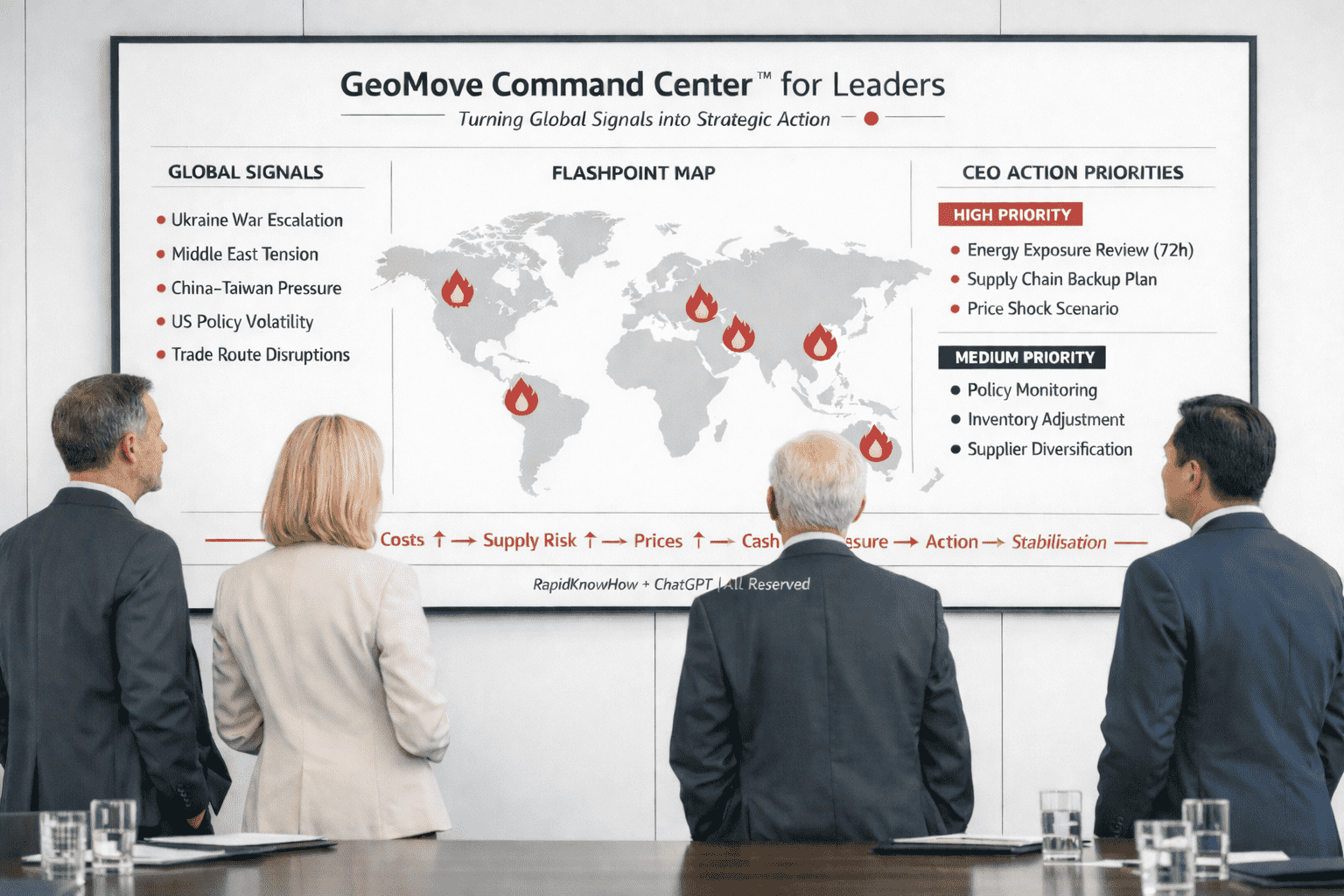
Current Geopolitical Power Moves and the Next Tit-for-Tat Reactions
A 30-second executive view of today’s main geopolitical moves: Ukraine/Russia, China/Taiwan/Philippines/Japan, U.S.–Iran, Israel/Lebanon/Hezbollah, and global market-risk transmission.
A) 30-Second GeoMove™ Snapshot
Result: Stalemate with negotiation window.
Risk: 24/35
Result: Deterrence game with miscalculation risk.
Risk: 27/35
Result: Controlled escalation plus negotiation.
Risk: 29/35
Result: Escalation spiral with diplomatic blockage.
Risk: 31/35
Result: Hidden economic escalation.
Risk: 25/35
B) GeoMove™ Tit-for-Tat Analysis
Ukraine / Russia: Diplomacy Window Before Winter
| GeoMove™ Question | Assessment |
|---|---|
| Who moves? | Ukraine, backed by European partners and dependent on continued U.S. and European support. |
| Why? | To convert Russian exhaustion into negotiation leverage before winter while keeping Western support aligned. |
| Likely countermove | Russia delays, raises terms, divides Western supporters, and waits for fatigue. |
| Strategic result | Stalemate with negotiation window. |
| Risk score | 24/35 — Escalation Move |
Best de-escalation move: Create a dual-track peace channel: security guarantees for Ukraine plus phased sanctions relief tied to verified behavior.
China / Taiwan / Japan / Philippines: Maritime Pressure and Alliance Testing
| GeoMove™ Question | Assessment |
|---|---|
| Who moves? | China. |
| Why? | To signal that Japan–Philippines coordination near Taiwan and disputed waters will be contested early. |
| Likely countermove | Japan, the Philippines, Taiwan, and the U.S. strengthen maritime coordination, surveillance, legal positioning, and joint exercises. |
| Strategic result | Deterrence game with high miscalculation risk. |
| Risk score | 27/35 — Escalation Move |
Best de-escalation move: Keep military hotlines active and separate coast-guard law-enforcement incidents from military escalation.
U.S. / Iran: Ceasefire Pressure, Hormuz Leverage, Limited Deal
| GeoMove™ Question | Assessment |
|---|---|
| Who moves? | Iran and the U.S., with Israel and Gulf states affected directly. |
| Why? | Iran seeks economic breathing space. The U.S. seeks containment, open shipping, and nuclear-risk control. |
| Likely countermove | The U.S. may offer limited sanctions or financial relief in exchange for shipping stability while keeping military pressure available. |
| Strategic result | Controlled escalation mixed with transactional negotiation. |
| Risk score | 29/35 — Escalation Move |
Best de-escalation move: Create a verified Hormuz-for-relief deal: shipping remains open, Iran receives phased relief, and nuclear talks are handled in a slower second track.
Israel / Lebanon / Hezbollah / Iran: Escalation Through Proxy Fronts
| GeoMove™ Question | Assessment |
|---|---|
| Who moves? | Israel, Hezbollah, Iran, Lebanon’s political actors, and the U.S. as mediator. |
| Why? | Israel seeks deterrence. Hezbollah seeks resistance credibility. Iran uses the proxy front as leverage while trying not to lose control of escalation. |
| Likely countermove | Hezbollah retaliates selectively; Iran uses escalation as proof that U.S.-backed de-escalation is unreliable. |
| Strategic result | Escalation spiral with diplomatic blockage. |
| Risk score | 31/35 — Systemic Danger Move |
Best de-escalation move: Separate the Lebanon ceasefire from the Iran nuclear/security track and create a monitored Hezbollah–Israel halt mechanism.
Markets / Energy / Inflation: Geopolitics Transmits Into Money
| GeoMove™ Question | Assessment |
|---|---|
| Who moves? | Markets, energy traders, central banks, Gulf states, shipping firms, and insurers. |
| Why? | Markets price risk faster than politicians resolve it. Energy disruption risk becomes inflation risk. |
| Likely countermove | Central banks delay easing, insurers raise premiums, Gulf states push de-escalation, investors rotate toward safer assets. |
| Strategic result | Hidden economic escalation. |
| Risk score | 25/35 — Escalation Move |
Best de-escalation move: Stabilize Hormuz, communicate energy-security guarantees, and create a visible de-escalation calendar.
C) GeoMove™ Executive Conclusion
The current global power game is not one single war. It is a connected tit-for-tat system.
| Front | System Pressure |
|---|---|
| Ukraine front | Pressure on Russia, Europe, NATO credibility, sanctions, and winter resilience. |
| Taiwan / South China Sea front | Pressure on U.S.–China balance, Japan, Philippines, sea lanes, and deterrence credibility. |
| Iran / Hormuz front | Pressure on energy, shipping, inflation, U.S. credibility, and Gulf stability. |
| Lebanon / Hezbollah front | Pressure on Israel, Iran, Lebanon, U.S. mediation, and regional proxy control. |
| Markets | Convert geopolitical escalation into household costs, inflation, insurance costs, and investor risk. |
The Hidden GeoMove™ Insight
The most dangerous moves are not always the loudest military moves. The most dangerous moves are those that connect three systems at once:
Military escalation + energy disruption + domestic political pressure
RapidKnowHow Recommendation
| Target Group | Recommended Action |
|---|---|
| Leaders | Do not react to single events. Map the next five countermoves before deciding. |
| Investors | Watch Hormuz, sanctions, oil, insurance premiums, shipping routes, and central-bank reactions. |
| Citizens | Separate facts from narrative framing. Ask: who benefits, who pays, who escalates, who can stop it? |
| RapidKnowHow | Turn this into a weekly product: GeoMove™ Weekly — Top 5 Power Moves, Tit-for-Tat Forecast, Risk Score, Best Action. |