Helium – Global AI-Orchestrator
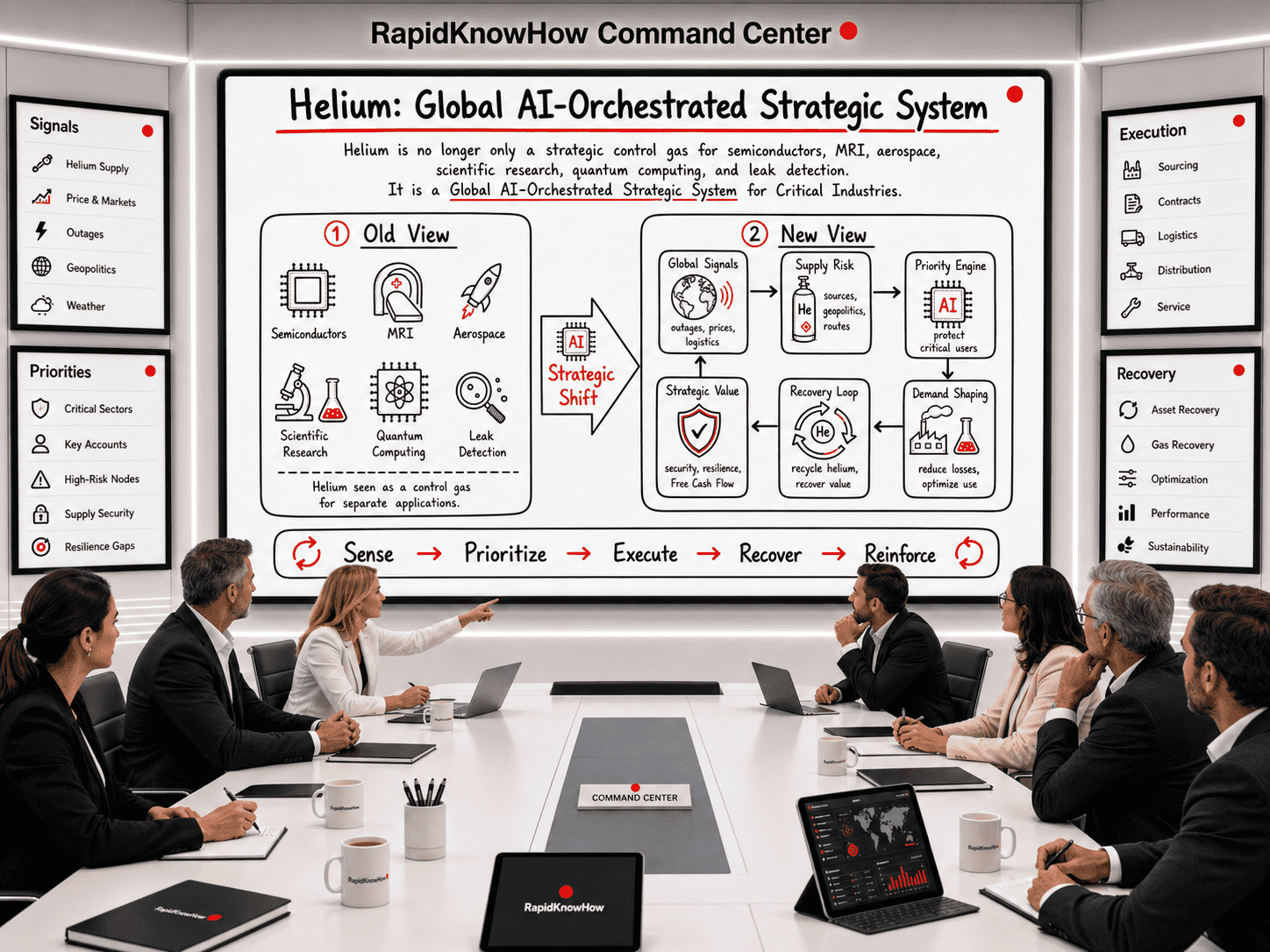
Helium is no longer a niche industrial gas. It is a strategic control gas for semiconductors, MRI, aerospace, scientific research, quantum computing, leak detection, welding, specialty gases, fiber optics and high-end cryogenics. The key fact is simple: helium is light, inert, extremely cold in liquid form, and difficult to replace. USGS notes that there is no substitute for helium in cryogenic applications requiring temperatures below −429°F, which makes helium a strategic bottleneck rather than a normal commodity.
The global helium system is fragile because helium is mostly extracted as a byproduct of natural gas. That means helium supply is not driven only by helium demand; it depends on natural gas fields, LNG economics, purification capacity, storage, specialty containers, sanctions, trade routes and geopolitical stability. USGS identifies the United States and Qatar as leading producers, with production capacity also connected to Algeria, Australia, Canada, Poland, Russia, South Africa and others.
The strategic problem: helium demand is concentrated in high-value sectors, but supply is concentrated in a few regions and constrained by logistics. Transporting helium requires high-pressure or extremely low-temperature equipment, and empty tankers must return to refineries before the next shipment. USGS explicitly describes helium logistics as complex and highlights supply-chain disruptions over the last 15 years.
In 2025, world helium production was estimated at about 190 million cubic meters. The largest reported production came from the United States, Qatar, Russia, Algeria, Canada, China and Poland, with South Africa entering the picture. Major world resources outside the United States are estimated in Qatar, Algeria, Russia, Canada and China; the United States itself has large identified recoverable helium resources.
This creates the case for a Global Helium AI-Orchestrator. The objective is not merely to buy helium cheaper. The objective is to secure, allocate, optimize and recycle helium better than competitors. The winning player will manage helium as a strategic operating system: signal detection, risk scoring, supply routing, customer prioritization, contract pricing, recovery investment and resilience measurement.
The AI-Orchestrator begins with global signals. These include production changes, plant outages, geopolitical restrictions, LNG project delays, sanctions, transport bottlenecks, container availability, spot prices, customer consumption patterns and reserve developments. For example, the sale of the U.S. Federal Helium System to Messer in 2024 marked a major ownership change in the U.S. helium infrastructure landscape.
Second, the system ranks supply nodes. A simple country list is not enough. Each source must be scored by operational reliability, geopolitical exposure, logistics distance, contract access, purification capacity, shipping risk, payment risk and substitute route options. Qatar may be large. The United States may be strategically deep. Algeria and Canada may offer diversification. Russia may hold capacity, but sanctions and political risk reduce reliable access for Western users. USGS states that EU and U.S. sanctions imposing an import ban on helium from Russia continued into 2025.
Third, the system creates a priority engine. Helium must be allocated first to users where substitution is lowest and value-at-risk is highest: MRI, semiconductors, aerospace, scientific research, quantum computing and critical industrial processes. Lower-priority uses should be served only after strategic demand is protected. In the United States, USGS reports helium use across analytical, engineering, lab, science and specialty gases; controlled atmospheres, fiber optics and semiconductors; lifting gas; MRI; aerospace; welding; diving; leak detection; and other applications.
Fourth, the Orchestrator drives demand shaping. This is where AI creates immediate value. Customers can reduce leak losses, improve cylinder tracking, optimize delivery intervals, switch to substitutes where technically safe, install recovery systems and redesign usage standards. The strongest suppliers will not merely deliver helium; they will help customers use less helium per unit of output.
Fifth, the system captures value through scarcity-based contract design. Helium contracts should link volume security, container turns, priority access, recovery commitments, surcharge logic and emergency allocation rules. The commercial model should not be “lowest price per cubic meter.” It should be “highest security-adjusted value per mission-critical process.”
Sixth, the system builds a resilience loop. Helium used in large-volume applications is often not recycled, though recovery systems are becoming more common in some uses. That is an opportunity. AI can identify where recovery economics are strongest, where customers have avoidable losses, and where closed-loop systems create both supply security and Free Cash Flow.
For Europe, helium should be treated as a strategic industrial security material. The EU Raw Materials Information System lists helium among Critical Raw Materials, while the Critical Raw Materials Act aims to reduce supply dependency, increase monitoring, stress testing, stockpiles, circularity and supply-chain resilience.
Strategic conclusion: the helium winner will not be the company with the largest gas contract alone. The winner will be the player with the best AI-Orchestrator: the best signal system, the best risk dashboard, the best supply-routing logic, the best customer segmentation, the best recovery economics and the best resilience score. Helium is a small molecule with large strategic leverage.
RapidKnowHow Positioning Sentence
Helium AI-Orchestrator = turning scarce helium from a fragile supply commodity into a resilient, AI-managed strategic value system for critical industries. – Josef David