Skip to content
RapidKnowHow

RapidKnowHow

Turning Signals into Actionable Results

Primary Menu
  • Decision Governance Leader
    • Industrial Gas Leader
    • Business Leader
    • GeoPower Leader
    • Life Leader
    • Wealth Leader
  • RapidThrive
  • Licensing
  • About
    • 🏛 IGAS AI-Orchestrator™ – Premium Governance Mandate Architecture
    • Josef David
    • Contact
    • Legal & Licensing Notice
×
Live
  • Home
  • Career Leader
  • The 1-Hour Career Leader
  • Illustrating 10 Multiple Causes for Cash-Flow Decline using the MCD Tool

Illustrating 10 Multiple Causes for Cash-Flow Decline using the MCD Tool

Josef David 5th May 2024 3 minutes read
RapidKnowHow

What are MCDs?

MCDs, or Multiple Cause Diagrams, are a tool used in business to identify and illustrate the various factors that contribute to a particular outcome. They are essentially visual maps that allow us to see the complex web of causes and effects that lead to a certain result. MCDs are particularly useful in situations where there are many interrelated factors at play, such as in the case of a cash-flow decline.

What are MCDs for Business and How they work?

In the context of business, MCDs can be used to analyse a wide range of issues, from operational problems to strategic challenges. They work by helping us break down complex problems into their constituent parts, making it easier to understand how different factors interact with each other.

To create an MCD, you start with the outcome you’re interested in – in this case, a decline in cash flow. You then identify all the potential causes of this outcome and map them out visually. This might involve drawing arrows between different causes to show how they’re related, or grouping similar causes together.

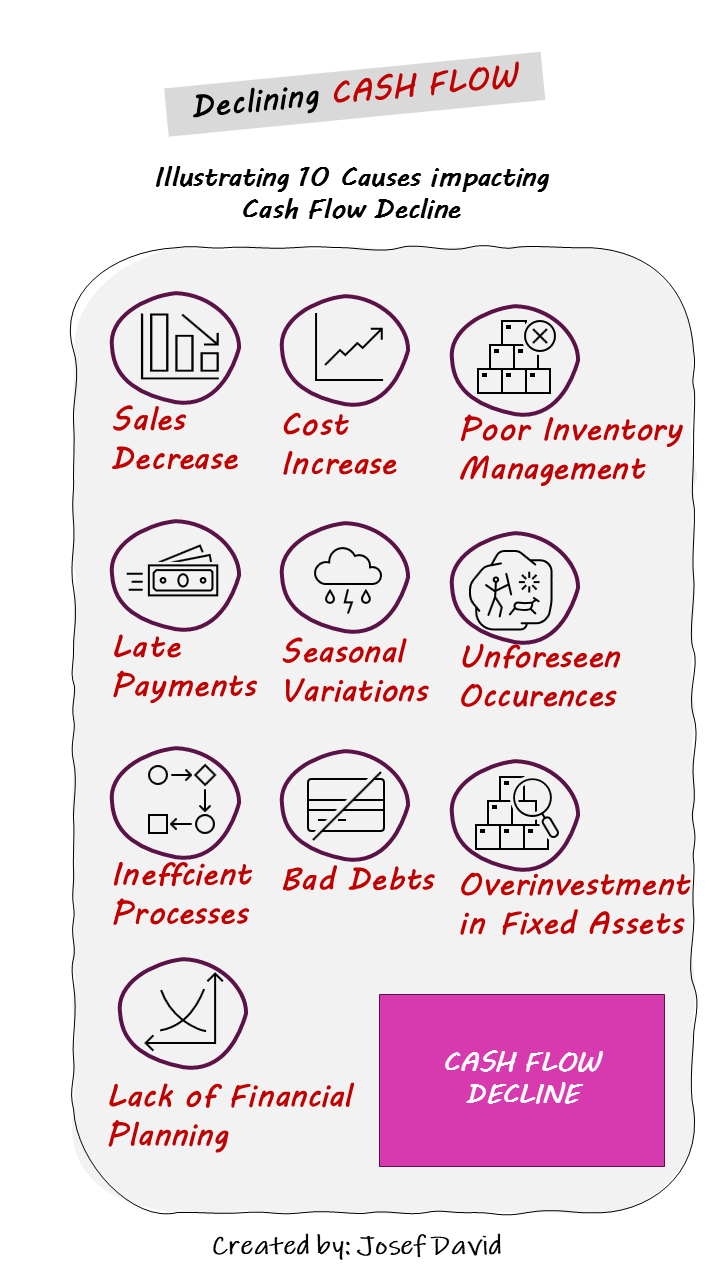
Illustrating 10 Multiple Causes for Cash-Flow Decline

1. Decreased Sales: This is perhaps the most obvious cause of cash-flow decline. If your business is selling less, it’s bringing in less money.

2. Increased Expenses: On the other side of the equation, if your costs go up – whether due to inflation, increased rent or higher supplier prices – your cash flow can take a hit.

3. Poor Inventory Management: If you’re holding too much stock, your money is tied up in inventory rather than being available for other uses.

4. Late Payments: If your customers aren’t paying their invoices on time, this can cause a serious cash-flow problem.

5. Seasonal Variations: Many businesses experience fluctuations in sales and cash flow throughout the year due to seasonal trends.

6. Unforeseen Circumstances: Events like natural disasters, pandemics or economic recessions can have a major impact on your cash flow.

7. Inefficient Processes: If your business processes are inefficient, this can lead to wasted time and money, affecting your cash flow.

8. Bad Debts: If customers fail to pay their invoices at all, this can result in a significant loss of income.

9. Overinvestment in Fixed Assets: If too much capital is tied up in property, equipment or other fixed assets, this can restrict your cash flow.

10. Lack of Financial Planning: Without a solid financial plan, it’s easy for spending to get out of control, leading to a decline in cash flow.

Conclusion and Next Steps

Understanding the multiple causes of cash-flow decline is the first step towards addressing the problem. Once you’ve identified the potential causes using an MCD, you can start to develop strategies to mitigate these issues.

This might involve improving your inventory management, tightening up your credit control processes or investing in more efficient business systems. It could also mean revisiting your pricing strategy or looking for ways to diversify your income streams.

In conclusion, MCDs are a powerful tool for understanding complex business problems. By helping us visualise the many interrelated factors that contribute to a particular outcome, they enable us to tackle these issues in a more systematic and effective way.

About the Author

Josef David

Administrator

Thriving Leadership / Owner RapidKnowHow.com /

Visit Website View All Posts
Sharing is Caring! Thanks!

Post navigation

Previous: Multiple Cause Diagram (MCD) for Business,Health and Politics
Next: Illustrating Top 5 Best Practices in a Strategy Consulting Business

Related Stories

15Sec

RapidKnowHow: 15 Seconds-Systems for Leaders

Josef David 5th April 2026
Industrial_Gas_FCF_Command_Center_V3

🧭 FCF COMMAND CENTER — INDUSTRIAL GAS – Week 15/2026

Josef David 5th April 2026
FCF_Command_Center_V3_CLEAN

🔎 RapidKnowHow — Week 15/2026

Josef David 5th April 2026

You may have missed

15Sec

RapidKnowHow: 15 Seconds-Systems for Leaders

Josef David 5th April 2026
Industrial_Gas_FCF_Command_Center_V3

🧭 FCF COMMAND CENTER — INDUSTRIAL GAS – Week 15/2026

Josef David 5th April 2026
FCF_Command_Center_V3_CLEAN

🔎 RapidKnowHow — Week 15/2026

Josef David 5th April 2026
IGCCV1 (1)

Industrial Gas Transformation 2026–2030

Josef David 4th April 2026
Copyright © RapidKnowHow I All rights reserved. | MoreNews by AF themes.
We use cookies on our website to give you the most relevant experience by remembering your preferences and repeat visits. By clicking “Accept”, you consent to the use of ALL the cookies.
Do not sell my personal information.
Cookie SettingsAccept
Manage consent

Privacy Overview

This website uses cookies to improve your experience while you navigate through the website. Out of these, the cookies that are categorized as necessary are stored on your browser as they are essential for the working of basic functionalities of the website. We also use third-party cookies that help us analyze and understand how you use this website. These cookies will be stored in your browser only with your consent. You also have the option to opt-out of these cookies. But opting out of some of these cookies may affect your browsing experience.
Necessary
Always Enabled
Necessary cookies are absolutely essential for the website to function properly. These cookies ensure basic functionalities and security features of the website, anonymously.
CookieDurationDescription
cookielawinfo-checkbox-analytics11 monthsThis cookie is set by GDPR Cookie Consent plugin. The cookie is used to store the user consent for the cookies in the category "Analytics".
cookielawinfo-checkbox-functional11 monthsThe cookie is set by GDPR cookie consent to record the user consent for the cookies in the category "Functional".
cookielawinfo-checkbox-necessary11 monthsThis cookie is set by GDPR Cookie Consent plugin. The cookies is used to store the user consent for the cookies in the category "Necessary".
cookielawinfo-checkbox-others11 monthsThis cookie is set by GDPR Cookie Consent plugin. The cookie is used to store the user consent for the cookies in the category "Other.
cookielawinfo-checkbox-performance11 monthsThis cookie is set by GDPR Cookie Consent plugin. The cookie is used to store the user consent for the cookies in the category "Performance".
viewed_cookie_policy11 monthsThe cookie is set by the GDPR Cookie Consent plugin and is used to store whether or not user has consented to the use of cookies. It does not store any personal data.
Functional
Functional cookies help to perform certain functionalities like sharing the content of the website on social media platforms, collect feedbacks, and other third-party features.
Performance
Performance cookies are used to understand and analyze the key performance indexes of the website which helps in delivering a better user experience for the visitors.
Analytics
Analytical cookies are used to understand how visitors interact with the website. These cookies help provide information on metrics the number of visitors, bounce rate, traffic source, etc.
Advertisement
Advertisement cookies are used to provide visitors with relevant ads and marketing campaigns. These cookies track visitors across websites and collect information to provide customized ads.
Others
Other uncategorized cookies are those that are being analyzed and have not been classified into a category as yet.
SAVE & ACCEPT