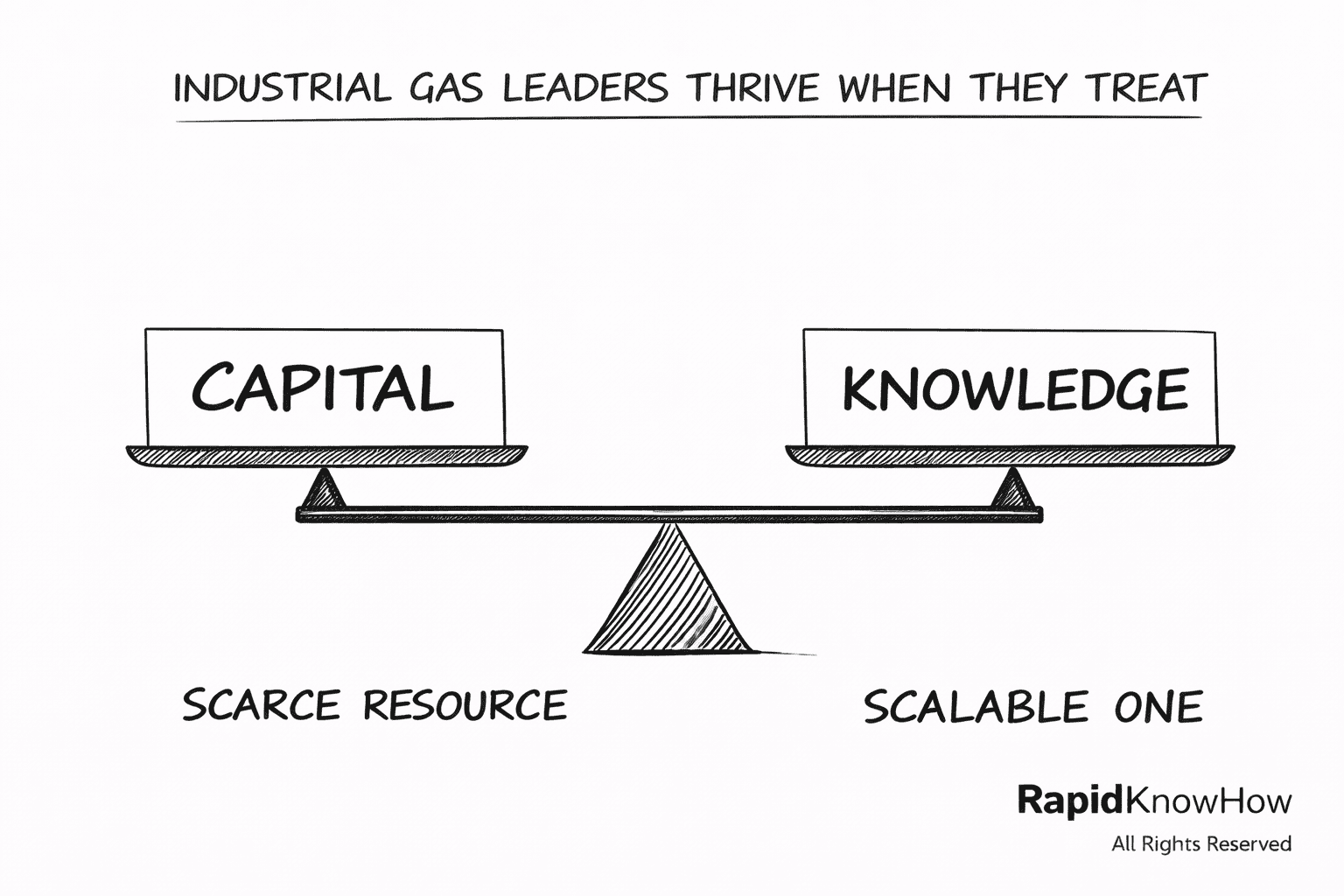
Thriving by Treating CAPITAL as a Scarce Resource
and KNOWLEDGE as a Scalable One
Power Report 2026–2030
A) EXECUTIVE STRATEGIC THESIS
Industrial Gas is one of the most capital-intensive industries in the world.
Players like
Linde plc,
Air Liquide,
Air Products
have mastered:
- Mega-scale ASUs
- Hydrogen infrastructure
- Long-term on-site contracts
- Engineering reliability
But 2026–2030 changes the competitive equation:
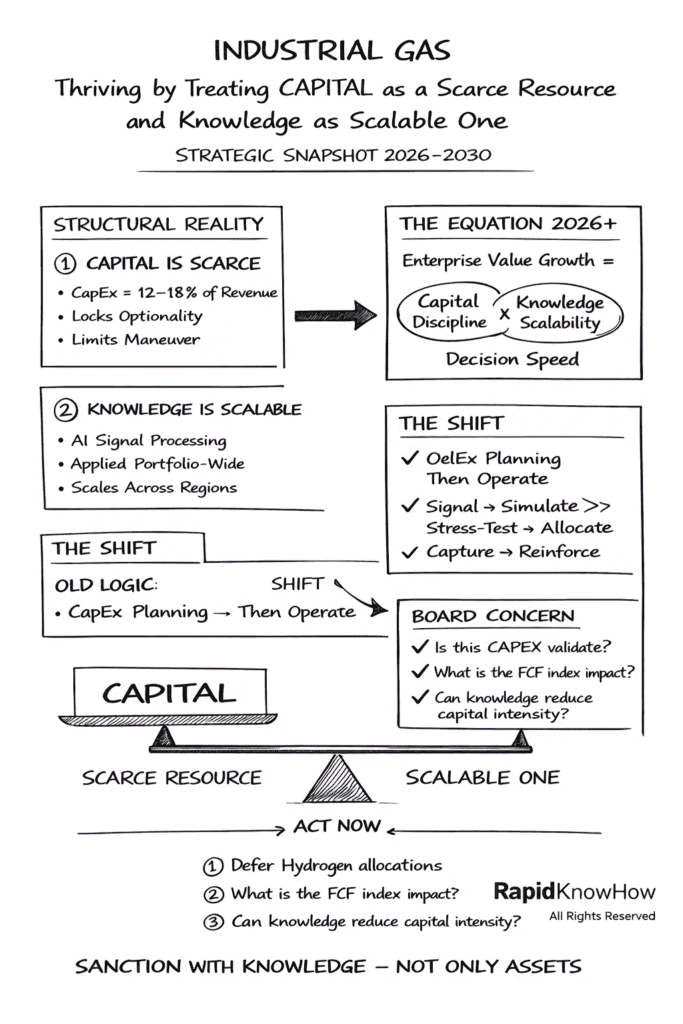
Capital remains scarce.
Knowledge becomes exponentially scalable.
The winners will not be those who deploy the most capital —
but those who deploy capital with superior knowledge compression and orchestration.
B) THE STRUCTURAL REALITY OF INDUSTRIAL GASES
1️⃣ CAPITAL IS SCARCE
Industrial Gas characteristics:
- CapEx = 12–18% of revenue
- Long asset lifetimes (20–30 years)
- High energy dependency
- Regulatory exposure
- Slow reallocation cycles
Every wrong investment decision:
→ Locks capital
→ Reduces optionality
→ Limits strategic maneuverability
Capital errors compound negatively.
2️⃣ KNOWLEDGE IS SCALABLE
In contrast, knowledge today:
- AI signal processing
- Exposure modeling
- Pass-through sensitivity
- CapEx scenario simulation
- Customer prioritization analytics
Once built:
→ Can be replicated across regions
→ Applied across portfolios
→ Scaled without proportional capital increase
Knowledge compounds positively.
C) THE NEW LEADERSHIP EQUATION (2026+)
Traditional model:
More assets = more advantage.
AI-Orchestrator model:
Better knowledge × faster decision cycles = more advantage.
The Strategic Formula
Enterprise Value Growth =
Capital Discipline × Knowledge Scalability × Decision Speed
Where:
- Capital Discipline protects downside
- Knowledge Scalability multiplies upside
- Decision Speed captures timing advantage
D) WHY THIS MATTERS NOW
1️⃣ Hydrogen Capital Risk
Billions announced.
But:
- Policy shifts
- Energy pricing
- Subsidy uncertainty
- Demand timing
Knowledge must validate capital before deployment.
2️⃣ AI Data Center Demand
Industrial gases benefit from:
- Nitrogen cooling
- Specialty gases
- Redundancy reliability
But:
The advantage goes to the leader who:
- Identifies high-ROICE accounts first
- Prioritizes capacity intelligently
- Prices dynamically
That is knowledge leverage.
3️⃣ Energy Volatility
ASUs are electricity-intensive.
Knowledge-driven pricing compression
prevents margin erosion.
E) THE STRATEGIC SHIFT
Old Logic
CapEx planning → Then operate.
New Logic
Signal → Simulate → Stress-Test → Allocate → Capture → Reinforce.
Capital becomes the final step.
Knowledge becomes the first step.
F) THE AI-ORCHESTRATOR APPLICATION
The AI-Orchestrator Leader treats:
CAPITAL as limited ammunition
KNOWLEDGE as scalable targeting intelligence
This changes:
- CapEx approval logic
- Portfolio re-ranking
- Contract structure
- Working capital discipline
- Energy pass-through timing
G) FINANCIAL IMPACT ILLUSTRATION
For a €10bn Industrial Gas company:
1% capital misallocation
= €100m strategic drag.
1% FCF improvement through knowledge orchestration
= €100m advantage.
Over 5 years:
The compounding gap becomes structural.
H) COMPETITIVE ADVANTAGE 2026–2030
Those who treat capital as abundant:
→ Overbuild hydrogen
→ Mis-time investments
→ Lock in low IRR projects
Those who treat knowledge as scalable:
→ Optimize CapEx timing
→ Accelerate pricing
→ Reallocate quickly
→ Protect FCF
The difference is not plant size.
It is orchestration intelligence.
I) BOARD-LEVEL IMPLICATIONS
Board questions must evolve:
- Is this capital deployment knowledge-validated?
- What is the exposure index impact?
- What is the FCF sensitivity?
- What happens under 3 stress scenarios?
- Can knowledge reduce capital intensity?
If the answer is unclear —
the decision is premature.
J) STRATEGIC CONCLUSION
Industrial Gas Leaders thrive when they:
- Respect capital scarcity
- Institutionalize knowledge scalability
- Compress decision cycles
- Orchestrate signals into FCF advantage
2026–2030 will reward:
Intelligent allocators — not aggressive spenders.-Josef David