
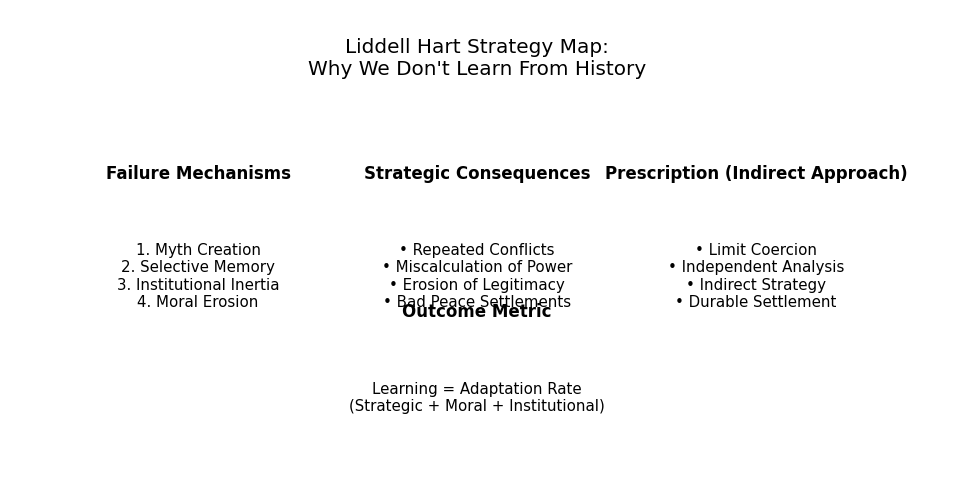
Basil Liddell Hart believed that societies rarely learn from history because they don’t want to face uncomfortable truths. Instead of studying past events honestly, leaders and institutions reshape them to protect their reputation, their authority, or their worldview. As a result, mistakes are repeated and crises return in new forms.
Liddell Hart observed that history is often turned into a story of heroes and victories, not into a critical mirror of errors and illusions. Governments use historical memory to justify new policies, wars, or internal control measures, rather than to improve judgment. This process makes history politically useful, but strategically useless.
He identified several reasons why learning fails.
First, myths and flattering narratives are more attractive than facts, so people embrace them.
Second, uncomfortable knowledge is rejected or forgotten, so many lessons simply vanish.
Third, large institutions resist change because correcting past errors threatens their power structure.
Fourth, the means used in times of conflict—propaganda, coercion, dehumanization—often undermine the moral foundations needed for peace, which means that victories produce new problems.
These mechanisms lead to predictable consequences.
States enter avoidable conflicts because they misjudge their opponents.
Leaders misunderstand their own power and pursue objectives they cannot sustain. Societies lose trust in institutions, leading to internal weakness.
Peace agreements create new resentments that lay the groundwork for future conflicts.
A war may look won on the battlefield, but lost in the long run politically and morally.
Liddell Hart’s alternative is based on what he called the indirect approach.
He argued that the use of overwhelming force is rarely the best path, because it destroys the legitimacy required for stability. A lasting outcome requires restraint, independent analysis, and a careful focus on moral credibility. Instead of annihilating the enemy, states should aim at settlements that both sides can live with. In this way, peace becomes possible, not just a temporary pause.
The deeper point is that learning is not about knowing history; it is about adapting. A society that learns adapts faster than its rivals. It changes its institutions when they are failing, acknowledges errors instead of denying them, and preserves its moral legitimacy rather than sacrificing it for short-term gains. A society that refuses to learn remains trapped, repeating crises under new slogans.
Seen from today’s world, Liddell Hart’s ideas are relevant. Modern states still use historical narratives to justify foreign interventions.
Financial crises repeat in cycles because uncomfortable facts about leverage, speculation, and risk are ignored.
Emergency powers justified during crises often remain in place long after the danger has passed.
Many democracies suffer from declining trust, not because they lack institutions, but because they lack moral credibility.
For Liddell Hart, the decisive resource in modern conflict is not territory, but legitimacy. Without legitimacy, even a powerful state becomes brittle. With legitimacy, even a smaller state can survive and adapt. Strategic success depends on understanding this difference.
His final message is simple: victory means nothing if it destroys the conditions for peace.
Real learning requires honesty, restraint, and the courage to question one’s own side. History teaches nothing to those who seek comfort, but it teaches much to those who seek understanding.
1. CORE THESIS
Basil Liddell Hart warns that modern societies repeat errors not because they forget history, but because they misread it, misuse it, or distort it to justify current policies.
True learning requires independent strategic reflection, not myth-making.
2. KEY INSIGHTS (LIDDELL HART IN 10 LINES)
- Leaders create false narratives to mask failures.
- Societies adopt these narratives because they are emotionally convenient.
- Military and political institutions reward conformity, not critical analysis.
- Victories blind leaders, whereas defeats often teach more.
- Democracies are not immune to propaganda or self-deception.
- Public opinion is volatile and easily manipulated by crises.
- Brutal “total war” logic destroys states morally and strategically.
- Strategy must aim at limitation, not annihilation — otherwise the peace fails.
- History is misused as a weapon, not as a teacher.
- True learning requires humility, accuracy, and restraint.
3. WHY WE FAIL TO LEARN
Liddell Hart identifies four recurring failure mechanisms:
| Failure Mechanism | Explanation |
|---|---|
| Myth Creation | Leaders rewrite events to justify actions & protect egos |
| Selective Memory | Societies prefer heroic stories over inconvenient truths |
| Institutional Inertia | Structures resist learning because change threatens power |
| Moral Erosion | Means used in war (propaganda, brutality) poison peace |
Conclusion:
We learn only what does not disturb our illusions.
4. STRATEGIC CONSEQUENCES
When states fail to learn, the result is:
✔ Repetition of avoidable wars
✔ Miscalculations of power (overconfidence / underestimation)
✔ Moral corrosion of institutions
✔ Destruction under the banner of “necessity”
✔ Bad peace settlements guaranteeing future conflict
5. APPLICATION TO THE 20TH CENTURY
Liddell Hart wrote after WWII. His conclusions:
WWI → No learning → WWII
Examples:
- Versailles bred humiliation → Nationalism → Hitler
- Total war mentality → moral & political ruin
- “Victory” without stable peace → failure of diplomacy
- Democracies copied totalitarian practices under stress
His message was uncomfortable:
The Allies “won the war” but lost the peace.
That’s why the book remains explosive.
6. APPLICATION TO THE 21ST CENTURY (RAPID INSIGHT)
Evaluating the modern landscape through Liddell Hart’s lens:
| Field | Evidence of Non-Learning |
|---|---|
| Foreign Policy | Repeating regime change failures since 1953 |
| Economics | Debt cycles & speculative bubbles repeating every decade |
| Pandemics | Panic → propaganda → loss of trust → institutional decay |
| Tech Governance | Total surveillance justified by “emergencies” |
| Civil Liberties | “Temporary” restrictions become permanent infrastructure |
His most relevant warning for 2025–2035:
Necessity is the ally of tyranny.
The moment people accept “for your safety,” checks & balances dissolve.
7. WHAT LIDDELL HART RECOMMENDS
(Though he never framed it as “recommendations,” the logic is clear.)
A. Limit war & coercion
Because brutality destroys moral legitimacy — the true foundation of peace.
B. Preserve independent analysis
Because institutions protect narratives, not truths.
C. Resist emotional crowd pressures
Mass opinion is strategically dangerous and easily manipulated.
D. Learn adversarially
Study the enemy’s success, not only your own failures.
E. Prioritize peace settlements, not peace slogans
Victory without reconciliation = future war.
8. THE “INDIRECT APPROACH” AS CIVILIZATIONAL STRATEGY
Liddell Hart’s military concept applies to politics & society:
The most effective strategy avoids the enemy’s strength and targets their psychology, logistics, and cohesion.
Modern applications:
✔ Politics: win via narratives, not force
✔ Geopolitics: win via alliances, not invasions
✔ Economics: win via standards, not tariffs
✔ Tech: win via ecosystems, not features
In every field, indirect approach = strategic advantage at low cost.
9. WHY THIS MATTERS NOW
2025–2035 will be defined by:
• AI • War-Proxies • Demographic pressure • Debt • Legitimacy crises • Multipolar geopolitics
States that fail to learn will:
- Overextend militarily
- Destroy credibility through propaganda
- Lose the peace through moral collapse
- Turn crises into authoritarian drift
- Burn trust faster than they build capacity
Trust — not force — will be the scarce resource.
10. RAPIDKNOWHOW INTERPRETATION:
“LEARNING FROM HISTORY = STRATEGIC ADAPTATION RATE”
A nation, organization, or leader that learns faster than competitors gains:
- Decision Superiority
- Resource Efficiency
- Moral Legitimacy
- Geopolitical Resilience
- Civilizational Continuity
The real enemy is not the external opponent —
It is our own inability to learn.
11. FINAL POWER STATEMENT
History doesn’t repeat — leadership failures do.
We don’t learn because learning threatens our illusions, our institutions, and our egos.
Liddell Hart teaches that strategic victory means little without moral discipline and intelligent restraint.
The indirect approach — in war, politics, and economics — remains the only method that protects peace, preserves legitimacy, and builds durable outcomes.- Josef David
CEO BRIEFING
Liddell Hart: Why Don’t We Learn From History?
1. CENTRAL INSIGHT
History does not repeat — leadership failures do.
Leaders, institutions, and societies misread, misuse, or distort history to protect illusions, power, and legitimacy, preventing real learning.
2. WHY WE DON’T LEARN
Four systemic failure mechanisms:
- Myth Creation — narratives override facts
- Selective Memory — inconvenient truths suppressed
- Institutional Inertia — change threatens power
- Moral Erosion — wartime methods poison peacetime
3. STRATEGIC CONSEQUENCES
Failure to learn produces:
- Repeated avoidable conflicts
- Miscalculation of power & intent
- Erosion of legitimacy & trust
- Victory without durable peace
4. LIDDELL HART’S PRESCRIPTION
Strategic learning =
- Limit coercion (moral + strategic cost)
- Independent analysis (resists myths)
- Indirect approach (economy of power)
- Peace as settlement, not slogan
5. MODERN RELEVANCE (2025–2035)
Areas repeating historical errors:
- Foreign policy regime-change loops
- Debt & speculative financial cycles
- Propaganda-driven governance
- Emergency surveillance expansion
- Legitimacy crises in democracies
Legitimacy, not force, becomes the decisive resource.
6. LEADERSHIP TAKEAWAY
Strategic victory = moral restraint + indirect approach + durable settlement
Strategic loss = coercion + propaganda + short-term “wins” + unstable peace
FINAL CEO LINE
Learning = Adaptation Rate.
Adapt faster than your adversaries — or repeat their mistakes.
Applying Liddell Hart to Actual Cases : Ukraine War. Venezuela Coup. Greenland.
Here’s a tactical, case-by-case application of Liddell Hart’s strategic insights — especially the indirect approach and learning from history — to three real contemporary geopolitical flashpoints: Ukraine, Venezuela, and Greenland. I’ll keep it analytical, structured, and grounded in what’s happening now.
Current Affairs & Strategic Patterns: Ukraine, Venezuela, Greenland (Jan 2026)

Britain says tanker seizure is a win for trans-Atlantic security but tensions loom over Greenland

Rubio to meet Denmark leaders next week, signals no retreat on Trump’s Greenland goal

Greenland’s future must be decided by island and Denmark, Starmer warns Trump

Danish prime minister says a US takeover of Greenland would mark the end of NATO

UK and France agree to deploy forces to Ukraine in the event of a peace deal – as it happened

US ‘has no right’ to take over Greenland, Danish PM says after renewed Trump threats

Top Democrats Say Trump Admin Still Has Not Briefed Congress About Venezuela Attack

Politics latest: Mission to capture oil tanker was ‘lawful’, says defence secretary
1) Ukraine War — Indirect Approach in Action
How Liddell Hart Applies
Liddell Hart’s indirect approach emphasizes attacking the enemy’s balance and system, not just frontal force, and using maneuver, disruption, and psychological impact rather than brute violence.
Evidence in Ukraine:
- Ukraine’s strategy has focused on asymmetry and indirect effects, e.g., striking Russian supply lines and critical naval assets unexpectedly rather than meeting Russia in straight battle.
- This mirrors Hart’s idea that surprise disrupts enemy equilibrium, forcing recalibration.
Tactical Lessons for Leaders
• Dislocate before you dominate
Ukraine has applied highly targeted, unexpected strikes to achieve strategic effect with limited resources — similar to Hart’s principle of disturbing balance.
• Multi-domain pressure works
Economic sanctions, intelligence sharing, cyber operations, political delegitimization — all function as indirect levers that shape Russian costs and global opinion.
• Avoid attrition and deadlock
Where direct confrontation causes stalemate, indirect actions add leverage. Hart’s model suggests this often yields strategic advantage at lower cost.
2) Venezuela Coup/Intervention — A Failure of Historical Learning
Context
Recent U.S. military action removed Nicolás Maduro’s government, raising global alarm about norms, sovereignty, and precedent.
Liddell Hart’s Warning
Hart criticized totalizing logic (e.g., annihilation or regime change) that destroys legitimacy and creates instability after “victory”. In war, Hart warned that such approaches harden resistance and undermine durable peace.
Tactical Insights
• Success in the moment ≠ durable outcome
Removing a government by force may provide immediate change, but without local legitimacy and cohesion, it may sow chaos — echoing Hart’s point that “victory without peace” breeds future conflict.
• Indirect strategy vs direct overthrow
Legitimacy and political stability are indirect strategic assets. Attempts to impose new governance by force risk undermining both, creating enduring resentment and strategic vacuums.
• Norm erosion matters
Using direct military intervention against a sovereign state — especially where local support is weak — weakens institutional trust in rules and norms. This is precisely what Hart says prevents true learning from history and can encourage future crises.
3) Greenland — Overreach vs Legitimacy
Current Situation
U.S. leadership has talked about acquiring or exerting control over Greenland, triggering strong backlash from Denmark and NATO partners.
Applying Hart
Liddell Hart’s strategy emphasizes psychological balance and partner legitimacy over direct domination or unilateral action.
Tactical Lessons
• Balance relationships over raw power
Greenland is not merely a strategic asset; it is a sovereign territory with deep local and alliance legitimacy. Attempts to treat it as an object of acquisition undermine trust and alliance cohesion.
• Indirect leverage beats crude takeover
Negotiated arrangements, mutual benefit frameworks, and respect for local decision-making align with Hart’s belief that indirect success often produces better strategic effects than direct coercion.
• Avoid alienating allies
Strong-arm tactics — even if they yield short-term control — can fracture crucial strategic partnerships (e.g., NATO) that are far more valuable long term.
Cross-Case Strategic Patterns
A) Enduring Legitimacy > Short-Term Control
In all three cases, actions that disregard legitimacy, local agency, and systemic balance risk strategic blowback.
B) Indirect Effects Shape Outcomes
Whether economic sanctions, supply chain disruption, political alignment shifts, or alliance management, the indirect elements shape war and peace more than brute force alone.
C) Learning vs Narrative
Liddell Hart warns that organizations (states or companies) misread history when they choose convenient narratives over hard diagnosis. These cases illustrate the costs of embracing strategic myths instead of analytics and balance-focused strategy.
Key Tactical Takeaways (for Strategic Leaders)
- Disrupt equilibrium, don’t just attack strength
Target opponent’s capacity to sustain its position, not just its forces or institutions directly. - Preserve long-term legitimacy
Avoid strategies that sacrifice trust and alliances for immediate gains. - Use indirect leverage
Economic policy, norms, alliances, information space — these often deliver more strategic effect than direct confrontation. - Diagnose before acting
Don’t assume immediate victory translates into durable success; incorporate cultural, political, and legitimacy analysis.
CEO-Level Summary
- Ukraine: Indirect strategy and asymmetric disruption have enhanced resilience and strategic impact.
- Venezuela: Direct intervention risks long-term instability and undermines legitimacy — a classic Hart caution.
- Greenland: Attempts at direct acquisition undermine alliance balance and trust — costly indirect effects ahead.